Digital risk management identifies, assesses, treats, and monitors risks created by digital assets, services, identities, data, suppliers, and external exposure.
Its scope extends beyond internal controls to domains, cloud services, social platforms, mobile applications, leaked data, third parties, and threat-actor activity. The program converts technical findings into owned business decisions with defined treatment, deadlines, and accepted residual risk.
Key Takeaways
Digital risk management identifies, assesses, treats, and monitors risks created by digital assets, services, identities, data, suppliers, and external exposure.
Its scope extends beyond internal controls to domains, cloud services, social platforms, mobile applications, leaked data, third parties, and threat-actor activity. The program converts technical findings into owned business decisions with defined treatment, deadlines, and accepted residual risk.
Unknown assets and shadow IT is a primary concern.
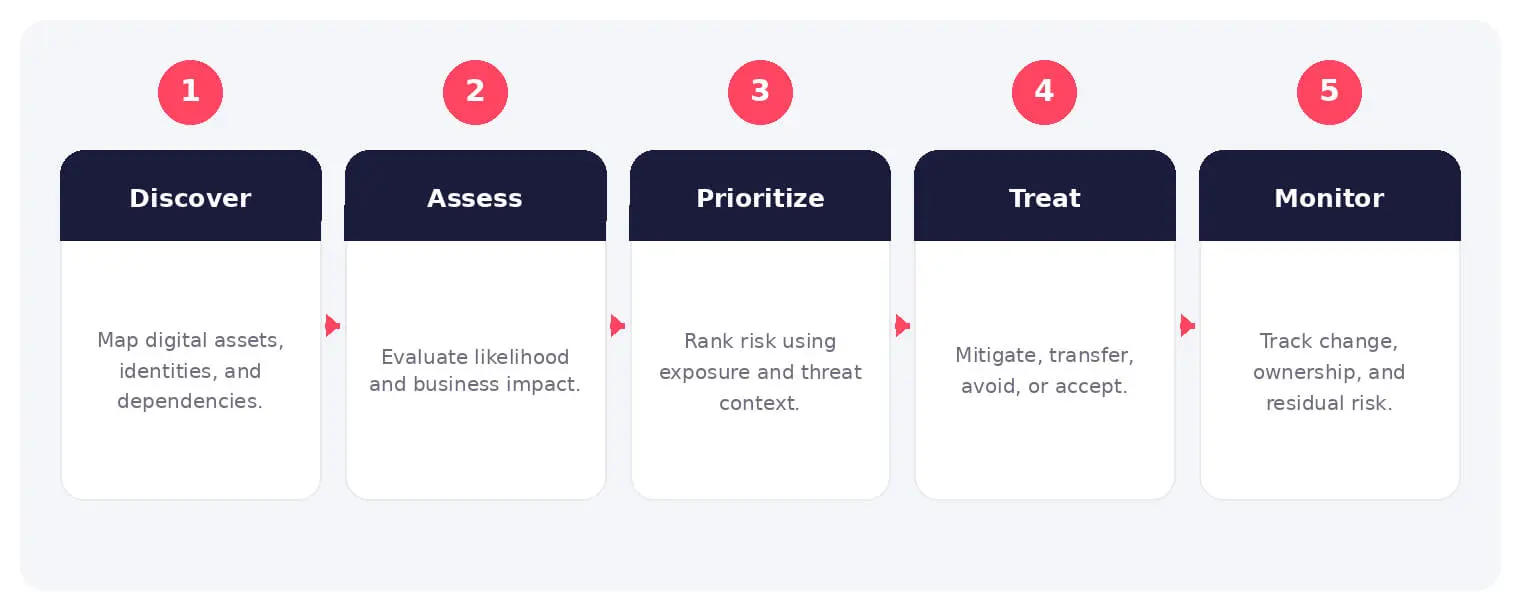
The main stages and decision points associated with digital risk management.
How It Works
The operating flow above turns the concept into observable steps. Exact implementations vary, but each stage needs accountable ownership, trusted inputs, documented policy, and evidence that analysts can use during investigation and review.
Its scope extends beyond internal controls to domains, cloud services, social platforms, mobile applications, leaked data, third parties, and threat-actor activity. The program converts technical findings into owned business decisions with defined treatment, deadlines, and accepted residual risk.
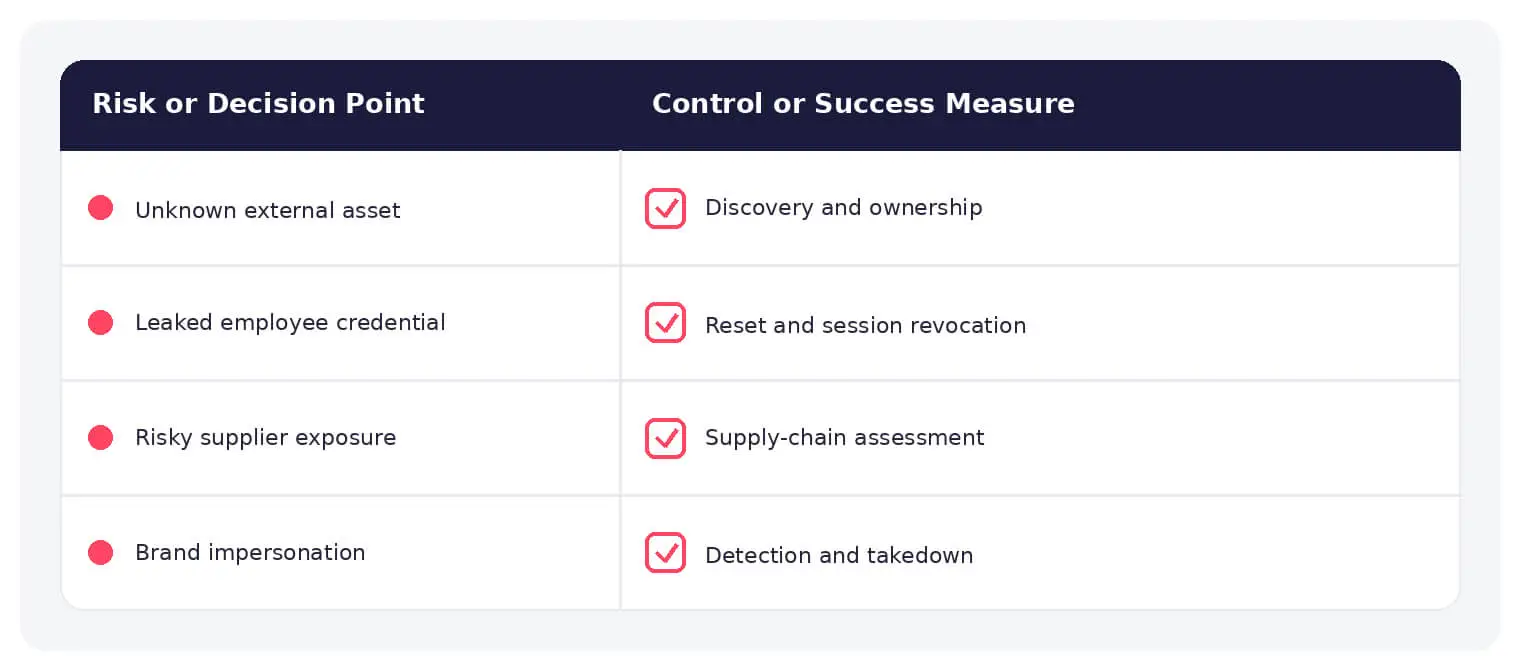
Common digital risk management risks paired with practical defensive controls.
Warning Signs and Detection
Monitor new domains and certificates, exposed services, leaked credentials, public data, supplier changes, brand impersonation, malicious applications, vulnerabilities under active exploitation, ownership gaps, overdue treatments, and accepted risks whose conditions have changed.
Best Practices
Define risk appetite, maintain a living inventory, connect findings to owners, enrich severity with threat and business context, set remediation deadlines, monitor suppliers, rehearse response, measure exposure reduction, and review accepted risk continuously.
How SOCRadar Can Help
SOCRadar adds external visibility, threat intelligence, exposure context, and continuous monitoring to help teams validate and prioritize risks related to digital risk management. This context complements internal security operations, identity, response, and governance controls.
Request a demo to strengthen threat-informed prevention and response.
Frequently Asked Questions
What Is Digital Risk Management and What Does It Cover?
Digital risk management is the practice of identifying, assessing, treating, and monitoring the risks that digital assets, services, identities, data, suppliers, and outside exposure create for an organization. Unlike programs limited to internal controls, it also covers domains, cloud services, social platforms, mobile applications, leaked data, third parties, and threat-actor activity. The output is not just a findings list — it is a set of owned business decisions with treatment plans, deadlines, and accepted residual risk.
Why Are Unknown Assets and Shadow IT a Primary Concern?
Assets without a named owner rarely receive patching, configuration reviews, or monitoring, which makes them attractive targets for attackers. Shadow services can expose data or credentials without anyone noticing. A living inventory with accountable ownership is the foundational control for closing this gap.
How Does a Digital Risk Management Program Work in Practice?
Most programs run a repeatable cycle: discover assets, identify risks, assess severity with threat and business context, assign treatment to accountable owners, and monitor for changes. Each stage requires trusted inputs, documented policy, and evidence analysts can use during investigation and review. Deadlines and accepted residual risk are recorded so decisions stay auditable over time.
What Warning Signs Point to Growing Digital Risk?
Watch for the following signals across your external and supplier footprint:
New lookalike domains and certificates
Exposed services and cloud misconfigurations
Leaked credentials and public data dumps
Brand impersonation and malicious mobile applications
Supplier breaches, ownership changes, or discontinued services
Vulnerabilities under active exploitation
Ownership gaps and overdue treatments also indicate that the program itself needs attention.
How Should Teams Respond to Leaked Credentials?
First confirm the leak is authentic and determine what was actually exposed. Reset affected credentials and revoke active sessions where the platform allows it, since a password reset does not automatically invalidate stolen sessions on every service. Then check for password reuse across systems and assess whether the leak included data beyond credentials.
How Do Third Parties and Suppliers Contribute to Digital Risk?
A compromise at a vendor can expose shared credentials, connected systems, or sensitive data your organization believed was contained internally. Because supplier environments sit outside your direct control, monitor supplier changes, review notification and contract terms, and track their external posture over time. This inherited exposure needs its own owners and treatment plans within the program.
How Can Organizations Reduce Brand Impersonation Risk?
Register defensive domains, monitor for lookalike domains, fake social profiles, and rogue mobile applications, and maintain a takedown process for confirmed abuse. Email authentication standards such as SPF, DKIM, and DMARC mainly protect against direct domain spoofing rather than every form of phishing, so pair them with employee reporting channels and clear customer communication plans.
What Business Impact Justifies Investing in Digital Risk Management?
Unmanaged digital risk contributes to breaches, brand damage, regulatory findings, and slower incident response. A mature program measures exposure reduction, shortens the distance between detection and treatment, and turns technical findings into decisions that named executives can own. That accountability also makes security spending easier to defend to leadership and auditors.
Is Digital Risk Management the Same as Cyber Risk Management?
They overlap, but digital risk management places more weight on exposure outside the traditional perimeter, including brand abuse, leaked data, supplier ecosystems, and the external attack surface. Cyber risk programs often concentrate on internal IT controls and compliance. The two approaches complement each other rather than replace one another.
How Often Should Accepted Risks Be Reviewed?
Whenever conditions change, such as new exploit activity, a supplier breach, or a shift in the asset’s business role, an accepted risk should be re-examined. Continuous monitoring catches these triggering events, while a scheduled review, commonly quarterly, catches quieter drift. Every accepted risk should retain an owner and a documented review condition.