
What Is Open-Source Intelligence (OSINT)?
Open-source intelligence (OSINT) is intelligence produced from publicly available or lawfully accessible information. Sources include websites, social media, public records, news, academic research, code repositories, maps, technical infrastructure, commercial datasets, and other openly obtainable material.
OSINT is more than searching. Analysts define a question, collect information, preserve provenance, evaluate source reliability, corroborate claims, analyze relationships, and communicate conclusions with confidence and limitations. Public availability does not remove privacy, ethical, or contractual duties.
Key Takeaways
- Technical and infrastructure OSINT is a central category or technique.
- Reliable assessment requires source, ownership, timing, and operational context.
- Detection should connect external evidence with identity, device, network, and business signals.
- Response should protect affected people and remove reusable access paths.
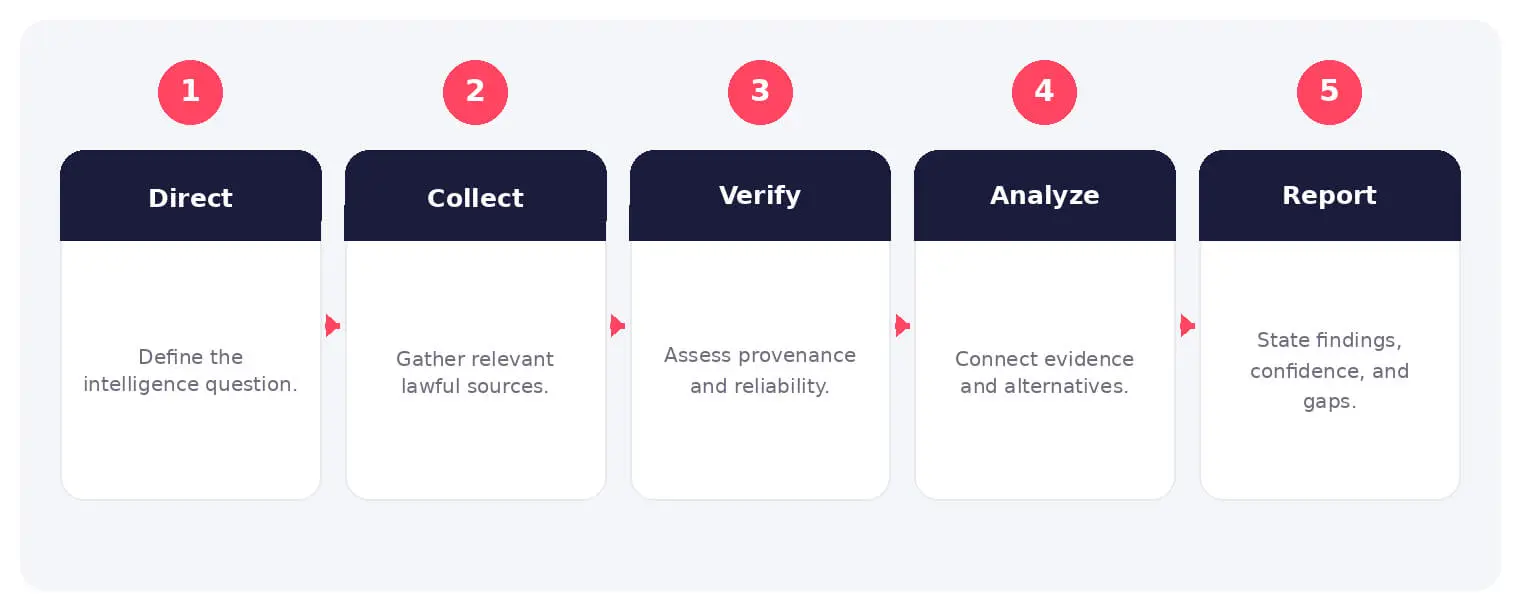
How Open-Source Intelligence (OSINT) Works
The sequence above provides a practical operating model. Individual steps can overlap, repeat, or involve different people and services, so each stage should be validated against available evidence.
OSINT is more than searching. Analysts define a question, collect information, preserve provenance, evaluate source reliability, corroborate claims, analyze relationships, and communicate conclusions with confidence and limitations. Public availability does not remove privacy, ethical, or contractual duties.
Common Types and Techniques
- Technical and infrastructure OSINT
- Social media and identity research
- Geospatial and imagery analysis
- Corporate, legal, financial, and public-record research
Security, Privacy, and Business Risks
- False conclusions from copied or manipulated sources
- Privacy harm and excessive personal-data collection
- Exposure of analyst methods or identities
- Legal, contractual, and operational risk
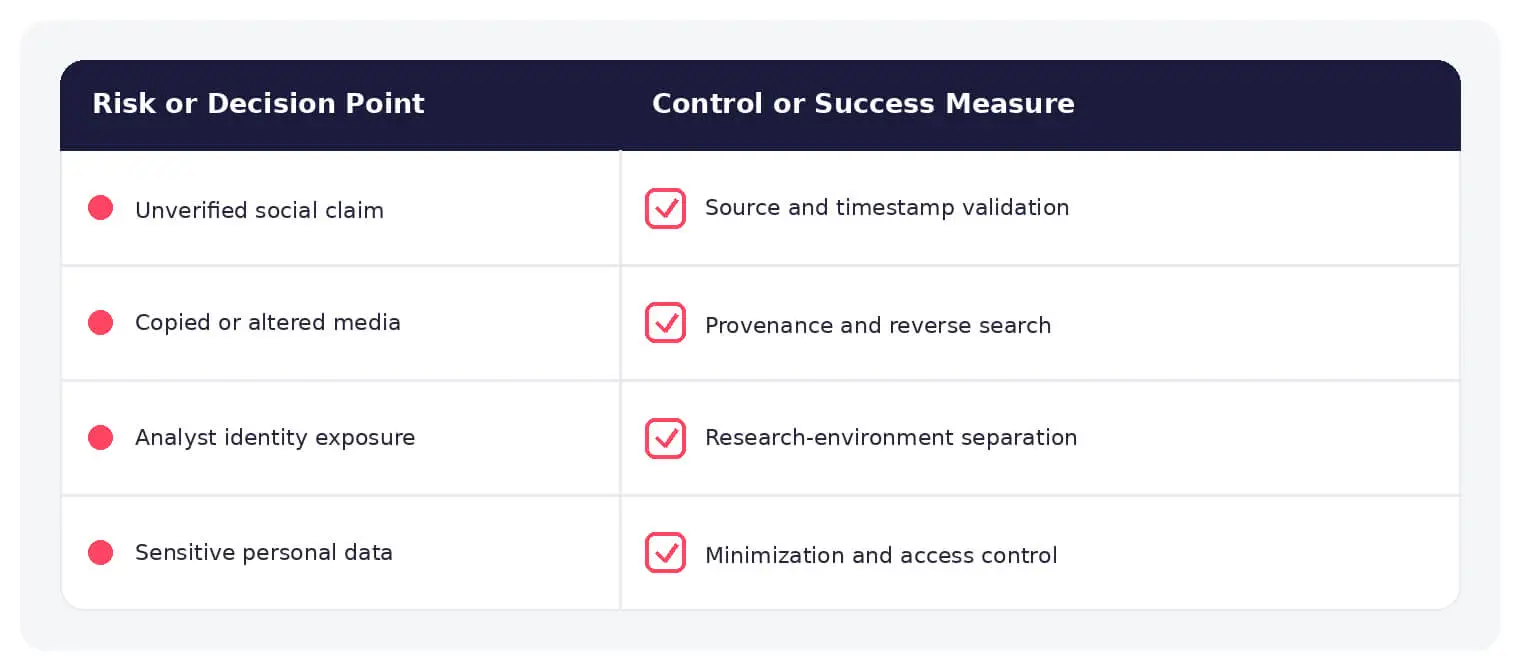
Warning Signs and Validation
Record URLs, timestamps, captures, source ownership, original publication, edits, and corroboration. Separate primary evidence from reposts and distinguish facts, assessment, and unknowns.
Prevention and Response
Use collection plans, lawful sources, protected research identities, data minimization, secure evidence storage, peer review, confidence language, and documented retention and escalation rules.
How SOCRadar Can Help
SOCRadar combines external intelligence, Dark Web visibility, brand monitoring, attack-surface discovery, and contextual enrichment to help teams identify exposure and investigate activity connected to open-source intelligence.
Explore SOCRadar Cyber Threat Intelligence or request a demo to strengthen external threat detection and response.
Frequently Asked Questions
What Sources Count as Open-Source Intelligence?
OSINT draws on any information that is publicly available or lawfully accessible: websites, social media, public records, news coverage, academic research, code repositories, maps and imagery, technical infrastructure, and commercial datasets. Material behind a login or paywall can still qualify if the access terms permit its use. What matters is that the source is lawful, examinable, and citable.
Is Collecting OSINT Legal?
Often, yes, but legality depends on how information is gathered and used. Data protection laws such as the GDPR restrict processing of personal data, platform terms of service limit automated collection, and contract or authorization boundaries still apply to technically public material. Teams should document their lawful basis, approved sources, and retention rules before collection begins.
What Makes OSINT Different From a Simple Web Search?
A search returns results; intelligence answers a defined question with assessed confidence. OSINT analysts plan collection around an information requirement, preserve provenance, evaluate source reliability, corroborate claims across independent sources, and deliver conclusions that state limitations. The structured analytical cycle, not the tooling, is what separates intelligence from lookup.
What Are the Main Types and Techniques of OSINT?
OSINT investigations commonly combine several families of techniques:
- Technical and infrastructure analysis: domains, certificates, exposed services, and network records.
- Social media and identity research: accounts, aliases, and organizational connections.
- Geospatial and imagery analysis: satellite imagery, maps, and location indicators.
- Corporate and public-record research: registrations, filings, court records, and financial disclosures.
Most real cases blend categories. Confirming a phishing domain, for example, may draw on DNS records, certificate transparency logs, and archived page captures.
How Can Attackers Misuse Publicly Available Information?
The same sources that support defense also support reconnaissance. Attackers enumerate employees for spear phishing, map exposed services and misconfigurations, harvest leaked credentials from underground forums, and study organizational details to build convincing pretexts. Reducing gratuitous public exposure and watching for abuse of your data narrows this advantage.
How Do Analysts Verify That OSINT Findings Are Accurate?
Verification starts by tracing a claim to its original source rather than a repost, then recording the URL, timestamp, capture, and source ownership. Independent corroboration from a second, unrelated source raises confidence, while signs of editing, recycled imagery, or mismatched timing lower it. Findings should separate established facts from assessment and clearly label what remains unknown.
How Should a Team Respond to Sensitive Information Found Through OSINT?
Contain harm to people and systems first: if credentials or session data are exposed, rotate them and revoke active sessions, keeping in mind that a password change alone may not invalidate a stolen session on every platform. Takedown requests can address leaked content or impersonation, and affected individuals should be informed where personal data is involved. Document what was found, where, and when so the exposure can later be confirmed as resolved.
How Do Analysts Protect Their Own Identities During Research?
Researchers use dedicated personas with separate accounts, browsers, and payment details, and never log into personal services from research environments. Handling screenshots, metadata, and file properties carefully prevents accidental attribution. Operational security must cover the entire workflow, because a single personal login can deanonymize an investigation.
How Can Organizations Use OSINT for Defensive Security?
Defensive teams apply OSINT to discover internet-facing assets they did not track, spot leaked credentials and exposed data, monitor for lookalike domains and brand impersonation, and follow threat actors discussing their organization. Evidence an attacker could find becomes an action list when defenders find it first. Those findings feed directly into patching, takedown, and detection work.
What Is the Difference Between OSINT, the Deep Web, and the Dark Web?
The deep web is simply content that standard search engines do not index, ranging from intranets and databases to subscription journals; it is not inherently hidden behind authentication. The dark web is a small portion of the deep web that requires specific software to reach. OSINT can draw on all of these layers where access is lawful, including monitoring underground marketplaces and forums for leaked data.
Oct 16, 2026
CVE-2026-102764: BeyondTrust Zero-Day Exploited
BeyondTrust has disclosed CVE-2026-102764, a critical Remote Support vulnerability exploited as a zero-day weeks before customers received a patch. The attack began…
Oct 15, 2026
Cisco Secure Email & PAN-OS Zero-Days Exploited
Cisco Secure Email & PAN-OS Zero-Days Exploited Cisco and Palo Alto Networks have patched two actively exploited zero-day vulnerabilities that can lead…
Oct 15, 2026
SOCRadar Splunk Integration: New MSSP and Vulnerability Apps
SOCRadar Splunk Integration: New MSSP and Vulnerability Apps Your analysts live in Splunk. Your external risk does not: SOCRadar alarms for dozens…
Intelligence in your inbox every Thursday.
Join 30,000+ security professionals reading SOCRadar research.
Subscribe