How MCP works technically?
How MCP works technically?
The Model Context Protocol operates on a client-server architecture that solves the “M×N integration problem” in AI applications. Instead of every AI tool needing custom integrations with every data source, MCP creates a standardized interface that acts like “USB for AI.”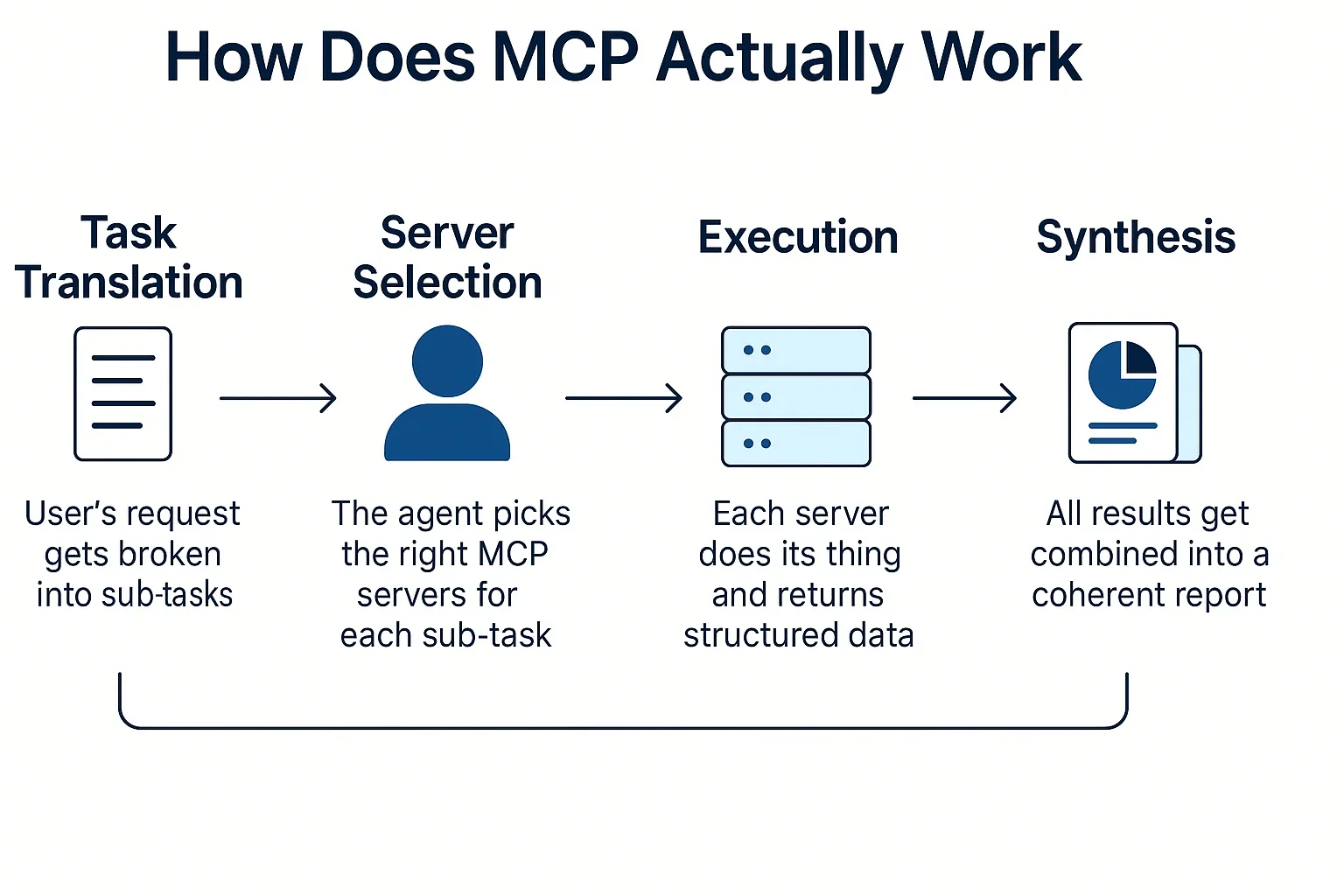
The Three-Layer Architecture
The Host Layer: Central Command The MCP Host serves as the orchestrator for applications like Claude Desktop or IDEs that need external data access. The host creates and manages multiple client instances while enforcing security policies, controlling connection permissions, and handling user authorization decisions. The host coordinates AI integration and aggregates context from multiple sources to provide users with a unified experience. When you ask Claude Desktop to analyze local files while querying a remote database, the host layer makes this seamless interaction possible. Client Management: Protocol Handlers MCP Clients maintain a strict 1:1 relationship with specific servers, ensuring isolation for security and reliability. Clients handle the technical communication: protocol negotiation, capability exchange, bidirectional message routing, and subscription management. This architecture creates clear security boundaries between servers while enabling the host to coordinate multiple simultaneous connections. Built on JSON-RPC, this focuses specifically on context exchange and sampling coordination. Servers: Specialized Capability Providers MCP Servers are lightweight, specialized programs that expose specific capabilities through the standardized protocol. They can be local processes accessing your computer’s files and databases, or they can connect to remote services and external APIs. Servers operate independently with focused responsibilities, providing access to resources, tools, and prompts while respecting security constraints imposed by the client-host relationship.How It All Works Together
When you interact with an MCP-enabled AI application, the host receives your request and coordinates with appropriate clients, each maintaining isolated connections to relevant servers. Servers provide the requested data through their clients, the host aggregates the information and maintains context across sources, then presents a unified response. This architecture transforms complex custom integrations into a standardized, scalable system that makes AI applications powerful while keeping them secure and maintainable.
Uncategorized @us-en

Oct 16, 2026
CVE-2026-102764: BeyondTrust Zero-Day Exploited
BeyondTrust has disclosed CVE-2026-102764, a critical Remote Support vulnerability exploited as a zero-day weeks before customers received a patch. The attack began…
Cyber News

Oct 15, 2026
Cisco Secure Email & PAN-OS Zero-Days Exploited
Cisco Secure Email & PAN-OS Zero-Days Exploited Cisco and Palo Alto Networks have patched two actively exploited zero-day vulnerabilities that can lead…
CTI Fundamentals
Oct 15, 2026
SOCRadar Splunk Integration: New MSSP and Vulnerability Apps
SOCRadar Splunk Integration: New MSSP and Vulnerability Apps Your analysts live in Splunk. Your external risk does not: SOCRadar alarms for dozens…
Intelligence in your inbox every Thursday.
Join 30,000+ security professionals reading SOCRadar research.
Subscribe