ShieldCrash PoC: Microsoft Defender Fix Bypass
Microsoft recently fixed CVE-2026-69414 (ShieldBreak), a High-severity elevation-of-privilege vulnerability in the Microsoft Malware Protection Engine.
Now, Nightmare Eclipse has released ShieldCrash, a Proof-of-Concept (PoC) that reportedly bypasses Microsoft’s remediation and enables arbitrary file reads with SYSTEM privileges on updated Windows systems. Microsoft has not publicly confirmed the reported bypass.
What Is ShieldCrash?
ShieldCrash is a newly released exploit associated with CVE-2026-69414 (CVSS 7.8), a vulnerability affecting the Microsoft Malware Protection Engine. Nightmare Eclipse published the ShieldCrash PoC on GitHub, claiming Microsoft fixed several exploitation paths associated with CVE-2026-69414 but left another path available.
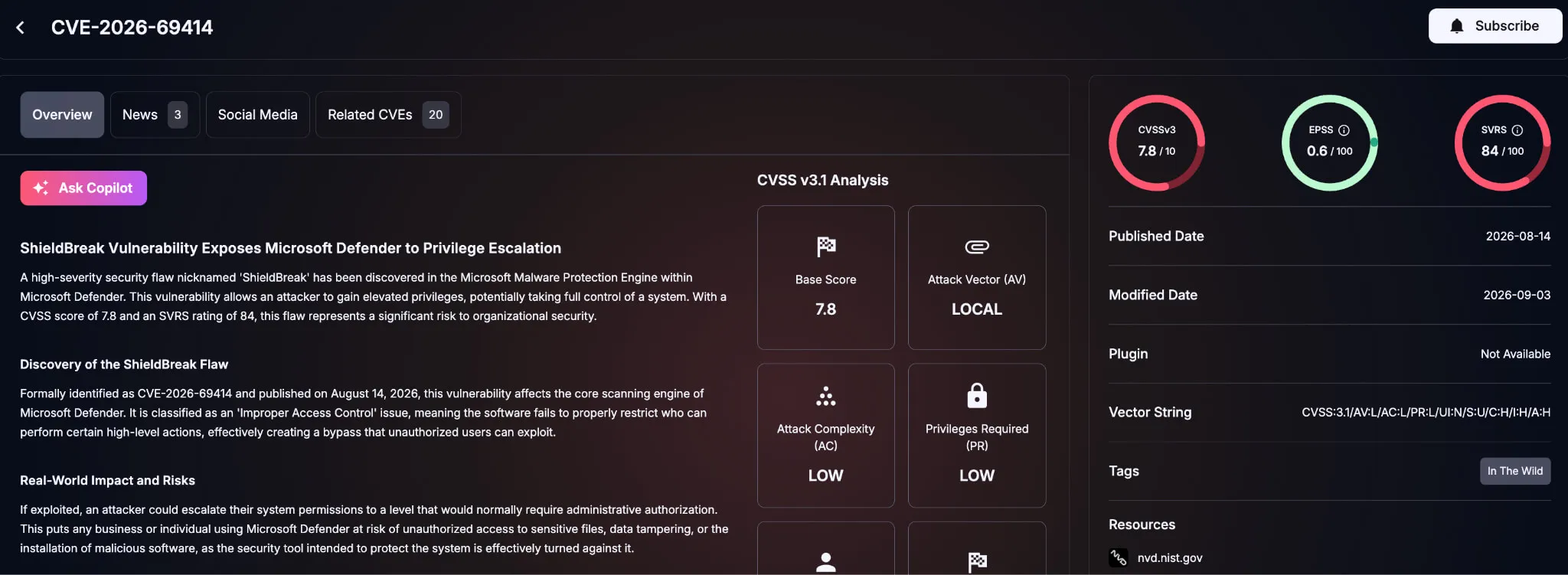
Details of CVE-2026-69414 (SOCRadar Vulnerability Intelligence)
The researcher describes ShieldCrash as a bypass of the ShieldBreak fix, reportedly allowing arbitrary file reads with SYSTEM privileges even after Microsoft’s remediation is installed.
ShieldCrash does not currently have a separate CVE. Nightmare Eclipse describes the public release as a skeleton PoC that demonstrates privileged file reads. It does not establish arbitrary file writes or SYSTEM-level code execution.
The underlying CVE-2026-69414 has a local attack vector and requires low privileges. ShieldCrash similarly appears to require an attacker to already have code execution or another low-privilege foothold on the endpoint. It is not presented as a remote initial-access exploit.
Which Windows Systems Could ShieldCrash Affect?
Nightmare Eclipse claims ShieldCrash affects all supported Windows versions, including updated Windows 10, Windows 11, and Windows Server systems.
Microsoft has not confirmed this scope or published a separate affected-version range for ShieldCrash. The broad Windows impact therefore remains a researcher claim.
| Component or issue | Status | Notes |
|---|---|---|
| Microsoft Malware Protection Engine | Reportedly affected by ShieldCrash | Component affected by CVE-2026-69414 |
| Windows 10, Windows 11, Windows Server | Reportedly affected | Broad scope claimed by Nightmare Eclipse |
| CVE-2026-69414 / ShieldBreak | Fixed by Microsoft | CVSS 7.8, High |
| ShieldCrash | Public PoC available | No separate CVE or Microsoft-confirmed fix |
Microsoft Malware Protection Engine version 1.1.26080.3 is identified as the remediation boundary for CVE-2026-69414. Defenders should verify Defender engine and platform versions separately from general Windows servicing.
How Does ShieldCrash Work?
CVE-2026-69414 affects the Microsoft Malware Protection Engine, which Defender uses to scan and remediate potentially malicious content.
At a high level, ShieldCrash reportedly takes advantage of a remaining path that lets a local attacker influence Defender’s privileged file-processing behavior. Because Defender performs these operations with elevated authority, the technique may cause its process to read protected files that the attacker’s own account cannot normally access.
Technical research surrounding ShieldBreak described privileged file-processing behavior involving Windows Cloud Filter API operations and data handled during Defender scanning. However, public information does not establish that ShieldCrash uses exactly the same mechanism.
The current ShieldCrash PoC reportedly demonstrates arbitrary file reads with SYSTEM privileges. Depending on the endpoint, this could expose sensitive configuration data, security information, credential-related material, or enterprise files that may assist further activity after an initial compromise.
The PoC does not demonstrate arbitrary file writes, remote exploitation, or SYSTEM-level arbitrary code execution.
ShieldCrash Follows Other Nightmare Eclipse PoCs
ShieldCrash is the latest in a series of security product exploit disclosures from Nightmare Eclipse.
The researcher recently released FalconFlank, an alleged privilege escalation zero-day affecting CrowdStrike Falcon Sensor for Windows. SOCRadar covered the claims and vendor response in our analysis of the FalconFlank CrowdStrike Falcon PoC.
The earlier research provides context for the source of ShieldCrash but does not independently validate the latest Microsoft Defender bypass claims.
Is ShieldCrash Actively Exploited?
There is currently no confirmed evidence that ShieldCrash is being exploited in the wild. Although a public PoC is available, exploit-code availability does not establish active exploitation.
For the underlying CVE-2026-69414, Microsoft assessed exploitation as “Exploitation More Likely.” This reflects expected exploitability rather than confirmation of attacks.
ShieldCrash should therefore be treated as a researcher-reported bypass with public PoC code and no confirmed active exploitation. Microsoft has not assigned ShieldCrash a separate CVE or publicly confirmed the reported bypass.
SOCRadar’s Cyber Threat Intelligence module can help defenders monitor ShieldCrash and CVE-2026-69414 for changes in vendor guidance, exploit reporting, PoC developments, and remediation status.
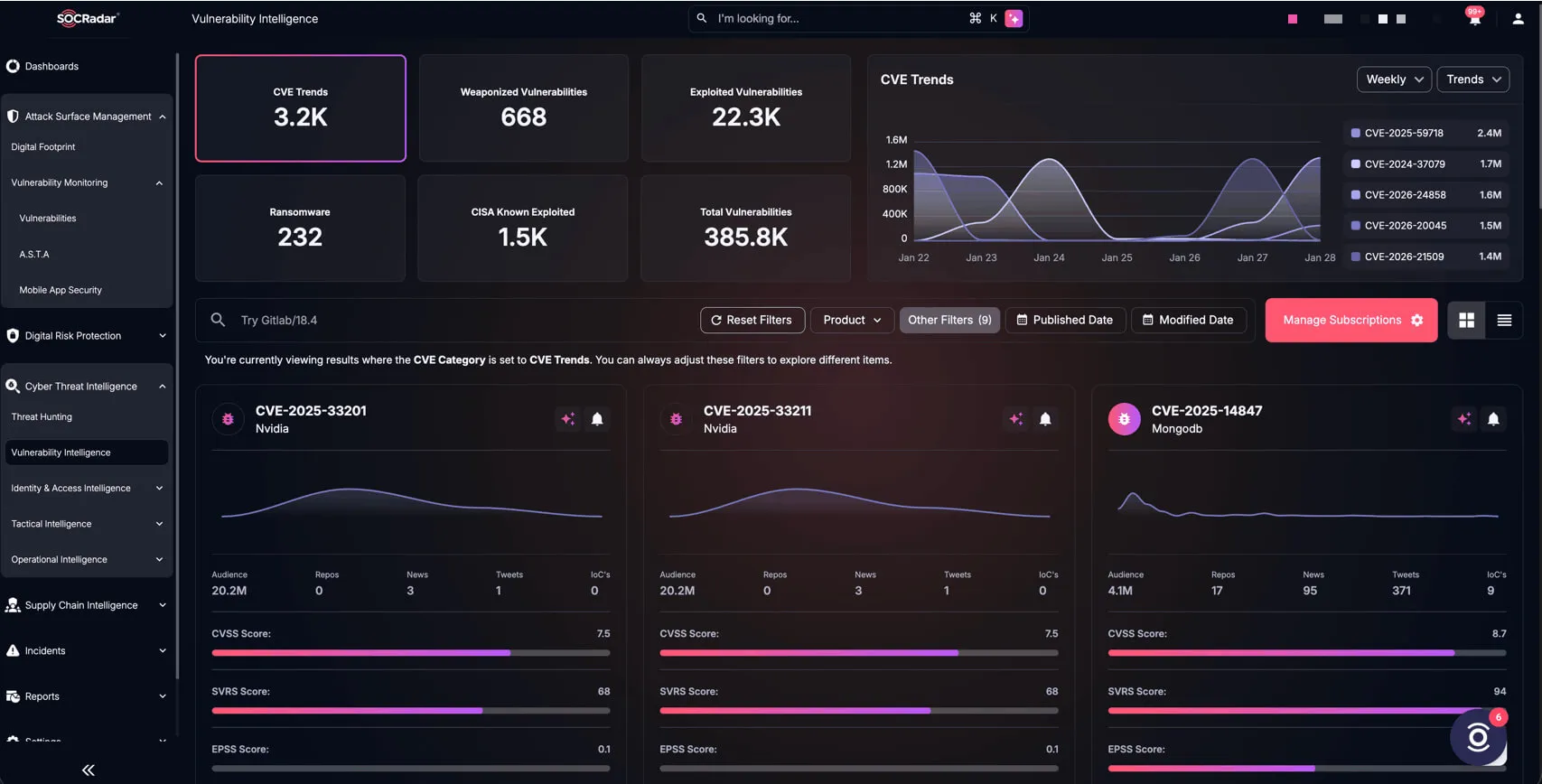
SOCRadar’s Vulnerability Intelligence, CTI module
What Should Defenders Do About ShieldCrash?
Verify Defender Updates and Reduce Exposure
Organizations should verify Microsoft Defender engine and platform versions across relevant endpoints and confirm that the remediation for CVE-2026-69414 is installed.
Because ShieldCrash reportedly requires an existing local foothold, defenders should also restrict untrusted code execution where practical, remove unnecessary local administrative privileges, and limit interactive access to sensitive systems.
Microsoft has not announced a separate remediation specifically for ShieldCrash. These measures are not a replacement for vendor fixes. Organizations should not disable Defender without authoritative guidance from Microsoft.
Hunt for Unusual Defender Activity
No confirmed ShieldCrash-specific detection rule is currently available. Defenders should instead monitor for unusual behavior involving Defender and privileged file access, such as:
- Unexpected sensitive-file reads involving MsMpEng.exe or related Defender processes
- Low-privilege activity followed by unusual Defender file operations
- Unexpected access to credential stores, security databases, or protected configuration files
- Suspicious credential access, persistence, or security-tool tampering following unusual Defender activity
These behaviors are general hunting signals, not ShieldCrash-specific indicators. Analysts should correlate them with process ancestry, user activity, endpoint context, and subsequent actions.
If suspicious privileged Defender activity is detected, preserve relevant endpoint and process telemetry before cleanup. Investigators should look for the local foothold required for exploitation and any subsequent credential access, persistence, or lateral movement. Suspicious Defender activity alone does not confirm exploitation of ShieldCrash.