Can NVD Modernization Keep Pace With AI?
AI can help security teams find vulnerabilities faster. That sounds entirely positive until we consider what happens after those vulnerabilities are found. Every new finding still needs to be validated, enriched, prioritized, communicated, and eventually fixed.
NIST is now considering how the National Vulnerability Database should adapt. In a recent RFI, the agency asks how AI, automation, machine-readable data, and stronger interoperability could support a more scalable and useful vulnerability management ecosystem.
What Is NIST Changing With the NVD?
NIST is exploring how the NVD can better handle growing vulnerability volumes, AI-assisted security processes, and the demand for faster, machine-readable vulnerability data. Its RFI asks where automation could improve enrichment, prioritization, and remediation while preserving human review, transparency, and accuracy.
For now, no finalized new NVD system or AI implementation has been announced. NIST is gathering industry input to help shape future changes.
Finding More Vulnerabilities Is Only Half the Job
The NVD already relies on automation. NIST says CVE records are generally ingested within approximately an hour, after which analysts enrich them with details such as severity and affected product versions. What is changing is the scale – NIST points to growing vulnerability volumes and AI-assisted discovery, triage, exploitation, and remediation.
We can already see this on the vendor side. Microsoft’s July 2026 Patch Tuesday addressed 622 CVEs, with AI-assisted vulnerability discovery contributing to the unusually large number of findings.
Finding weaknesses earlier is valuable. But what happens when our ability to find vulnerabilities grows faster than our ability to assess and remediate them? Without better AI vulnerability management, defenders could simply face a larger backlog.
Better Prioritization Needs Better Infrastructure
AI and other automated mechanisms could improve risk prioritization by connecting vulnerability data with vendor advisories, threat intelligence, asset information, and remediation workflows. Security teams need more than severity scores; they need context on exposure, affected technology, and urgency.
This need is growing as vulnerability infrastructure expands. In August 2026, the NATO Communications and Information Agency and AISLE joined the CVE Program as CVE Numbering Authorities under the ENISA Root. ENISA said that Frontier AI models and their effects on vulnerability discovery and exploitation increase the need for scalable vulnerability management infrastructure.
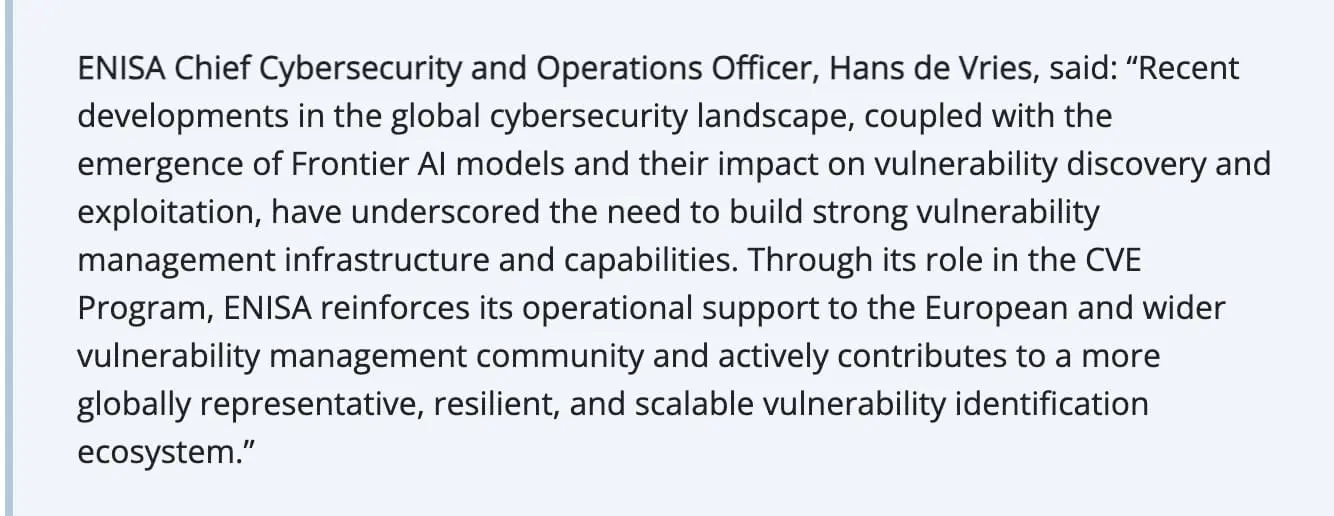
ENISA on AI’s growing impact on vulnerability management (enisa.europa.eu)
As AI makes vulnerability discovery faster, the systems responsible for organizing, enriching, and prioritizing that information must scale with it. More discovery capacity without equally strong prioritization could become another source of noise.
The Difficult Part Will Be Managing Machine-Scale Mistakes
Automation also changes the consequences of getting vulnerability information wrong. When automated systems generate or propagate incorrect product mappings, prioritization decisions, or remediation recommendations at scale, the effects can spread through security tools and remediation workflows.
NIST’s RFI asks which activities should be automated and which should retain human review. It also raises questions about transparency, auditability, and safeguards against erroneous AI-generated remediation. We think provenance and confidence should become essential parts of machine-scale vulnerability data. Automation works best when it removes repetitive work without removing accountability.
Conclusion
NVD modernization is necessary as vulnerability management becomes more automated. The real benefit, however, is not simply finding or processing more vulnerabilities. It is identifying which vulnerabilities deserve attention first.
That requires combining vulnerability data with context such as affected assets, external exposure, exploitation activity, and business importance. Tools like SOCRadar XTI can help add that context and support more practical prioritization.
If NIST’s modernization efforts succeed, the NVD can help ensure that our ability to understand and prioritize vulnerabilities scales with discovery.