
CVE-2026-3854 Exposes a Critical Weak Point in GitHub’s Git Push Pipeline
A newly disclosed GitHub vulnerability, CVE-2026-3854, has drawn attention because it turned a routine git push operation into a path to remote code execution. The issue affected GitHub’s git push pipeline and was serious enough that GitHub says it validated, fixed, and investigated the bug in under two hours after receiving the report. The flaw was assigned CVE-2026-3854, and GitHub published patches for supported GitHub Enterprise Server releases while also stating that it found no evidence of real-world exploitation and no customer data compromise during its investigation.
What makes this issue important is not just the severity of the bug, but the trust boundary it crossed. A normal git feature meant to pass optional metadata during a push became the entry point for injecting malicious internal values into downstream services. That created a route from repository push access to server-side command execution, which is exactly the kind of flaw defenders do not expect in a core development workflow.
What Is CVE-2026-3854?
CVE-2026-3854 is a critical remote code execution vulnerability tied to how GitHub handled user-supplied git push options during the push pipeline. According to GitHub’s incident write-up, a user with push access to a repository could send a crafted push option containing an unsanitized character and achieve arbitrary command execution on the GitHub server processing that push.
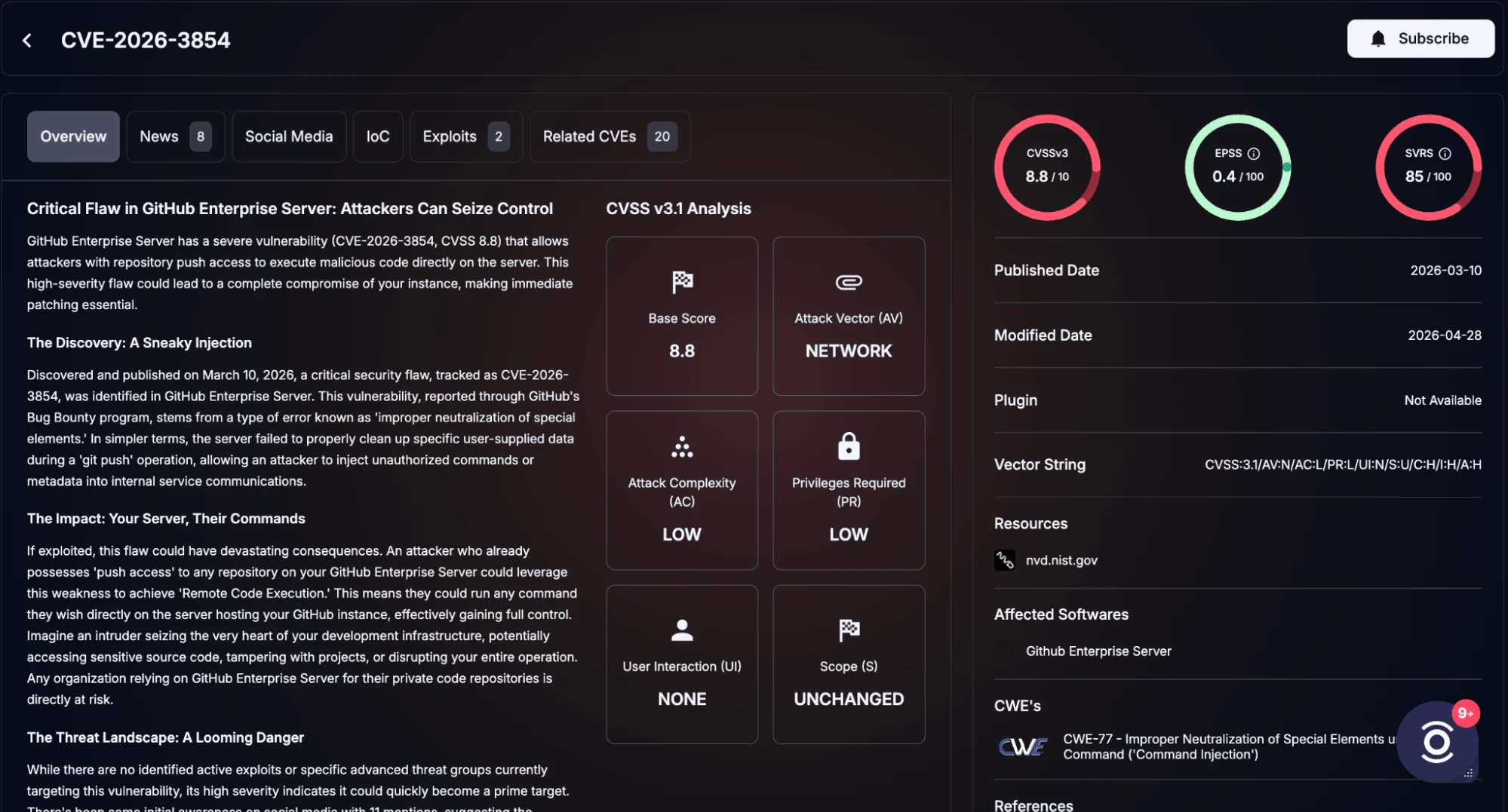
Details of CVE-2026-3854 (SOCRadar Vulnerability Intelligence)
At a high level, this was an input neutralization and metadata injection problem. User-controlled values were incorporated into internal service metadata without sufficient sanitization, and because the metadata format used a delimiter that could also appear in user input, an attacker could inject extra fields that downstream services treated as trusted internal values.
Which GitHub Environments Were Affected?
GitHub says it prepared patches for all supported GitHub Enterprise Server releases and recommends that customers upgrade immediately. The patched versions listed by GitHub are 3.14.25, 3.15.20, 3.16.16, 3.17.13, 3.18.8, 3.19.4, 3.20.0, or later.
Coverage of the issue also says the flaw affected GitHub Enterprise Cloud, GitHub Enterprise Cloud with Data Residency, GitHub Enterprise Cloud with Enterprise Managed Users, and GitHub Enterprise Server. That means the issue was not limited to one narrow deployment model, even though the remediation path for self-managed environments centers on GHES upgrades.
How Did a Git Push Turn Into Remote Code Execution?
The flaw came from the way GitHub’s internal services exchanged metadata during a push. Git push options are a legitimate git feature, but in this case, the values supplied by the user were passed forward without enough sanitization. Because of how internal headers were structured, a crafted value could inject extra metadata fields and alter how downstream components interpreted the request.
GitHub says the bug let attackers manipulate trusted internal values. Follow-up reporting describes how this could be escalated by altering execution environment settings, bypassing sandbox protections, redirecting hook directories, and eventually executing arbitrary files as the git service user. In practical terms, that turned a simple push operation into a path to server-side command execution.
What Does This Say About Trust in Developer Pipelines?
CVE-2026-3854 is also a reminder that convenience features inside developer workflows can quietly become security-critical control points. Git push options are a legitimate part of normal git behavior, not something most teams would immediately treat as a high-risk feature. But in this case, user-controlled input reached internal service metadata and was later interpreted as trusted by downstream components.
That makes the issue relevant beyond GitHub itself. Modern development platforms rely heavily on service-to-service metadata, internal headers, and pipeline context to move requests between components. When user input is allowed to influence those internal signals without strict separation, trusted workflow features can turn into attack surface. The broader lesson is that developer pipeline features need threat modeling not only for what they do, but also for how their inputs are handled across internal services.
Was CVE-2026-3854 Exploited in the Wild?
GitHub says it confirmed no exploitation beyond security researchers’ testing and that no customer data was compromised. The company also says it reproduced the bug internally within 40 minutes of the report and completed validation, fixing, investigation, and hardening work in a very short window.
That said, the absence of confirmed in-the-wild exploitation should not reduce the urgency of patching. A bug that allows remote code execution from a standard git workflow is the kind of issue organizations should assume would attract rapid interest if left exposed, especially once public details are available. This final point is an inference based on the disclosed impact and exploit path.
What Should Organizations Do Right Now?
For GitHub Enterprise Server customers, the immediate step is to upgrade to a patched version. GitHub’s own guidance is direct on this point, and the supported fixed versions are already available.
Teams should also treat this as more than a patch-only event. Because the issue involved git push processing and internal metadata handling, it is worth reviewing recent push activity, unusual hook behavior, and any unexplained changes in repository-processing workflows during the relevant exposure window.
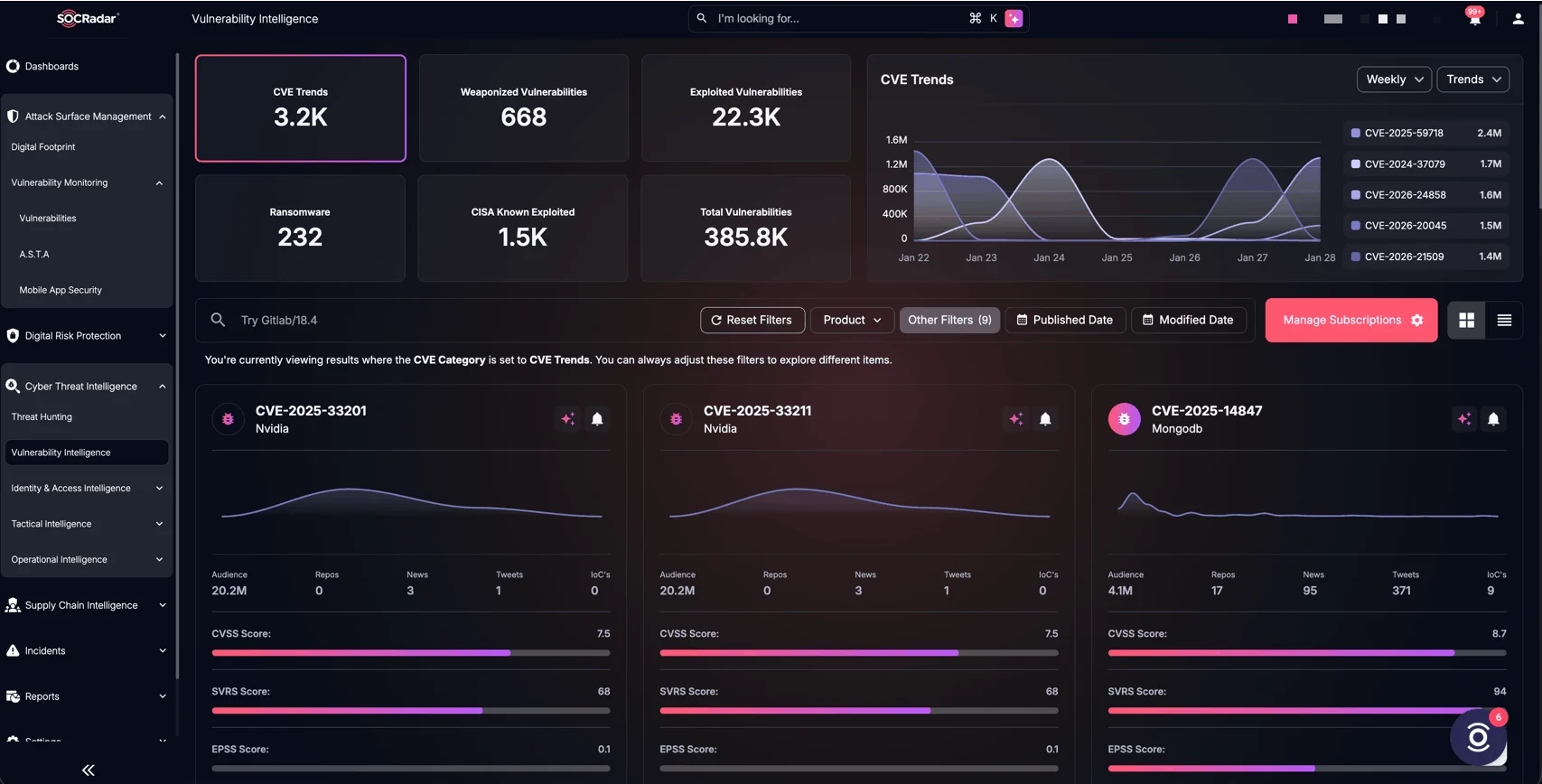
SOCRadar Vulnerability Intelligence module
For organizations that want broader context around newly disclosed flaws, SOCRadar Vulnerability Intelligence and Attack Surface Management can help connect critical CVEs to exposed assets and remediation priorities, making it easier to focus first on the systems that matter most.