CVE-2026-69836: Microsoft Entra ID RCE Fixed
Microsoft recently disclosed CVE-2026-69836, a critical Remote Code Execution (RCE) vulnerability in Microsoft Entra ID (formerly Azure Active Directory). Because this issue affected a Microsoft-hosted cloud service, remediation was applied on the backend rather than through a traditional customer patch.
In this post, we explore what CVE-2026-69836 is, whether customer action or patching is required, whether active exploitation exists, what defender steps should be taken, and what other high-severity Microsoft cloud vulnerabilities were disclosed alongside it.
What Is CVE-2026-69836?
CVE-2026-69836 is a Microsoft Entra ID remote code execution vulnerability caused by deserialization of untrusted data, mapped to CWE-502.
Unsafe deserialization occurs when an application reconstructs data into active objects without sufficiently validating what that data represents. In severe cases, attacker-controlled serialized data can trigger unexpected object behavior, unauthorized service activity, or code execution.
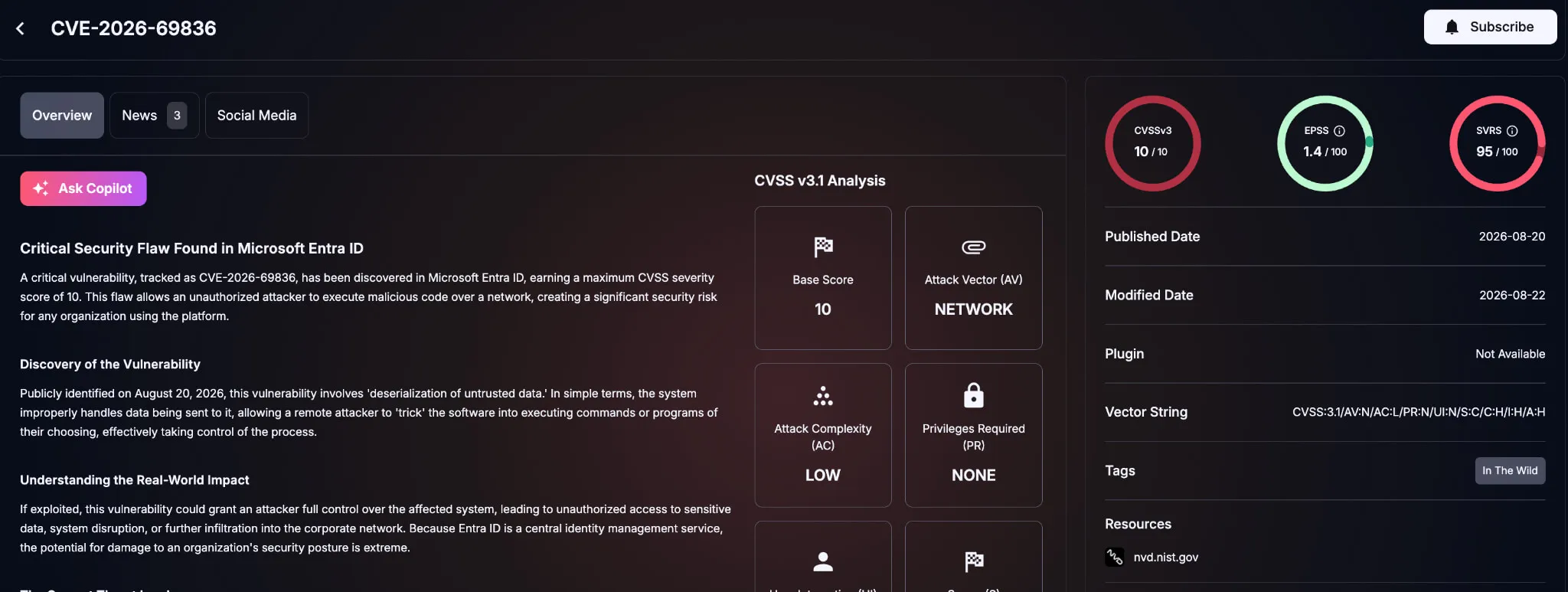
Details of CVE-2026-69836 (SOCRadar Vulnerability Intelligence)
NVD lists the vulnerability as Critical, with a Microsoft CNA CVSS 3.1 score of 10.0. The CVSS vector is:
CVSS:3.1/AV:N/AC:L/PR:N/UI:N/S:C/C:H/I:H/A:H
That vector indicates a network-reachable flaw with low attack complexity, no privileges required, no user interaction, changed scope, and high confidentiality, integrity, and availability impact. However, the score does not prove that every Entra ID tenant was exposed in the same way or that successful exploitation would automatically grant tenant administrator access.
Microsoft has not publicly disclosed the vulnerable endpoint, backend component, serialization format, payload structure, or execution mechanism.
Why Does This Entra ID Vulnerability Matter?
Entra ID sits at the center of identity and access management for many Microsoft cloud environments. It supports authentication, application registrations, service principals, administrative access, Conditional Access, federation, and access to Microsoft 365, Azure, and connected enterprise applications.
That role makes a remote code execution vulnerability in Entra ID significant even when customers do not need to deploy a local patch. The issue affected a Microsoft-hosted service boundary, and the public record does not provide enough technical detail to assess tenant-level impact.
Do Customers Need to Patch CVE-2026-69836?
No customer-side patch is identified for CVE-2026-69836. NVD lists the affected product as Microsoft Entra, with the affected version shown as “-,” and tags the CVE as an exclusively hosted service.
That means remediation occurs on Microsoft’s cloud infrastructure rather than through a customer-installed update. Customers should still check the Microsoft advisory, Microsoft 365 service health, Entra admin center messages, Defender portal notifications, and tenant-specific communications for current guidance.
For hosted identity services, the response shifts from patch deployment to validation, monitoring, and review of identity activity around the disclosure window.
Was CVE-2026-69836 Exploited in the Wild?
Current official vulnerability data lists no confirmed exploitation for CVE-2026-69836. NVD’s CISA-ADP SSVC data records exploitation as none, while also marking the issue as automatable with total technical impact.
Is There a Public PoC?
No credible, independently verified public proof of concept was confirmed in the reviewed official sources. Microsoft has not published the endpoint, request path, serialized object format, payload structure, or other details needed to reproduce the vulnerability.
Security teams should treat “working exploit” repositories or scanners claiming to test CVE-2026-69836 with caution unless they come from a trusted source and have been validated safely.
What Should Defenders Do Now?
1. Confirm Microsoft’s Service-Side Mitigation
Review the Microsoft advisory, Microsoft 365 service health, Entra admin center messages, Defender portal notifications, and tenant-specific communications. Since CVE-2026-69836 affects a hosted service, Microsoft’s current guidance should be the source of truth for remediation status.
2. Preserve Entra Logs
Export relevant Entra audit logs, sign-in logs, service-principal activity, privileged-role changes, and Microsoft Defender alerts to a SIEM before retention limits remove useful evidence. This is a review measure, not a CVE-specific detection rule.
3. Review Identity and Application Changes
Look for unexpected application registrations, new or modified service principals, new secrets or certificates, unfamiliar owners, delegated permissions, app-role assignments, admin consent grants, federation changes, Conditional Access changes, and privileged role assignments.
These events do not prove CVE-2026-69836 exploitation. They are high-value identity changes that deserve review after any major identity-service vulnerability disclosure.
4. Check Sign-In and Privileged Activity
Review unusual source locations, unexpected user agents, impossible-travel patterns, abnormal service-principal sign-ins, unfamiliar authentication methods, and privileged administrator activity outside normal workflows.
Correlate suspicious events with change tickets, known administrators, device context, Conditional Access outcomes, and security alerts before drawing conclusions.
5. Avoid Unverified Exploit Claims
Do not run public repositories, scripts, or scanners claiming to test CVE-2026-69836 unless they come from a trusted source and have been validated safely. The public record does not contain enough technical detail to support most exploit claims.
Which Other Microsoft Cloud Flaws Were Disclosed?
CVE-2026-69836 was disclosed alongside several other Microsoft cloud-service vulnerabilities. Like the Entra ID issue, these entries involve hosted services with no conventional customer-installed version range in public NVD records.
| CVE | Service | Issue | CVSS |
|---|---|---|---|
| CVE-2026-65816 | Azure Arc / Azure Web Apps | Incorrectly resolved name or reference leading to elevation of privilege | 10.0 |
| CVE-2026-69555 | Azure Arc | Incorrect authorization leading to elevation of privilege | 10.0 |
| CVE-2026-65801 | Exchange Online | Server-side request forgery leading to elevation of privilege | 10.0 |
| CVE-2026-65770 | Azure Managed Instance for Apache Cassandra | Argument injection leading to remote code execution | 10.0 |
The related NVD records describe these flaws as Microsoft cloud-service vulnerabilities and reference Microsoft advisories for each CVE. Organizations using these services should confirm Microsoft’s mitigation status, monitor administrative changes, and track advisory updates for any tenant-specific follow-up.
How Can SOCRadar Help Track Entra ID Risk?
SOCRadar’s Cyber Threat Intelligence (CTI) module helps security teams track critical CVEs, exploitation-status changes, advisory updates, public PoC developments, and threat activity related to widely used enterprise technologies. For CVE-2026-69836, this can help teams monitor whether new technical details, exploitation claims, or Microsoft guidance emerge after disclosure.
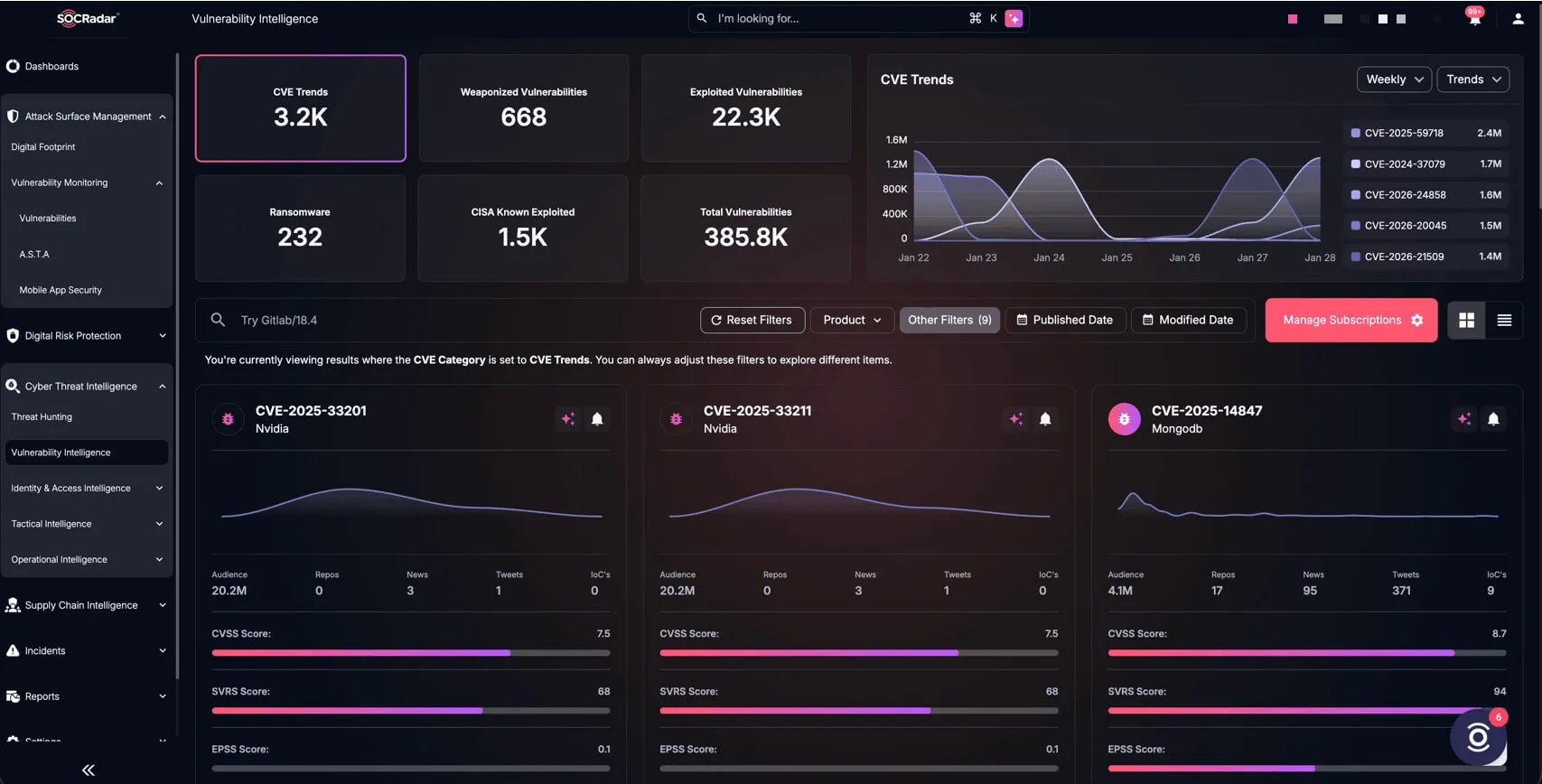
SOCRadar’s Vulnerability Intelligence
Beyond gathering intelligence, understanding organizational exposure is equally important. This is where SOCRadar’s Attack Surface Management (ASM) module complements your defense, helping organizations map exposed assets, cloud services, domains, certificates, public-facing applications, and external dependencies that may rely on Entra ID for access. ASM provides the visibility needed to prioritize monitoring across identity-dependent infrastructure and public-facing applications that rely on Entra ID for access.