

Mar 10, 2026

Jul 03, 2026
14 Mins Read
Oct 12, 2026
Table Of Content
What Is Remote Code Execution?
RCE vs. Arbitrary Code Execution and Command Injection
How Remote Code Execution Vulnerabilities Work
Common Types of RCE Vulnerabilities
What Can Happen After an RCE Exploit?
Notable Remote Code Execution Vulnerability Examples
How To Prevent Remote Code Execution Attacks
What To Do If You Suspect an RCE Exploit
Prioritize RCE Risk With SOCRadar
Frequently Asked Questions About RCE
Conclusion
Related Articles

SMS Bombing

Threat Actors
Jan 08, 2026
Dark Web Monitoring
Feb 19, 2026

Ransomware
Jan 31, 2026
OSINT Framework
Apr 17, 2026

What Is Remote Code Execution (RCE)?
Remote code execution (RCE) is a type of security vulnerability that lets an attacker run their own code or commands on a target system from a remote location, without needing physical or direct access to the device. It’s considered one of the most serious outcomes a software vulnerability can produce, because a successful RCE can hand an attacker a working foothold inside an organization’s environment, under the context of whatever application or service the flaw was found in.
That foothold can be enough to steal credentials, deploy malware, install a web shell, move laterally, disrupt operations, or prepare a ransomware attack. The final impact depends on the affected system, its permissions, its exposure, and the attacker’s access after exploitation.
For the first time in the 19-year history of Verizon’s Data Breach Investigations Report, vulnerability exploitation overtook stolen credentials to become the single most common way attackers get their initial foothold in a breach – accounting for 31% of breaches in the 2026 report, up from 20% the year before. Remote code execution vulnerabilities are only one part of that broader category, but they remain especially important because they can turn an exposed product or application into an initial access point.
What Is Remote Code Execution?
A remote code execution vulnerability allows an attacker to execute code or commands on a target system from another device or network location. The vulnerable system may be a web application, email server, VPN gateway, firewall, cloud workload, endpoint, or another internet-facing service.
The word remote describes where the attacker is operating from. It does not automatically mean that a vulnerability can be exploited by anyone on the public internet. Some RCE flaws require authentication, access to an internal network, a specific configuration, or another vulnerability to be exploited first, which is part of why an RCE vulnerability and an RCE exploit aren’t quite the same thing (more on that distinction below).
Likewise, successful RCE does not always give an attacker full administrative control of a server. The code normally runs with the permissions of the vulnerable process. However, if that process has elevated privileges, access to sensitive data, or a trusted position in the network, the consequences can be severe.
RCE vs. Arbitrary Code Execution and Command Injection
Remote code execution is often used interchangeably with other security terms. While they are related, they do not always mean the same thing, including two terms central to this page: an RCE vulnerability (the underlying flaw) and an RCE exploit (the method used to trigger it).
| Term | Meaning | Relationship to RCE |
| Remote Code Execution | The ability to run attacker-controlled code or commands on a system from a remote location. | The core subject of this article. |
| RCE Vulnerability | A flaw in code, configuration, or a third-party component that could allow remote code execution if an attacker finds and triggers it. | The underlying weakness; tracked publicly as a CVE, such as Log4Shell (CVE-2021-44228). |
| RCE Exploit | The code, request, or technique an attacker uses to actually trigger an RCE vulnerability and achieve code execution. | The mechanism that turns a vulnerability from a theoretical risk into a working attack. |
| Arbitrary Code Execution | The ability to execute code chosen by an attacker. It may be local or remote. | RCE is a remote form of arbitrary code execution. |
| Command Injection | A flaw where untrusted input is included in an operating system command. | A common path to RCE, but not the only one. |
| Local Code Execution | The ability to run code after an attacker already has local access to a device. | Unlike RCE, it does not provide remote initial access by itself. |
| Privilege Escalation | The ability to gain higher permissions on a system. | It may follow RCE when an attacker first gains low-privileged access. |
That distinction matters for prioritization. An RCE vulnerability can sit unexploited for months or years. It only becomes an active incident once a working RCE exploit exists and is used against a system that’s actually reachable.
How Remote Code Execution Vulnerabilities Work
RCE vulnerabilities are caused by weaknesses that let untrusted data influence how an application processes instructions, files, memory, or system commands.
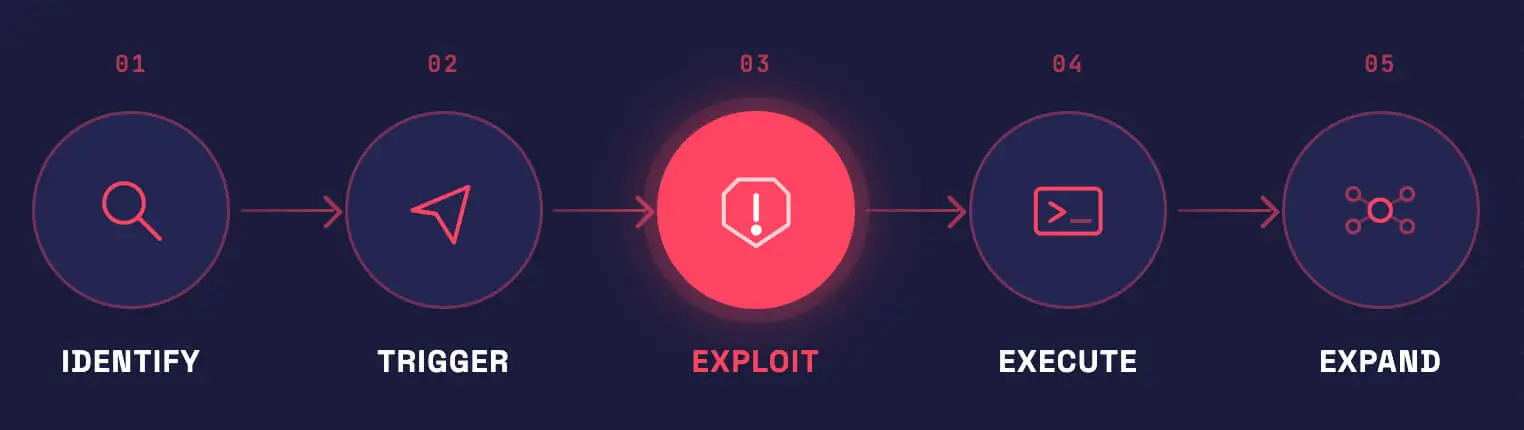
A typical attack chain looks like this:
- An attacker identifies a reachable service, application, appliance, or exposed management interface.
- They trigger a vulnerability through a malicious request, manipulated file, unsafe input, or another supported interaction point.
- The vulnerable application misinterprets the attacker-controlled data as an instruction, or its normal execution flow is altered.
- The attacker gains code execution in the context of the vulnerable service.
- They may then attempt persistence, credential theft, lateral movement, data theft, or disruption.
The key question for defenders is not only whether a CVE has an RCE label. It is whether the vulnerable system is exposed, whether the flaw is exploitable in the organization’s configuration, and what an attacker could access after successful execution.
Common Types of RCE Vulnerabilities
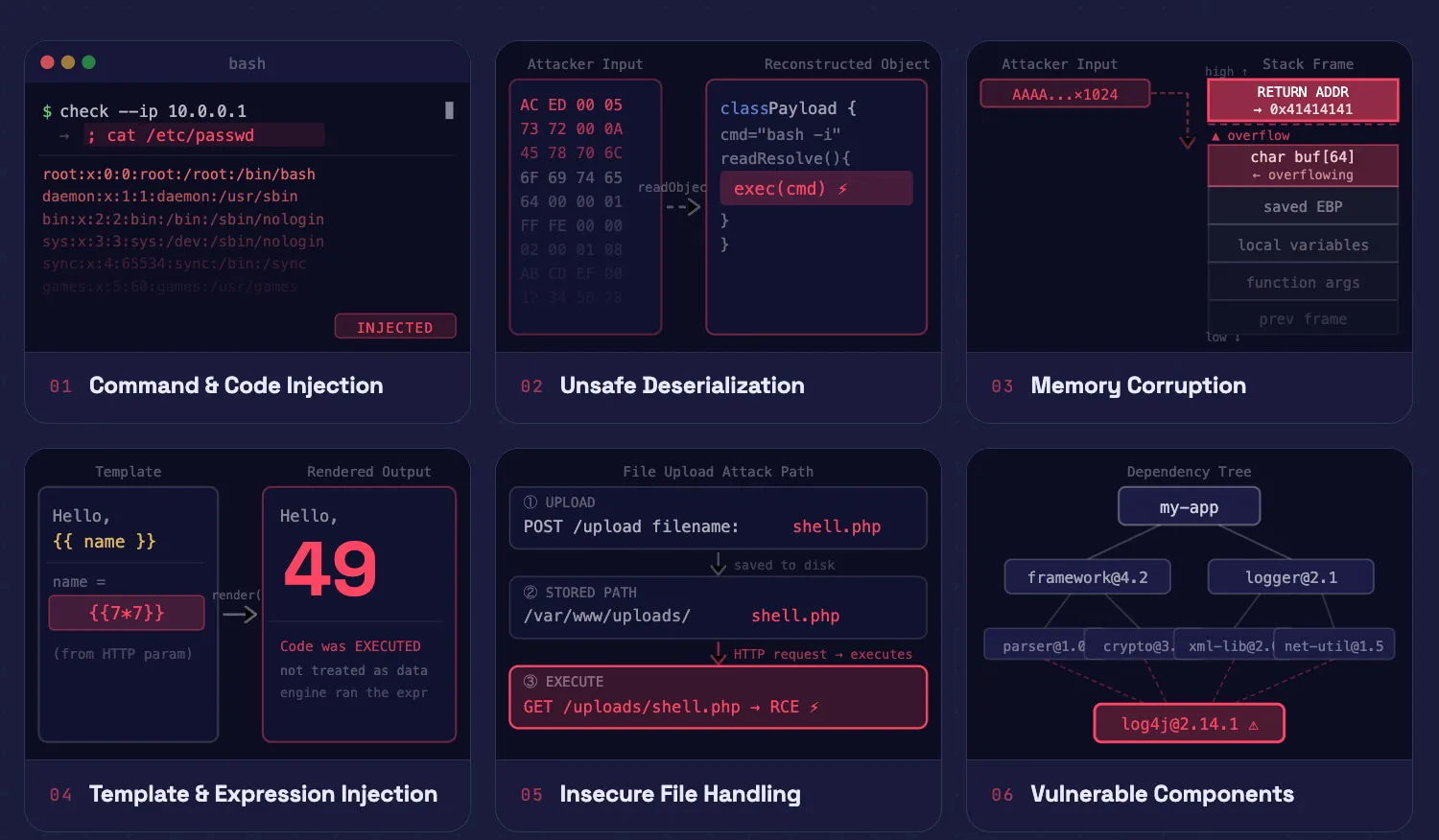
Command and Code Injection
Command injection occurs when an application passes untrusted input into an operating system command without properly restricting or separating that input. Code injection follows a similar pattern, but targets an application’s language interpreter, runtime, or evaluation function.
These flaws are often found in web applications, administration panels, automation tools, and APIs that process user-controlled data.
Unsafe Deserialization
Applications sometimes store or exchange objects in serialized form. If a product deserializes attacker-controlled data without sufficient safeguards, an attacker may be able to influence how the application reconstructs that object and trigger unintended code execution.
Unsafe deserialization has affected enterprise software, Java applications, APIs, and middleware products over the years.
Memory Corruption Vulnerabilities
Memory-safety issues, including buffer overflows, use-after-free flaws, and out-of-bounds writes, can allow an attacker to alter a program’s intended execution flow.
These vulnerabilities are common in software written in memory-unsafe languages and can be particularly serious in network appliances, operating systems, browsers, and security products.
Template and Expression Injection
Many applications use templates and expression languages to generate content dynamically. If an application evaluates attacker-controlled content as an expression rather than treating it as data, it may expose a path to RCE.
This type of weakness has affected web frameworks, collaboration platforms, and enterprise applications.
Insecure File Handling
File-upload functionality, path-handling weaknesses, and unsafe archive extraction can sometimes allow attackers to place or modify files in locations where the application will execute them.
The risk increases when upload directories are executable, when write permissions are overly broad, or when an application fails to separate public uploads from sensitive files.
Vulnerable Internet-Facing Products and Components
RCE vulnerabilities are especially urgent when they affect software exposed at the network edge, such as VPN gateways, email servers, firewalls, remote management tools, and web applications.
A vulnerable third-party component can create the same risk. Even when an organization does not directly use a library, it may be embedded within another product or application dependency.
What Can Happen After an RCE Exploit?
An RCE vulnerability can give an attacker a practical starting point, not necessarily the final objective. After gaining execution, an attacker may attempt to:
- Install a web shell or other persistence mechanism
- Steal application secrets, API keys, credentials, or session data
- Deploy malware, ransomware, or cryptomining tools
- Enumerate internal systems and connected services
- Move laterally to higher-value systems
- Exfiltrate sensitive data
- Disrupt services or alter business-critical workloads
The impact is often greatest when the affected application runs with excessive privileges, has access to sensitive data, or sits in a trusted network segment.
Notable Remote Code Execution Vulnerability Examples
Log4Shell in Apache Log4j
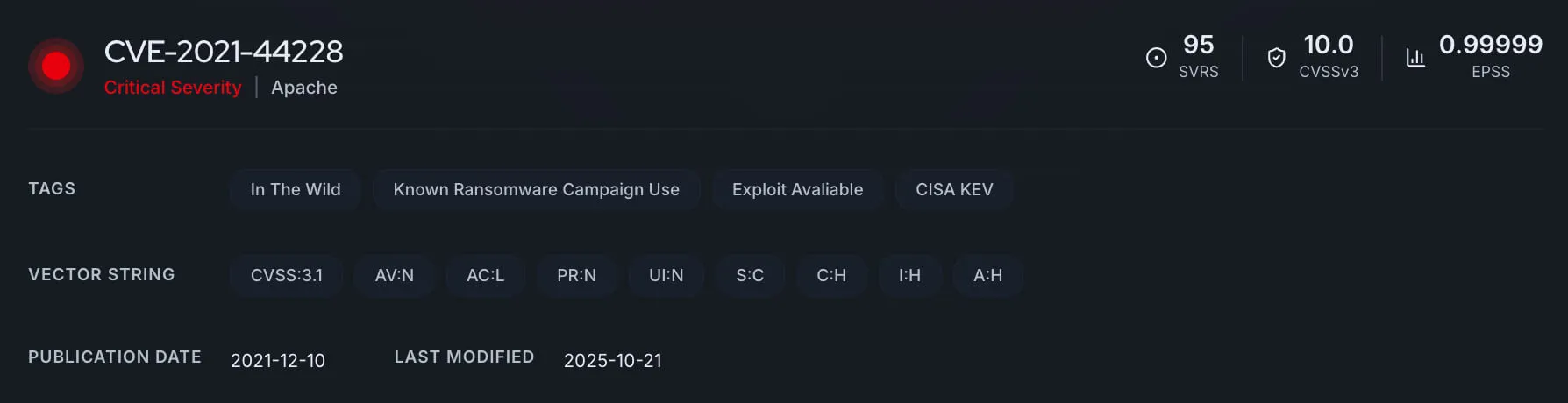
Disclosed in December 2021, CVE-2021-44228, known as Log4Shell, affected Apache Log4j, a widely used Java logging library. Under vulnerable conditions, attacker-controlled data could trigger remote code execution through Log4j’s handling of JNDI lookups.
Log4Shell became a defining example of software supply-chain risk because the library was embedded deeply within countless applications and products. CISA warned that the flaw was being actively exploited shortly after disclosure.
Lesson: Organizations need visibility into direct and indirect software dependencies. A patching effort cannot succeed if teams do not know where a vulnerable component exists.
Microsoft Exchange ProxyLogon
The 2021 Microsoft Exchange incidents involved a chain of vulnerabilities, commonly referred to as ProxyLogon (CVE-2021-26855, CVE-2021-26857, CVE-2021-26858, and CVE-2021-27065). They included an SSRF flaw, post-authentication code execution, and arbitrary file-write vulnerabilities that could be combined for unauthenticated remote code execution on on-premises Exchange Servers.
Microsoft observed web-shell deployment, code execution, and data-exfiltration activity following attacks against vulnerable systems.
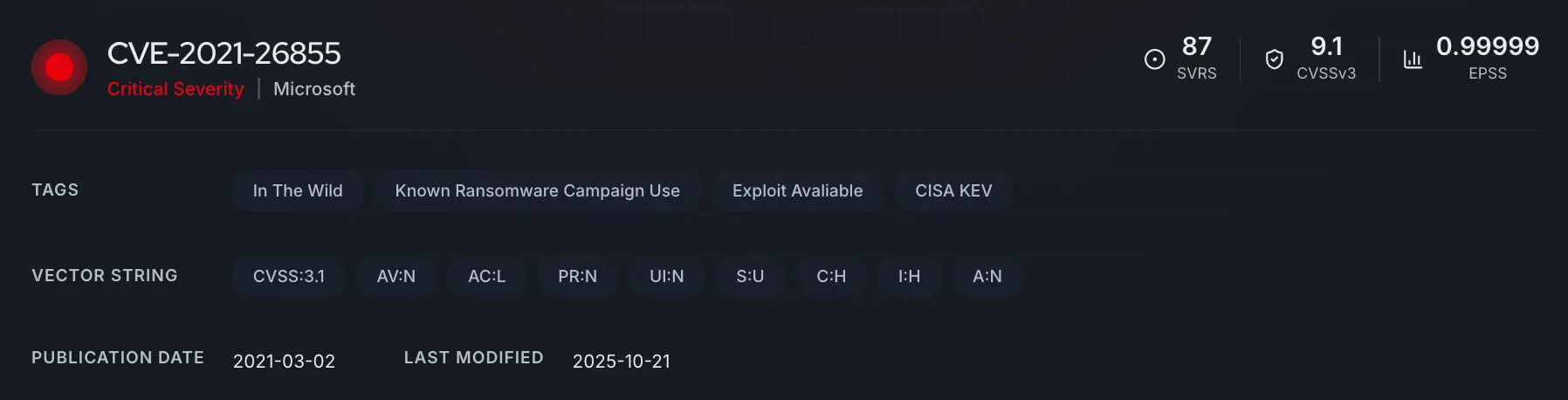
Lesson: Attackers often combine multiple weaknesses. A vulnerability’s real risk depends on the full attack path, not only on the description of an individual CVE.
Atlassian Confluence RCE
CVE-2022-26134 was a critical unauthenticated RCE vulnerability affecting Confluence Server and Data Center. The OGNL injection flaw allowed an unauthenticated attacker to execute arbitrary code on affected instances, and Atlassian reported active exploitation at the time of disclosure. Atlassian Cloud sites were not affected.
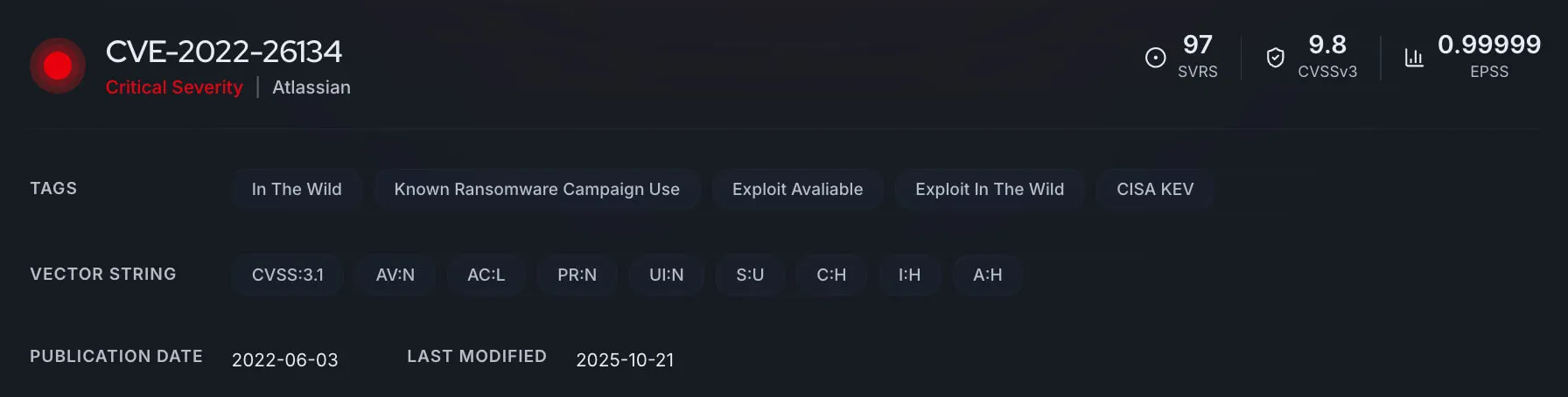
Lesson: Internet-facing collaboration platforms can become high-value targets because they are widely deployed, commonly connected to internal business processes, and often hold sensitive documentation.
FortiOS and FortiProxy SSL-VPN RCE
CVE-2024-21762 was an out-of-bounds write vulnerability in FortiOS and FortiProxy that could allow a remote unauthenticated attacker to execute code or commands through specially crafted HTTP requests. Fortinet said the issue was potentially being exploited in the wild, and CISA later highlighted post-exploitation activity associated with previously exploited Fortinet vulnerabilities.
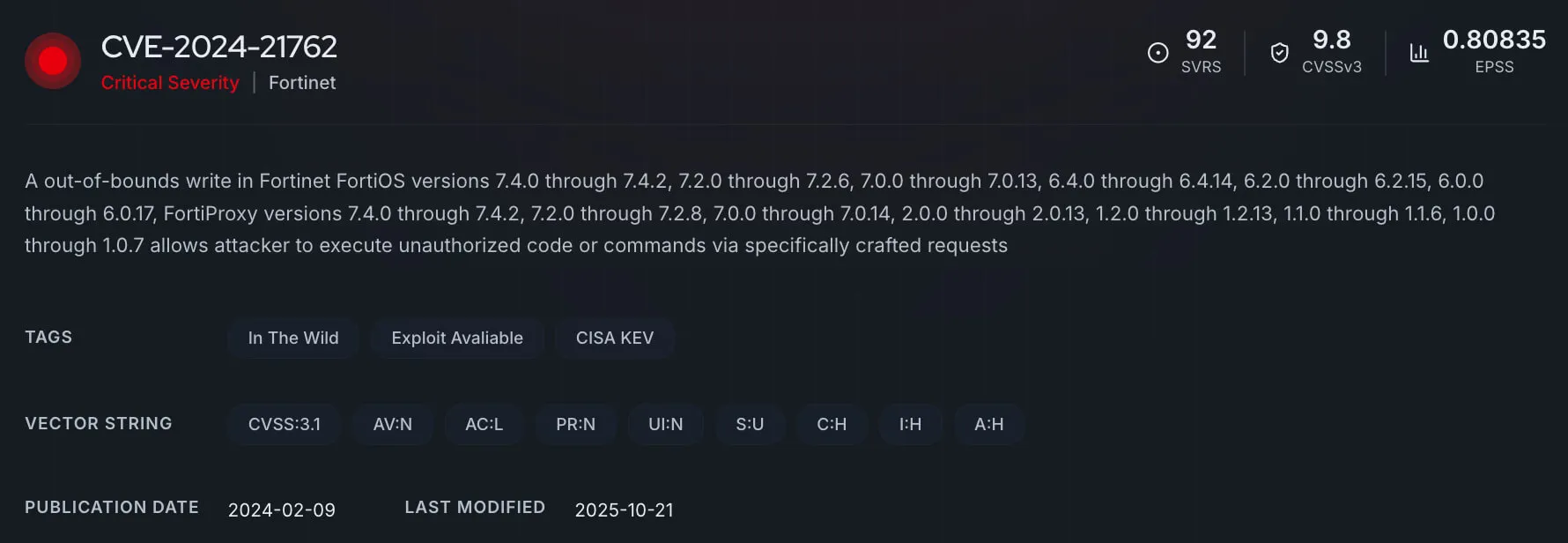
Lesson: Security appliances are not inherently safe from attack. Because they sit at the network edge and are trusted by the rest of the environment, exposed VPNs and firewalls require rapid remediation and continuous exposure monitoring.
Apache Tomcat RCE Conditions
CVE-2025-24813 affected Apache Tomcat and could lead to RCE, information disclosure, or malicious content upload under particular conditions. Exploitation required a combination of configuration choices, including write access being enabled for the Default Servlet, which is disabled by default.
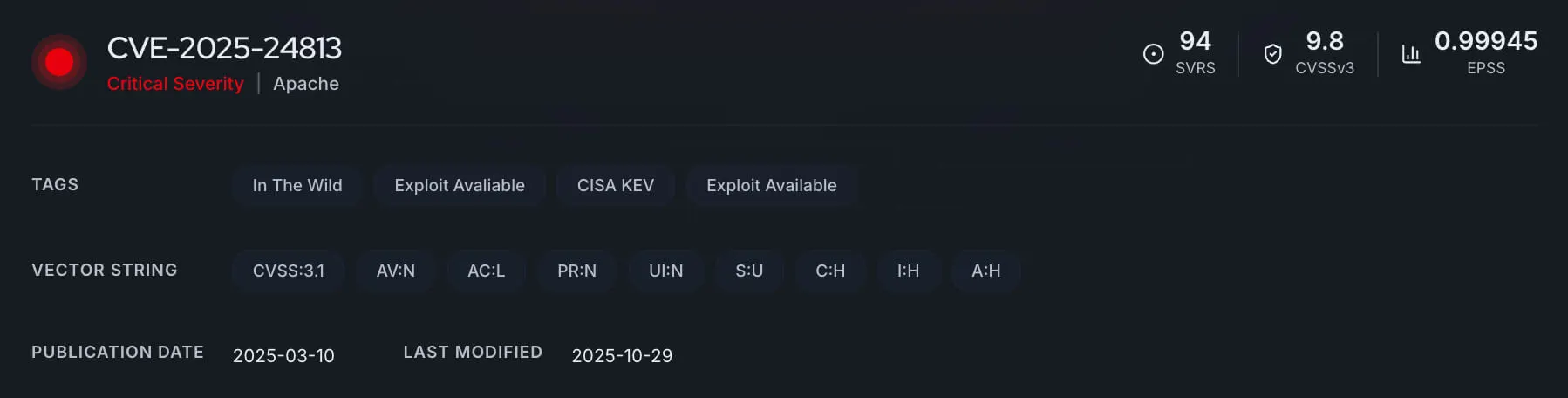
Lesson: Severity scores matter, but configuration context matters too. Security teams should validate whether a vulnerability is reachable and exploitable in their own environment while still applying vendor guidance quickly.
How To Prevent Remote Code Execution Attacks
There’s no single control that prevents every remote code execution (RCE) vulnerability, but a layered defense can stop most attempts and limit the damage from the ones that get through. Preventing remote code execution comes down to reducing exposure, improving patching speed, limiting the impact of successful execution, and detecting suspicious behavior early.
Maintain an Accurate Asset Inventory
You cannot prioritize a vulnerability if you do not know where the affected software is running. Track public-facing applications, remote-access services, cloud workloads, security appliances, software versions, and third-party dependencies.
Pay close attention to forgotten test environments, legacy systems, development servers, and management interfaces exposed to the internet.
Prioritize Based on Exploitability and Exposure
CVSS is useful, but it should not be the only factor in prioritization. A high-risk RCE issue deserves immediate attention when it affects an internet-facing asset, is listed in a known-exploited vulnerability catalog, has public exploit activity, or provides access to a sensitive environment.
Use vendor advisories, exploitation evidence, asset criticality, and threat intelligence to decide what must be remediated first.
Patch and Mitigate Quickly
Apply vendor patches as soon as operationally possible. If a patch cannot be deployed immediately, follow the vendor’s documented mitigation guidance and establish a clear deadline for permanent remediation.
Temporary controls can reduce exposure, but they should not quietly become the final response to a critical vulnerability.
Restrict Access to Administrative Services
Administrative interfaces, VPN portals, remote management systems, and web-based consoles should not be openly available unless there is a documented operational need.
Use network segmentation, IP allowlists, VPN access, multifactor authentication, and strong identity controls to reduce unnecessary exposure.
Apply Least Privilege
Applications and services should run with only the permissions they need. This limits the damage if an attacker gains code execution through a vulnerable process.
Avoid running web servers, application services, or automation tools with local administrator or root privileges unless that access is genuinely required.
Segment Critical Systems
Network segmentation can help stop an RCE compromise from becoming an environment-wide incident. Separate internet-facing systems from internal workloads, restrict unnecessary east-west traffic, and limit access to identity infrastructure, backups, and sensitive data stores.
Monitor for Post-Exploitation Behavior
Detection should focus on the actions that often follow successful RCE. Security teams should investigate:
- Web servers or application services spawning shells or command interpreters
- Unexpected child processes from Java, web, email, or VPN services
- New scheduled tasks, services, startup entries, or web-accessible files
- Unusual outbound connections from servers that do not normally initiate external traffic
- Changes to application directories, configuration files, or authentication settings
- Suspicious use of diagnostic, administrative, or remote-management utilities
A patch closes the known vulnerability. Monitoring helps identify whether an attacker exploited it before remediation.
What To Do If You Suspect an RCE Exploit
Treat a confirmed RCE event as a potential system compromise, even if a patch has already been applied.
First, isolate the affected system according to your incident-response procedures while preserving evidence. Review vendor guidance and logs for known indicators, examine for web shells or unauthorized files, identify suspicious processes and outbound connections, and assess which credentials or secrets may have been exposed.
Teams should also hunt for related activity across the environment, rotate potentially compromised credentials, and verify that the root cause has been removed rather than simply blocking an observed indicator.
Prioritize RCE Risk With SOCRadar
Remote code execution risk is not just a vulnerability-management problem. It is an exposure and prioritization problem.
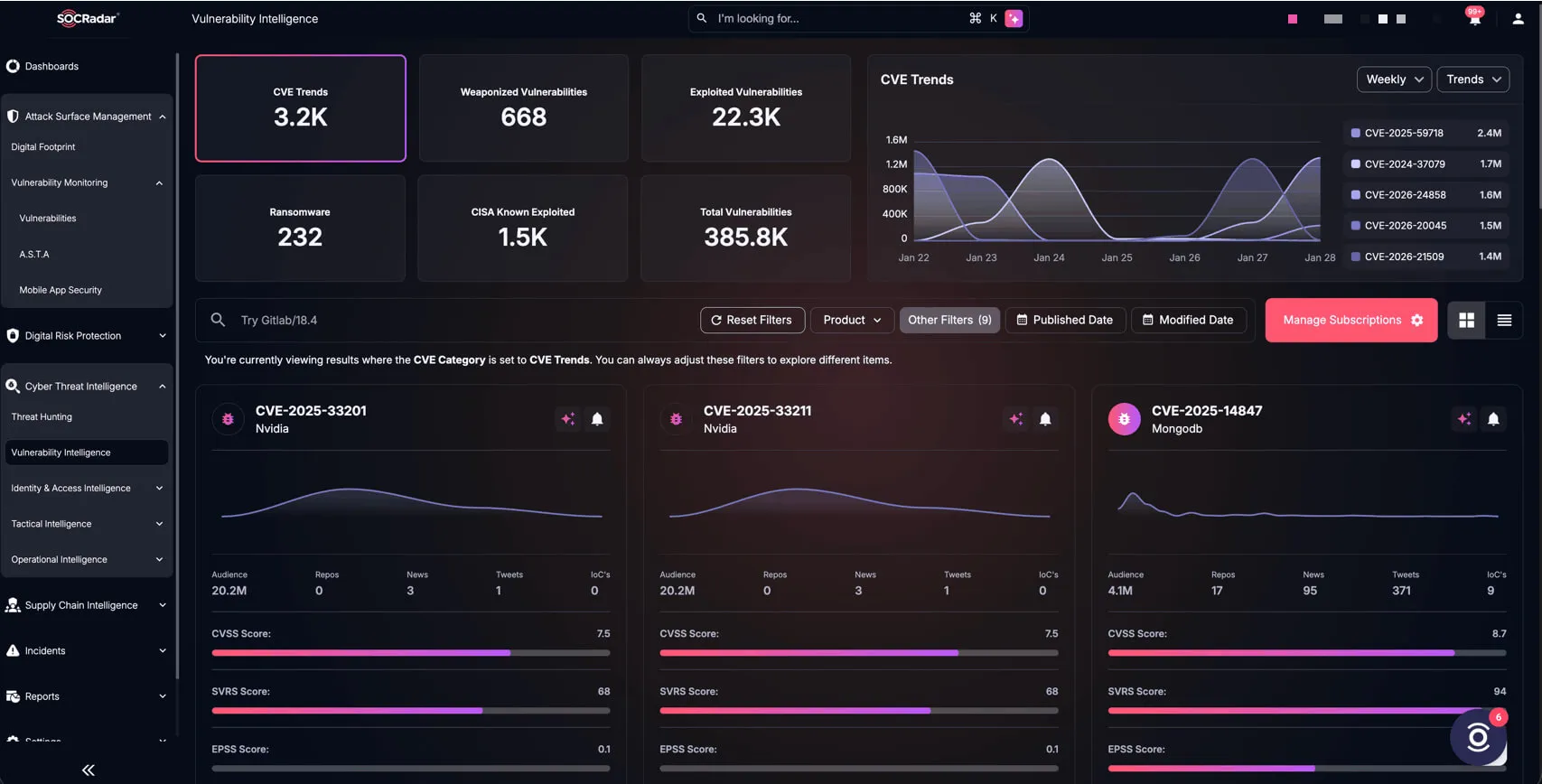
SOCRadar Attack Surface Management can help organizations identify internet-facing assets and services that may be affected by emerging vulnerabilities. SOCRadar Cyber Threat Intelligence adds context around exploitability, known exploitation, threat activity, and remediation urgency, helping security teams focus their response on RCE issues that pose a realistic risk to their environment.
Frequently Asked Questions About RCE
What Is RCE?
RCE stands for remote code execution: a vulnerability, or the resulting attack, that lets someone run code or commands on a system they don’t own or control, from a separate device or network. Whether it’s written as “an RCE,” “a RCE vulnerability,” or just “RCE,” it refers to the same underlying issue – a flaw serious enough to give an attacker a working foothold on the target system.
What Is an RCE Vulnerability?
An RCE vulnerability is the underlying flaw – in code, configuration, or a third-party component – that makes remote code execution possible. Having the vulnerability doesn’t mean a system has already been attacked; it means the door is unlocked. Whether it actually gets used depends on the system’s exposure, whether a working exploit exists, and how quickly the flaw is patched or mitigated.
What Is an RCE Exploit?
An RCE exploit is the code, request, or technique an attacker uses to actually trigger an RCE vulnerability and gain code execution. Security teams track exploit availability closely: a vulnerability with a public or “in the wild” exploit is far more urgent to remediate than one that’s currently only theoretical.
Is every RCE vulnerability critical?
Not necessarily. The severity depends on reachability, authentication requirements, user interaction, required configuration, the privileges of the affected process, and the potential impact on the organization. However, remotely exploitable RCE flaws on internet-facing systems should generally be treated as urgent.
Is command injection the same as RCE?
Command injection is one possible route to RCE. It occurs when an application passes attacker-controlled input into an operating system command. RCE is broader and can also result from memory corruption, deserialization flaws, template injection, vulnerable components, and other weaknesses.
Can RCE happen without authentication?
Yes, but not every RCE vulnerability is unauthenticated. Some require valid credentials, internal-network access, elevated privileges, or another vulnerability in the attack chain.
What Is the Difference Between RCE and Privilege Escalation?
RCE gives an attacker the ability to execute code remotely. Privilege escalation allows an attacker to gain more permissions than they initially had. Attackers may use RCE to gain an initial foothold and then attempt privilege escalation.
Conclusion
Remote code execution vulnerabilities are dangerous because they can convert a software flaw into direct access to an application, server, or network edge device. But RCE does not need to become a full compromise.
The strongest defense combines complete asset visibility, rapid remediation, reduced exposure, least-privilege design, network segmentation, and detection for post-exploitation activity. When a serious RCE vulnerability is disclosed, the critical question is not simply whether it affects a product in your inventory. It is whether an attacker can reach it, exploit it, and use it to move deeper into your environment.