What Is a Data Breach?
A data breach is a security incident in which protected, confidential, or sensitive information is accessed, acquired, disclosed, altered, or destroyed without authorization. A breach may result from a deliberate attack, insider misuse, lost equipment, misdelivery, insecure storage, or another control failure.
Breach severity depends on the data involved, who obtained it, whether it can be misused, how long exposure continued, and which legal or contractual duties apply. Teams should avoid announcing conclusions before scope and evidence support them, but notification deadlines make early coordination essential.
Key Takeaways
- A data leak is exposure; a data breach is a confirmed security incident involving unauthorized data access or disclosure.
- Stolen credentials, vulnerable systems, cloud misconfiguration, third parties, and insiders are recurring causes.
- Response must contain access while preserving evidence and meeting legal, contractual, and customer obligations.
- Prevention begins with knowing where sensitive data lives, who can reach it, and how it leaves.
How a Data Breach Works
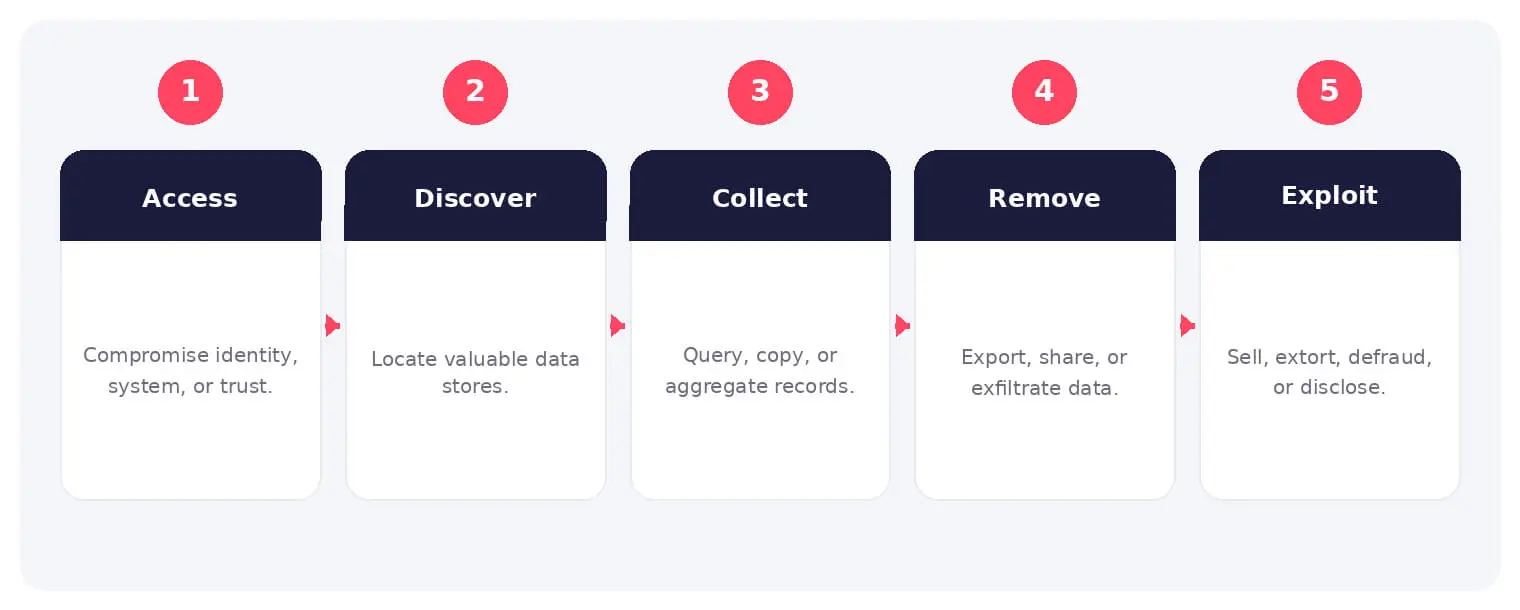
Attackers commonly enter through phishing, stolen credentials, vulnerable applications, exposed remote services, third parties, or malware. They discover valuable repositories, increase access, collect information, and stage it for removal.
Not every breach follows an intrusion. Public cloud storage, incorrect access permissions, email sent to the wrong recipient, misplaced devices, or a malicious insider can expose data without external malware.
Common Types and Techniques
- Credential-driven account and cloud compromise
- Application, API, and internet-facing system exploitation
- Third-party and supply-chain data exposure
- Accidental disclosure and malicious or negligent insiders
Security and Business Risks
- Identity theft, fraud, extortion, and follow-on phishing
- Regulatory investigation, notification, and litigation
- Operational disruption and incident-response cost
- Loss of customer, employee, and partner trust
Warning Signs and Detection
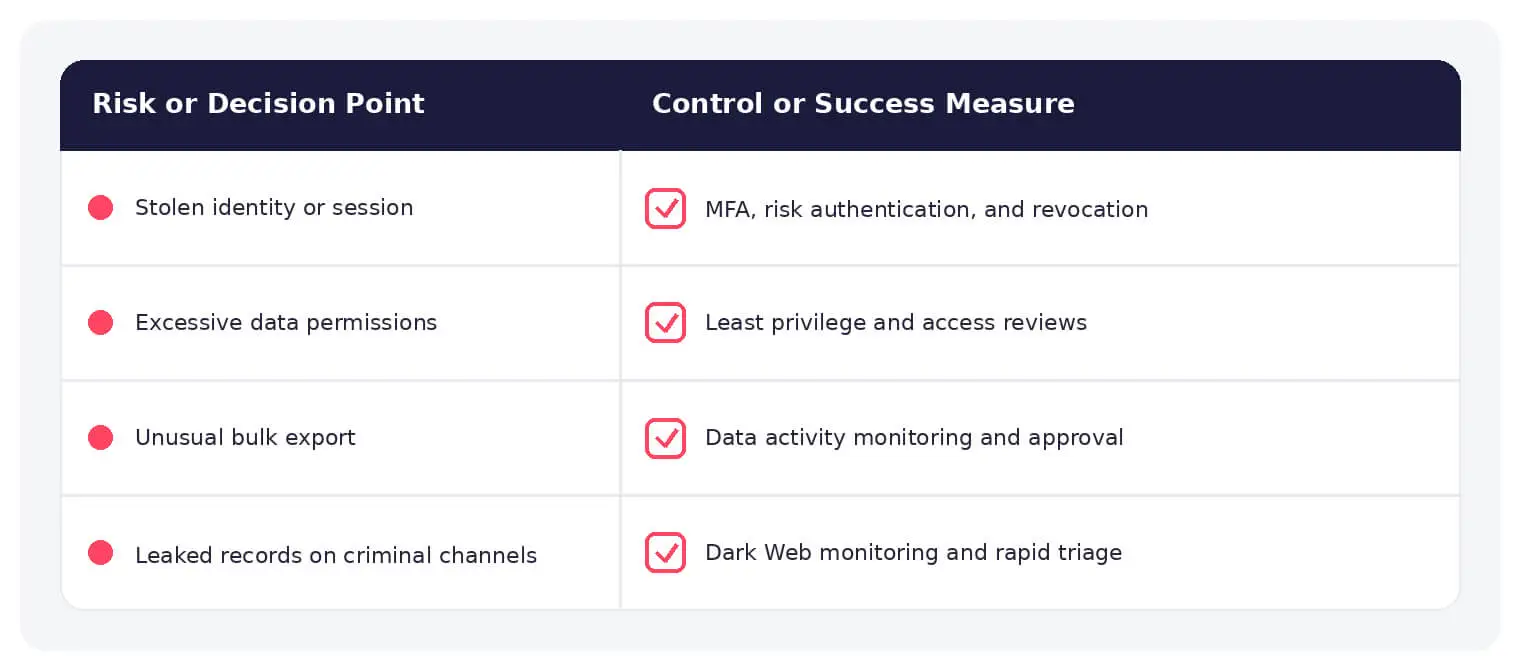
Watch for unusual access to sensitive repositories, large exports, new sharing links, abnormal queries, cloud permission changes, mailbox forwarding, data staging, and outbound transfers. External monitoring can reveal stolen records offered or discussed before internal discovery.
Prevention and Response
Classify and minimize data, apply least privilege, encrypt sensitive information, protect identities, patch exposed systems, control exports and sharing, assess suppliers, monitor high-risk access, and maintain a breach response plan with legal and communications roles.
How SOCRadar Can Help
SOCRadar combines external asset visibility, threat intelligence, Dark Web monitoring, vulnerability context, and indicator enrichment to help teams identify exposure and investigate activity connected to data breach.
Explore SOCRadar Dark Web Monitoring or request a demo to strengthen threat-informed prevention and investigation.
Frequently Asked Questions
What Is the Difference Between a Data Leak and a Data Breach?
A leak describes data becoming exposed, often through misconfiguration or human error, while a breach is a confirmed security incident in which data was accessed, acquired, disclosed, altered, or destroyed without authorization. An open storage bucket becomes a breach once evidence shows someone actually obtained the data. Many organizations treat discovered leaks as potential breaches until scoping proves otherwise.
What Are the Most Common Ways Attackers Gain Access to Sensitive Data?
Stolen credentials, phishing, exploitation of internet-facing applications and APIs, vulnerable remote-access services, third-party compromise, and insider misuse account for most incidents. Credential abuse is especially common because valid logins let attackers blend in with normal user activity. Overly permissive cloud settings often turn a small foothold into large-scale exposure.
How Do Data Breaches Happen Without an External Attacker?
Not every breach involves malware or an intrusion. Public cloud storage left misconfigured, excessive sharing permissions, email sent to the wrong recipient, lost or stolen devices, and negligent or malicious insiders can all expose protected data on their own. These incidents carry the same notification, legal, and reputational consequences as a hack.
What Warning Signs Suggest Data Is Being Staged or Stolen?
Watch for unusual access to sensitive repositories, bulk exports, abnormally large query volumes, new sharing links, sudden cloud permission changes, mailbox forwarding rules, and outbound transfers at unusual hours. Data staged into compressed archives frequently precedes exfiltration. External signals, such as records or credentials surfacing in underground markets, can reveal a breach before internal detection does.
What Are the First Steps in Responding to a Data Breach?
Activate the incident response plan and scope what data, systems, and accounts are involved. Contain affected access by disabling accounts, revoking sessions and tokens, and rotating credentials, while preserving logs and evidence for forensics and regulators. Bring legal, privacy, communications, and business leadership in early, because notification obligations start running as soon as the organization becomes aware.
How Quickly Must an Organization Notify After a Breach?
Deadlines depend on jurisdiction, sector, and contract. GDPR generally requires notifying the supervisory authority within 72 hours of becoming aware of a breach, while U.S. state laws set their own windows, sometimes measured in only a few days. Customer and partner agreements often impose even shorter timelines, so legal teams should map these duties before an incident occurs.
Does Encryption Mean a Breach Did Not Happen?
Not necessarily. Strong encryption with well-protected keys may limit severity and, under some regulations, reduce or remove notification duties, but unauthorized access to encrypted data can still qualify as a reportable breach. Encryption also does little against attackers who use a valid application session, because the data is decrypted during normal use.
Does Resetting Passwords Stop an Ongoing Breach?
Resets are an important containment step, but they may not immediately cut off an attacker. On many platforms, existing sessions and OAuth tokens remain valid after a password change unless they are explicitly revoked. Pair resets with session revocation, token invalidation, and enforcement of phishing-resistant MFA to close active access paths.
How Can Organizations Tell Their Data Is Being Sold Online?
Underground forums and markets frequently list stolen credentials, stealer logs, sample records, or access sales before the victim organization is aware of any compromise. SOCRadar Dark Web Monitoring tracks these sources for an organization’s domains, brands, and leaked data so teams can begin scoping and credential resets sooner. Findings still require internal confirmation, but early notice can meaningfully shorten exposure time.
Oct 23, 2026
CVE-2026-114625: Actively Exploited VeloCloud Orchestrator Flaw Grants Superuser Access
CVE-2026-114625 is an actively exploited SQL injection flaw in VeloCloud Orchestrator that lets authenticated users gain superuser operator privileges…

Oct 22, 2026
PHP2Shell Exploit Tooling Found on Exposed Attacker Server
SOCRadar Threat Intelligence Unit (STRU) researchers found PHP2Shell exploit tooling on an attacker-controlled server whose working directory was exposed…

Oct 22, 2026
New LiteLLM Supply Chain Attack Hits PyPI and Docker
A new LiteLLM supply chain attack has turned version 1.107.0, an official release of the popular open-source LLM gateway, into a credential…
Intelligence in your inbox every Thursday.
Join 30,000+ security professionals reading SOCRadar research.
Subscribe