

| Attribute | Detail |
|---|---|
| Market type | Multi-category wallet escrow marketplace |
| Reported launch date | October 2023 (unverified) |
| Status | Active as of publication |
| Language | English |
| Accepted currencies | BTC, XMR, USDT |
| Sales commission | 4% |
| Coin swap fee | 4% |
| Vendor bond | USD 500 |
| Escrow window | 14 days international, 7 days domestic, 3 days digital |
| Observed listings | Approximately 6,733 in a single authenticated view |
| Product categories | Narcotics, Fraud, Digital Products, Cracked Software, Botnets & Malware, Security & Hacking, Counterfeit Items, Electronics |
| Prohibited | Fentanyl, weapons, venoms, child sexual abuse material, government data |
| Distinguishing features | Built-in coin swap, in-market dice wagering, mnemonic-only account recovery, tiered vendor and trust levels |
| Access model | Tor / onion service |
Aug 04, 2026
13 Mins Read
Sep 25, 2026

Summarize with:
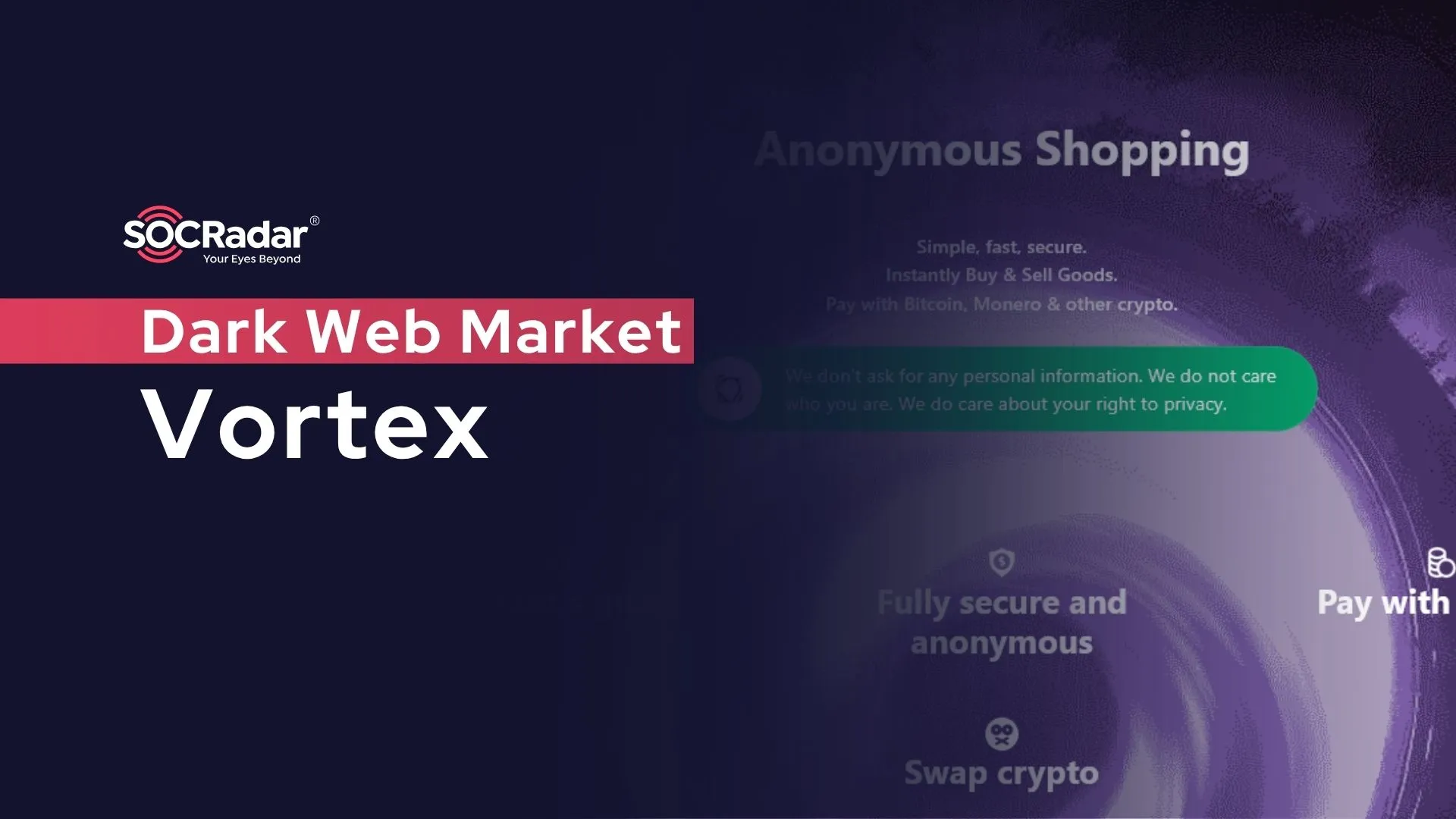
Dark Web Market: Vortex Market
Vortex Market describes itself as a “classic wallet escrow market,” and that self-description is accurate. It is a general-purpose Dark Web marketplace built around anonymous trade, vendor reputation levels, and cryptocurrency payments held in market-controlled wallets. Reporting on mirror directories places the launch of the Vortex darknet market in October 2023 with full public access during 2024. Its footer carries a 2026 copyright, and the platform remains active.
What makes Vortex worth a closer look is not its narcotics inventory, which dominates the listing counts. It is the surrounding infrastructure: an internal Bitcoin-to-Monero-to-USDT swap function, an integrated wagering feature, mnemonic-only account recovery, and a layered vendor trust system. Together, these keep funds, identity, and reputation inside the market’s own perimeter, which has direct consequences for investigators and for organizations whose data ends up on the platform.
Key Takeaways
- What it is: A multi-category wallet escrow Dark Web marketplace, active as of 2026, trading narcotics, fraud data, malware, and counterfeit goods.
- Scale: Roughly 4,800 to 6,700 listings depending on the view, with about 2,000 in cyber-relevant categories.
- Cost model: 4% sales commission, 4% internal coin swap fee, 10% house cut on in-market wagering, USD 500 vendor bond.
- Why it matters to defenders: An internal BTC-to-XMR-to-USDT swap and wallet-funded wagering degrade blockchain tracing against transactions originating on the platform.
- Sourcing caution: Multisig, AES-256, six-currency, and user-count claims circulating on Vortex mirror directories contradict the market’s own documentation and should not be cited.
Vortex Market at a Glance
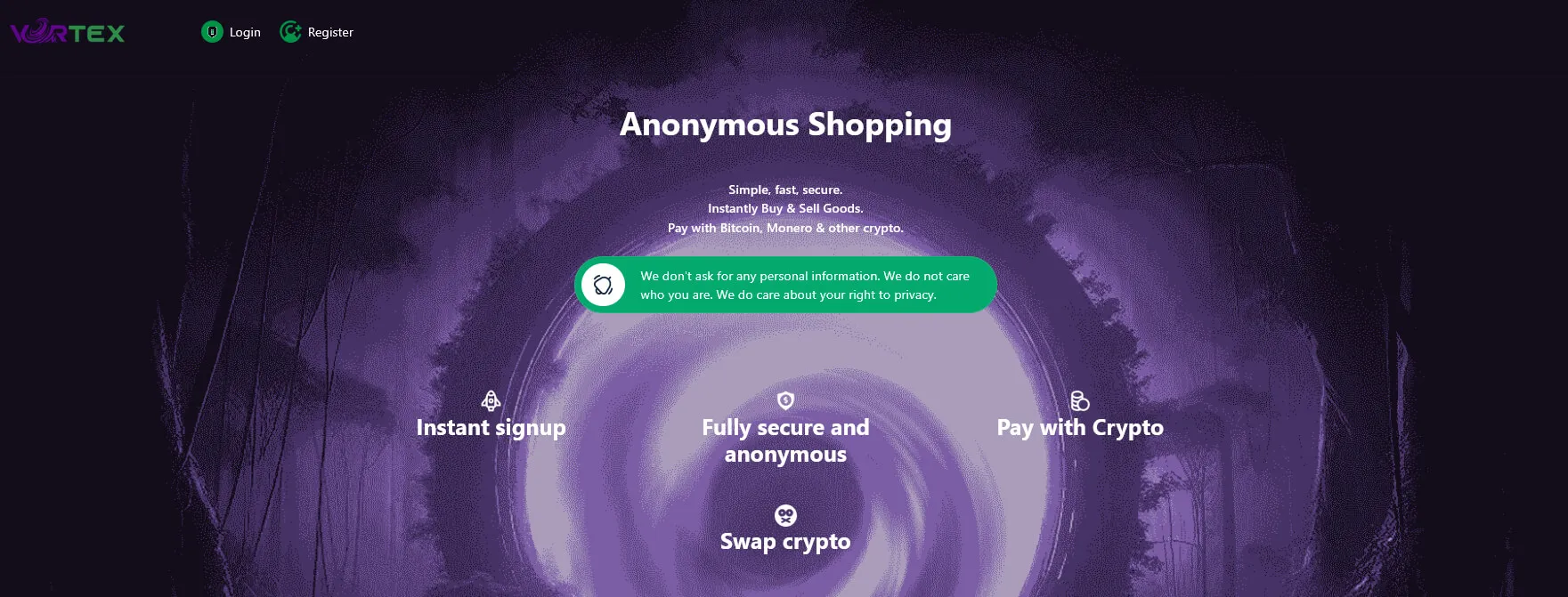
Vortex Market’s public landing page, promoting instant signup, crypto-only payment, and no collection of personal information
What is a Dark Web Market?
A Dark Web market is an online marketplace reachable through anonymity-preserving networks such as Tor, hosting the trade of illegal goods and services outside conventional law enforcement visibility. These platforms use cryptocurrency to reduce traceability and escrow systems to establish enough trust between anonymous parties for commerce to function.
Vortex sits in the multi-category tier of that ecosystem, alongside markets covered in SOCRadar’s Top 10 Dark Web Markets analysis. It is distinct from credential-focused shops such as Russian Market or STYX, which specialize in stealer logs and fraud data rather than broad-catalog trade, and it sits closer to general-catalog markets such as Torzon.
Vortex Market Structure
Once authenticated, Vortex presents a conventional e-commerce layout: a search bar spanning all categories, filtering controls, and a grid of recommended products. Each listing tile carries the vendor handle, star rating, cumulative sales, positive feedback percentage, shipping origin, payment mode, and price rendered simultaneously in BTC, XMR, and USDT.
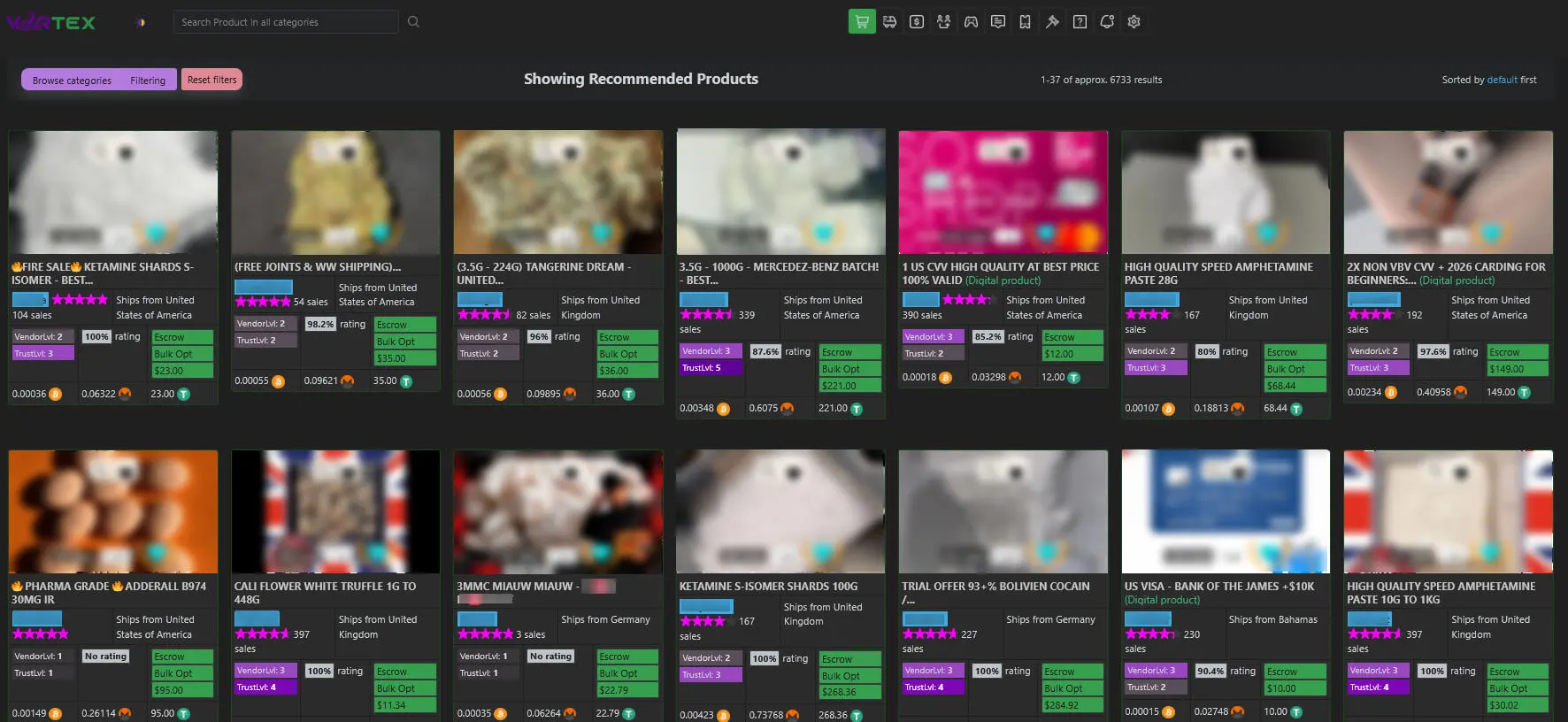
Vortex Market’s authenticated marketplace view, showing approximately 6,733 product results with per-listing vendor level, trust level, feedback percentage, and multi-currency pricing
Product Diversity and Categories
The category sidebar exposes listing counts that make the market’s composition legible at a glance. Narcotics categories account for roughly 5,100 of the counted listings, with Stimulants (1,317) and Cannabis & Hashish (842) leading. The cyber-relevant categories total roughly 2,000 listings: Fraud (1,014), Digital Products (622), Security & Hacking (250), and Cracked Software, Botnets & Malware (155). Sidebar counts sum higher than the displayed result total, which is consistent with listings appearing under more than one category.
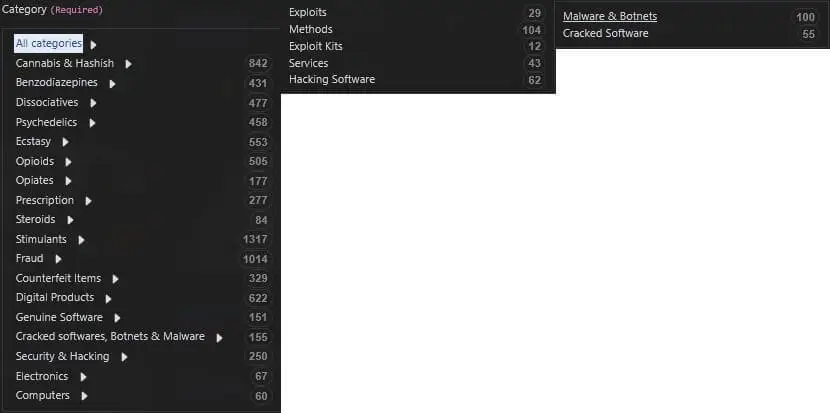
Vortex Market’s category tree, where narcotics dominate volume while Fraud, Digital Products, and Security & Hacking supply the cyber-relevant inventory
Vortex’s stated prohibitions are narrower than the marketing suggests. The market bans fentanyl, weapons, venoms, child sexual abuse material, and the sale of any government data. The last item is the operationally interesting one. Excluding government data is a deliberate risk calculation rather than an ethical stance, since state-linked datasets attract the kind of law enforcement attention that ends marketplaces. Fraud ,malware, and carding inventory sits well inside the permitted set.
Security & Hacking Inventory
The Security & Hacking tree breaks into Methods (104), Hacking Software (62), Services (43), Exploits (29), and Exploit Kits (12). The volume is modest compared to specialist criminal forums, but the composition matters more than the count. “Methods” being the largest subcategory signals that the market’s cyber trade is weighted toward procedural knowledge and monetization playbooks rather than novel tooling.
Fraud Listings and Monetization Content
Fraud is the second-largest category on the platform and the one with the clearest enterprise impact. A representative card listing on the market advertises US CVV data at USD 12 per item under escrow, in line with the ranges tracked in SOCRadar’s Dark Web Price Index, from a vendor at Vendor Level 3 with a 4.3 of 5 product rating, 235 recorded sales, and 4,500 views. The listing text disclaims any balance guarantee and offers cashout guidance in exchange for positive feedback, which illustrates how reputation itself functions as currency on these platforms.
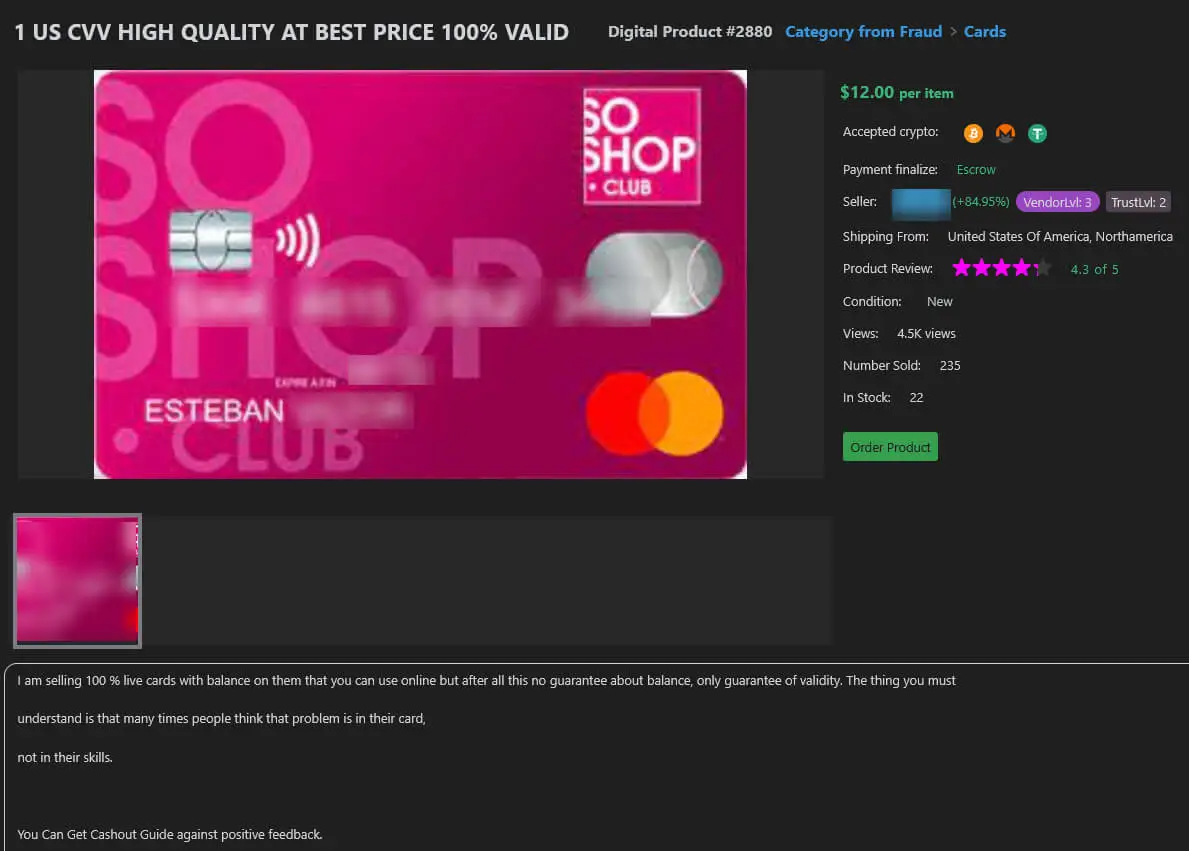
A Fraud category card listing showing escrow payment, vendor level, sales volume, and stock count
Alongside raw data, Vortex hosts tutorial listings that package fraud tradecraft into instructional products: video walkthroughs, proxy and account-preparation guidance, BIN selection advice, and cashout methods, advertised as current for 2026. These listings lower the skill threshold for entry-level fraud actors more effectively than the data itself does, and they are why “Methods” outnumbers “Exploits” by a factor of three.
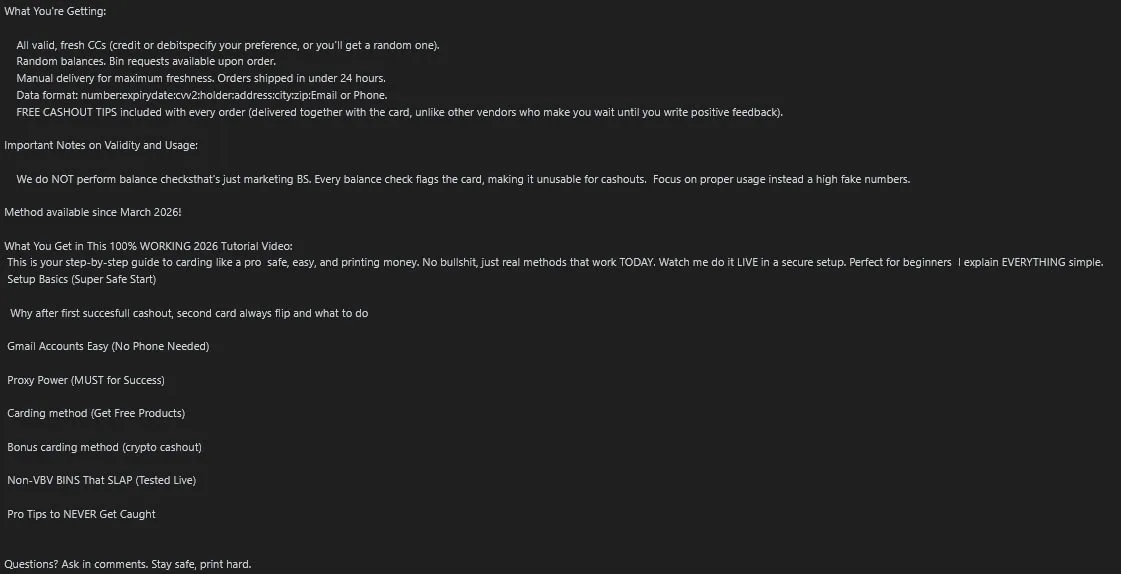
A tutorial listing packaging carding tradecraft as an instructional product
Vortex Market’s Operation Model
Vortex holds user funds in market-controlled wallets rather than releasing them directly between parties, which is the defining property of the “wallet escrow” model. Deposits, withdrawals, swaps, and order settlement all pass through the market’s own accounting layer.
Escrow and Order Lifecycle
Escrow windows differ by product type. Physical goods are held for 14 days internationally and 7 days domestically. Digital products are held for 3 days. Buyers can extend escrow twice, after which a dispute option becomes available. Orders that receive no extension or dispute auto-finalize at the deadline, releasing funds to the vendor.
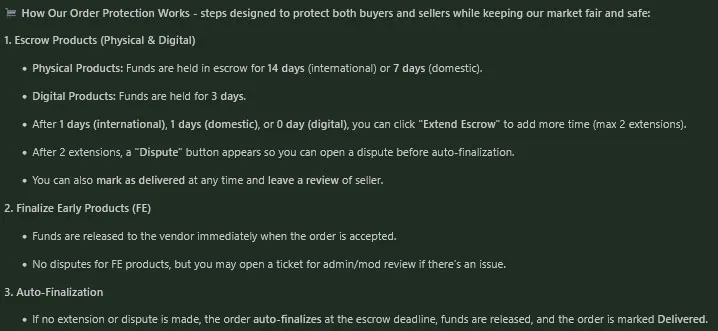
Vortex Market’s order protection terms, setting escrow duration by product type and defining the extension and dispute sequence
Finalize Early (FE) status removes escrow entirely. Funds transfer to the vendor as soon as the order is accepted, with no dispute path available beyond an administrative ticket. The market restricts FE to vendors with sufficient accumulated feedback, which makes FE privilege the most valuable asset a Vortex vendor can hold and the most attractive target for account takeover.
Disputes are resolved by market staff, who weigh trade terms, shipping evidence, buyer and seller message history, user reputation, and prior trading record. Finalized orders cannot be disputed, and feedback can only be left on finalized orders. Both rules concentrate leverage in the moderator layer.
Internal Coin Swap
Vortex operates a built-in conversion function between BTC, XMR, and USDT at a stated 4% fee. Users convert inside the market rather than at an external exchanger.
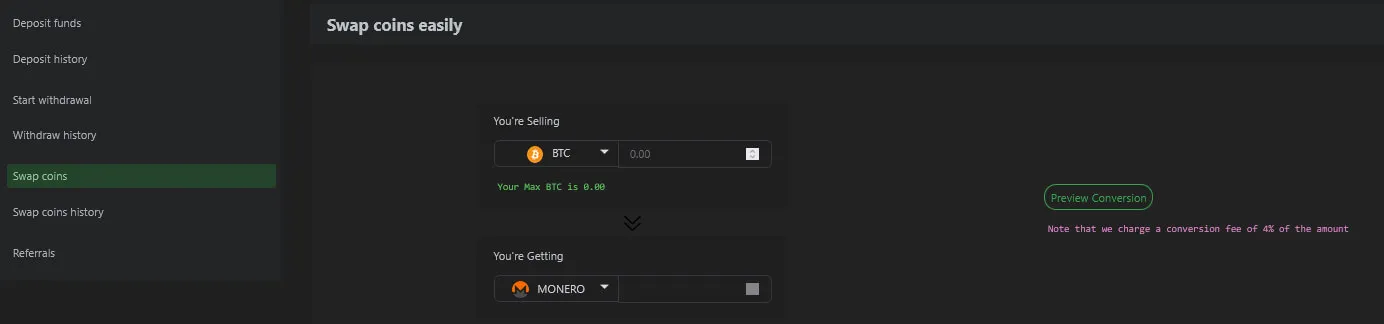
The internal coin swap function, converting between BTC, XMR, and USDT at a stated 4% conversion fee
For threat intelligence teams, this is the most consequential feature on the platform. An internal swap removes any requirement for users to touch a KYC-bound exchange service, and Bitcoin deposits converted to Monero inside a market-controlled wallet break the on-chain continuity that blockchain analytics depends on. The 4% fee is the price the market charges for that break, and the fact that users pay it indicates the demand is real.
In-Market Wagering
Vortex also runs a dice wagering feature that draws directly on user wallet balances, taking a 10% commission on wins across all three supported currencies.
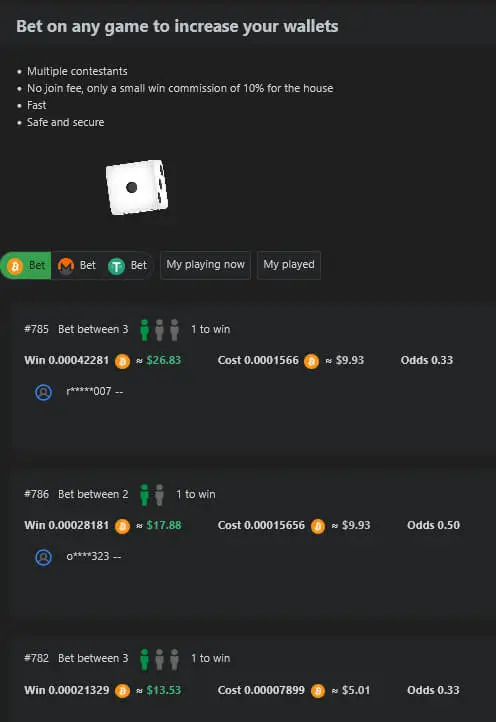
Vortex Market’s integrated dice wagering feature, drawing on user wallet balances with a 10% house commission on wins
The feature serves two purposes. It retains balances inside the market, and it introduces wallet activity unrelated to any order, which complicates attempts to correlate deposits with purchases.
Account Model and Recovery
Vortex issues a mnemonic phrase of 12 to 24 words once, at first login. That phrase and the username are the only recovery mechanism. No email address, phone number, or alternate identifier is collected. Users manage a numeric PIN for withdrawals and import their own PGP public key for encrypted communication. Accounts flagged for suspicious activity are frozen, blocking withdrawal, sales, and profile changes.
This design minimizes the data the market holds, which is the point. It also means a lost mnemonic is an unrecoverable balance, and a stolen mnemonic is a complete account compromise with no fallback. Credential-harvesting operations targeting Dark Web users trade on exactly this asymmetry.
Threat Implications
- Payment Card Fraud: Active CVV inventory with escrow protection and vendor accountability makes low-volume card fraud accessible at USD 12 per record, sustaining chargeback and account takeover pressure on card issuers and merchants.
- Commodity Malware Access: The Malware & Botnets branch supplies packaged tooling to actors without development capability, lowering the barrier to entry for ransomware affiliates and loader operators.
- Tradecraft Distribution: Tutorial listings convert one operator’s working method into a repeatable product, accelerating technique diffusion across the fraud ecosystem faster than tooling alone.
- Attribution Friction: Internal BTC-to-XMR conversion and wallet-funded wagering degrade the effectiveness of blockchain analytics against transactions originating on the platform.
- Credential and Data Exposure: Digital Products and Fraud listings are a distribution channel for stolen accounts and corporate credentials, feeding credential stuffing and initial access activity against organizations that never see the transaction.
Sourcing Note on Circulating Claims
Mirror directories and unofficial wiki pages promoting Vortex claim 2-of-3 multisignature escrow, AES-256 encryption, six supported currencies, a USD 400 vendor bond, and specific user and vendor counts. None of these align with the market’s own documentation, which describes wallet escrow, three currencies, and a USD 500 bond. These pages are promotional assets with referral incentives.
Current Status of Vortex Market
Vortex remains operational, with listing volume in the observed range of roughly 4,800 to 6,700 results depending on the view and filter state. It accepts vendors migrating from active and defunct markets with a minimum trading history, which is standard positioning for a market absorbing displaced sellers after takedowns and exit scams. The market maintains multiple mirrors and directs users to third-party verification directories, an operational pattern that reflects both takedown resilience planning and a persistent phishing problem targeting its own user base.
Mitigation and Security Measures
Dark Web Monitoring: Multi-category markets like Vortex are where corporate credentials, card data, and account access surface without any accompanying breach notification. SOCRadar’s Dark Web Monitoring tracks marketplace listings and vendor activity for organizational identifiers, providing detection before exposed data is monetized.
Card and Account Fraud Controls: Card issuers and merchants facing marketplace-sourced fraud benefit from BIN-level exposure monitoring, velocity controls tuned to low-value testing transactions, and step-up authentication on the transaction patterns that packaged cashout methods depend on.
Takedown and Brand Protection: Marketplace ecosystems generate phishing infrastructure at scale, including mirror clones and impersonation domains. SOCRadar’s Integrated Takedown Service removes fraudulent domains and listings that abuse corporate brands.
Frequently Asked Questions About Vortex Market
What is Vortex Market?
Vortex Market is a multi-category Dark Web marketplace that describes itself as a classic wallet escrow market. It trades narcotics, fraud data, malware, cracked software, and counterfeit goods, holding user funds in market-controlled wallets and settling orders through timed escrow.
Is Vortex Market still active in 2026?
Yes. SOCRadar observed the market operating with roughly 4,800 to 6,700 visible listings, and the platform footer carries a 2026 copyright. Marketplace availability changes without notice, so status should be treated as current only as of publication.
What currencies does Vortex Market accept?
BTC, XMR, and USDT. The market also runs an internal swap function that converts between the three at a stated 4% fee, which allows users to avoid external exchange services entirely.
What does Vortex Market charge?
A 4% commission on sales, a 4% fee on internal coin swaps, and a 10% house commission on wins from its in-market wagering feature. Vendor accounts require a USD 500 bond.
How does escrow work on Vortex Market?
Physical goods are held for 14 days internationally and 7 days domestically. Digital products are held for 3 days. Buyers can extend escrow twice before a dispute option becomes available, and orders auto-finalize at the deadline if no extension or dispute is filed. Finalize Early listings bypass escrow entirely and release funds when the vendor accepts the order.
Is Vortex Market a scam?
The question is difficult to answer usefully, because every Dark Web marketplace carries exit scam risk regardless of its operating history, and escrow only mitigates vendor-level fraud rather than operator-level fraud. Separately, much of the material promoting Vortex online consists of referral-driven mirror directories publishing claims that contradict the market’s own documentation. Those pages are not reliable sources on the platform they promote.
What cybersecurity threats come from Vortex Market?
Payment card fraud from active CVV inventory, commodity malware and botnet access for actors without development capability, distribution of fraud tradecraft as packaged tutorials, exposure of stolen corporate credentials through its Digital Products and Fraud categories, and attribution friction created by its internal coin swap.

Table Of Content
Dark Web Market: Vortex Market
Key Takeaways
Vortex Market at a Glance
What is a Dark Web Market?
Vortex Market Structure
Vortex Market's Operation Model
Sourcing Note on Circulating Claims
Current Status of Vortex Market
Mitigation and Security Measures
Frequently Asked Questions About Vortex Market
Related Articles
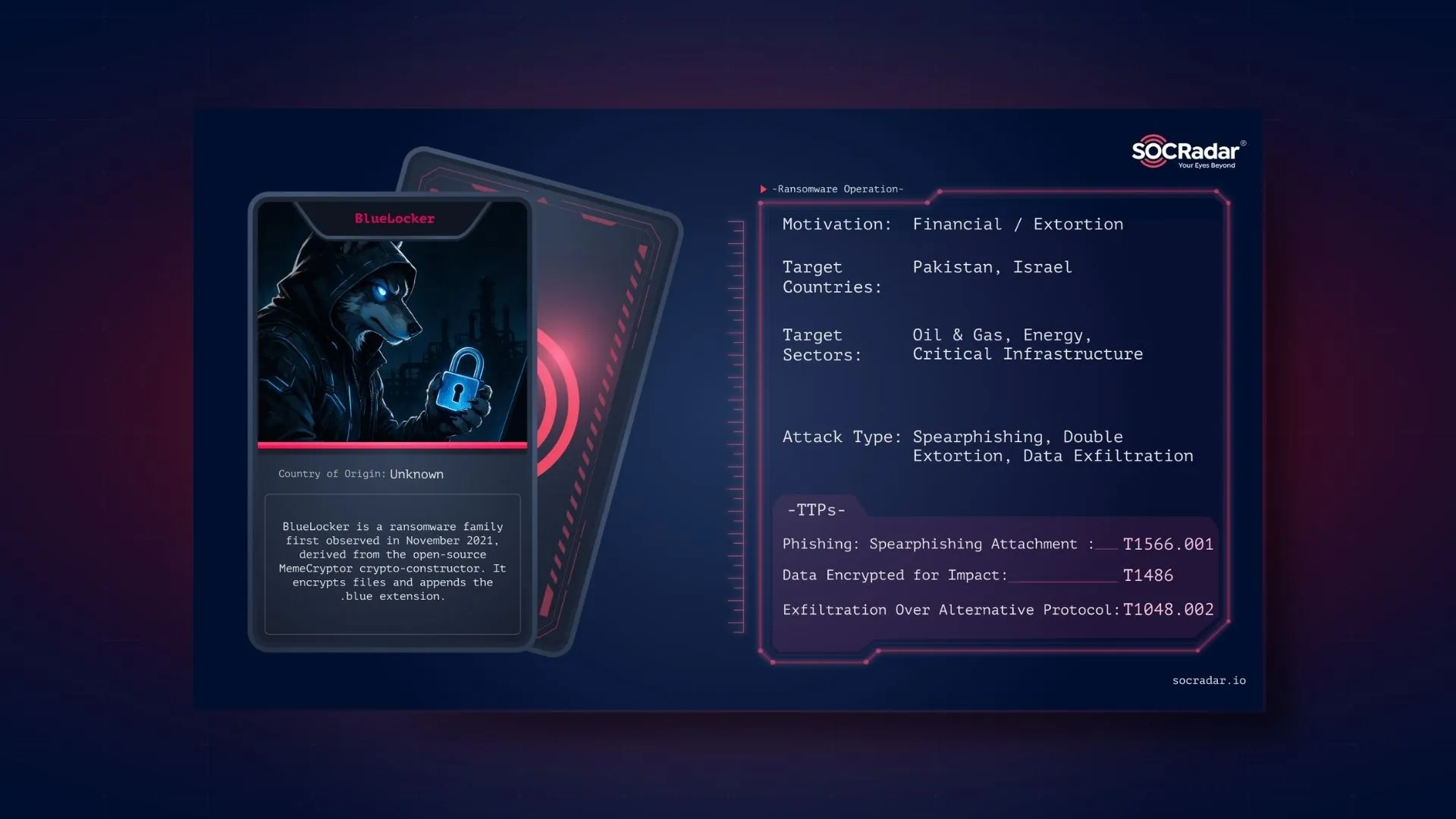
Dark Web Profile: Blue Locker Ransomware
Sep 25, 2026
ShinyHunters Claims Access to FBI Systems
Sep 24, 2026

Clop Hack: ShinyHunters Hijacks Data Leak Site
Sep 21, 2026