

| Data or service | Typical price (USD) | Notes |
|---|---|---|
| Personal record (email, phone, address) | $1 – $4 | Abundant; sold in bulk |
| Social Security number | $1 – $6 | Priced low due to oversupply |
| Payment card (US, with CVV) | $5 – $50 | Region-dependent; US cards cheapest |
| Card with high balance | ~$110 – $120 | Eroded from a ~$240 peak in 2020-2021 |
| ID, passport, or driver’s license scan | $30 – $60 | Digital scans; used to bypass verification |
| Payment account (PayPal, Revolut, etc.) | ~$100 avg | Direct-to-cash accounts priced higher |
| Bank login (low balance) | $200 – $500 | High-balance logins reach $1,000+ |
| Crypto exchange account | ~$100 – $1,000+ | Varies by exchange, verification, balance |
| Complete medical record | $250 – $310 | Highest-value personal data class |
| Social media account | $20 – $50 | Facebook the most traded; aged accounts cost more |
| Streaming account | $10 – $15 | Long tail; sold with “warranty” replacements |
| Stealer malware | from $15 | Subscriptions ~$100 – $200/month; single logs $5 – $50 |
| Phishing kit or panel | below $500 | Custom phishing pages $50 – $2,000 |
| AiTM phishing-as-a-service kit | $120 – $350/month | MFA-bypass tooling on a subscription |
| DDoS-for-hire | from $20 | Booter and stresser services |
| Zero-day exploit | $100 – $150,000+ | Priced by target, exclusivity, and impact |
| Initial corporate access | hundreds to six figures | Tiered by privilege and target revenue |
| Money-laundering service | ~2% of amount | Fee-based; scales with volume |
Jul 29, 2026
13 Mins Read

Summarize with:
Dark Web Price Index 2026: How Much Is Your Data Worth?
TL;DR: Personal records sell for $1 to $4, payment cards from $5, medical records $250 to $310, bank logins $200 to $500, and corporate network access from the low thousands into six figures. Stealer malware starts at $15 and DDoS-for-hire at $20. Cheap data marks where mass abuse is likely; expensive data marks what attackers want most.
A stolen credit card sells for less than a movie ticket. A single Social Security number goes for the price of a coffee. A corporate network foothold can clear six figures. The gap between those numbers is the most useful thing the Dark Web tells defenders, because a price is a demand signal: it shows which of your assets attackers value, how easily they can be monetized, and where the next attack is most likely to start.
This is SOCRadar’s 2026 Dark Web Price Index. Figures below come from SOCRadar’s own intelligence: the Annual Dark Web Report, built on data observed across underground forums, marketplaces, and encrypted channels throughout the year, together with SOCRadar’s continuous Dark Web research and its platform.
Key Takeaways
- Common personal data is cheap because supply has outrun demand: Personal records such as phone numbers and addresses trade for around $1 to $4, and stolen payment cards start at roughly $5. Years of mass breaches flooded the market, and prices fell accordingly.
- Access is the premium tier, and it is climbing: The retail catalog stayed flat while corporate-access prices rose. SOCRadar’s Dark Web team tracks Initial Access Brokers shifting toward larger, higher-value targets and charging premium prices for verified access, with domain and cloud admin listings at the top of the market.
- Health records are the most valuable personal data: A complete medical record commands roughly $250 to $310, nearly ten times a payment card, because it cannot be canceled or reissued the way a card can.
- The Dark Web is, above all, a marketplace: Data and database leaks make up 64.06% of Dark Web activity, and selling posts account for 59.32%.
- Low prices lower the barrier to entry: Stealer malware from $15 and DDoS services from $20 put scalable attacks within reach of low-skill actors, while high-end capability stays limited to well-funded groups.
- Treat pricing as a risk signal, not a shopping list: What is cheap tells you where mass abuse is likely; what is expensive tells you what attackers are willing to work hardest to obtain.
The 2026 Dark Web Price Index at a Glance
Source: SOCRadar Annual Dark Web Report 2025 and Annual Dark Web Report 2024, plus SOCRadar Dark Web team observations across underground marketplaces, forums, and encrypted channels. Ranges reflect observed listings and shift with data freshness, completeness, and seller reputation.
The Most Expensive Data on the Dark Web
The top of the market is dominated by assets that convert to money fast or cannot be rotated away.
Corporate network access: Initial Access Brokers, who sell pre-built footholds into corporate networks to ransomware crews, are the wholesale tier. SOCRadar’s Dark Web team sees access priced in tiers: most listings sit in the low thousands, but pricing scales with privilege and target value, and domain or cloud admin access to a large enterprise reaches well into five and six figures. RDP and VPN credentials remain the most frequently traded access types. The direction of travel is clear in SOCRadar’s monitoring: brokers are moving toward larger, higher-revenue targets and charging premium prices for access that is already verified, because a validated foothold saves a ransomware affiliate the slow, risky work of breaking in. When access to a company is listed for sale, the real attack is usually only days away.
Zero-day exploits: SOCRadar’s Annual Dark Web Report tracks a zero-day market spanning $100 at the low end to $150,000 and beyond for high-end exploits, priced by the target software, exclusivity, and blast radius.
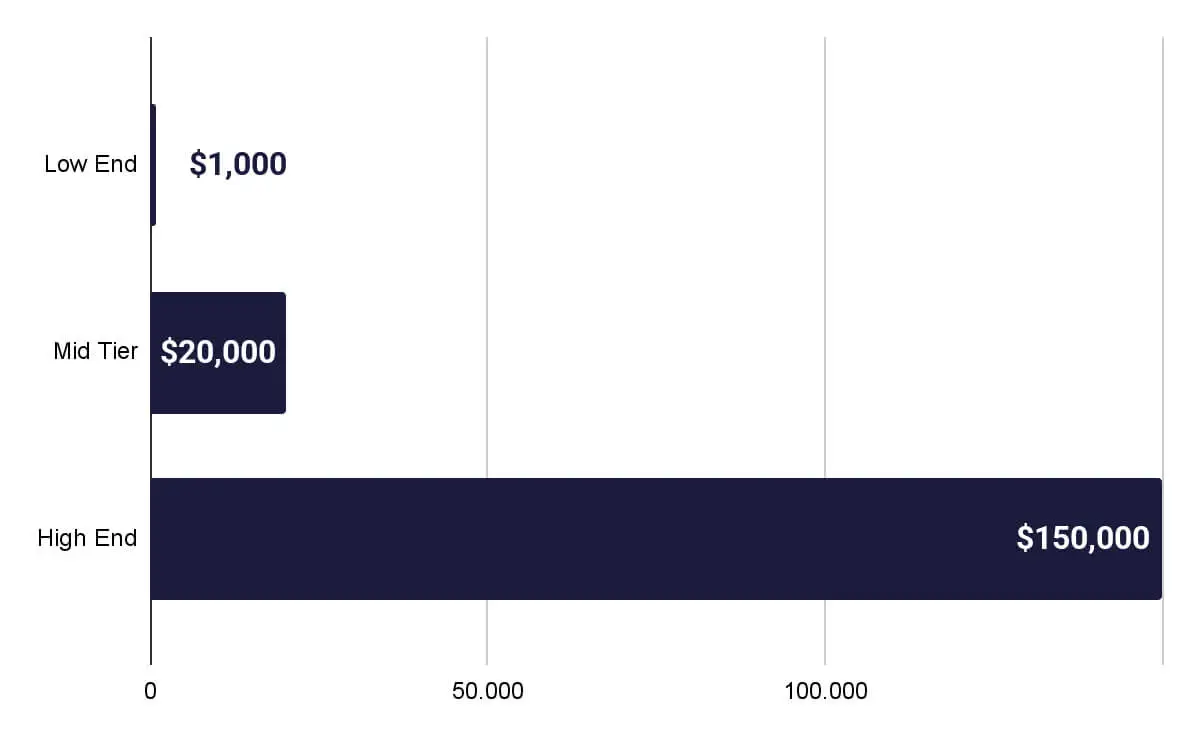
Zero-day exploit prices (SOCRadar Annual Dark Web Report)
Medical records: Health data is the most valuable personal-data class SOCRadar tracks, with a complete medical record selling for roughly $250 to $310, nearly ten times a payment card. The premium is durability: a patient cannot reissue their medical history the way a bank reissues a card, and the records fuel insurance fraud and extortion for years, which is why healthcare stays a top target in SOCRadar’s Dark Web monitoring.
Verified crypto and high-balance financial accounts: Crypto exchange logins are among the most expensive consumer accounts because they route straight to liquid funds without the laundering overhead a stolen card requires. High-balance bank logins follow the same logic, with accounts holding six figures selling for several thousand dollars.
The Commodity Floor: Cheap but Dangerous
At the other end, the cheapest data is cheap because it is everywhere, not because it is harmless.
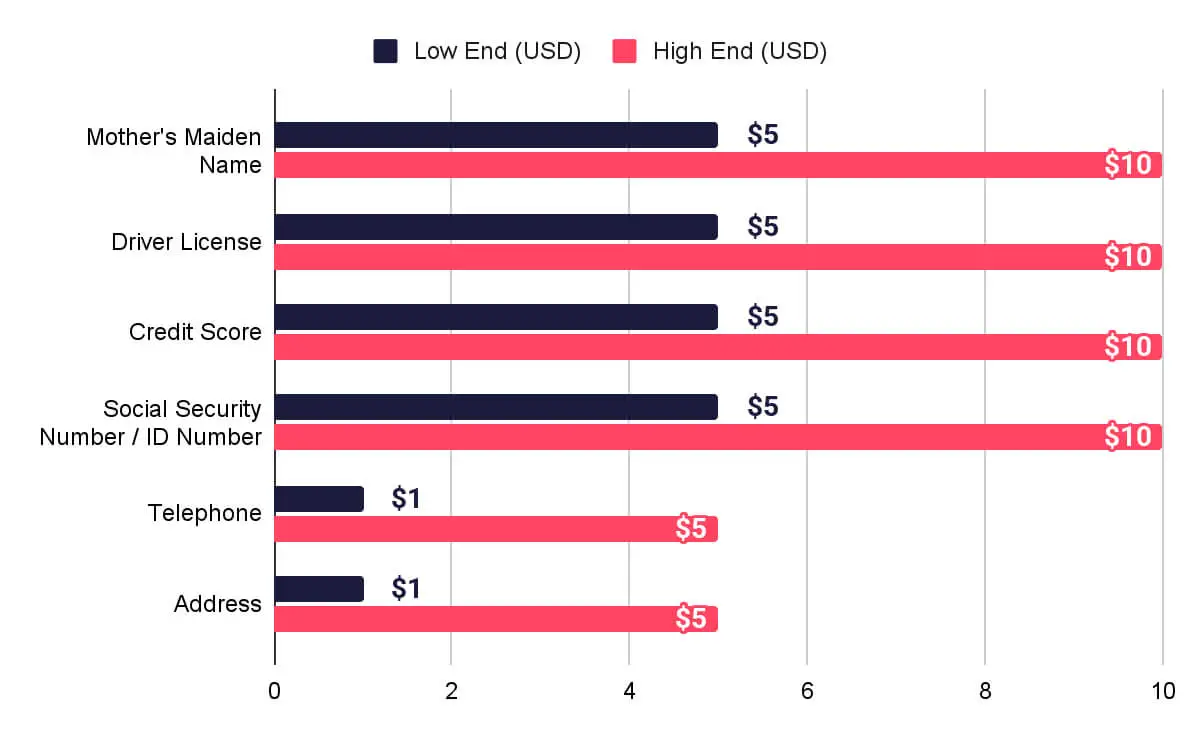
Personal Information and Documents prices (SOCRadar Annual Dark Web Report)
Personal records such as email addresses, phone numbers, and physical addresses trade for around $1 to $4 each and are sold in bulk. Payment cards start near $5. These are the raw material for phishing, credential stuffing, and social engineering, which means low price and high threat sit in the same line item. SOCRadar’s data shows stealer malware from $15 and DDoS-for-hire from $20, pricing that puts credential theft and disruption within reach of actors with no technical depth. When the entry ticket is this low, volume is the risk.
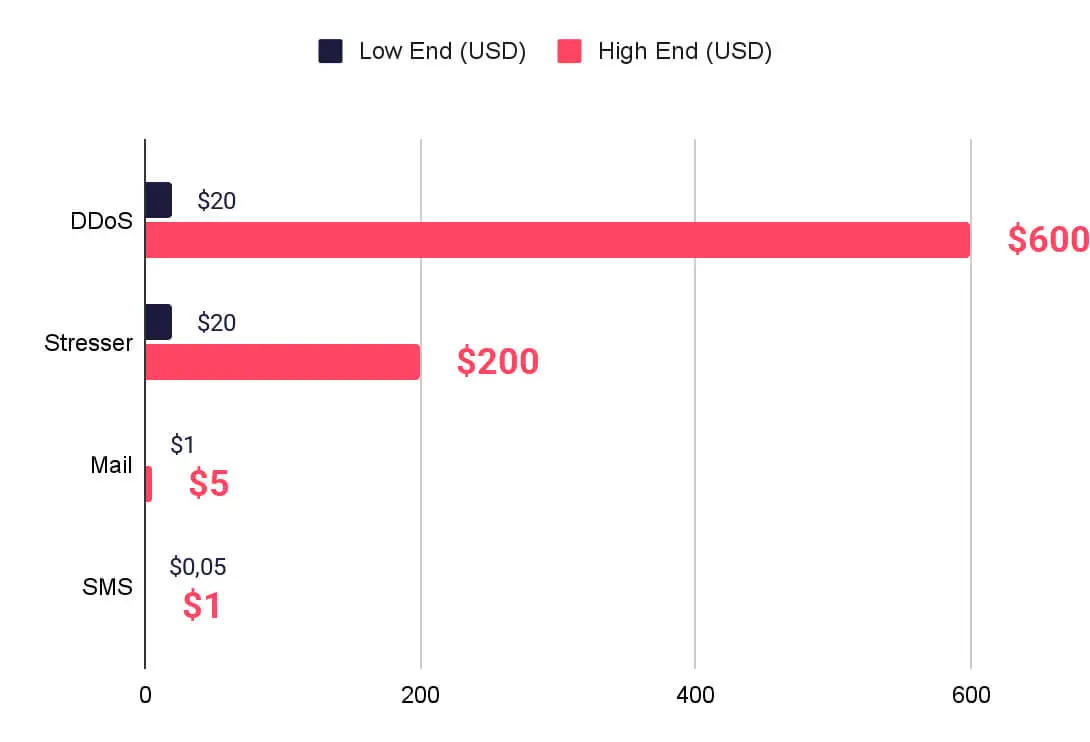
Spamming and DDoS Service prices (SOCRadar Annual Dark Web Report)
The ranking in SOCRadar’s data is consistent: standalone personal details sit at the bottom (miscellaneous personal information around $3.50, phone numbers and addresses near $2), the payment and identity tier occupies the middle, and health records and verified access sit at the top. The lesson for defenders is that market price tracks monetization potential and permanence, so the cheapest data is often the most widely abused precisely because there is so much of it.
What Actually Sets the Price
Five factors move nearly every figure in the index:
- Freshness: Recently stolen data outsells stale data. A stealer log under 48 hours old can command several times the price of an older one because its session tokens and passwords still work.
- Validity and completeness: A package with a full identity outsells a bare SSN, and a card confirmed active outsells an untested one.
- Rarity and region: US payment cards are cheap because they flood the market; cards from countries with lower supply and stricter fraud detection cost more. The US supplies the majority of card listings, which keeps its prices at the bottom of the range.
- Monetization path: Data that converts to cash with little friction, such as crypto accounts or high-balance bank logins, carries a premium over data that needs laundering.
- MFA-bypass premium: Access confirmed to defeat multi-factor authentication, typically through stolen session cookies, is worth a significant markup, which is what the adversary-in-the-middle phishing-as-a-service market monetizes at $120 to $350 per month.
How the Marketplaces Work
The underground trade runs on the same trust machinery as legitimate e-commerce, adapted for a setting with no legal recourse. Dark Web Marketplaces operate over anonymizing networks and increasingly settle in privacy-focused cryptocurrency to frustrate blockchain tracing. Escrow holds a buyer’s funds until data is confirmed, vendor reputation scores and reviews signal reliability, and vendor bonds deter fraudulent sellers. When law enforcement seizes a marketplace, the effect is redistribution rather than removal: listings resurface on other forums or private channels within weeks, and the price floor holds.
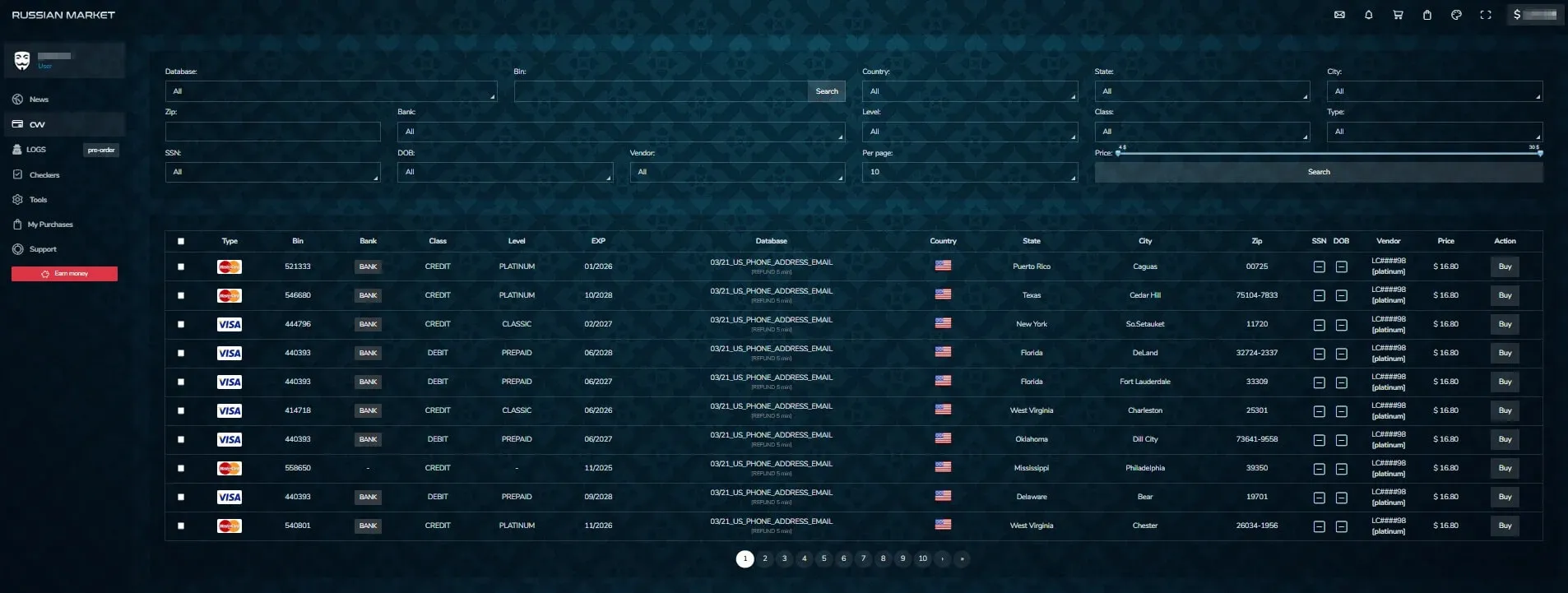
Russian Market’s CVV section, featuring a large selection of credit card data, is typically sold in bulk.
Regional and Macro Picture
Pricing is uneven across geographies, and so is exposure. SOCRadar’s Annual Dark Web Report 2025 places the United States at 19.91% of Dark Web news, 41.42% of ransomware attacks, and 66.20% of phishing activity, with Public Administration leading industry exposure at 12.85%. Country-level activity can be tracked continuously through SOCRadar’s Dark Web Index. On the supply side, data and database leaks dominate underground trade at 64.06% of all Dark Web activity, and that oversupply of stolen records is what keeps commodity-tier prices flat or falling even as access prices climb.
From Breach to Marketplace
A single stolen credential usually travels a predictable path. An infostealer lands on a victim machine, harvests saved passwords, session cookies, and tokens, and packages them into a log. That log sells cheaply, often $5 to $50, in a stealer marketplace. A broker buys it, validates any corporate credentials inside, and repackages the verified access for far more on a forum frequented by ransomware affiliates. The same raw material that cost $10 as a commodity log becomes a five- or six-figure access listing once its value is confirmed. Understanding that pipeline is what turns a price list into an early-warning system.
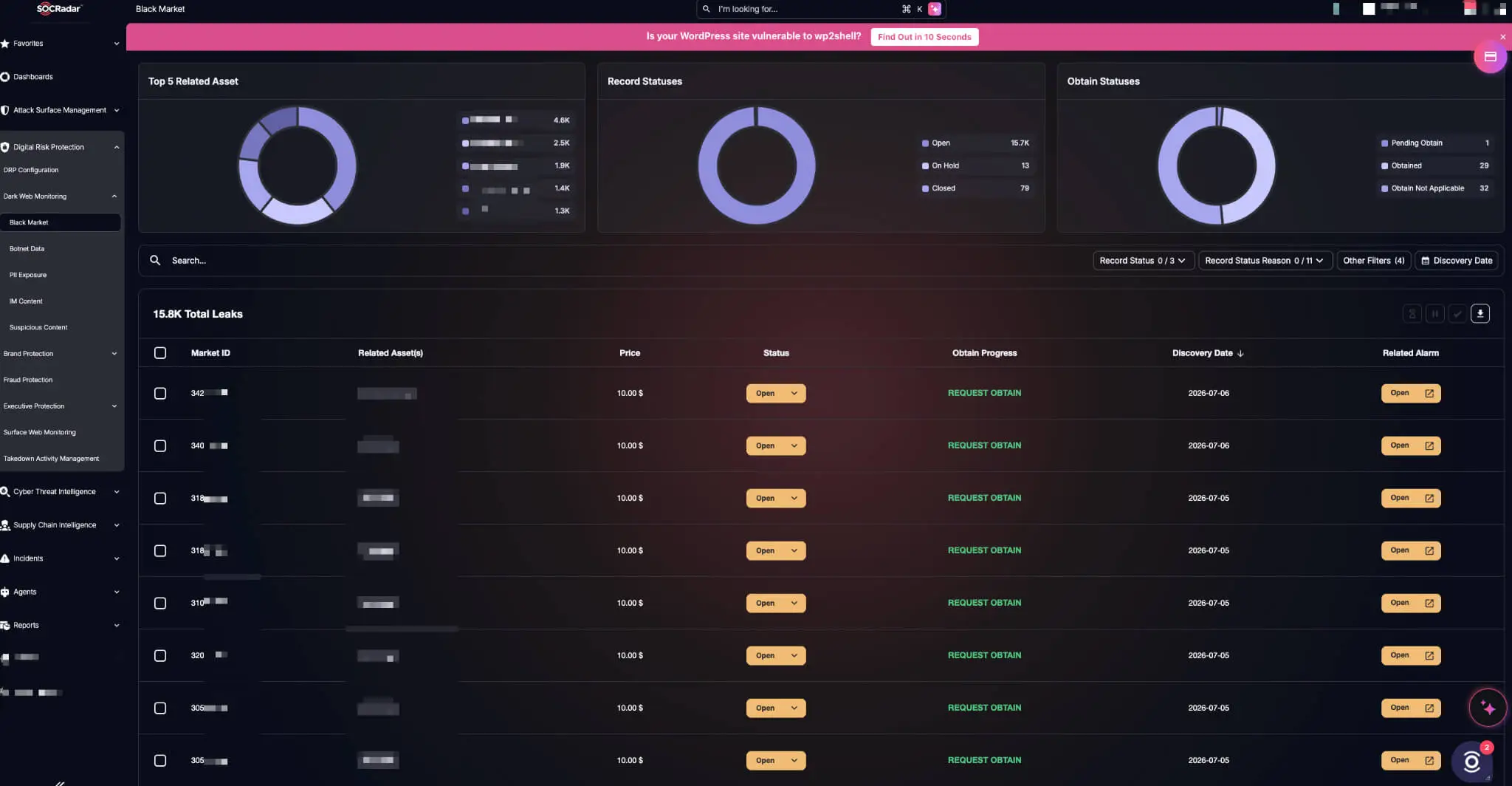
SOCRadar Black Market Monitoring
Why This Matters for Defenders
Dark Web pricing gives security teams an attacker-calibrated way to prioritize. A few implications stand out:
- Weight monitoring by data type. Health and access data deserve their own tier of scrutiny; an exposed benefits database is a different class of risk than a leaked marketing list.
- Assume the cheap data is already out there. Email addresses and reused passwords are how most intrusions begin. Low market value does not mean low volume of harm.
- Cost out an MFA-bypass test. Session-cookie theft is now a subscription product. Validate that your identity flows survive an adversary-in-the-middle attempt.
- Watch pricing as a leading indicator. A rising price for a category, or a fresh listing tied to your organization, is a signal to act before follow-on attacks land.
Organizations can check their own exposure with SOCRadar’s free Dark Web Report, which scans marketplaces, stealer-log platforms, and breach databases for leaked domains, emails, and credentials.
Frequently Asked Questions
How much does stolen data cost on the Dark Web in 2026?
Prices span a wide range by data type. Personal records trade for about $1 to $4, Social Security numbers for $1 to $6, and payment cards for roughly $5 to $50. A fullz identity package runs $20 to $100 or more, a medical record $250 to $310, and corporate network access from hundreds to six figures. Stealer malware starts at $15 and DDoS-for-hire at $20.
What is the most expensive personal data on the Dark Web?
Complete medical records, at roughly $250 to $310 each, are the most valuable personal data class. Their value comes from permanence, because a patient cannot reissue a medical history the way a bank can reissue a card, which makes the data useful for fraud and extortion over long periods.
Why are stolen credit cards so cheap?
Supply. Years of large breaches flooded the market, and US cards in particular are abundant, which pushes prices to the bottom of the range. A card also has a short monetization window, since its value drops to near zero once it is reported compromised.
How much does corporate network access cost?
Access is priced in tiers. Most Initial Access Broker listings sit in the low thousands of dollars, but pricing scales with privilege and target value: domain or cloud admin access to a large enterprise reaches well into five and six figures. SOCRadar’s Dark Web team observes brokers increasingly favoring larger, higher-revenue targets and charging a premium for verified access, with RDP and VPN the most commonly traded access types.
Where does SOCRadar’s pricing data come from?
The figures come from SOCRadar’s own intelligence: the Annual Dark Web Report 2025 and 2024, built on data observed across underground forums, marketplaces, and encrypted channels throughout the year, together with SOCRadar’s ongoing Dark Web research, stealer logs, initial access, and financial fraud. SOCRadar’s Dark Web team monitors these sources continuously, and prices are presented as ranges because they shift with data freshness, completeness, and seller reputation.
Can I remove my data from the Dark Web?
No. Once data is leaked and copied across decentralized marketplaces and channels, full removal is not possible. The practical response is damage control: rotate compromised passwords, enable phishing-resistant MFA, invalidate active sessions, and monitor for new listings tied to your identity or organization.
Methodology and Sources
This index is built entirely on SOCRadar’s own intelligence. The primary source is SOCRadar’s Annual Dark Web Report 2025, which combines threat-activity data with market-level pricing intelligence observed across underground forums, marketplaces, and encrypted channels throughout the year. It is supported by SOCRadar’s Annual Dark Web Report 2024 for social media and personal-data pricing, and by SOCRadar’s continuous Dark Web research on dumps, stealer logs and stealer malware, Initial Access Brokers, and financial fraud. All prices are ranges rather than fixed rates and move with data freshness, validity, completeness, account balance, and seller reputation. SOCRadar’s Dark Web team monitors underground marketplaces, stealer-log platforms, and breach databases in real time; organizations can check their own exposure with the free SOCRadar Dark Web Report.

Table Of Content
Dark Web Price Index 2026: How Much Is Your Data Worth?
Key Takeaways
The 2026 Dark Web Price Index at a Glance
The Most Expensive Data on the Dark Web
The Commodity Floor: Cheap but Dangerous
What Actually Sets the Price
How the Marketplaces Work
Regional and Macro Picture
From Breach to Marketplace
Why This Matters for Defenders
Frequently Asked Questions
Methodology and Sources
Related Articles
Dark Web Profile: Blue Locker Ransomware
Sep 25, 2026
ShinyHunters Claims Access to FBI Systems
Sep 24, 2026
Clop Hack: ShinyHunters Hijacks Data Leak Site
Sep 21, 2026