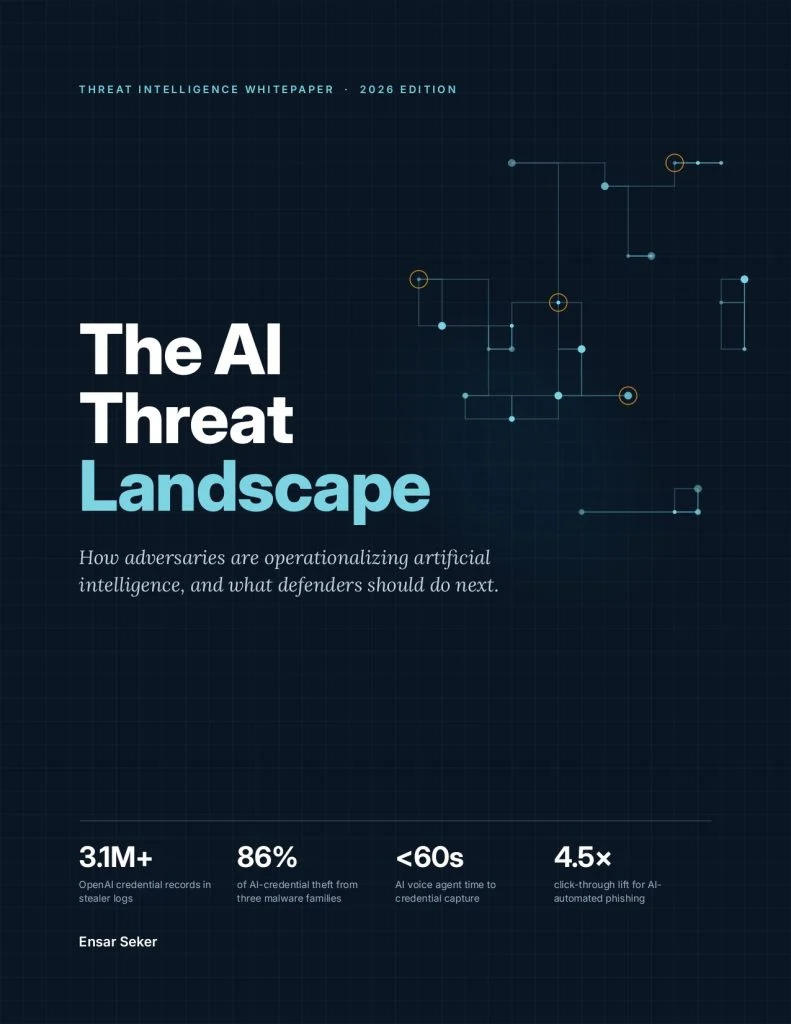
Welcome to The AI Threat Landscape 2026!
Explore how artificial intelligence is reshaping cybercrime with The AI Threat Landscape 2026, a threat intelligence white paper by Ensar Seker. This research examines how threat actors use AI-powered phishing, voice cloning, deepfake identity fraud, autonomous agents, and underground AI tools to accelerate cyberattacks. Drawing on Dark Web monitoring, criminal AI tool testing, and the analysis of more than 3.1 million AI-account credential records, the report reveals how AI is reducing the time, expertise, and resources required to conduct attacks at scale.
Download the full report today to understand how adversaries are operationalizing AI, identify emerging risks to enterprise systems and identities, and strengthen your organization’s defenses against AI-augmented threats.
Fill in your details to access the complete intelligence brief.
Thank you. Your download is ready.
Download PDFKey Insights from the AI Threat Landscape
- AI Is Accelerating Existing Cyber Threats: Artificial intelligence reduces the time, technical expertise, and resources needed to conduct phishing, fraud, malware development, and other cyberattacks at scale.
- AI Credentials Are Exposed at Massive Scale: More than 3.1 million OpenAI credential records linked to over 1.3 million unique victims were identified in commodity infostealer datasets.
- Three Malware Families Dominate AI Credential Theft: Lumma/LummaC2, RedLine, and StealC account for approximately 86% of observed AI-account credential exposure.
- AI-Powered Phishing Significantly Increases Engagement: Research cited in the report shows AI-automated phishing achieving a 54% click-through rate compared with 12% for traditional phishing, a 4.5-fold increase.
- AI Voice Agents Accelerate Credential Theft: Documented AI-driven vishing sessions demonstrated credential capture in under 60 seconds, while automated platforms support multilingual conversations and real-time social engineering.
- Deepfake Technology Challenges Identity Verification: Underground platforms combine real-time face swapping, voice manipulation, and virtual camera technology to target Know Your Customer (KYC) and liveness verification systems.
- AI-Powered Cybercrime Is Becoming Industrialized: Criminal platforms increasingly combine phishing kits, voice cloning, identity fraud tools, and automated workflows into subscription-based services.
- Underground AI Tools Often Underperform Their Claims: Testing of WormGPT and other uncensored models shows that many provide limited technical advantages, although they can make offensive capabilities more accessible to inexperienced attackers.
- Prompt Injection Creates New Enterprise Risks: AI applications connected to untrusted documents, emails, plugins, and external tools can be manipulated into following malicious instructions or exposing sensitive information.
- Autonomous AI Agents Expand the Attack Surface: Agents with access to private data, external communications, and enterprise tools introduce risks involving unauthorized actions, supply chain compromise, and excessive inference costs.
Why This Report Matters
The AI threat landscape is changing how cybercriminals operate. Rather than introducing entirely new attack categories, AI is making existing techniques faster, cheaper, and easier to scale. Phishing campaigns can be personalized automatically, voice agents can conduct convincing fraud attempts, and deepfake technology can challenge traditional identity verification. Meanwhile, the growing exposure of AI service credentials creates additional opportunities for attackers to compromise developer environments and connected enterprise systems.
Organizations must also address the risks introduced by their own AI adoption. Prompt injection, insecure integrations, exposed API keys, autonomous agents, and AI supply chain vulnerabilities create security challenges that traditional controls may not fully address. Defending against these threats requires stronger identity governance, continuous monitoring, and security measures that operate independently of AI model guardrails.
For security leaders, developers, fraud prevention teams, and organizations adopting AI, understanding these changes is essential to building effective defenses and maintaining resilience as AI-enabled cybercrime continues to evolve.
Take Action Now
- Dark Web Monitoring: Detect exposed AI credentials, stolen API keys, infostealer activity, and underground AI tools targeting enterprise environments.
- AI Identity Security: Protect AI service accounts, enforce strong authentication, monitor developer credentials, and secure access to connected platforms.
- Phishing & Vishing Defense: Strengthen detection of AI-generated phishing, deepfake impersonation, and automated voice fraud through phishing-resistant authentication and independent verification.
- AI Agent & Application Security: Restrict agent permissions, monitor tool interactions, defend against prompt injection, and require human approval for sensitive actions.
- AI Supply Chain & Risk Monitoring: Assess AI models, plugins, MCP servers, and third-party integrations while monitoring unusual agent behavior and inference costs.
Experience the power of comprehensive
cybersecurity firsthand.
See SOCRadar in Action. Join 30,000+ security professionals who trust SOCRadar to protect their organizations.