

Mar 10, 2026
May 14, 2026
5 Mins Read
Sep 13, 2026
Table Of Content
Related Articles

SMS Bombing

Threat Actors
Jan 08, 2026
Dark Web Monitoring
Feb 19, 2026

Ransomware
Jan 31, 2026
OSINT Framework
Apr 17, 2026

What Is Enumeration in Cybersecurity?
Enumeration in cybersecurity is the active collection of detailed information from systems, services, identities, applications, or cloud environments. An operator sends queries and analyzes responses to identify users, groups, hosts, shares, domains, software, permissions, or other resources that can support an attack or an authorized assessment.
Enumeration usually follows broad discovery and precedes exploitation or lateral movement. The same techniques are used by administrators, penetration testers, vulnerability scanners, and attackers, so intent must be assessed through authorization, source, timing, volume, and subsequent behavior.
Key Takeaways
- Enumeration turns a general attack surface into a detailed map of reachable identities, services, and trust paths.
- Network, DNS, directory, application, API, and cloud enumeration require different telemetry.
- Legitimate administration can resemble hostile discovery, making context and baselines essential.
- Reducing exposed detail and unnecessary access limits what an attacker can learn and use.
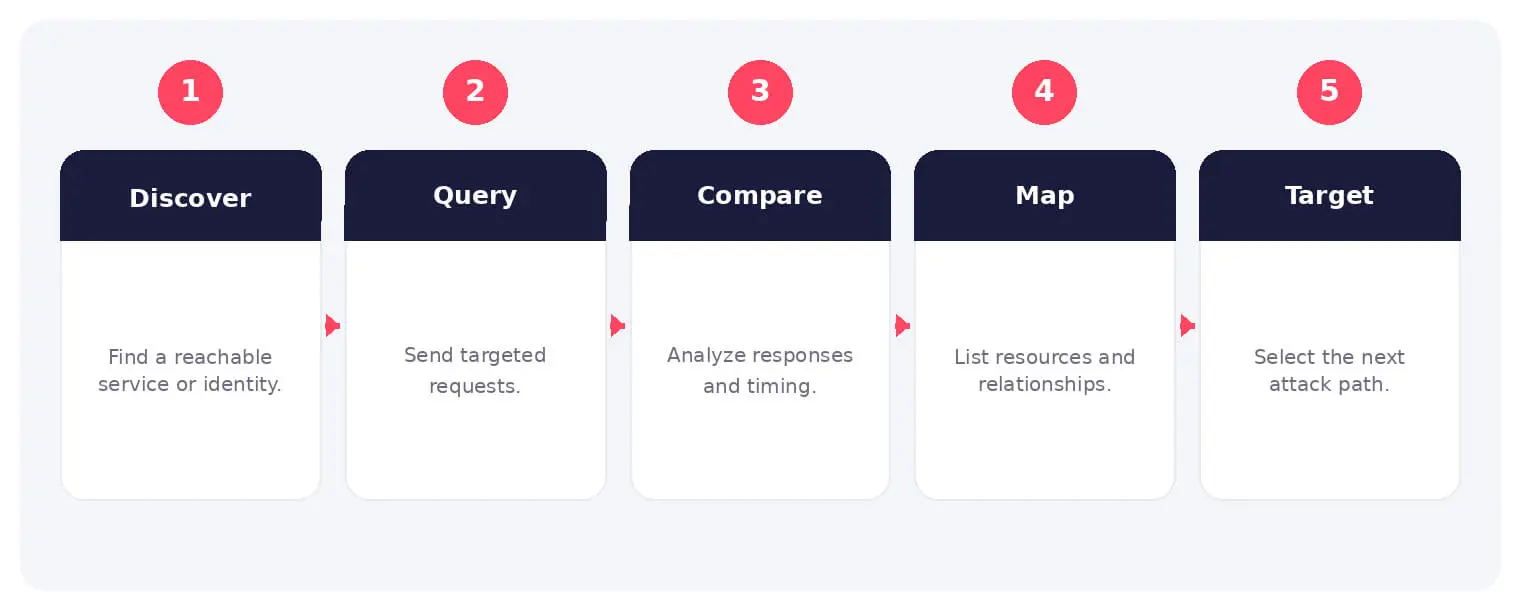
How Enumeration in Cybersecurity Works
An operator probes a protocol or application with valid, malformed, or repeated requests. Differences in status codes, timing, error messages, banners, directory responses, and access decisions reveal which resources exist.
After initial compromise, directory and cloud queries can expose privileged groups, service accounts, shared storage, applications, roles, and reachable systems. Attackers use this map to choose escalation and lateral-movement paths.
Common Types and Techniques
- Network, port, service, and protocol enumeration
- DNS, domain, email, and username enumeration
- SMB, SNMP, LDAP, and Active Directory enumeration
- Application, API, container, and cloud-resource enumeration
Security and Business Risks
- Disclosure of valid accounts and authentication targets
- Identification of vulnerable services and legacy systems
- Mapping of privileged roles, shares, and trust relationships
- Faster privilege escalation and lateral movement
Warning Signs and Detection
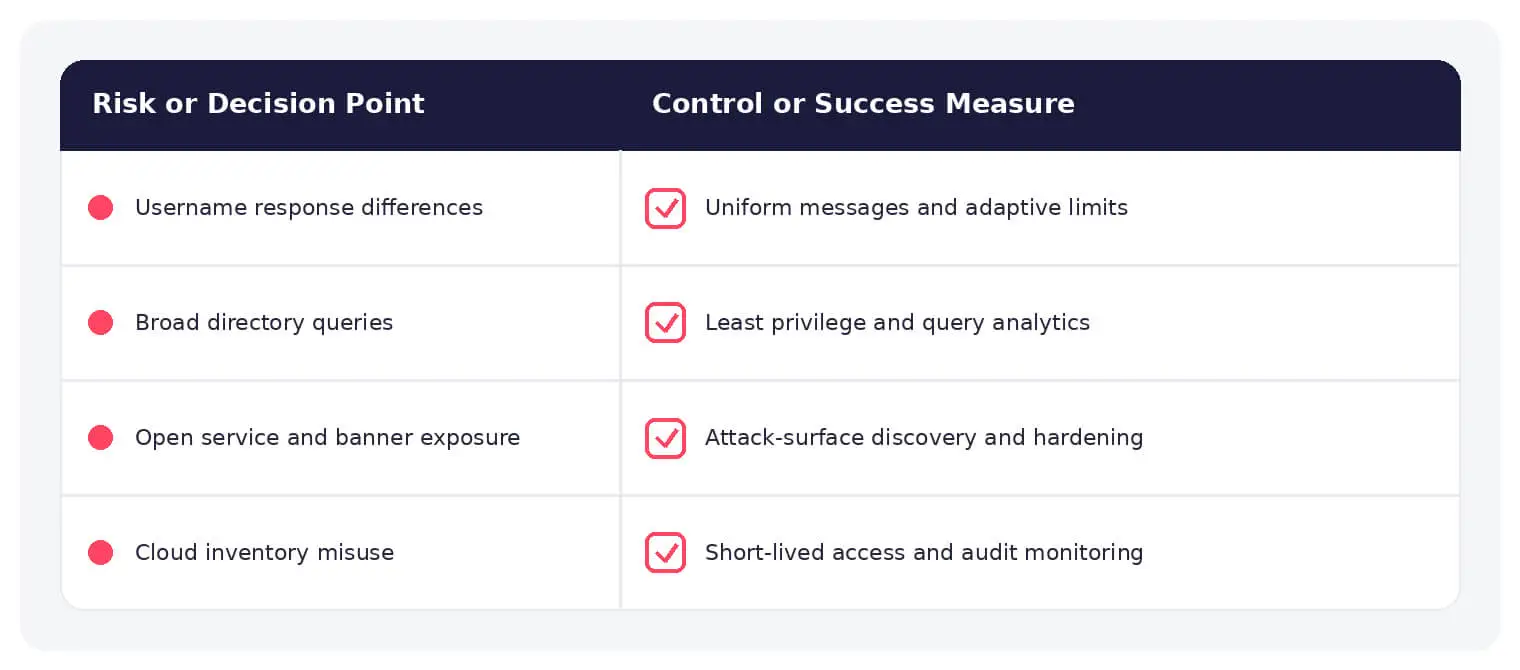
Monitor high-rate or sequential queries, repeated differences in login or recovery responses, unusual directory searches, broad share access, service discovery, cloud inventory calls, and reconnaissance from new sources. Correlate enumeration with later authentication or execution.
Prevention and Response
Minimize service exposure, disable unused protocols, restrict directory and management queries, normalize authentication responses, remove verbose errors and banners, segment networks, apply least privilege, and rate-limit public endpoints without blocking legitimate operations.
How SOCRadar Can Help
SOCRadar combines external asset visibility, threat intelligence, Dark Web monitoring, vulnerability context, and indicator enrichment to help teams identify exposure and investigate activity connected to enumeration in cybersecurity.
Explore SOCRadar Attack Surface Management or request a demo to strengthen threat-informed prevention and investigation.
Frequently Asked Questions
What Is Enumeration in Cybersecurity?
Enumeration is the active extraction of detailed information from systems, services, identities, applications, or cloud resources. An operator sends targeted queries and studies responses, such as status codes, error messages, banners, and access decisions, to map users, groups, hosts, shares, domains, and roles. It typically follows broad discovery and precedes exploitation or lateral movement.
Which Protocols Are Most Often Used for Enumeration?
Frequently abused protocols include SMB for shares and users, SNMP for device inventory, LDAP for directory objects, DNS for records and zone data, and cloud APIs for resource listings. Application endpoints and APIs also leak detail through differences in responses. Each protocol produces distinct telemetry, so detection coverage needs to span several sources.
What Makes Username Enumeration Valuable to Attackers?
A confirmed username is a validated authentication target. Attackers feed these names into password spraying, credential stuffing, phishing, and account recovery abuse. Normalizing login and password-reset responses, applying rate limits, and requiring MFA reduce how much an enumerator can confirm.
How Does Enumeration Support Privilege Escalation and Lateral Movement?
Directory and cloud queries reveal privileged groups, service accounts, roles, shared storage, and reachable hosts. That map shows an intruder where credentials are likely to work and which paths lead toward sensitive data. Without it, attackers must probe blindly, which is slower and generates more noise.
How Is Enumeration Different From Scanning?
Scanning answers whether a host, port, or service is reachable. Enumeration goes further by interacting with a discovered target to extract specifics such as account names, share lists, software versions, or permission settings. The two overlap in practice, since an aggressive scan can return enumeration-level detail.
What Warning Signs Indicate Enumeration in Progress?
Watch for high-rate or sequential queries, such as LDAP searches across many objects, SNMP walks, or scripted login attempts with uniform timing. Other indicators include repeated differences in error or recovery responses, broad share browsing, and cloud inventory calls from unfamiliar sources. A single source touching many distinct resources in a short window deserves review.
Which Log Sources Help Detect Enumeration?
High-value sources include authentication logs, directory service events, DNS query logs, firewall and proxy records, API gateway logs, cloud audit trails, and file-share audit data. Endpoint and application logs add context on what was queried and by which process. Correlating query breadth and sequence across sources is more reliable than judging any single log in isolation.
How Should a Team Respond to Suspected Enumeration?
First check whether the source is an authorized scanner or administrator, since legitimate tools resemble hostile discovery. If the activity is unauthorized, block or rate-limit the source, review the queried accounts and resources for follow-on access, rotate credentials where exposure is likely, and increase monitoring on privileged groups and share access.
What Preventive Controls Limit Enumeration Exposure?
Reduce exposed detail at the source by disabling unused protocols, restricting anonymous queries, removing verbose errors and banners, and normalizing authentication responses. Network segmentation, least privilege, and rate limits on public endpoints shrink what a single query can return. Directory and management interfaces should be reachable only from trusted administration paths. SOCRadar’s attack surface management can show which internet-facing assets and services are exposed, clarifying what an outside enumerator could discover.
Can Enumeration Be Legitimate?
Yes. Administrators, asset inventory tools, vulnerability scanners, and authorized penetration testers enumerate systems routinely. Intent is judged from authorization, source, timing, volume, and what follows; approved activity generally matches known tools and schedules, while hostile enumeration often precedes unusual authentication or execution.