Why Was Telegram Removed From the App Store?
[Update] August 5, 2026: Durov Claims “Takedown Extortionist” Triggered App Store Removal
Telegram briefly disappeared from the App Store worldwide on Monday night – no warning, no explanation, and no way for new users to download it. Why did it disappear? Is it back now, and how does this connect to the legal trouble already piling up around Telegram’s founder elsewhere?
Here is what actually happened, what each side said, and why a few hours of downtime became a much bigger conversation.
What Happened to Telegram?
Telegram quietly disappeared from Apple’s mobile app marketplace, App Store, worldwide on the night of August 3, 2026. Existing users kept full access; only new downloads stopped working. Hours later, Apple confirmed that a routine App Store review had flagged content breaching its rules against child sexual abuse material (CSAM), and that the listing came back once Telegram deleted the material and permanently banned whoever had shared it.
The removal came just hours after the X post below went viral, which led some online to speculate the two events were connected. They weren’t; Apple and Telegram have each pointed to the CSAM review, not the GTA 6 and Epstein files joke, as the actual trigger.

Telegram’s post hours before the app briefly vanished (X)
Apple previously pulled Telegram for similar reasons in 2018, and the app has frequently clashed with regulators in Brazil and China over its moderation policies. However, the platform’s challenges extend far beyond content reviews and app store compliance.
While it serves as a mainstream chat app for roughly a billion users, Telegram is also one of the most active cybercrime hangouts. Ransomware crews, hacktivists, and data brokers who once relied on Dark Web forums now trade leaked databases and stolen credentials in plain sight. Because joining those channels directly carries real risk for analysts, threat intelligence teams increasingly monitor Telegram from a distance instead.
Is Telegram Back on the App Store Now?
Yes. The app was restored to the App Store the same night. Telegram marked the moment with a post riffing on the old saying about reports of one’s death being greatly exaggerated, and adding an apple emoji.

Telegram’s response once the app reappeared on App Store (X)
What Has Telegram Said About the Takedown?
Telegram pushed back hard on the framing. In a press statement, the company said the whole thing came down to one user who was banned right away, and pointed to its own numbers: Telegram’s safety page puts 2026’s CSAM-related takedowns at over 337,900 groups and channels, with another 29,640 removed in 2025.
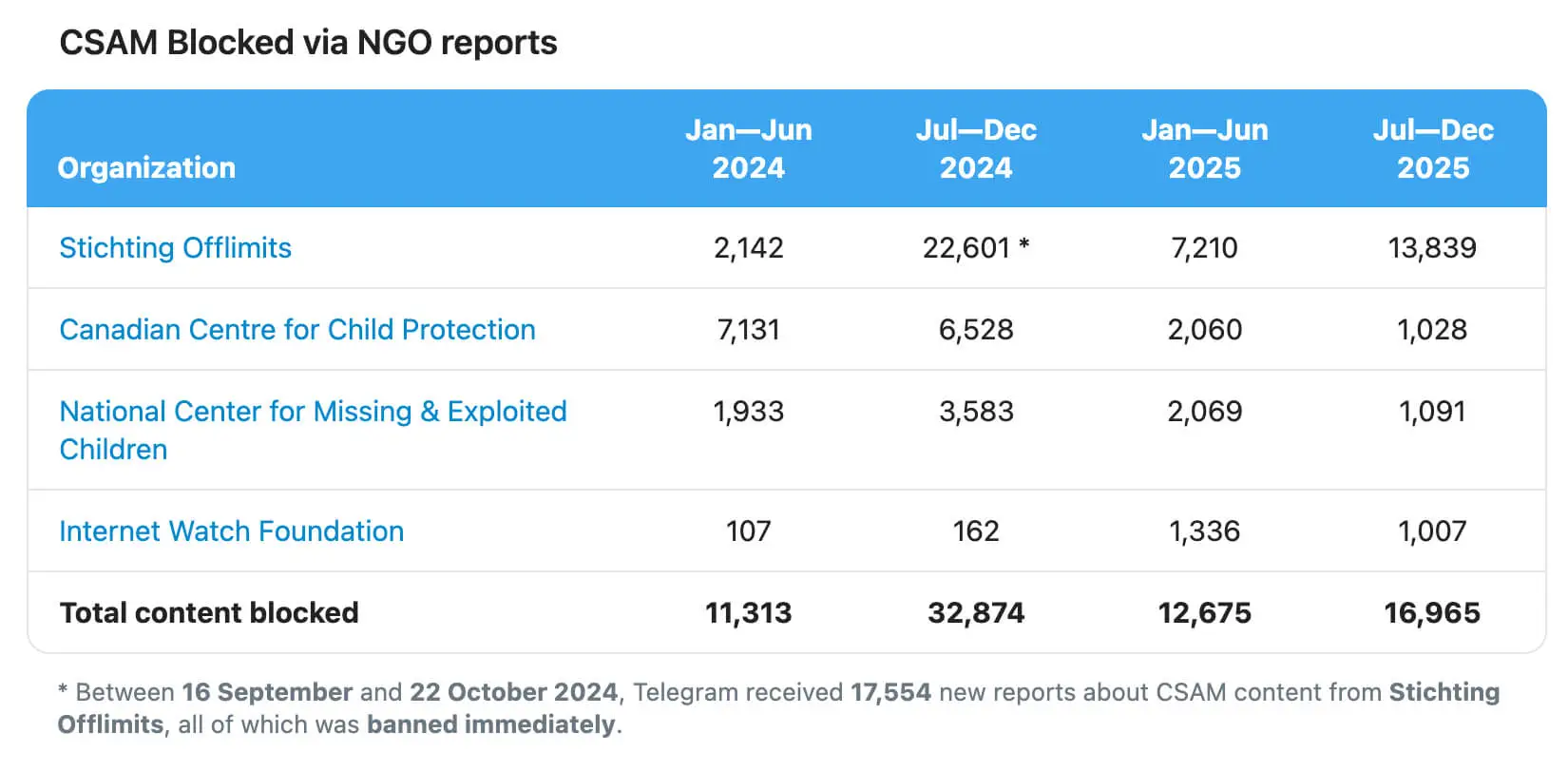
Telegram’s official safety page, showing CSAM blocked after NGO reports
The company also went after Apple directly on X, tagging its account and asking, pointedly, whether Apple would hold every other app in the Store to that same standard going forward.
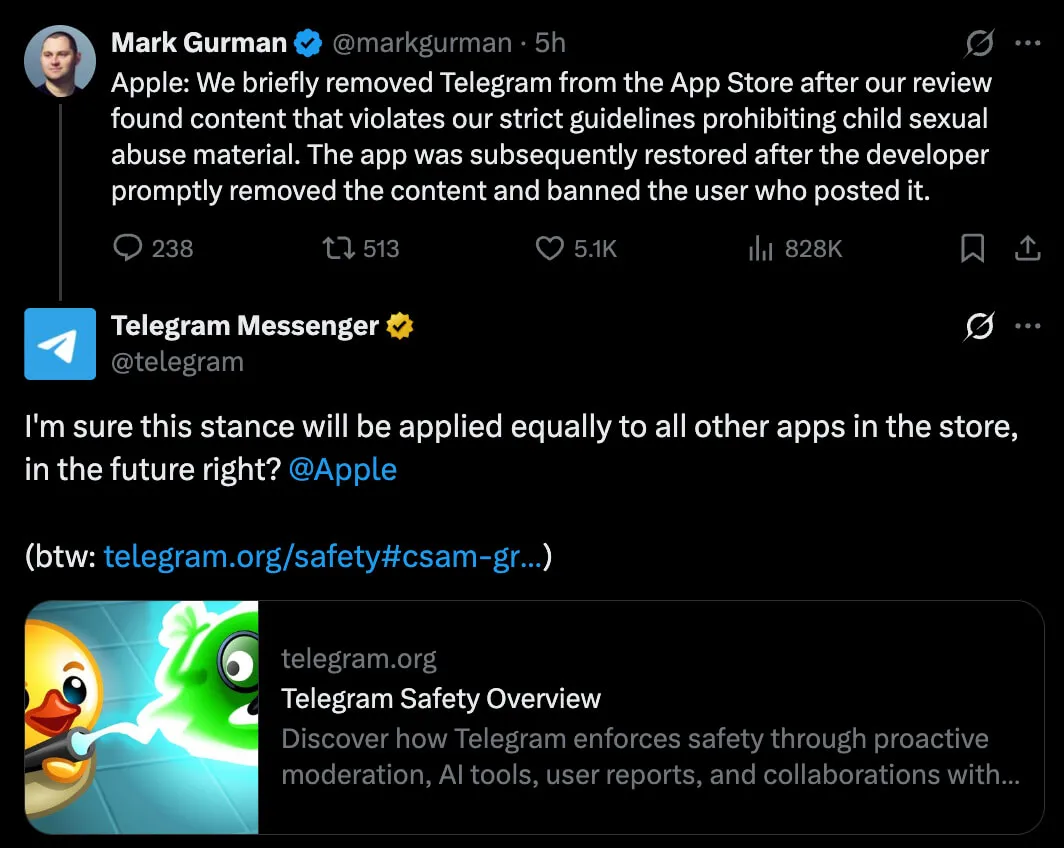
Telegram’s post tagging Apple (X)
Durov Claims “Takedown Extortionist” Triggered App Store Removal
Telegram founder Pavel Durov has since published a more detailed account of the incident, claiming Apple briefly removed Telegram after an attacker “planted illegal porn in a public chat.” According to Durov, Telegram was restored within hours, but he said the episode highlights a growing risk for apps that host user-generated content.
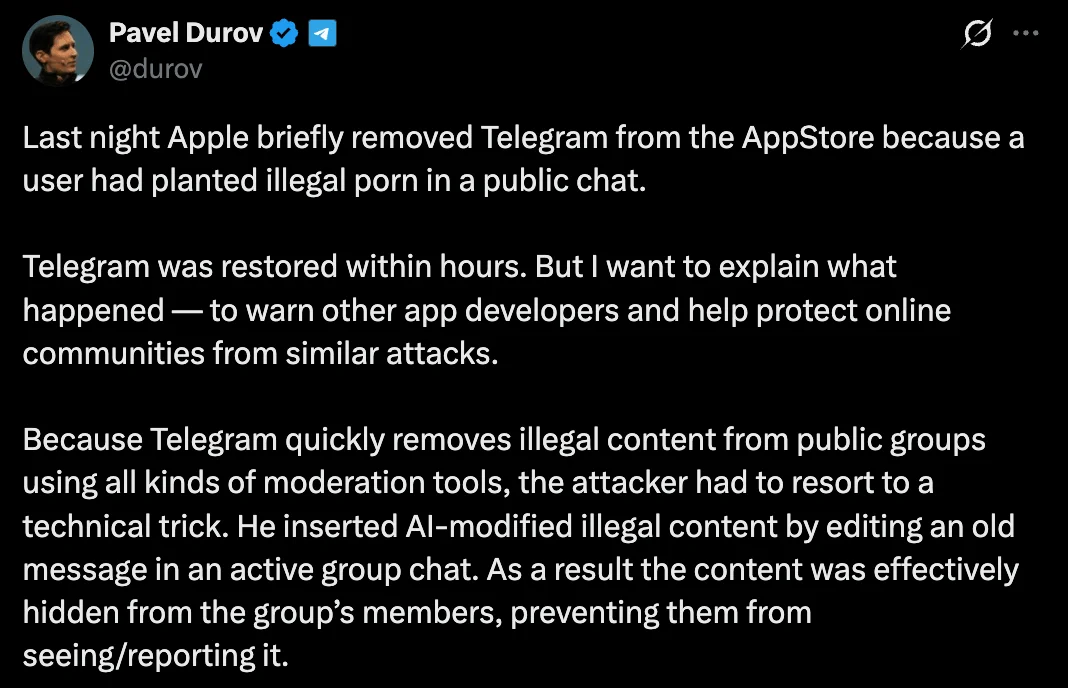
Durov’s statement on Telegram’s removal. Read the full post on X
Durov alleged the actor used a “technical trick” by editing an old message in an active public group to insert AI-modified illegal content. He claimed this made the content effectively hidden from group members, reducing the likelihood of user reporting, while the attacker reported it directly to Apple.
He further alleged the attacker was a “takedown extortionist” who demands payment from group owners to avoid targeting their communities. Durov claimed such actors use automated accounts to plant illegal content in public groups and then attempt to trigger platform or app store enforcement when owners refuse to pay.
Durov also criticized Apple’s process, alleging Telegram was removed before Apple contacted the company, and warned that similar tactics could be used against other major apps.
What Other Legal Trouble Is Telegram Facing Right Now?
This wasn’t Telegram’s only headache this week. Russia moved first: on July 29, the Federal Security Service (FSB) filed terrorism related charges against founder Pavel Durov and added him to an international wanted list, arguing the company had let channels and bots tied to a Ukrainian recruitment scheme keep running. Telegram’s only visible reaction was an image of its founder holding up his middle finger, shared on X without any caption – a separate matter from the ongoing French probe into Telegram’s moderation that’s trailed Durov since 2024. We have covered the Russia charges, and what they mean for Telegram’s cybercrime problem, in more detail here: “Russia Charges Pavel Durov: What It Means for Cybercrime.”
A day later, Australia’s eSafety Commissioner opened its own front, taking Telegram to federal court over claims that flagged clips tied to the Christchurch and Buffalo attacks stayed live for weeks before coming down. The regulator is seeking a penalty of up to A$54.6 million; Telegram denies wrongdoing, countering that it has taken down upwards of 150,000 channels this year over alleged terrorism links..
Conclusion
In a single week, Telegram has been charged with aiding terrorism by Russian authorities, sued by an Australian regulator over extremist content, and briefly pulled from the App Store worldwide. Three different complaints, one company at the center of all of them. The App Store episode is already behind it, but the other two disputes are only just beginning, and whether Russian or Australian authorities can ultimately prevail in their cases remains to be seen. For updates as this develops, keep an eye on SOCRadar’s blog.