

Sep 28, 2026
Table Of Content
How Security Teams Track Threat Actor Activity on Telegram Without Joining Risky Channels
How Threat Actors Use Telegram as a Dark Web Operations Hub
The Hidden Risks of Joining Threat Actor Telegram Channels
Passive Telegram Monitoring and Integrated Threat Intelligence
Enrichment Through Identity and Behavioral Correlation
Best Practices and Practical Tips
Related Articles

Jan 23, 2026
11 Mins Read
Aug 19, 2026

Summarize with:
How Security Teams Track Threat Actor Activity on Telegram Without Joining Risky Channels
Over the past decade, the cybercrime ecosystem has undergone a clear migration. What once operated mainly through slow, fragmented TOR-based forums has steadily shifted to fast, encrypted, publicly accessible platforms like Telegram. This shift has turned Telegram into a gray zone where ransomware groups, hacktivists, initial access brokers, and data leak traders operate side by side, often in plain sight.
Telegram’s evolution has extended beyond messaging, including its earlier plans for the GRAM cryptocurrency
For security teams, this visibility creates a paradox. Threat actor activity is easier to observe than ever, yet tracking it has become more operationally risky. Channels appear and disappear without warning, actors constantly rebrand or split into new aliases, and a single campaign may unfold across dozens of groups at once. High message volume, reposting, and informal coordination make it difficult to separate meaningful signals from background noise.
Manual monitoring introduces additional risks. Joining channels directly exposes analysts to untrusted content, social engineering attempts, and platform-level weaknesses that can undermine operational security. At the same time, keeping up with the scale and pace of Telegram activity is no longer feasible through ad hoc workflows or individual researcher accounts.
This raises a critical question for modern security operations: how can teams track threat actor activity on Telegram without directly engaging with risky channels, while still maintaining continuity, context, and analytical depth? Answering this requires moving beyond manual observation toward passive, infrastructure-level monitoring and intelligence-driven correlation.

How Threat Actors Use Telegram as a Dark Web Operations Hub
Telegram functions as a multi-purpose operational layer for threat actors, where coordination, monetization, and signaling occur simultaneously. Different actor types rely on the platform in predictable but fast-moving ways.
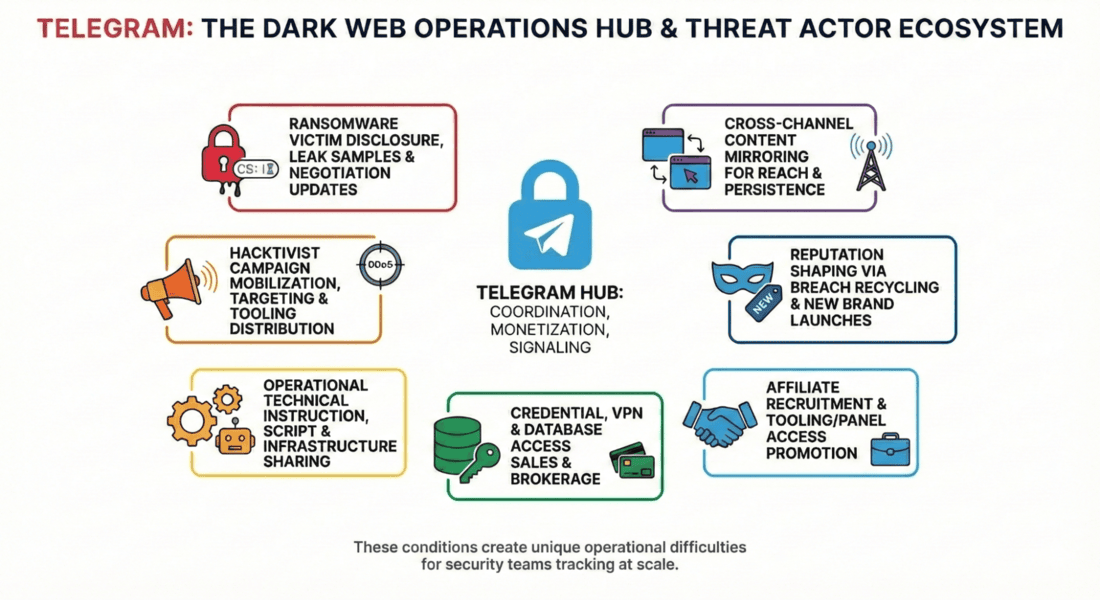
Telegram has become a central hub for coordination, distribution, and monetization across ransomware operations, hacktivist campaigns, and the underground economy.
- Victim disclosure and extortion signaling: Ransomware groups publish victim names, leak samples, countdowns, and negotiation updates to apply public pressure.
- Hacktivist coordination and campaign mobilization: Hacktivist collectives use Telegram to announce targets, distribute DDoS tooling, publish hit lists, and coordinate time-based operations in real time.
- Operational coordination and task distribution: Groups share technical instructions, scripts, and infrastructure details, often supported by bots to automate participation.
- Data sales and access brokerage: Initial access brokers advertise credentials, VPN access, stealer logs, and database samples through dedicated channels.
- Affiliate recruitment and service advertising: Ransomware and extortion operations promote affiliate programs, revenue splits, and tooling or panel access.
- Reputation shaping and rebranding: Actors recycle old breaches, repost leaked data, or launch new brands to appear active and credible.
- Cross-channel amplification: The same content is mirrored across multiple channels and groups to increase reach and persistence.
All of this activity takes place in an environment defined by high volume, rapid change, and limited visibility. Channels are unstable, identities shift, and meaningful signals are buried in constant noise. At the same time, even passive observation introduces OpSec exposure. These conditions make Telegram monitoring uniquely challenging and lead directly into the operational difficulties security teams face when tracking it at scale.
The Hidden Risks of Joining Threat Actor Telegram Channels
Telegram is often assumed to be safe for observation, especially when analysts believe they are only consuming public content. In reality, even limited interaction with threat actor channels introduces operational and privacy risks that are easy to overlook.
Telegram’s public channels and groups expose user-level signals such as usernames, interaction patterns, and shared memberships. These signals can be correlated using open-source techniques, especially when identifiers are reused across platforms. Even without posting, analysts may leave observable traces that enable profiling over time.
Passive observation is not inherently safe. Simply opening a link, triggering a media preview, or interacting with Telegram bots can expose analysts to tracking mechanisms, infrastructure fingerprinting, or direct IP disclosure. This includes one-click IP leak scenarios, where proxy links or crafted invitations silently force a network request without explicit user intent. In adversarial channels, such content is often designed specifically to identify observers rather than engage participants.
Beyond exposure, manual monitoring is difficult to sustain. Channels frequently disappear or rebrand, actors fragment into new groups, and activity spreads across multiple interconnected channels. This volatility increases analyst risk while making consistent tracking and attribution harder.
For security teams, the challenge is not visibility alone. It is preserving anonymity and maintaining long-term intelligence collection without becoming part of the observable surface. These risks drive the shift toward passive, infrastructure-level Telegram monitoring rather than direct participation.
Passive Telegram Monitoring and Integrated Threat Intelligence
Passive monitoring means collecting intelligence without directly interacting with the target environment. In Telegram’s case, this allows security teams to observe threat actor activity without joining channels or exposing analyst accounts.
At a basic level, open-source services such as TGStat provide visibility into public Telegram channels. These platforms help identify active channels, posting frequency, and trending discussions, which is useful for discovery and initial context.
However, these sources offer limited analytical depth. They do not preserve long-term history, correlate activity across multiple channels, or link Telegram content to known threat actors, infrastructure, or past campaigns.
Threat intelligence platforms address this gap by ingesting Telegram as a monitored data source rather than an operational workspace. Large volumes of channels and groups are indexed continuously, with content analyzed for threat actor names, ransomware families, brand mentions, and Indicators of Compromise.
In this passive model, monitoring functions as an early warning layer. Mentions of an organization, a new ransomware victim claim, or references to specific operations are detected automatically, providing visibility without direct exposure.
When Telegram data is correlated with other sources such as dark web forums and breach markets, isolated messages gain context. This correlation reduces noise and allows security teams to focus on actionable intelligence instead of raw message streams.
Integrating Telegram Intelligence into Threat Intelligence Platforms
Advanced threat intelligence platforms integrate Telegram data into broader intelligence workflows through search, filtering, and historical indexing capabilities. Analysts can query specific keywords, threat actor names, or IoCs such as hashes and domains, and immediately see which Telegram channels have referenced them, including past mentions. This removes the need to manually monitor and review large numbers of channels.
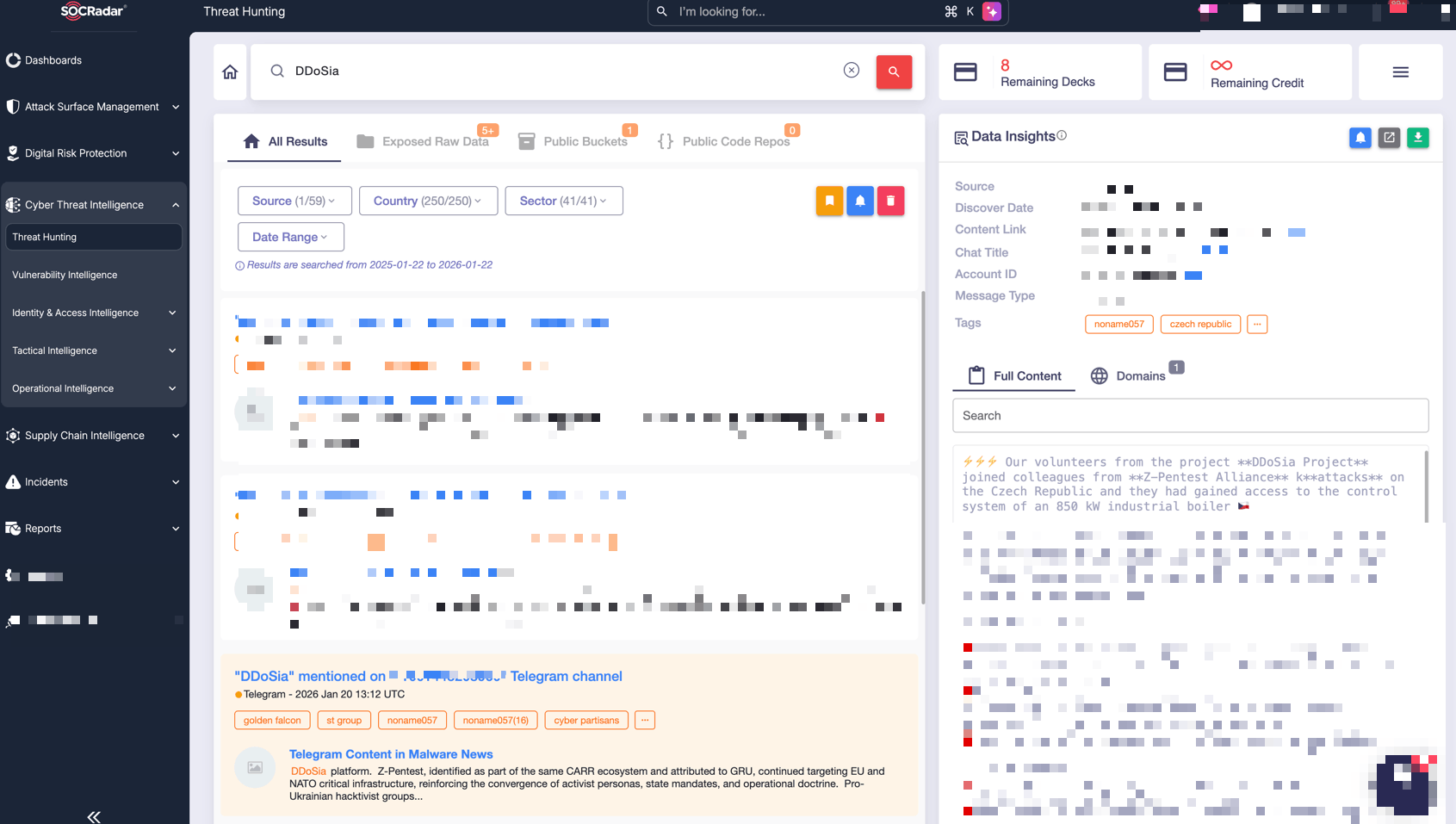
Using DDoSia queries in SOCRadar Threat Hunting helps surface threat actor connections and recently observed targets.
Passive Telegram monitoring tools can aggregate an actor’s past posts across multiple channels within seconds. For example, when the name DDoSia is searched, the platform can surface messages mentioning this actor across different Telegram channels, including groups such as NoName(057)16 and Z-Pentest Alliance, and present them in a single view. This allows analysts to quickly access relevant content without manually inspecting dozens of channels.
These platforms also support real-time alerting. When predefined triggers are met, such as a company name, domain, or a monitored threat actor appearing in a Telegram post, the system generates immediate notifications. This acts as an early warning mechanism, helping organizations identify potential data leaks or attack preparations at an early stage.
Another key capability is threat actor profiling and correlation. Instead of treating Telegram messages as isolated data points, the platform links them to known threat actor profiles when available. This provides context such as associated groups, previous activity, and targeting history, turning individual Telegram messages into actionable threat intelligence rather than raw data.
Enrichment Through Identity and Behavioral Correlation
Telegram intelligence becomes meaningful only when it is enriched with identity, infrastructure, and historical behavior. Isolated messages or channel posts rarely explain who an actor is or how credible their claims are. Enrichment addresses this gap by correlating Telegram content with persistent identifiers and past activity across underground ecosystems.
Rather than relying on usernames or channel names, advanced threat intelligence platforms correlate Telegram data with deeper signals such as TOX IDs, reused aliases, contact handles, and shared technical artifacts. These identifiers tend to persist even when actors rebrand or migrate between platforms.
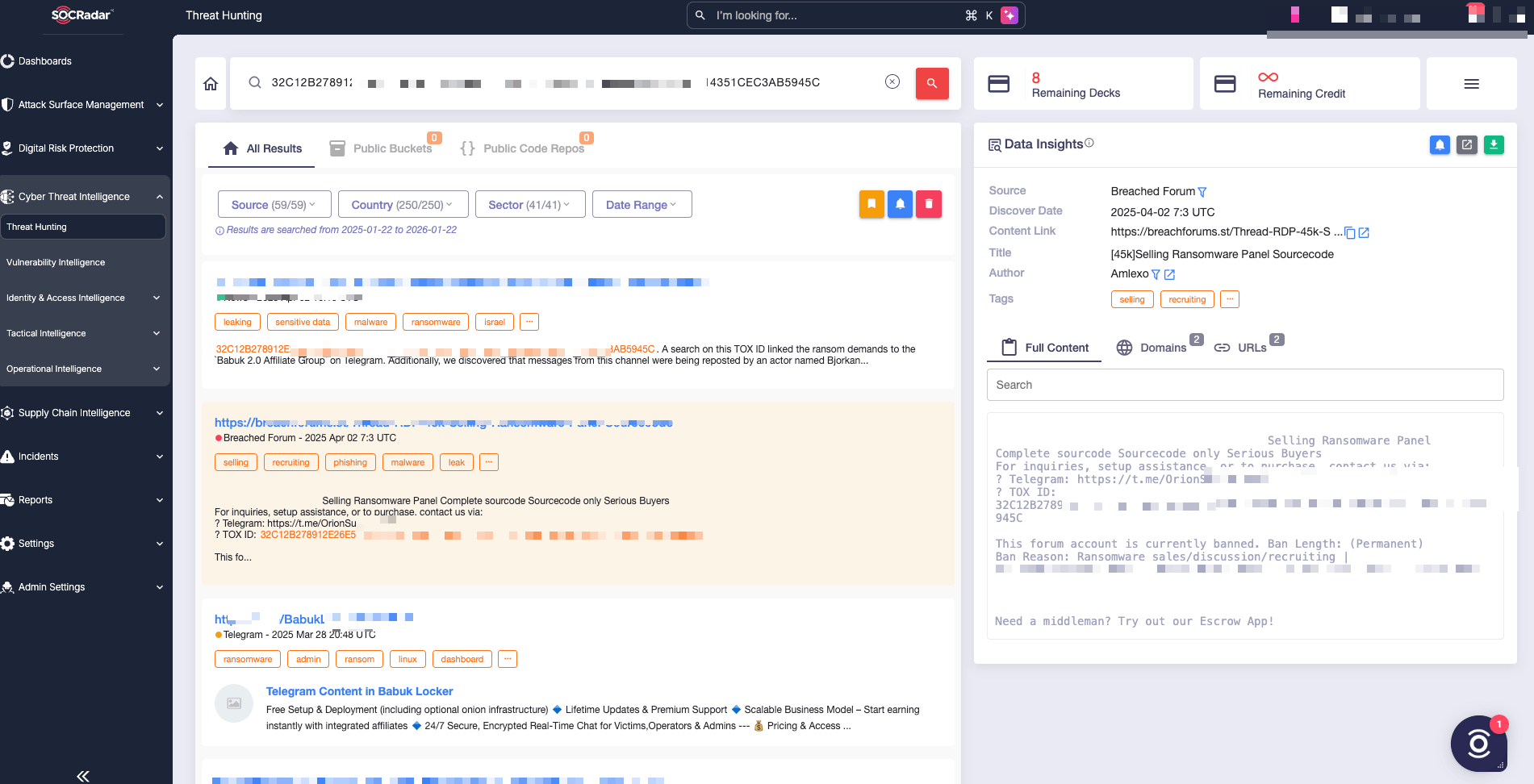
Mentions of Orion in hacker forums and Telegram channels (SOCRadar Threat Hunting)
The Orion Ransomware case illustrates this clearly. Using SOCRadar’s Threat Hunting module, analysts identified a TOX address listed on Orion’s data leak site. Searching this identifier across underground sources revealed historical activity tied to previously shut down forums and discussions linked to Babuk2 related operations. The same TOX address also led to the discovery of the “orionsupport” Telegram channel, connecting Orion’s current presence to earlier actor behavior.
This enrichment made it possible to assess Orion beyond itself reported victim claims. By linking Telegram activity to prior forum posts, reused narratives, and known actor infrastructure, analysts could evaluate credibility, reputation, and operational intent rather than treating Orion as a standalone new group.
Beyond TOX identifiers, enrichment also leverages recurring nicknames, shared channel administrators, repeated announcement language, victim naming patterns, and overlapping infrastructure such as domains or cryptocurrency wallets. When these signals are correlated across Telegram, dark web forums, and breach markets, they reduce false attribution and clarify actor continuity.
In practice, enrichment transforms Telegram from a noisy message stream into structured threat intelligence. It allows security teams to understand who is communicating, how groups like Orion relate to older operations such as Babuk2, and whether an observed campaign represents a real operational threat or recycled activity dressed as something new.
Best Practices and Practical Tips
To get maximum value from Telegram-based threat actor monitoring while maintaining security, the following best practices should be applied consistently:
- Respect legal and ethical boundaries: Limit monitoring to open sources and publicly accessible channels. Avoid attempting to access closed or private groups without authorization, as this can lead to legal and ethical issues. If a platform does not legitimately index restricted content, do not rely on grey-area methods to obtain it.
- Maintain strong operational security (OPSEC): If manual Telegram access is required, never use personal or corporate accounts. Use disposable profiles, virtual phone numbers, VPNs, and sandboxed environments to prevent identity exposure. Anonymity is a prerequisite for safe and sustainable analysis.
- Stay alert to deception and traps: Threat actors may share links designed to expose observers. Treat unfamiliar URLs with caution, especially proxy-related links that can reveal IP addresses. Avoid opening raw links from Telegram on analyst machines unless they are handled in controlled, isolated environments.
- Prioritize sources strategically: Telegram contains thousands of channels and groups. Focus on those most relevant to your industry, region, and threat model. Use filtering by threat type, geography, or language to reduce noise and improve signal quality.
- Continuously update and adapt coverage: Threat actors shift platforms over time as enforcement pressure changes. Regularly review monitored sources, add emerging actors or groups, and adjust tooling coverage to reflect current threat landscapes.
- Cross-validate intelligence: Do not treat every Telegram claim as fact. Actors often exaggerate or spread misinformation. Validate findings against other sources such as dark web forums, breach markets, or trusted open-source reporting before escalating.
- Define an action plan in advance: Establish clear response workflows for Telegram-derived alerts. Determine who should be notified, which teams are responsible, and how escalation or external communication should be handled. Intelligence only has value when it is operationalized within incident response and risk management processes.
Telegram has become a high-value but high-risk intelligence surface. When monitored manually, it exposes analysts to operational, legal, and security risks; when integrated properly, it becomes a powerful early signal source. Passive collection, enrichment, and correlation allow organizations to benefit from Telegram intelligence without direct exposure, while structured workflows ensure that insights lead to timely action. The difference is not access, but control and context. Teams that treat Telegram as part of an integrated threat intelligence ecosystem, rather than a channel to watch, are better positioned to detect emerging threats early and respond with confidence.