NoName057(16) and DDoSia Project Analysis: Russia’s Most Persistent Hacktivist Operation
New SOCRadar Whitepaper Reveals the Inner Workings of DDoSia and Pro-Russian Cyber Aggression
Since March 2022, a sophisticated pro-Russian hacktivist group has been waging a relentless cyber campaign against Western institutions. Today, SOCRadar releases an in-depth analysis exposing NoName057 (16) and its custom denial-of-service weapon, the DDoSia Project.
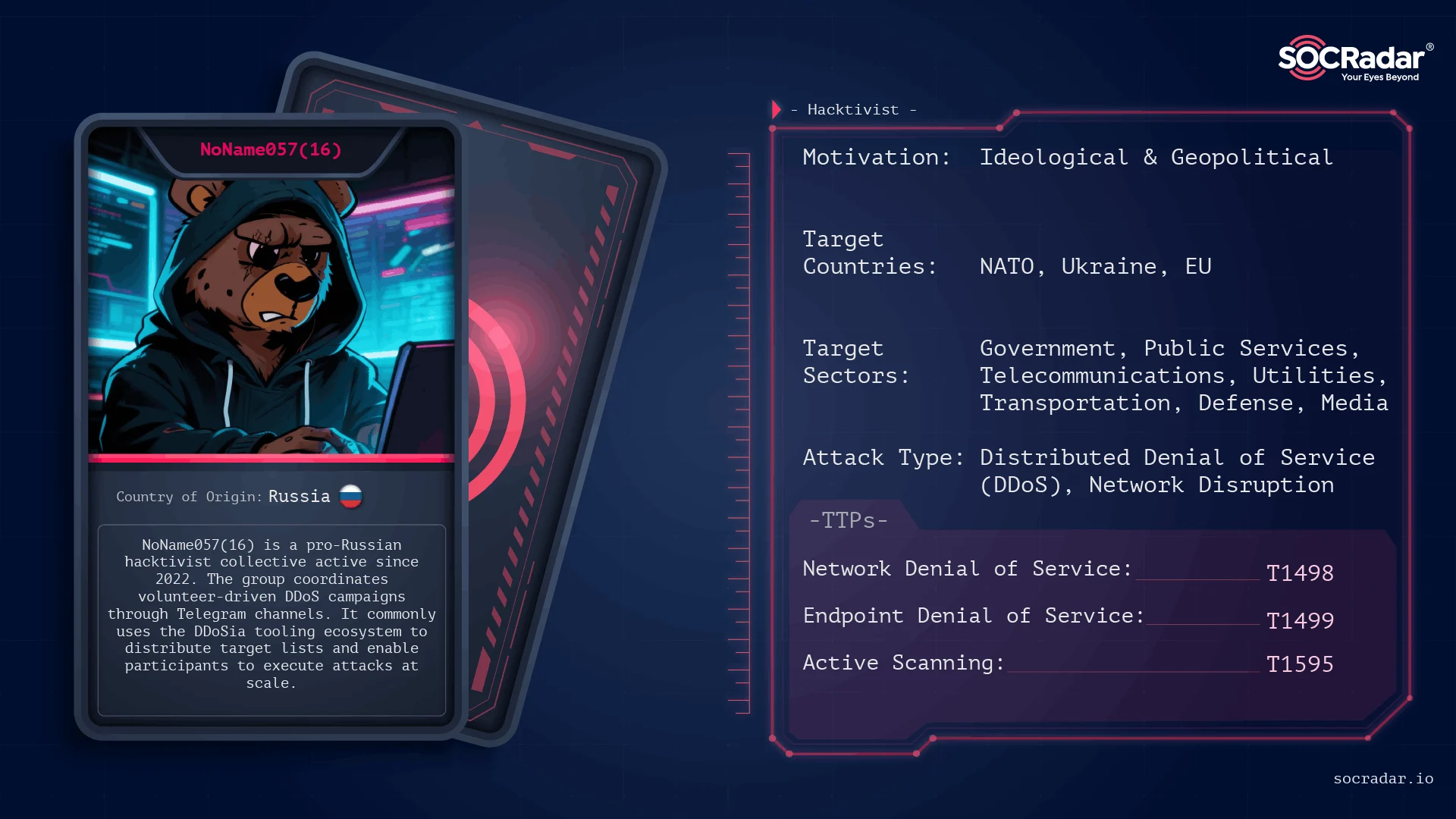
Threat actor card of NoName057(16)
A Voluntary Botnet with a Political Mission
Unlike traditional botnets that compromise systems without user knowledge, DDoSia operates on a disturbing premise: thousands of willing participants knowingly install the tool and coordinate attacks against targets designated by the group’s operators. Through propaganda, gamification, and cryptocurrency rewards, NoName057(16) has built a distributed attack force that requires minimal technical skill to join, yet demonstrates remarkable operational sophistication.
Key Findings from Our Analysis
Our comprehensive research reveals:
- Rapid Technical Evolution: DDoSia has progressed through five major versions since 2022, each adding stronger evasion capabilities, including encrypted C2 communication, user-agent rotation, proxy use, and anti-analysis features.
- Geopolitical Coordination: Attack campaigns consistently align with political events—such as NATO accessions, sanctions announcements, and military aid to Ukraine—typically launching within 24-72 hours of the triggering event.
- Extensive Target Profile: Primary victims include government bodies (40-50% of attacks), financial institutions (17-23%), and media outlets (12-18%) across NATO member states and Ukraine supporters.
- Multi-Platform Reach: The tool supports Windows, Linux, and Android systems, with Dockerized versions for easy VPS deployment.
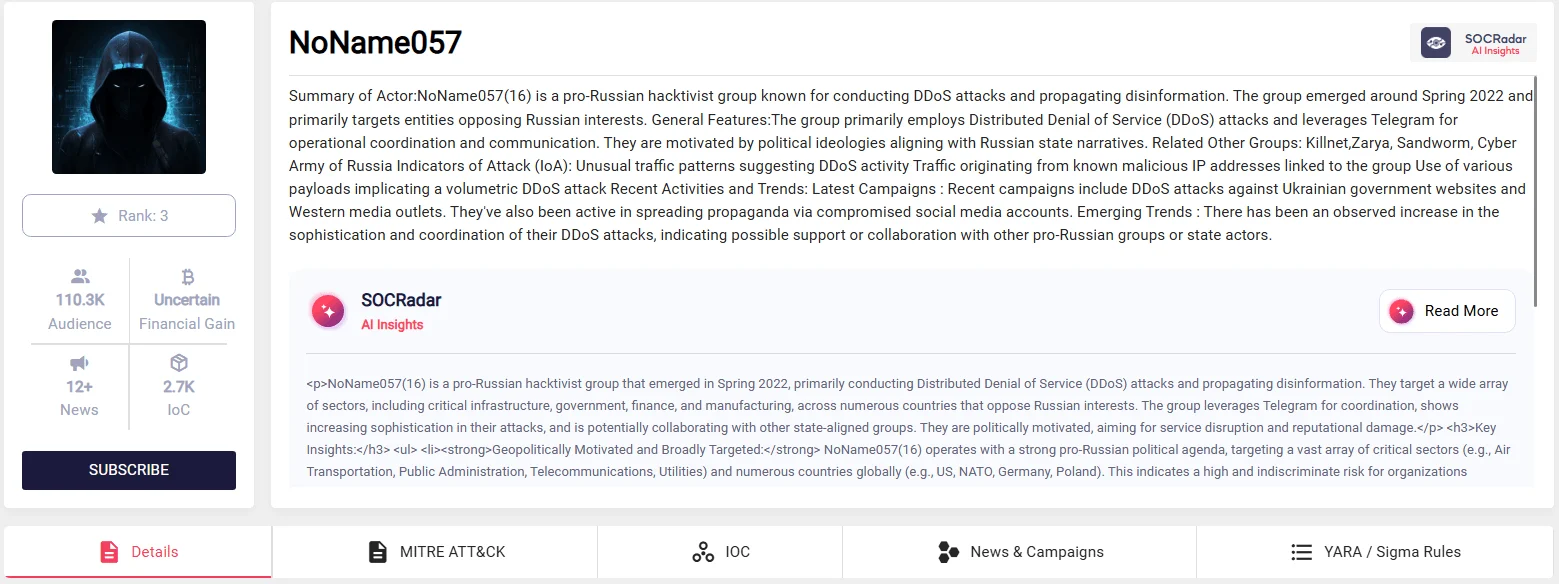
SOCRadar Threat Actor Intelligence
The Concerning Tactics Behind DDoSia
Our technical analysis uncovered several sophisticated capabilities:
- Multiple Attack Vectors: HTTP/HTTP2 floods, TCP SYN floods, UDP floods, Slowloris attacks, and TLS handshake exploitation
- Evasion Techniques: Runtime string obfuscation, AES-GCM encryption, cookie handling to bypass anti-bot systems, and anti-VM detection
- Dynamic Targeting: C2 servers distribute updated target lists without requiring binary redistribution
- Device-Specific Assignment: Attack methods adapt based on the affiliate device capabilities
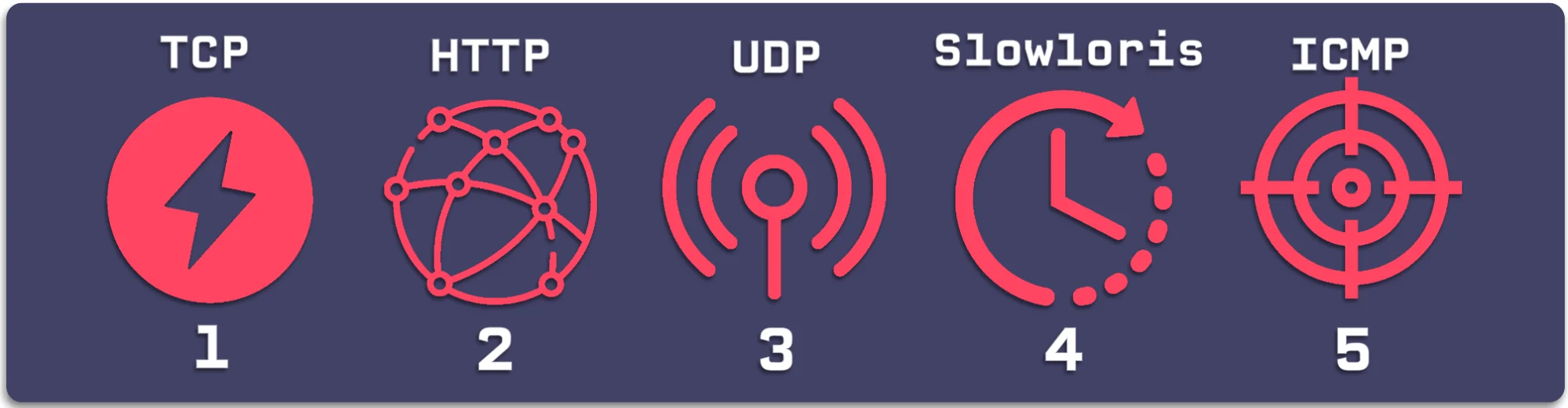
Most used attack methods of NoName057(16)
A Propaganda Machine Driving Cyber Warfare
NoName057(16)’s success is partly due to its sophisticated propaganda operation. Through active Telegram channels with over 20,000 followers, the group:
- Frames attacks as “self-defense” against Western aggression
- Uses gamification with points, rankings, and leaderboards
- Provides real-time “evidence” of successful disruptions
- Creates a sense of patriotic duty among Russian nationalists
Looking Ahead: What Organizations Need to Know
As long as Russia-Ukraine tensions persist, NoName057(16) will likely remain active and continue evolving. Our analysis projects potential developments, including:
- Integration of machine learning for adaptive attacks
- Increased decentralization using blockchain technology
- Expansion into IoT environments
- Rapid CVE exploitation integration
Download the Full Report
The complete whitepaper provides:
- Detailed technical analysis of DDoSia versions 1-5
- MITRE ATT&CK TTPs mapping
- Indicators of Compromise (IoCs)
- Attack method breakdowns and victimology analysis
- Infrastructure correlation and C2 tracking
- Future trend predictions
Protect Your Organization
Understanding this threat is the first step toward defense. SOCRadar’s Threat Intelligence platform provides real-time tracking of hacktivist campaigns, including NoName057(16) activities, infrastructure changes, and emerging attack patterns.
Stay informed. Stay protected.