

Oct 07, 2026
Table Of Content
Related Articles




Jul 17, 2026
32 Mins Read
Oct 02, 2026

Summarize with:
Top 10 MSSPs in the UK&I in 2026
For the first time, the UK is about to regulate MSSPs themselves. The Cyber Security and Resilience Bill, now before the House of Lords, will turn medium and large managed service providers into regulated entities with 24-hour incident-reporting duties, overseen by the Information Commissioner. And here is the uncomfortable part for buyers: “24/7 SOC” on a provider’s website can mean an accredited in-house facility, an offshore centre, or another company’s SOC white-labelled, and not every claim can be verified against the CREST and NCSC registers. This guide runs that check for you.
The stakes were set in 2025. The Cyber Monitoring Centre assessed the Jaguar Land Rover attack at an estimated £1.9 billion, in what it called likely the most economically damaging cyber event to hit the UK, weeks after household names like M&S, Co-op and Harrods were taken offline. In a market of 2,603 cyber security firms generating £14.7 billion, choosing a Managed Security Service Provider is one of the most consequential security decisions an organization will make, and the size of the choice has not made it easier.
This guide profiles 10 leading MSSPs active in the United Kingdom and Ireland in 2026, listed in no particular order; it is not a ranking. These providers stand out for different reasons: different service specializations, sector strengths, and organization sizes. Providers were selected editorially for verified own-SOC or MDR delivery, register-checkable accreditations, and a deliberate mix of sizes and specialisms; some featured providers are SOCRadar partners or customers, and no payment was involved in inclusion. Readers are encouraged to weigh them against their own operational context and obligations.
Why the UK&I’s MSSP Market Matters in 2026
The UK is one of the most heavily targeted cyber environments in the world. The NCSC’s Annual Review 2025 recorded 204 nationally significant incidents, more than double the previous year’s 89, including 18 “highly significant” incidents, up almost 50% on the year before and the third consecutive annual increase. The past two years supplied case studies no British board can ignore: the attacks on M&S, Co-op and Harrods (April-May 2025), widely attributed to Scattered Spider using DragonForce ransomware, which M&S estimated at ~£300 million in lost profit; the Jaguar Land Rover shutdown (September 2025), assessed by the Cyber Monitoring Centre at £1.9 billion in economic damage (range £1.6-2.1 billion) across more than 5,000 organisations, with £196 million in confirmed direct costs and a £1.5 billion government loan guarantee; the Qilin ransomware attack on NHS pathology provider Synnovis (June 2024), which postponed over 10,000 outpatient appointments and was a contributing factor in a patient death; and the Rhysida attack on the British Library (October 2023), whose recovery reportedly consumed around 40% of the institution’s reserves.
Several key forces are driving managed security (MSSP) demand in 2026:
Regulatory pressure. The Cyber Security and Resilience Bill, introduced to Parliament in November 2025 and now before the House of Lords after clearing the Commons in June 2026, will modernize the NIS Regulations 2018 and, critically, bring medium and large managed service providers directly into regulatory scope as “relevant managed service providers,” overseen by the Information Commissioner. Alongside it: UK GDPR with its 72-hour ICO breach-notification window and fines up to £17.5 million or 4% of global turnover, whichever is higher; the NCSC’s Cyber Assessment Framework v4.0 (August 2025), the benchmark for CNI and increasingly for public-sector supply chains; the FCA/PRA operational resilience rules, fully in force since 31 March 2025, plus the new Critical Third Parties regime for the financial sector; and the Cyber Governance Code of Practice (April 2025), which puts cyber risk explicitly on boards’ desks. The government has also confirmed plans to legislate a ransomware payment ban for public-sector bodies and CNI operators, with a proposed 72-hour incident-reporting model still under development.
The UK assurance “stack” at a glance:
- NIS Regulations 2018 → Cyber Security and Resilience Bill – the baseline for essential and digital services, soon extending to MSPs
- UK GDPR / ICO – 72-hour breach notification, fines to £17.5m / 4%
- NCSC CAF v4.0 – the assessment framework for CNI and government
- Cyber Essentials / CE+ – over 215,000 certificates awarded (gov.uk count, as of mid-2025); required in many government, MOD and NHS contracts
- FCA/PRA operational resilience + CTP regime – binding on financial services
- Cyber Governance Code of Practice – board-level accountability
- CREST SOC & Incident Response accreditations, NCSC Assured Services (CIR Enhanced/Standard) – the register-checkable quality marks for SOC and incident-response providers
- CHECK – the NCSC scheme for penetration testing of government and CNI systems (a pen-testing mark, not a SOC/IR one)
Talent shortage. According to the government’s Cyber security skills in the UK labour market 2025 report, 49% of UK businesses have a basic technical cyber security skills gap and around 30% have advanced skills gaps in areas like penetration testing and forensics, against a total cyber workforce of roughly 143,000. Sector employment grew just 3% last year, the slowest since records began in 2018. MSSPs meet the need for immediate, 24/7 coverage and mature expertise that most organizations cannot realistically build in-house.
Cloud and digital acceleration. 60% of large UK businesses now use a public cloud provider, and all three hyperscalers operate in-country regions (AWS London, Azure UK South/UK West, Google Cloud London), keeping UK data residency achievable and expected. Within the UK market, managed security is among the fastest-growing service lines (analyst estimate), as continuous cloud monitoring becomes a compliance expectation rather than a differentiator.
Attack sophistication. The retail and automotive attacks of 2025 showcased the new playbook: native-English social engineering of help desks, ransomware-as-a-service brands like DragonForce and Qilin, and supply-chain single points of failure. The NCSC now reports the UK faces four nationally significant cyber attacks every week. Against this blend, MSSPs that pair UK-relevant threat intelligence with genuine incident-response depth are meaningfully more effective than generic, off-the-shelf detection.
Check your organization’s current exposure with SOCRadar’s free Dark Web Report:
What Is an MSSP and Why You Need One in the UK&I
A Managed Security Service Provider (MSSP) provides operational continuity through 24/7 monitoring, threat detection, and incident response via a Security Operations Center. In the UK, outsourcing supports the round-the-clock resilience most organizations cannot realistically staff in-house, helping manage threats at all hours, generate the audit-ready evidence boards now owe under the Cyber Governance Code of Practice, and meet the ICO’s strict 72-hour breach-notification window.
Compliance obligations are expanding under the Cyber Security and Resilience Bill, which extends NIS-style duties to managed service providers themselves and tightens incident reporting across essential services. Organizations increasingly require specialized services such as a CREST-accredited 24/7 SOC, Managed Detection and Response (MDR), and NCSC-assured incident response, plus alignment with the CAF for critical infrastructure, FCA/PRA operational resilience rules for financial services, and Cyber Essentials Plus for public-sector supply chains.
This support is critical as the UK absorbs the lessons of 2025, a year in which household-name retailers were taken offline for weeks and a single automotive attack dented national GDP. A locally fluent MSSP is built to handle this combination of escalating regulation and active, well-resourced threats.
Quick Reference Table
| Provider | Type | Primary Strength | Best For | Website |
|---|---|---|---|---|
| Sapphire | UK independent | CREST-accredited 24/7 UK SOC, MDR | Enterprise & public sector wanting a veteran UK pure-play | sapphire.net |
| Safetech Innovations UK | UK (int’l group) | SOC-as-a-Service / MDR, London SOC | Mid-market seeking flexible SOC models | safetechinnovations.com |
| Smarttech247 | UK-listed (AIM), Cork HQ | Technology-agnostic MDR on its own VisionX platform | Organizations adding MDR over their existing security stack | smarttech247.com |
| Saepio | UK independent (advisory-led) | Managed threat intelligence (M-THREAT), awareness, GRC | Organizations building the layers around detection | saepio.co.uk |
| NCC Group | UK global | MDR, global SOCs, analyst-recognized | Large enterprise, regulated sectors | nccgroup.com |
| Capgemini | Global integrator (UK SOC Inverness) | Hybrid UK + global SOC delivery, government heritage, ISG UK Leader | Enterprise & government at scale | capgemini.com |
| Integrity360 | European (Dublin HQ, London since 1998) | European-scale MSS/MDR, NCSC-assured IR (UK-wide) | Enterprises accepting EU-SOC delivery for scale | integrity360.com |
| Bridewell | UK independent | CREST SOC + incident response, CNI specialism | Critical national infrastructure | bridewell.com |
| Quorum Cyber | UK independent | Microsoft-centric MDR/SOC | Microsoft-stack enterprises | quorumcyber.com |
| Ekco | UK & Ireland (Dublin HQ, UK SOC Milton Keynes) | CREST SOC + pen testing; security + managed cloud combined | Mid-market & enterprise consolidating security and cloud | ek.co |
The Top 10 Managed Security Service Providers in the UK&I in 2026
1. Sapphire
Website: sapphire.net | Founded: 1996 | HQ: Newcastle upon Tyne, UK (relocated 2026; offices include Glasgow) | Employees: 100-499 (per CREST profile)
Sapphire managed cyber security services
Sapphire is one of the UK’s longest-standing independent cyber security providers, operating since 1996, and it has spent those three decades building something most of the market still advertises rather than owns: a UK-based 24/7/365 Security Operations Centre. Now headquartered in Newcastle upon Tyne, the company describes itself as 100% UK owned and operated, delivering managed detection and response and managed SIEM from its UK SOC.
Its credentials hold up to the register test, not just the logo test. Sapphire is CREST-accredited for both its Security Operations Centre and its Penetration Testing practice, verified on the CREST register, and holds ISO 27001, Cyber Essentials Plus, and NCSC CHECK status. It is also a listed supplier on the UK Government’s G-Cloud Digital Marketplace, a standard procurement route for public-sector buyers. The company serves energy and utilities, finance, healthcare, and the public sector.
Register-verified assurance: CREST Penetration Testing and Security Operations Centre; NCSC CHECK (penetration testing).
For a market where “24/7 SOC” can mean anything from an in-house facility to a white-labelled partner, Sapphire is the reference case of the former: a veteran pure-play whose SOC accreditation, longevity, and sovereign delivery are all independently verifiable.
Core Services: Managed SOC, MDR, Managed SIEM, Penetration Testing, Incident Response Ideal for: Enterprises and public-sector bodies that want a veteran, CREST SOC-accredited UK pure-play with sovereign delivery.
2. Safetech Innovations Global Services
Website: safetechinnovations.com | UK entity founded: 2022 | UK SOC: Plexal, Here East, London | Parent: Safetech Innovations S.A. (listed, Bucharest)
Safetech Innovations cyber security services
Safetech Innovations Global Services is the UK arm of Safetech Innovations S.A., a cyber security group listed on the Bucharest Stock Exchange with more than a decade of security operations behind it. The UK entity was incorporated in 2022 and in 2023 announced the launch of a 24/7 Security Operations Centre at the Plexal innovation hub in London’s Here East campus (company-stated; the launch was covered by Infosecurity Magazine as part of the group’s commitment to building a UK cyber workforce).
The company delivers SOC-as-a-Service and MDR under its own brand, backed by group capability that includes its own SOC and an established CERT (STI CERT). Its fully managed and hybrid (co-managed) SOC models are aimed at organizations that want enterprise-grade monitoring without enterprise-scale procurement. The parent company holds CREST Penetration Testing accreditation, verified on the CREST register, alongside ISO 27001 and ISO 9001.
Register-verified assurance: CREST Penetration Testing (held by the parent, Safetech Innovations S.A.); no UK-entity CREST or NCSC assured-service listings found as of July 2026.
Safetech is the challenger entry on this list: a young UK presence backed by an international, publicly listed track record. For mid-market buyers, that combination often translates into flexibility and attention that larger providers reserve for their biggest accounts.
Core Services: SOC-as-a-Service, MDR, Threat Intelligence, Penetration Testing, Security Engineering Ideal for: Mid-market organizations that want flexible, co-managed SOC models from an international group with a growing London operation.
3. Smarttech247
Website: smarttech247.com | HQ: Cork, Ireland (registered office: Fleet Street, London; UK office in Belfast) | Listed: AIM, London Stock Exchange (since December 2022) | Platform: VisionX MDR
Smarttech247 is the MDR specialist on this list: its business is built around one managed service line, delivered through a platform it owns. Headquartered in Cork with a registered office on London’s Fleet Street, the group has been quoted on the London Stock Exchange’s AIM market since December 2022 and operates further offices in the UK (Belfast), Romania, Poland, and the US.
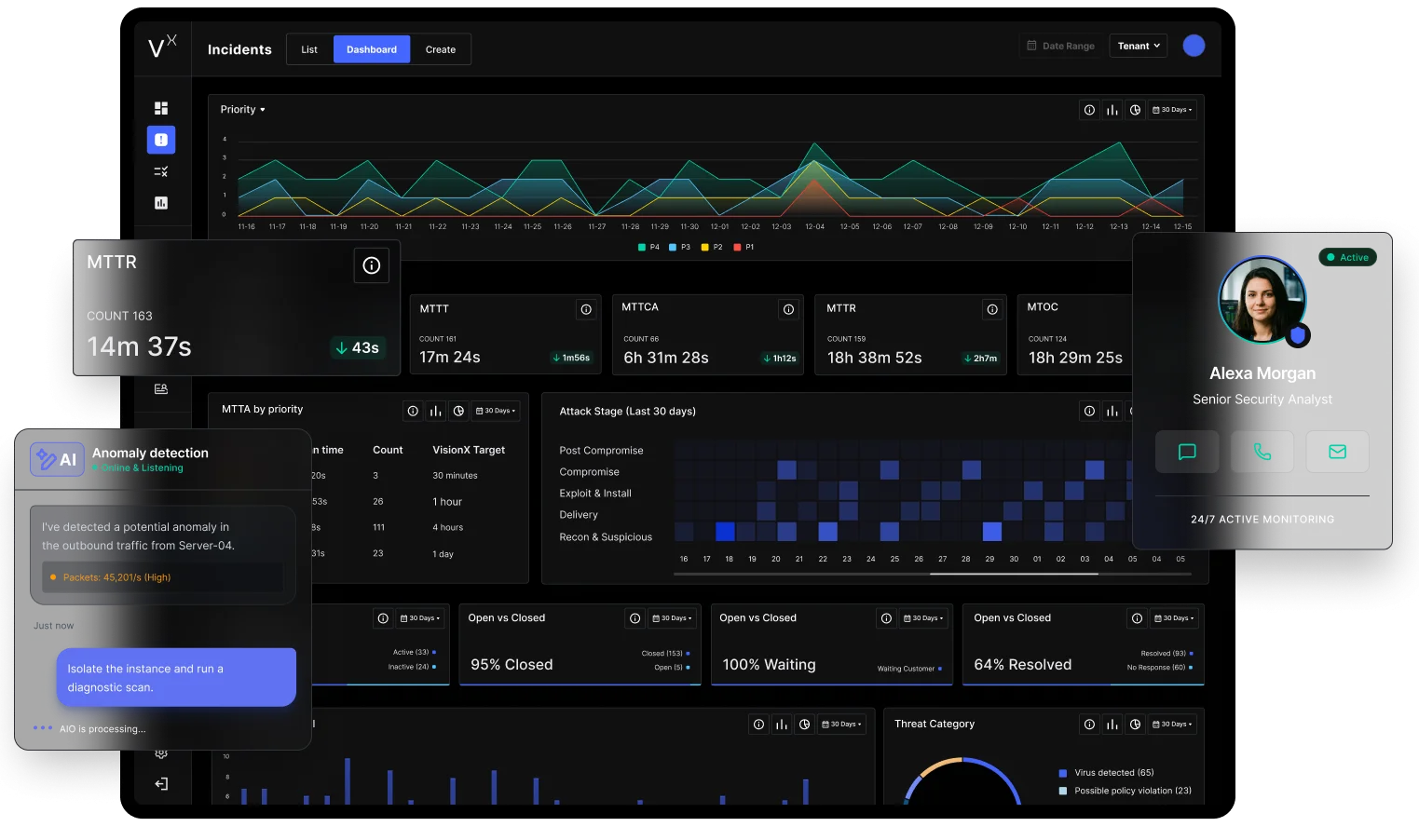
Smarttech247’s dashboard
The service runs on VisionX, the company’s proprietary, technology-agnostic MDR platform launched in 2022, which pairs AI-driven analytics with human-led 24/7 SOC monitoring, threat hunting, incident response, and remediation across network, endpoint, cloud, identity, and data. Coverage extends to AWS, Microsoft, and Google cloud environments and to operational technology through integrations with Claroty, Armis, and Forescout, and the company reports a mean time to respond of under 15 minutes (company-stated). Around the core service sit NoPhish for real-time email phishing detection and remediation, ThreatHub for continuous threat exposure management, penetration testing and red teaming, and vCISO and compliance services. Smarttech247 was recognized in the Gartner Market Guide for Managed Detection and Response for the second consecutive year in 2025 (vendor-stated; Gartner Market Guide inclusion is not a ranking or endorsement).
Register-verified assurance: NSAI-issued ISO 9001 and ISO/IEC 27001 certification and Cyber Essentials, and its penetration testers hold individual CREST certifications (CPSA, CRT); individual certifications are not company accreditation. Monitoring is delivered from Irish SOC operations.
For organizations that want MDR as the core purchase, with one platform consolidating detection across the security stack they have already paid for, Smarttech247 is the focused, publicly listed specialist on this list.
Core Services: MDR (VisionX), 24/7 SOC Monitoring, Threat Hunting & Incident Response, MDR for Cloud and OT, Email Security (NoPhish), Continuous Threat Exposure Management (ThreatHub), Penetration Testing & Red Teaming, vCISO & Compliance Ideal for: Mid-market and enterprise organizations in sectors such as pharmaceuticals, healthcare, fintech, and manufacturing that want technology-agnostic MDR layered over their existing security stack, and that accept monitoring delivered from Irish SOC operations.
4. Saepio
Website: saepio.co.uk | HQ: High Wycombe, Buckinghamshire | NCSC Assured Cyber Advisor | Owner: Aurias (since April 2024)
Saepio cyber security services
Saepio is a deliberate exception on this list, and it says so upfront: it is not a SOC operator. It is a vendor-neutral, advisory-led security partner that designs, builds, and runs the layers around detection, transparent about what it delivers itself and what it does not. The company reports serving more than 1,000 UK organisations (company-stated).
Its managed services cover the parts of a security program most SOCs leave behind. M-THREAT delivers managed threat intelligence and dark-web monitoring, with UK-based analysts triaging findings on a platform powered by SOCRadar, so organizations get curated, actionable intelligence rather than a raw feed. That sits alongside M-SAT, its managed security awareness service, M-GRC for governance, risk, and compliance, and an advisory practice spanning strategy, frameworks, and security technology selection, including guidance on sourcing SOC and MDR capability where needed. Its penetration testing is delivered through Ruptura InfoSecurity, a firm Saepio acquired in 2025.
Register-verified assurance: NCSC Assured Cyber Advisor, a government assurance mark for advice on implementing the Cyber Essentials technical controls; Saepio itself does not appear on the CREST register as of July 2026, though its pen-testing arm Ruptura InfoSecurity holds CREST Penetration Testing accreditation.
For organizations that have detection covered, or are still deciding how to source it, Saepio is the connective tissue: intelligence, awareness, governance, and independent advice from a government-assured UK partner.
Core Services: Managed Threat Intelligence & Dark Web Monitoring (M-THREAT), Managed Security Awareness (M-SAT), Managed GRC, Penetration Testing (via Ruptura), Security Advisory & Technology Selection Ideal for: Organizations that want a UK advisory-led partner to build and run the intelligence and human layers of their security program.
5. NCC Group
Website: nccgroup.com | Founded: 1999 | HQ: Manchester, UK | Scale: ~£294m FY2025 revenue (constant currency, per preliminary results)
NCC Group cyber resilience services
NCC Group is one of the UK’s largest dedicated cyber security firms: founded in Manchester in 1999, publicly listed on the London Stock Exchange, and operating globally with revenue of around £294 million in FY2025. Few providers combine its breadth, from technical assurance and penetration testing to software escrow, incident response, and fully managed detection and response delivered from its own SOCs.
Its managed security credentials carry independent analyst weight, which remains rare in the UK market. NCC Group was named a Leader in the IDC MarketScape: European MDR Services 2024 and recognized as a Strong Performer in the Forrester Wave: MDR Services in Europe, Q3 2025, one of only eleven vendors evaluated. That research heritage feeds the managed service: the same firm that banks and exchanges engage for assurance work is the one watching the network.
Register-verified assurance: CREST Security Operations Centre, Incident Response, Incident Exercising, Penetration Testing, and Vulnerability Assessment (plus STAR-FS and threat-led pen-testing specialisms); NCSC CHECK, Cyber Incident Response at both Standard and Enhanced level, Cyber Incident Exercising, Cyber Resilience Audit, and Cyber Security Consultancy. The fullest register footprint of any provider on this list.
For large and regulated enterprises, NCC Group’s appeal is the combination of UK headquarters and governance with global delivery, plus the confidence of choosing a provider whose MDR has been examined by the major analyst houses rather than self-certified.
Core Services: MDR, Managed SOC, Incident Response, Penetration Testing & Technical Assurance, Software Escrow & Resilience Ideal for: Large and regulated enterprises that want a UK-headquartered provider with analyst-validated MDR and global reach.
6. Capgemini
Website: capgemini.com | Group HQ: Paris | UK scale: 5,000-19,999 UK employees (gov.uk band, April 2025) | UK SOC: Inverness

Capgemini technology and cyber security services
Capgemini holds a position in UK public-sector technology that few can match: a relationship with HMRC dating to the 2004 Aspire contract, continued in 2024 with a new award worth up to £574 million to run HMRC’s legacy tax platform to 2029, and in 2026 with lead-supplier status on HMRC’s £600 million contact-centre deal; a £225 million MOD Defence Digital contract with 24/7 service centres in Inverness and Nairn (running to 2027, currently being re-tendered); and a strategic infrastructure contract with the Metropolitan Police. Less well known is that its UK cyber delivery has a Scottish anchor: Capgemini operates a security operations centre in Inverness and was still actively recruiting cybersecurity staff there as of June 2026.
Delivery is hybrid by design: the UK operation is complemented by Capgemini’s global network of Cyber Defense Centers across India, Europe, and North America, offered as dedicated, managed, or hybrid SOC models, with MDR built on the Microsoft stack (MXDR powered by Microsoft Sentinel and Defender). Its UK standing carries current analyst weight: ISG Provider Lens Cybersecurity UK named Capgemini a Leader in three quadrants in both its 2025 and 2026 reports, and ISG’s 2025 Provider Lens Public Sector Services and Solutions report for the UK named it a Leader in all five quadrants.
Register-verified assurance: CREST Penetration Testing, 19 years’ membership (per CREST Marketplace, accessed July 2026); NCSC CHECK and NCSC Assured Cyber Security Consultancy. No CREST SOC/IR or NCSC CIR listings as of July 2026; monitoring is delivered from a hybrid UK-plus-global model.
For large enterprises and government programmes that want managed security embedded inside a broader transformation partner, with UK SOC delivery and global scale behind it, Capgemini is the integrator’s answer.
Core Services: Managed SOC / Cyber Defense Centers (dedicated, managed, hybrid), MXDR (Microsoft stack), Penetration Testing (CHECK), Security Consulting & Transformation Ideal for: Large enterprises and public-sector programmes that want managed security from a global integrator with UK SOC delivery and deep government heritage.
7. Integrity360
Website: integrity360.com | HQ: Dublin (UK entity trading since 1998, London office) | Scale: 775+ staff, revenue over €160m (company-reported)
Integrity360 managed cyber security services
Integrity360 is the European-scale entry on this list. Backed by August Equity since 2021, the Dublin-headquartered group has grown through nine acquisitions in four years (per its own January 2026 count) into one of Europe’s largest independent cyber security services companies, reporting over €160 million in revenue and 775+ staff, of whom 585+ are security professionals. Its UK business is no newcomer: the London operation is the former Caretower, a security services firm trading since 1998 and acquired in 2022.
Be clear about the delivery model: Integrity360’s roughly 200-person SOC organisation operates from SOCs in Dublin, Stockholm, Rome, Sofia, Madrid, and Cape Town (with Johannesburg added via recent acquisitions); there is no SOC on UK soil. What the UK operation does hold is register-verified incident-response assurance: NCSC Assured Cyber Incident Response at Standard level, covering the whole of the UK, alongside CREST accreditations. The company has been named a Representative Vendor in multiple Gartner Market Guides spanning managed security services, MDR, and co-managed SIEM (vendor-stated; Gartner Market Guide inclusion is not a ranking or endorsement).
Register-verified assurance: CREST Incident Response and Penetration Testing (note: no CREST SOC accreditation); NCSC Assured Cyber Incident Response, Standard level, operating region “Whole of UK.” Monitoring is delivered from non-UK SOCs.
For organizations comfortable with European delivery in exchange for scale, breadth, and a large multi-vendor technology practice, Integrity360 offers a full-stack alternative to both the UK boutiques and the global giants.
Core Services: Managed Security Services, MDR, Co-Managed SIEM, Incident Response, Penetration Testing, PCI/Compliance Services, Security Technology Integration Ideal for: Enterprises that want European-scale managed security with a long-established London operation and NCSC-assured incident response, and that accept monitoring delivered from EU SOCs.
8. Bridewell
Website: bridewell.com | Founded: 2013 | HQ: Reading, UK | Employees: 200-400 (estimate)
Bridewell cyber security services
Bridewell is the UK independent that critical national infrastructure operators tend to shortlist first. Founded in Reading in 2013, it runs its own 24/7 UK Security Operations Centre staffed by UK-based analysts the company states are SC-cleared, and it has built its practice around the sectors where sovereignty is not a preference but a requirement: aviation, energy, transport, water, and government.
Its accreditations are among the most complete of any UK independent, and they check out on the registers. Just as important for its client base is regulatory fluency: Bridewell consults extensively on the NCSC Cyber Assessment Framework and NIS obligations, the exact frameworks its CNI customers are audited against, and pairs IT monitoring with genuine OT/ICS security capability rather than relabelled IT tooling. The company also reports SOC 2 compliance.
Register-verified assurance: CREST Security Operations Centre, Incident Response, Penetration Testing, Vulnerability Assessment, Incident Exercising, and Threat-Led Penetration Testing (CREST register); NCSC CHECK, Cyber Advisor, Cyber Incident Response (Standard level), Cyber Incident Exercising, Cyber Resilience Audit, and Cyber Security Consultancy.
Bridewell is the answer to a specific question: who can watch an environment that includes industrial control systems, with cleared UK personnel, and produce evidence a CNI regulator will accept? Few firms can say yes to all three.
Core Services: Managed SOC, MDR, OT/ICS Security, Incident Response, Penetration Testing, CAF/NIS Consulting Ideal for: CNI and government-adjacent organizations that need sovereign, security-cleared UK delivery and CAF fluency.
9. Quorum Cyber
Website: quorumcyber.com | Founded: 2016 | HQ: Edinburgh, UK | Scale: 350+ staff, revenue run-rate £31.3m at end-2024 (company-reported)
Quorum Cyber Microsoft-focused security services
Quorum Cyber is the specialist’s pick. Founded in Edinburgh in 2016, it made an early and deliberate bet on the Microsoft security stack, building its MDR and SOC services natively on Microsoft Sentinel and Defender rather than layering a proprietary platform on top. That focus has been repeatedly recognized by Microsoft itself: Quorum Cyber was a finalist for Microsoft’s 2025 Security Partner of the Year for the second consecutive year, a shortlist drawn from Microsoft’s global partner ecosystem.
The company is also one of the UK’s fastest-growing independents, reporting more than 350 staff and a revenue run-rate of £31.3 million at the end of 2024, and it expanded into North America through its acquisition of Canadian Microsoft security specialist Difenda in September 2024. For customers, the Microsoft-native model has a concrete payoff: organizations already licensed for Microsoft E5 or Defender can activate mature managed detection on tooling they own, rather than paying for a parallel stack.
Register-verified assurance: CREST Incident Response, Penetration Testing, and Vulnerability Assessment (note: no CREST SOC accreditation); NCSC Assured Cyber Incident Response, Standard level.
For the many UK enterprises now standardized on Microsoft security, Quorum Cyber offers the depth of a specialist with the trajectory, and increasingly the footprint, of a much larger firm.
Core Services: MDR (Microsoft stack), Managed SOC, Threat Intelligence, Incident Response, Security Consulting Ideal for: Microsoft-standardized enterprises that want a specialist UK MDR partner growing on both sides of the Atlantic.
10. Ekco
Website: ek.co | HQ: Dublin (UK HQ: Milton Keynes, plus London) | Scale: 1,000+ staff; ~€200m group revenue, ~€100m from security (company-reported)
Ekco security-first managed services
Ekco is the security-first managed cloud provider on this list, and the fastest-built. Backed by London private equity firm Corten Capital since 2022, the Dublin-headquartered group has assembled more than 1,000 staff across Europe through a rapid acquisition run, including six UK deals: among them iSYSTEMS (2023), Bluecube (2023), which brought a Milton Keynes 24/7 SOC and more than doubled its UK operation, Manchester pen-testing firm Predatech (2025), and Bristol’s Solsoft (2025). Security now accounts for roughly €100 million of its ~€200 million group revenue (company-reported).
Delivery runs from its own 24/7 SOCs in Dublin, Milton Keynes, and Kuala Lumpur, covering MDR, managed XDR and SIEM, SOC-as-a-Service, DFIR, penetration testing, and CISO-as-a-Service, with the distinctive twist that the same group runs the client’s cloud and infrastructure if wanted. Its credentials pass the register test: Ekco is CREST-accredited for both Security Operations Centre and Penetration Testing, verified on the CREST register, and reports ISO 27001 group-wide, with Cyber Essentials Plus and NHS DSPT for its UK operation; its subsidiary Predatech is an NCSC-assured Cyber Advisor.
Register-verified assurance: CREST Security Operations Centre and Penetration Testing; NCSC Cyber Advisor via subsidiary Predatech. Group HQ and flagship SOC are in Dublin; UK monitoring runs from the Milton Keynes SOC.
For organizations that want managed security and managed cloud from one accountable provider, with a genuine UK SOC behind it, Ekco is the consolidation play.
Core Services: MDR, Managed XDR/SIEM, SOC-as-a-Service, DFIR, Penetration Testing, CISO-as-a-Service, Managed & Private Cloud Ideal for: Mid-market and enterprise organizations, including healthcare and regulated sectors, that want security and cloud operations combined, delivered from UK and Irish SOCs.
How to Choose the Right MSSP in the UK&I
The ten providers above differ widely in accreditation, focus, scale, and depth, and the right choice is rarely the “biggest” name; it is the one that fits your sector, your regulatory exposure, and the gaps you cannot staff internally. For a UK CISO who has to answer to a board, a regulator, and increasingly a procurement committee, a few dimensions matter more than the generic vendor checklist.
Start with assurance you can verify.
The UK has no single MSSP licence, but it has strong proxies: CREST accreditation for SOC and incident response, NCSC Assured Services for incident response (Enhanced for nationally significant incidents, Standard for common attacks like ransomware), CHECK status for public-sector penetration testing, and ISO 27001 with a named certification body. If a provider claims a credential you cannot find on the issuing body’s register, ask why.
Anticipate the Cyber Security and Resilience Bill.
Once enacted, medium and large managed service providers will themselves be regulated entities with incident-reporting duties, including a 24-hour initial notification and a 72-hour full report. Ask any prospective MSSP how it is preparing, and how its own regulatory posture will protect, not complicate, yours. A provider that will owe the regulator a 24-hour initial incident notification is a provider with strong internal discipline; one that has not heard of the Bill is a red flag.
Demand practical regulatory fluency, not a compliance brochure. Your provider should map its delivery to your specific obligations: the NCSC CAF v4.0 if you are CNI or public sector, FCA/PRA operational resilience rules and impact tolerances if you are a financial institution, UK GDPR including the ICO’s 72-hour breach-notification workflow, and the Cyber Governance Code of Practice reporting your board now expects. Ask to see the audit-ready evidence their service generates, because when the regulator or your board asks, you answer, not the MSSP.
Ask where the SOC actually is, and who owns it.
“24/7 SOC” on a website can mean an in-house UK facility, an offshore centre, or another company’s SOC white-labelled. All three models can work, but you should know which you are buying. Ask where the analysts who will watch your environment sit, whether UK data residency is contractual, and, if you handle government data, whether analysts are SC-cleared.
Test for UK-relevant threat intelligence and IR depth.
The 2025 attacks succeeded through help-desk social engineering and identity abuse, not exotic malware. Ask for concrete, recent examples of locally relevant activity the provider detected and actioned, and how quickly it can surge incident-response capability. The M&S and JLR timelines show recovery speed is now a board-level number.
Match the provider’s strength to your actual gap.
National-scale and government-heritage coverage points to NCC Group (#5) or Capgemini (#6); European-scale managed security to Integrity360 (#7); CNI and security-cleared delivery to Bridewell (#8); Microsoft-stack depth to Quorum Cyber (#9); veteran sovereign UK SOC delivery to Sapphire (#1); flexible mid-market SOC models to Safetech (#2); financial-sector advisory-led services to Smarttech247 (#3); threat-intelligence, awareness and GRC program building to Saepio (#4); and combined security-plus-cloud operations to Ekco (#10).
Check sector references.
Ask for references from organizations of comparable size in your industry. How a provider performs during a live incident, not in a proposal, is the most reliable predictor of the relationship you will have.
Frequently Asked Questions
What is an MSSP, and how is it different from a traditional IT security vendor?
An MSSP runs your security operations on an ongoing basis: 24/7 monitoring, threat detection, incident response, and compliance support, rather than selling a product or performing a one-off assessment. It takes day-to-day operational responsibility for spotting and stopping threats, usually through a 24/7 SOC.
MSSP, MDR, SOC-as-a-Service: what’s the difference?
They overlap. A SOC (or SOC-as-a-Service) is the monitoring facility and analysts; MDR adds active threat hunting and hands-on containment rather than just alerting; “MSSP” is the umbrella term for a provider delivering managed security services, which usually include a SOC and often MDR plus vulnerability management and compliance. Most UK providers offer all three.
Is there an official licence for MSSPs in the UK?
Not yet, but that is changing. The Cyber Security and Resilience Bill, now before the House of Lords, will bring medium and large managed service providers into a regulatory regime overseen by the Information Commissioner, with registration and incident-reporting duties. Until then, the strongest proxies are CREST SOC and incident-response accreditation, NCSC Assured Service status, CHECK, and ISO 27001, always verified against the issuing body’s register rather than a logo.
How do I verify an MSSP’s accreditations?
Check the CREST register for SOC, incident response and penetration testing accreditations, the NCSC website for CHECK and Assured Service providers, and ask for the ISO certificate number and certification body. Don’t rely on a logo or marketing claim alone.
Do MSSPs help with UK GDPR, CAF, and FCA compliance, and how does regulation affect which one I choose?
Yes. Leading UK MSSPs map their delivery to the NCSC CAF, FCA/PRA operational resilience requirements, and UK GDPR. Because an MSSP that handles your personal data is a “processor” under UK GDPR, its data-processing agreement, data residency, breach-notification support, and audit-ready evidence all factor into the choice.
Does my data have to stay in the UK?
UK GDPR restricts transfers of personal data to countries without adequacy or appropriate safeguards, and many public-sector and defence contracts require UK data residency and cleared personnel. All three hyperscalers operate UK regions, and several UK MSSPs offer fully sovereign delivery. Confirm residency contractually before signing.
How quickly must a data breach be reported in the UK?
Under UK GDPR, organizations must notify the ICO within 72 hours of becoming aware of a personal-data breach that risks individuals’ rights, and inform affected individuals where the risk is high. The government’s proposed ransomware reporting regime is expected to add a 72-hour incident report with a 28-day follow-up. A capable MSSP detects quickly and supports that notification workflow within the window.
Do I still need an MSSP if I have an in-house team?
Often, yes. Few organizations can fully staff a 24/7 SOC or retain scarce analysts. The government’s own research shows 49% of UK businesses have a basic cyber skills gap. A co-managed model is common: the MSSP runs round-the-clock monitoring while your team focuses on strategy, architecture, and business context.
Which sectors most need an MSSP in the UK?
Critical national infrastructure (energy, water, transport, health), financial services under FCA/PRA operational resilience rules, retail (the 2025 attacks proved its exposure), manufacturing and automotive (JLR), and any organization in the public-sector supply chain. With the Cyber Security and Resilience Bill extending duties across essential services and their suppliers, most mid-size organizations now have a baseline to meet.
Can a UK MSSP secure OT/ICS environments?
Some can. Protecting industrial control systems requires different tooling and skills than IT monitoring, so look for providers with genuine OT/ICS capability and CNI references rather than IT-only monitoring relabelled “OT-ready.”
How much does an MSSP cost in the UK?
It varies widely with organization size, scope, and compliance needs: from low five figures annually for SME-grade monitoring to seven figures for enterprise CNI programs. Treat any published figure as indicative and scope a quote against your own environment.
Are these ten the only MSSPs in the UK?
No. This guide highlights ten notable providers, but the UK market includes over 2,600 cyber firms, many delivering managed services, including BT’s national-scale security practice, global integrators such as Accenture, IBM and Fujitsu, global MDR vendors like Sophos (which absorbed Secureworks in 2025), Kroll’s Redscan-built MDR practice, LRQA’s CREST-accredited SOC, and capable UK independents like Socura (whose CREST-accredited Cardiff SOC runs CymruSOC, the UK’s first national SOC), Talion, e2e-assure, SecurityHQ and Claranet. Use the selection criteria above to build a shortlist for your context.
What makes the UK’s threat landscape distinct?
The 2025 attacks showed the UK’s exposure concentrates in retail, manufacturing, health and CNI, driven by English-language social engineering (help-desk compromise), industrialized ransomware brands, and supply-chain single points of failure, against a regulatory backdrop that is tightening faster than almost anywhere in Europe. Generic global detection underweights this mix, so UK-relevant threat intelligence and proven IR speed are meaningful differentiators.
SOCRadar provides extended threat intelligence covering threat actors targeting the United Kingdom, on dark web forums, Telegram channels, and data leak sites. Our dark web monitoring capabilities help detect early exposure of organizational data before that exposure escalates into a breach. Request a demo or run a free dark web scan to understand your current exposure baseline.