




Sep 08, 2026

Table Of Content
Related Articles



May 04, 2026
12 Mins Read

Summarize with:
Top 10 AI Pentest Tools
AI pentest tools are gaining popularity in offensive security workflows. These tools accelerate reconnaissance and automate workflows, but at the same time, enable less skilled actors to execute complex attacks.
Now, security teams are forced to confront automated threats that move quickly and scale at minimal cost. We saw an example of such threats from Anthropic. These developments pressure defenders to understand how these tools operate and the types of threats they can generate for organizations. Let’s examine some of those AI-driven penetration testing tools.

1. Strix
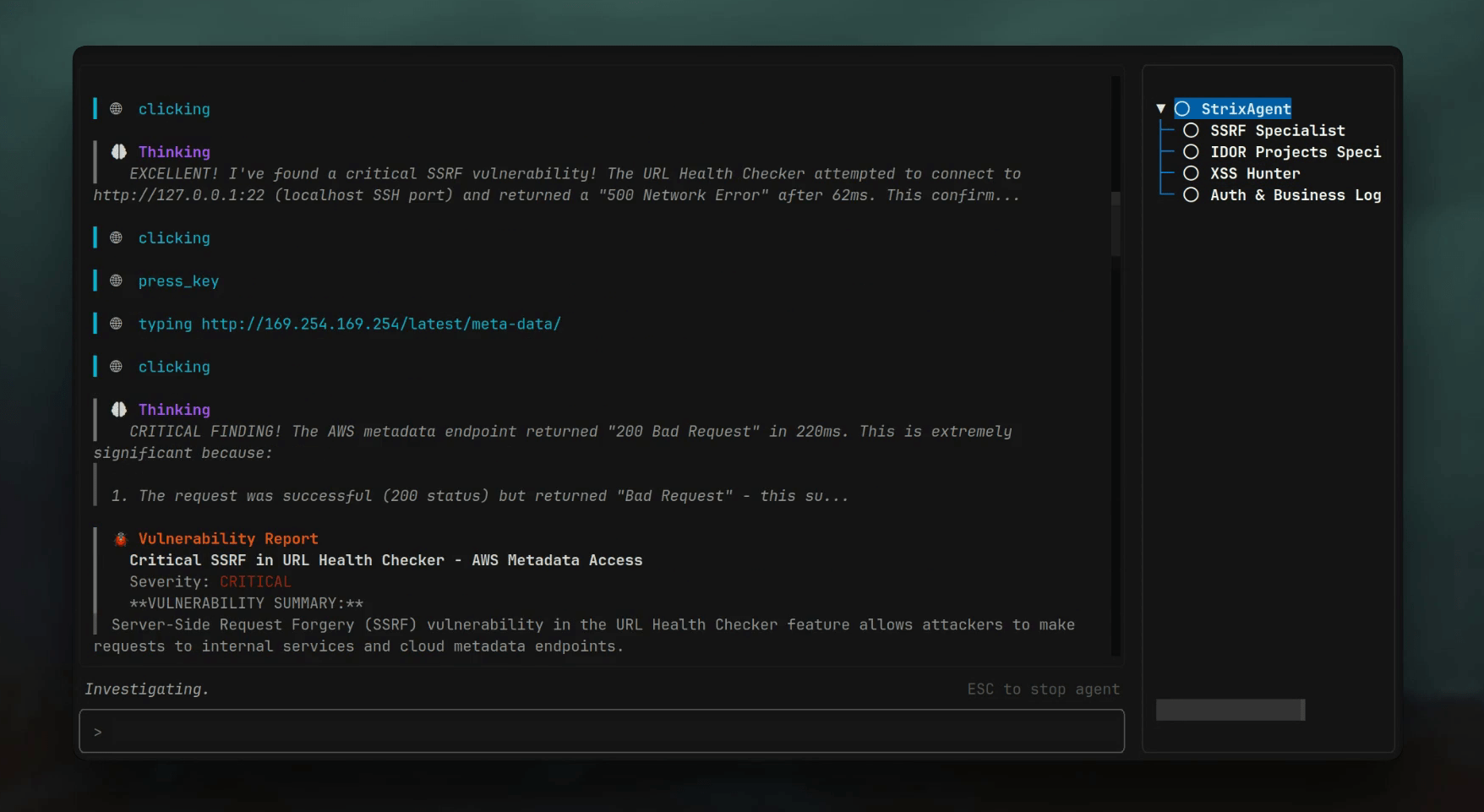
Strix is an autonomous security testing system that operates with AI agents that behave like human attackers. It runs code in real conditions, identifies vulnerabilities, and verifies each issue with proof-of-concept exploits.
The main targets are developers and security teams that need reliable testing without the cost and delay of manual penetration tests or the noise produced by static analysis.
Strix focuses on practical validation. It generates findings that include real evidence rather than theoretical alerts. It also supports workflows that help teams fix issues quickly and track remediation.
The tool draws on several open-source projects, including LiteLLM, Caido, ProjectDiscovery, Playwright, and Textual, and provides several core capabilities.
- It includes a full hacker-oriented toolkit that operates out of the box.
- It supports teams of cooperating agents that distribute tasks and scale across targets.
- It validates each finding with a working proof-of-concept, which reduces false positives.
- It offers a developer-focused command line interface that produces actionable reports.
- It also provides automated remediation support and reporting features that help teams close gaps faster.
Strix fits into the common application-security workflows.
- It can perform application security testing and confirm critical vulnerabilities through dynamic exploitation.
- It can run rapid penetration tests that complete in hours and produce compliance-ready outputs.
- It can automate bug bounty research, including proof-of-concept generation.
- It also integrates into CI/CD pipelines, which allows teams to block risky changes before they reach production.
You can use it locally with Docker, Python, and an LLM but it is also offered in a hosted cloud version. It removes the need for local setup and avoids management of API keys or LLM consumption.
2. PentestGPT
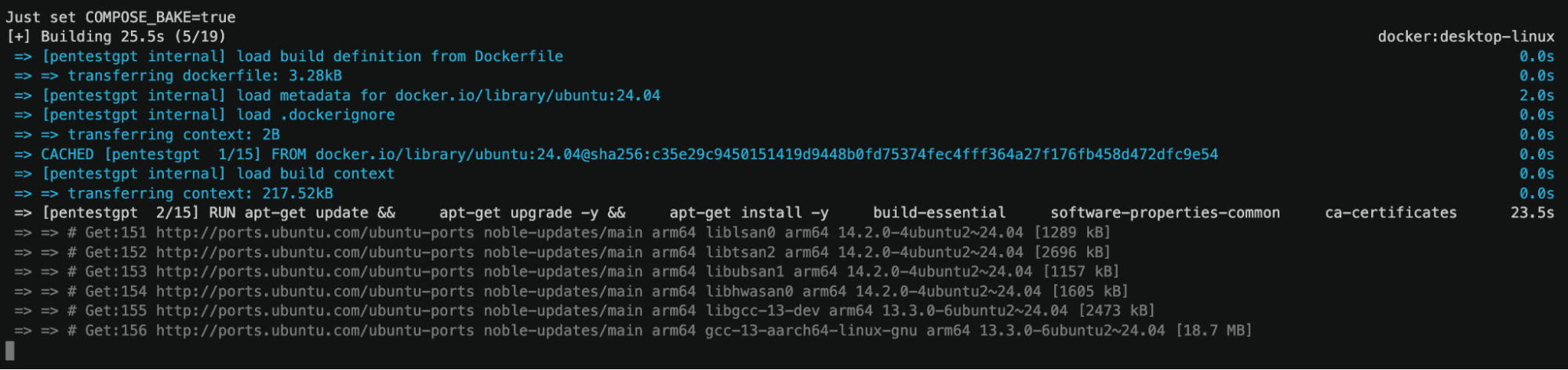
PentestGPT is an AI-driven penetration testing tool built for web security testing. It uses a unified terminal handler and three core components. These components are:
- The test generation module
- The test reasoning module
- The parsing module
Together, they support command generation, test guidance, and output parsing during an engagement.
The tool begins with an initialization step. The user provides target information to start a new session. PentestGPT then builds a task tree and identifies the first action. It generates the exact command for the user and waits for the execution result. The user can submit tool output, webpage content, or a short description. The parsing module processes the input and updates the task tree. The reasoning module selects the next task and passes it to the generation module for command creation. This loop continues until the user exits the program.
PentestGPT provides several commands to support testing. These include help, next, more, todo, discuss, google, and quit. It also offers subtask commands such as brainstorm and continue. The interface supports autocomplete and input submission shortcuts, and users can provide information from tools, websites, or their own notes.
The tool uses LLMs for test reasoning and it is built on top of the ChatGPT API but it also supports multiple models (including local LLMs).
3. Cybersecurity AI (CAI)
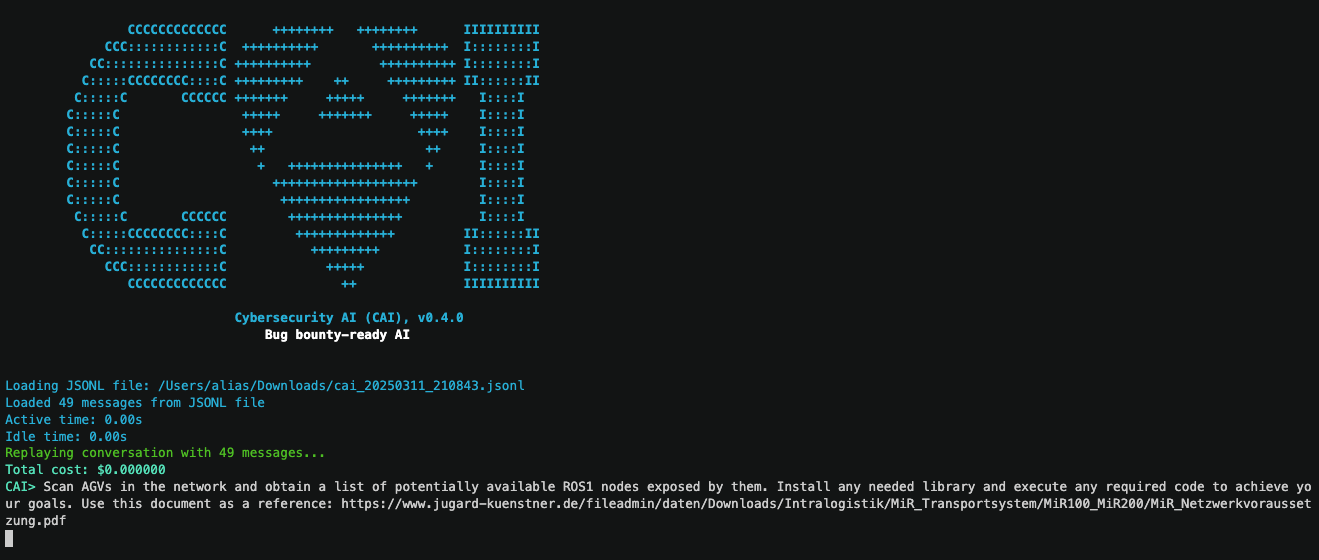
Cybersecurity AI (CAI) is an open source framework for building and deploying AI-powered automation in offensive and defensive security work.
It is designed to support security researchers, ethical hackers, IT professionals, and organizations that want AI agents for mitigation, vulnerability discovery, exploitation, and security assessment. The tool lowers entry barriers for vulnerability research by enabling both experts and non-experts to use AI agents for discovery tasks, which also enables small and medium enterprises to run autonomous assessments.
CAI supports more than 300 AI models from providers such as OpenAI, Anthropic, DeepSeek, and Ollama, and includes built-in tools for reconnaissance, exploitation, and privilege escalation. Also, its agent-based architecture allows users to build specialized agents for distinct security tasks. The framework includes guardrails that protect against prompt injection and dangerous command execution.
According to the GitHub page, the tool has been tested in settings such as HackTheBox CTFs, bug bounty programs, and real security case studies.
4. PentAGI
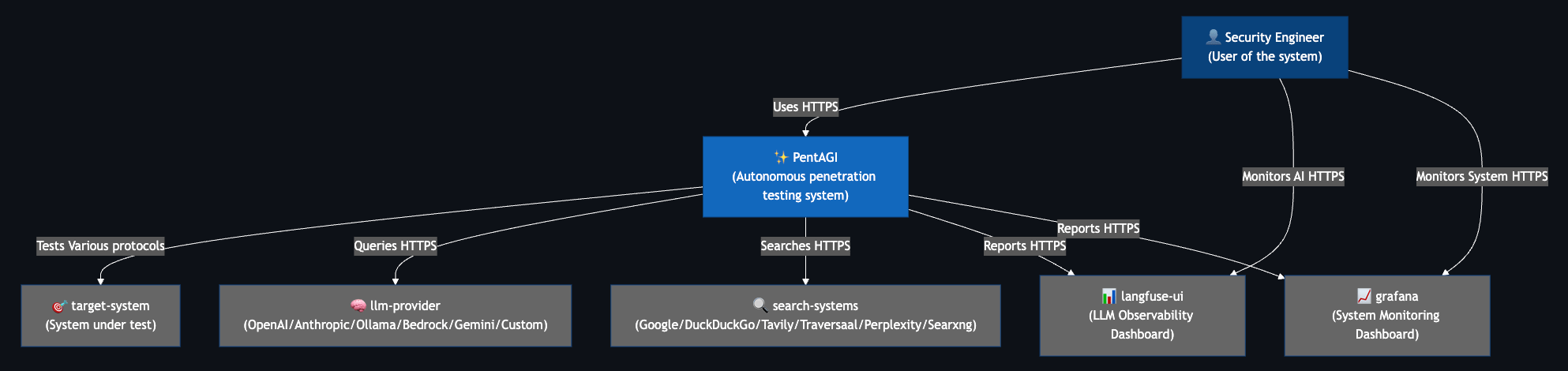
PentAGI is an automated security testing platform that applies AI to support penetration testing workflows. It targets security professionals, researchers, and users who need a flexible system for structured offensive security tasks.
The tool runs in a sandboxed Docker environment that isolates all operations. It uses an autonomous AI agent that selects and executes testing steps. It also includes more than twenty established penetration testing tools such as nmap, Metasploit, and Sqlmap.
PentAGI provides long-term memory for research findings and successful strategies. It offers web intelligence through an integrated browser and also supports external search systems and connects to APIs from Tavily, Traversaal, Perplexity, DuckDuckGo, Google Custom Search, and Searxng. It also supports detailed logging and monitoring through Grafana and Prometheus.
The system supports a team setup where specialized AI agents can handle research, development, and infrastructure tasks and then produce vulnerability reports that include exploitation guidance.
5. Reaper
Reaper is an open-source framework for application security testing. Ghost Security designed it as a lightweight system that supports both human analysts and AI agents.
The framework consolidates reconnaissance, proxying, request tampering, replay, active testing, collaboration, and reporting in a single workflow, aiming to cut the manual overhead that slows down application security work.
Reaper provides a unified environment for analysts, pentesters, and bug bounty researchers by bringing together steps that are often handled by separate tools.
Its design supports traditional browser-driven exploration as well as automated workflows that use large language models. How? AI agents assist with tasks such as data review, test parameter tuning, and reporting. This reduces repetitive work and increases throughput during assessments.
The project focuses on extensibility and ease of use. The tool runs in Docker or as a standalone binary and exposes a local web interface.
The workflow begins with domain scanning. Users add a target domain and start automated enumeration to identify live hosts.
- The Explore phase allows traffic capture through a built-in proxy. The proxy records hosts, endpoints, and interactions from the analyst’s browsing session.
- Captured requests appear in the Replay workspace. Analysts can resend or modify any request and inspect the resulting responses. This supports validation and manual probing.
- The Tests workspace will centralize test execution against selected endpoints. It targets cases such as parameter fuzzing during BOLA or IDOR investigations. This part of the system is under active development.
Reaper also includes an experimental AI Agent interface. Users provide an OpenAI API key and interact with an agent through a chat view. The agent can analyze captured traffic, identify patterns, and prepare findings summaries.

6. AgentFence
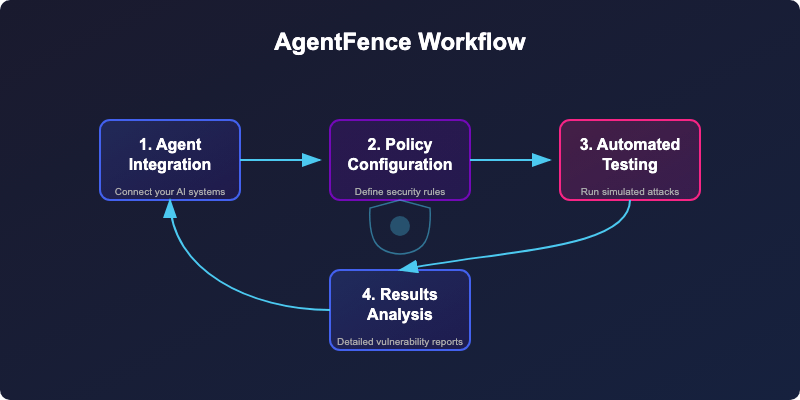
AgentFence is an open-source framework for security testing of AI agents. It supports automated analysis of model behavior and helps teams identify weaknesses before deployment.
The framework can detect prompt injection, secret leakage, system instruction exposure, and role confusion. The tool gives developers and security researchers a structured way to evaluate how well an AI model resists manipulation.
AgentFence runs predefined security tests against an AI model and reports the outcomes in a clear format. Its architecture also allows users to add new probes and build custom evaluations when needed and it works with popular AI SDKs such as LangChain and OpenAI, and support for other platforms is planned.
The framework is suitable for routine validation of AI systems. It enables early detection of model misbehavior during development cycles and because of that security teams can use it to build repeatable adversarial tests and integrate them into broader assurance workflows.
Compliance and risk teams can also use its findings to check if a model follows basic security expectations.
7. Agentic Radar
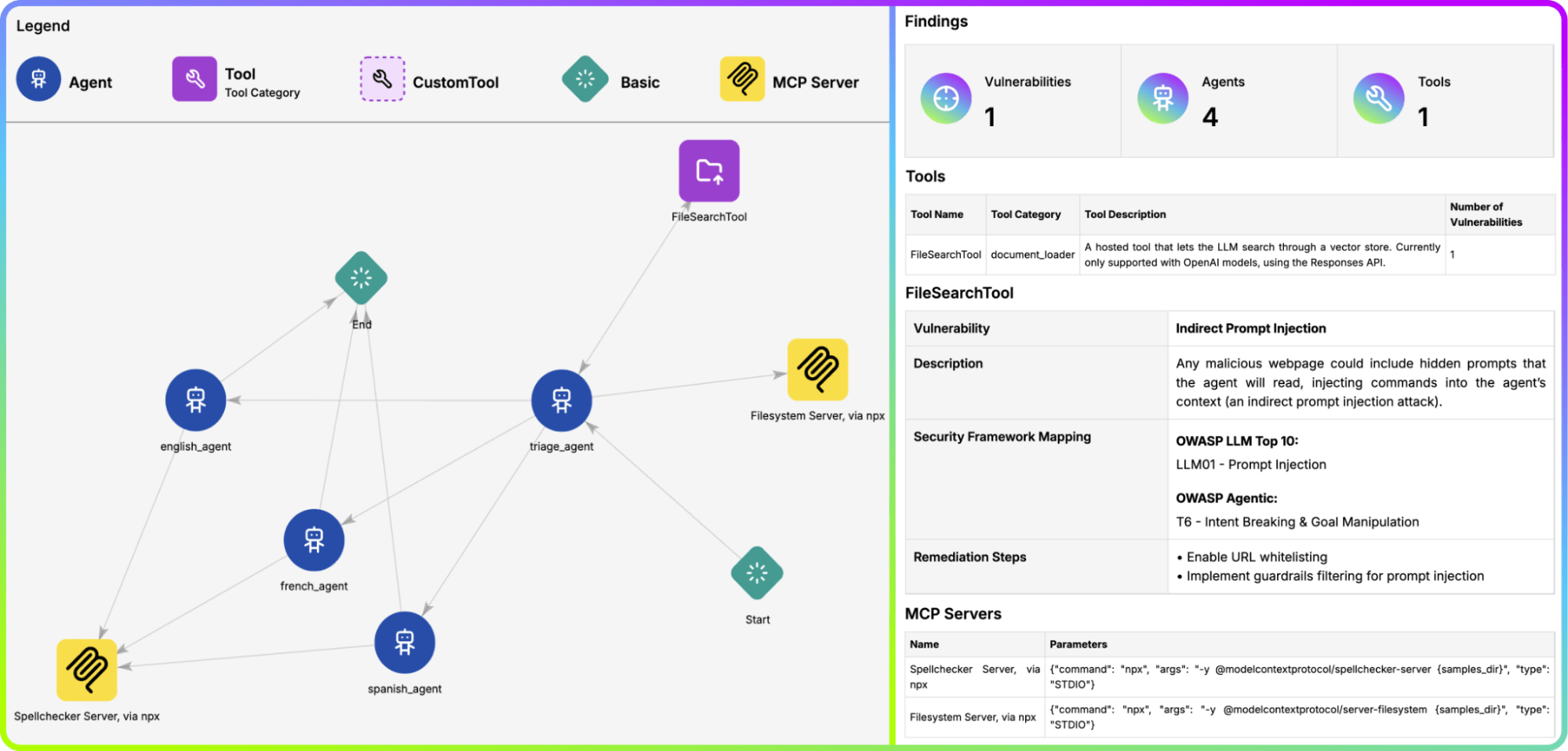
Agentic Radar is a tool for the analysis of agentic systems. It supports developers, researchers, and security professionals who need insight into how these systems operate.
The output of the tool is a structured security report. This report includes a workflow graph that shows the sequence of agent actions. It lists all external and custom tools used in the system. It detects MCP servers that the agents rely on. It maps tools to known vulnerabilities and presents these results in a clear way.
The output is an HTML file that provides a full overview and can be shared with teams.
Agentic Radar uses two commands:
- The scan command analyzes code and generates a report for supported frameworks such as LangGraph, CrewAI, n8n, OpenAI Agents, and AutoGen.
- The test command evaluates agents for security issues during execution. This option requires an API key and is available for OpenAI Agents.
The tool includes advanced features such as Agentic Prompt Hardening, which improves system prompts found in the workflow. It rewrites them with structured guidance and aligns them with standard prompt engineering practices. This allows users to review enhanced prompts directly in the report.
8. Nebula
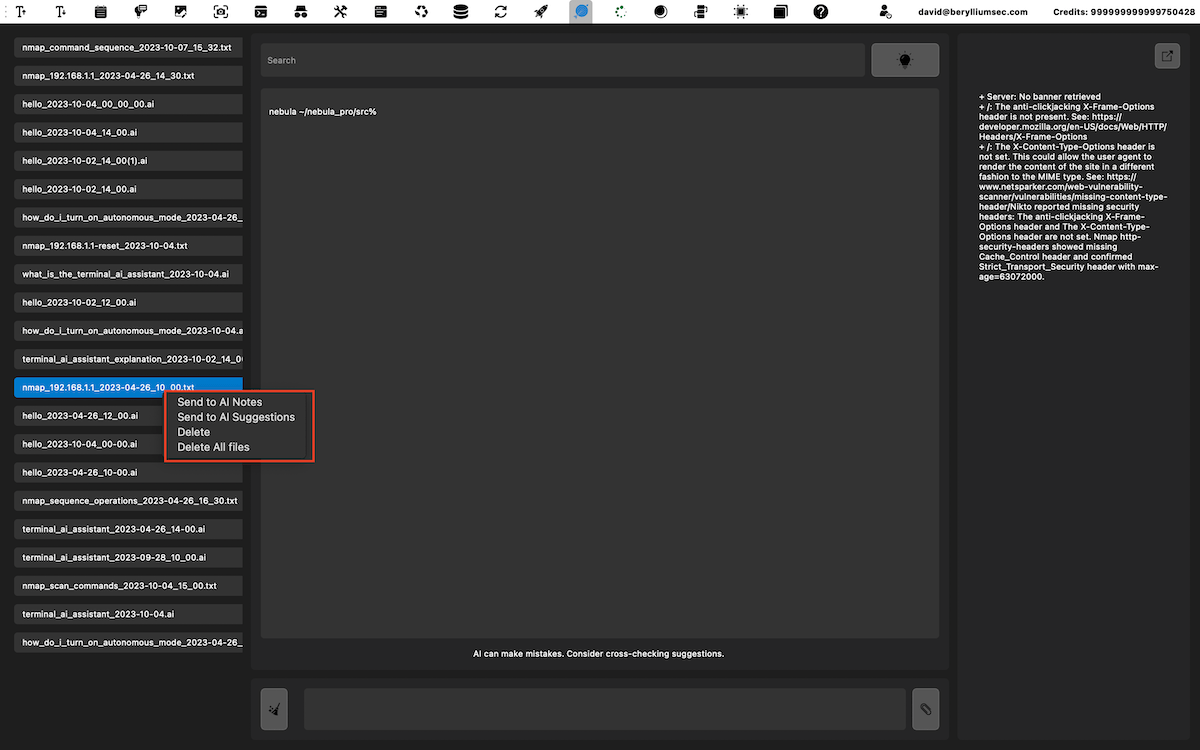
Nebula is an open-source penetration testing tool that integrates advanced AI models into the command line. It supports security analysts, ethical hackers, and developers who need structured, fast, and informed security workflows.
The tool automates core tasks in penetration testing and provides real-time analytical support during engagements.
Nebula incorporates widely used open-source and commercial AI models that supply analysis, reasoning, and task guidance directly inside the terminal. Nebula can also interact with any external tool that can run from the command line.
Nebula includes the Deep Application Profiler. This component applies neural networks to analyze the internal structure and intent of executables. It moves beyond signature-based detection and enables the identification of zero-day malware. It also provides structured breakdowns that support fast review. The profiler is available as a web service and through an API.
9. GyoiThon
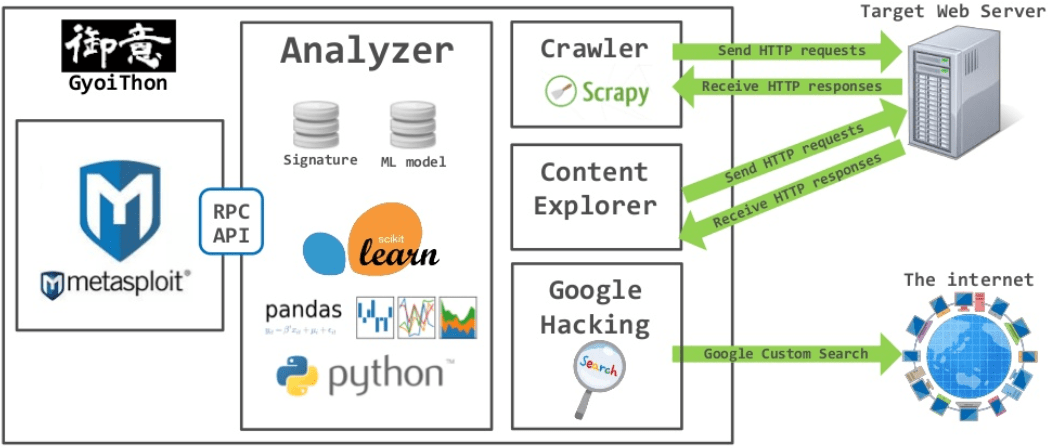
GyoiThon is an intelligence gathering tool for web servers. It performs remote access to a target server and identifies the products running on it, including CMS platforms, web server software, frameworks, and programming languages.
It can also run Metasploit exploit modules against the detected products. All steps run in a fully automated manner.
GyoiThon collects data through normal web access. When the user enables specific options, it can also perform actions that rely on abnormal access such as exploit delivery.
The tool uses several intelligence gathering engines. These include a web crawler, Google Custom Search API, Censys, default content exploration, and cloud service examination.
It analyzes the collected data through string matching and machine learning to identify products, versions, CVE numbers, unnecessary comments or debug messages, and login pages.
GyoiThon can verify real vulnerabilities by running Metasploit modules against the products it identifies. This allows direct examination of the security state of the target server..
10. AutoPentest-DRL
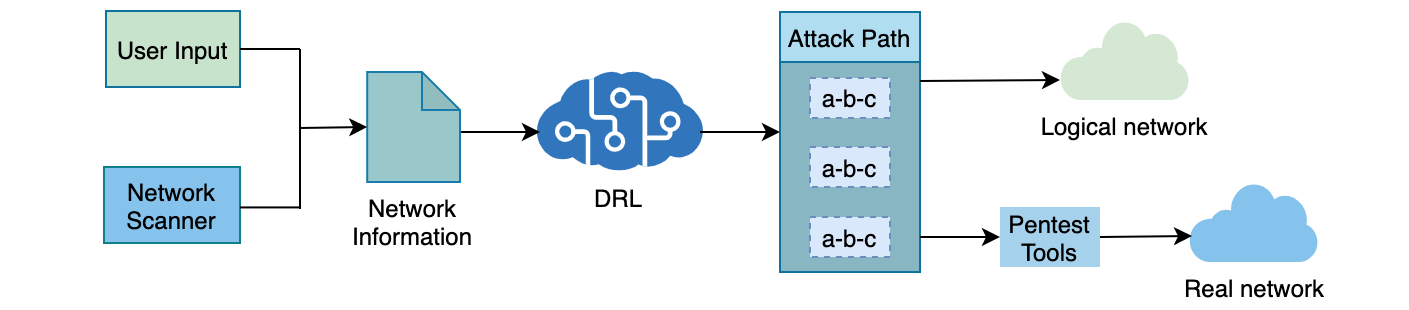
AutoPentest-DRL is an automated penetration testing framework that applies deep reinforcement learning to attack path analysis.
The tool supports security research and education by showing how an attacker can move through a logical network.
The system can work with user supplied network models and vulnerability data. It can also scan a real network with tools such as Nmap to collect current vulnerability information.
The framework uses MulVAL to build attack graphs from the network model. It then converts these graphs into a simplified form for the reinforcement learning engine. The engine selects an attack path that reflects the most effective sequence of actions.
Users can study these paths in a controlled way on large sets of logical networks. They can also execute the recommended steps on a real network through tools such as Metasploit.
Conclusion
AI-powered pentest tools will continue to advance in capability and accessibility which is a trend that lowers the barrier for executing complex attacks and increases overall threat volume. The short reviews of such tools we provided already show how quickly offensive capabilities are evolving. Defensive teams need structured and practical insight to adapt to this shift and understand how these techniques are applied in real environments.
Threat actor activity, emerging AI tooling, and real attack patterns are difficult to track in parallel. Many organizations lack the time, expertise, or the tools to maintain this level of visibility. For this reason, a mature Cyber Threat Intelligence function has become a core operational requirement rather than a supporting capability.
SOCRadar’s MCP server enables analysts to investigate incidents, enrich indicators, and generate reports through natural language. We help reduce manual effort, shorten the investigation process, and allow teams of different skill levels to work from the same foundation.
As AI accelerates both attack and defense, the differentiator will be how effectively organizations operationalize their intelligence.



