

Oct 05, 2026
Table Of Content
Related Articles
Dark Web Profile: Blue Locker Ransomware
Sep 25, 2026
ShinyHunters Claims Access to FBI Systems
Sep 24, 2026

Clop Hack: ShinyHunters Hijacks Data Leak Site
Sep 21, 2026

Jul 29, 2026
11 Mins Read

Summarize with:
Dark Web Profile: Section9 Ransomware
Section9 or SECTION9, is a ransomware operation that skipped the slow, quiet build-up most new brands go through before any victim ever appears on a leak site. Within roughly 48 hours of first detection, the group had listed victims across a dozen countries and nearly twenty industry verticals. Whether that debut reflects a genuinely capable operation or a bulk-listing strategy designed to manufacture reputation is, at this stage, an open question.
This Dark Web Profile reviews what is currently assessed about Section9, its operating model, and the defensive priorities it warrants while under review.
Who Is Section9?
Section9 appears to have surfaced publicly on July 26, 2026, launching directly with an active Tor-hosted data leak site (DLS) rather than the slower forum-based recruitment pattern many Ransomware-as-a-Service (RaaS) brands follow ahead of a public debut. No earlier activity has been reliably linked to the group under this name, and no confirmed aliases, predecessor operations, or rebrand history have surfaced. As of this writing, the group’s leak-site activity and the victim claims built on top of it represent the only verifiable picture of the operation.
Section9 logo
Section9’s visible model follows the standard double-extortion pattern: data is claimed to be exfiltrated ahead of encryption, and non-paying victims are threatened with public disclosure under short negotiation windows. There is no confirmed evidence yet of a structured affiliate program, recruitment advertising, or revenue-sharing terms, so Section9 should currently be treated as an emerging operation of unconfirmed maturity rather than an established RaaS enterprise.
A few points are worth flagging before assigning the group more credibility than the evidence supports:
- The name likely echoes fiction rather than describing the actor: “Section9” mirrors Public Security Section 9, the fictional cyber-intelligence unit from Ghost in the Shell. Media-derived aliases are common in this space, so this is a plausible branding choice, but it has not been confirmed by the group, and no link to any known threat actor identity, nationality, or prior operation has been established. This should be read as an assessed observation, not an attribution.
- Some listed victims may not hold up under scrutiny: We assess Dark Web monitoring has flagged that listings attributed to Section9 include claims that could be unverified or fabricated, and recommends treating individual postings as unconfirmed until corroborated. A rapid, high-volume victim listing immediately after launch is a tactic other 2026 newcomers have used to manufacture the appearance of scale for affiliate recruitment. It is not, by itself, evidence of genuine operational maturity.
- The claims are not purely unfounded, either: Multiple independent trackers spanning several continents have corroborated the existence of the leak site and at least some of the individual claims, including encryption assertions tied to a Japanese software firm and a Brazilian fintech company. The realistic read is a mixed picture rather than a clean “credible” or “fake” verdict.
How Does Section9 Operate?
Section9’s visible workflow centers on a Tor-hosted DLS that names victims, states negotiation deadlines, and threatens data publication for non-payment, following the standard double-extortion playbook rather than anything novel. Our monitoring indicates that victim communication is routed through Tox messaging, consistent with current RaaS practice of avoiding centralized, more easily monitored negotiation channels.. External tracking also reportedly associates at least one Tox identifier with the group; this profile has not independently reproduced or verified it, and it remains unconfirmed pending corroboration.
The pace is the most distinctive feature so far: independent tracking shows an average gap of roughly one day between an alleged compromise and its public claim, and the group’s first-week victim count grew quickly across a wide geographic and sectoral spread. That combination (fast claim publication plus broad, unfocused targeting) points toward a specific working theory: it looks more consistent with converting a pre-existing pool of purchased access into public claims in bulk than with a slower, hands-on-keyboard intrusion campaign against each victim individually.
Defenders monitoring Section9 mentions should keep the same three categories separate that matter for any new leak-site actor: what the group itself has published, what external monitoring has reported about that publication, and what an affected organization has actually confirmed. For Section9, most currently available information sits in the first two categories.
Data Leak Site and Exposure Channel
The known exposure channel is a Tor-hosted (.onion) DLS attributed to Section9. External tracking describes the site as running on a standard Python web-server stack, listing victim names, industry classification, country, and a claimed compromise or posting date, alongside a negotiation deadline and Tox-based contact details. The same reporting describes countdown timers of roughly 1–30 days attached to victim entries, after which the site reportedly reveals withheld details or data, along with postings intended to serve as proof of exfiltration. This profile has not independently re-verified these structural details, so treat them as reported claims, not confirmed technical findings.
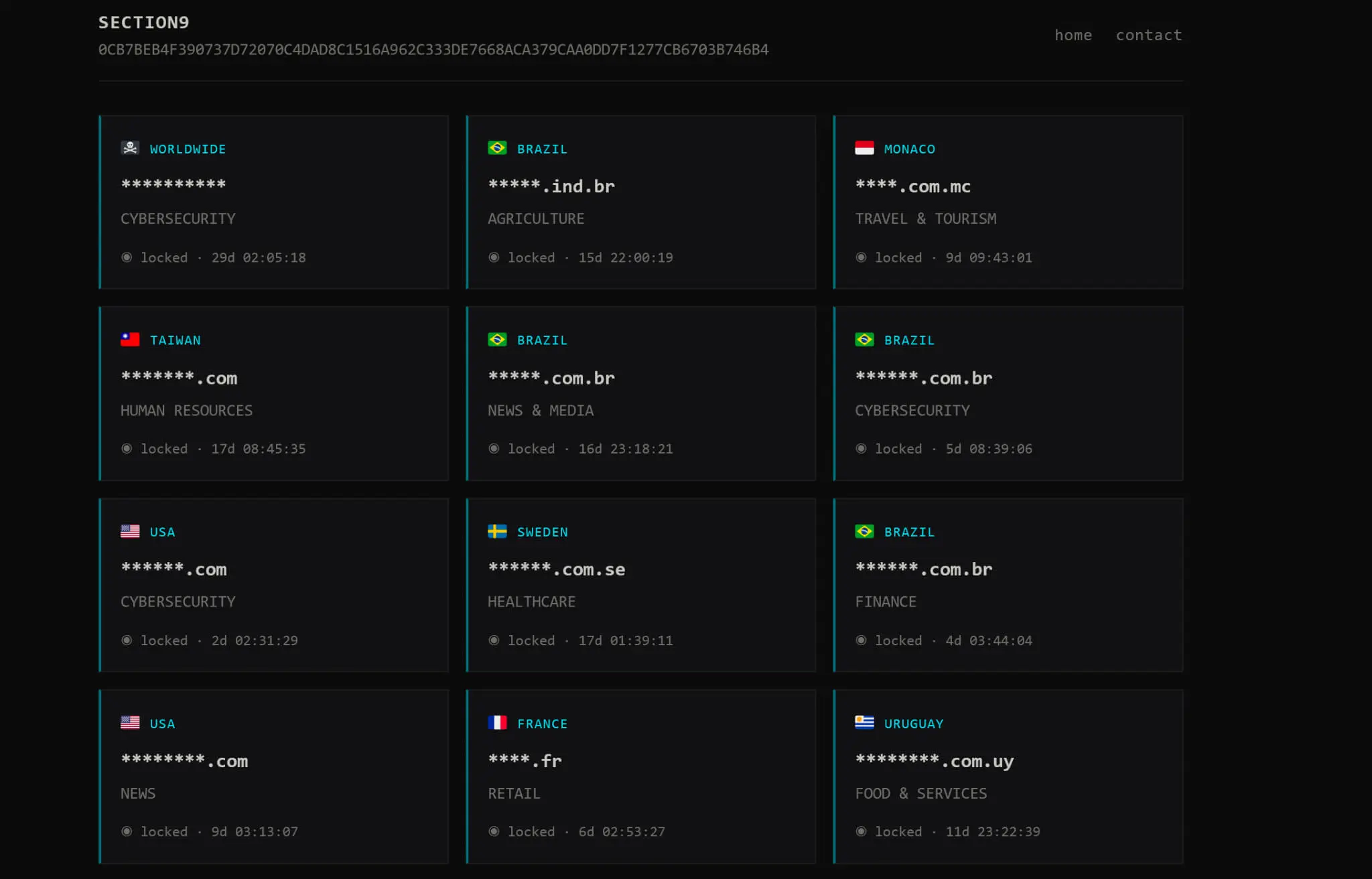
Section9 Data Leak Site
Primary evidence does not yet establish a confirmed encryptor family, file extension, or ransom-note filename for Section9, which is typical for an operation still in its first week of public visibility. Analysts expect technical detail to firm up as samples become available for reverse engineering.
What Are Section9’s Targets?
Section9’s claimed victims span at least a dozen countries and close to twenty industry categories, with no single sector or region accounting for a majority of activity apart from one clear geographic outlier.
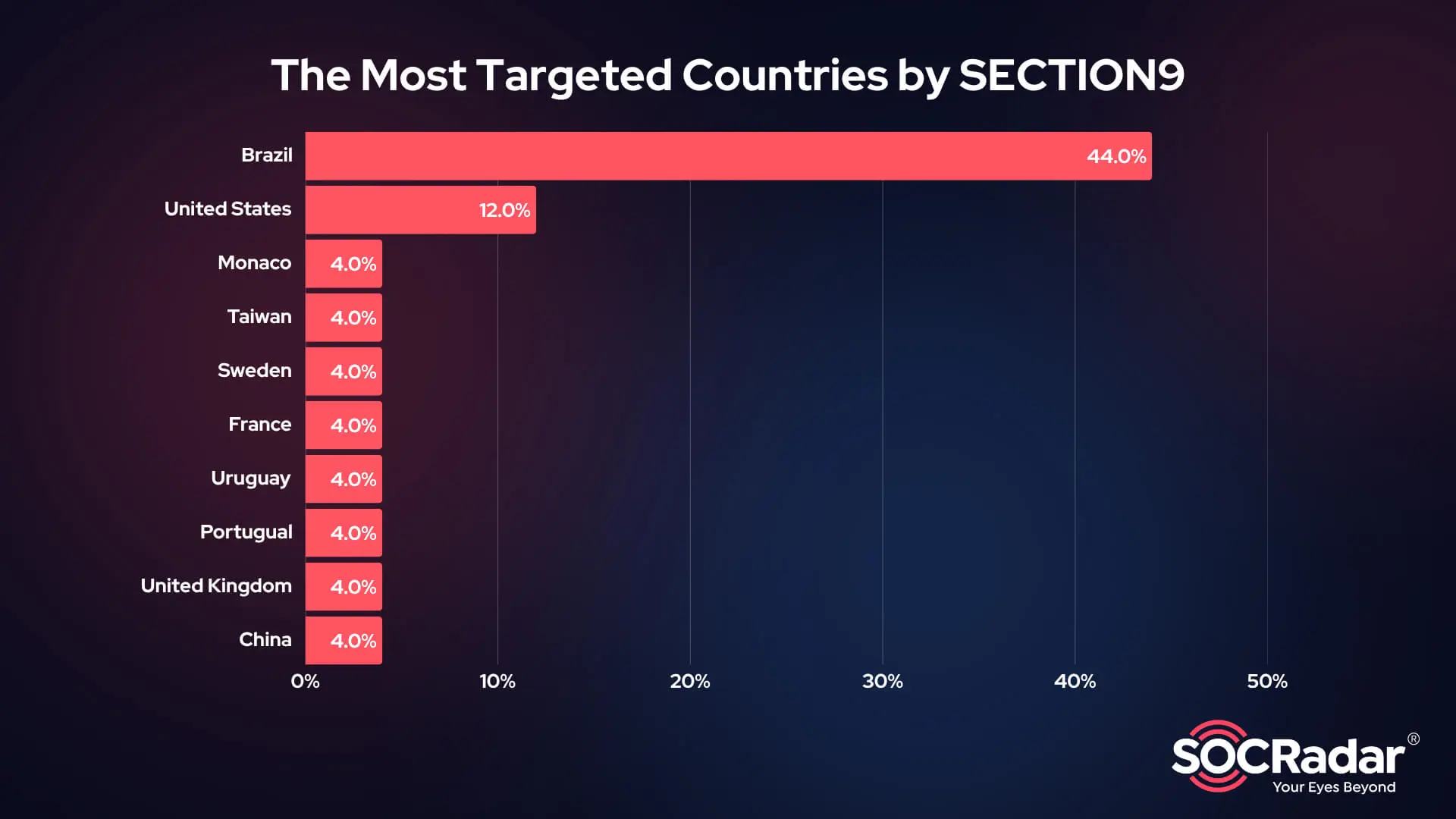
Top countries by claimed victim count
Brazil alone accounts for close to half of all claimed victims, an outsized share for a group whose claims otherwise span a dozen countries. That concentration is the strongest signal in the current dataset: it points to either a specific access broker or affiliate cluster with an existing foothold in Brazilian networks, or simply a market where compromised credentials and exposed remote-access services are more readily available for purchase right now. Every other country in the set shows only a single claimed victim, which reads as opportunistic overflow rather than a deliberate secondary target list.
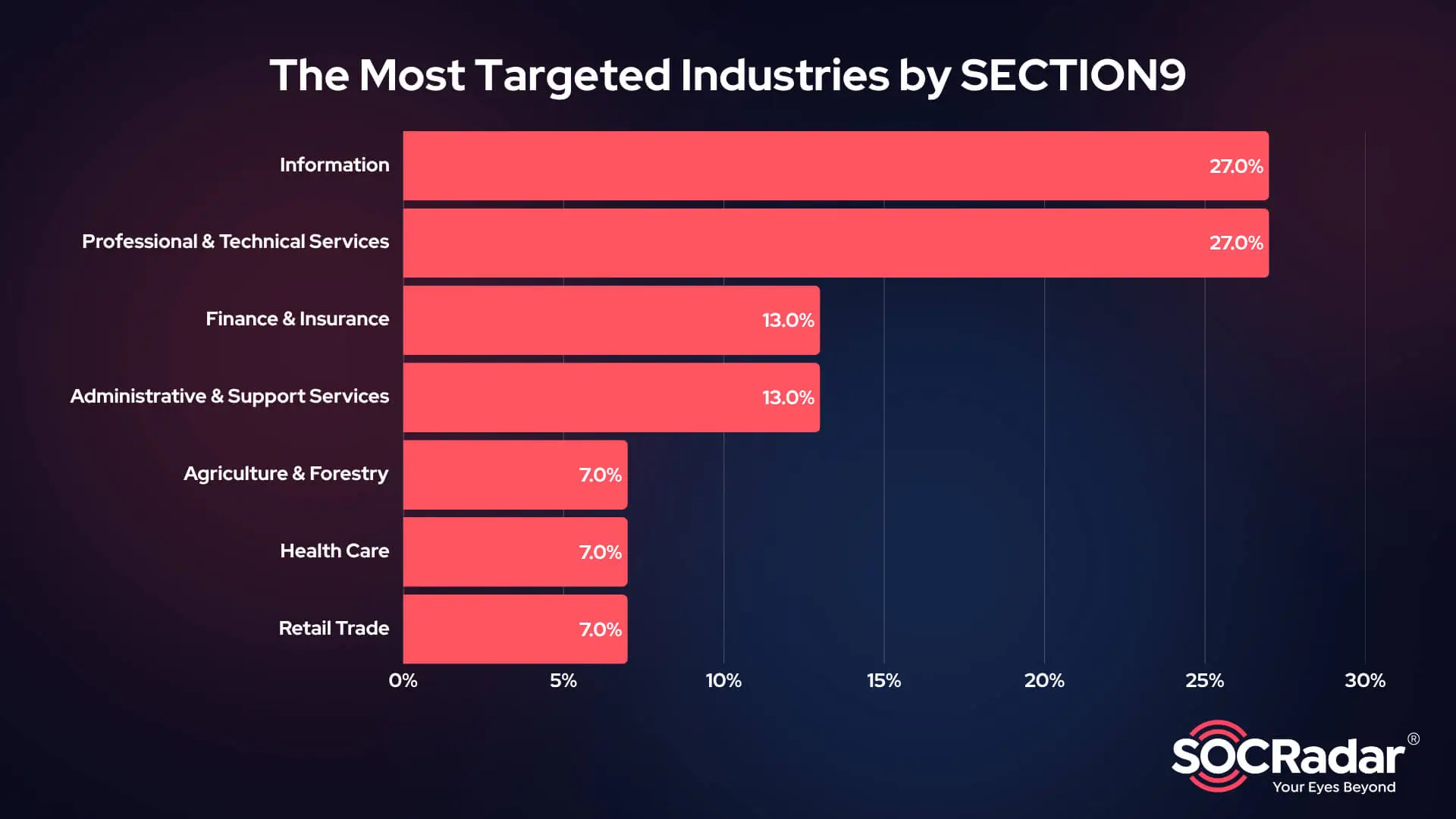
Top industries by claimed victim count
Unlike the country breakdown, the industry spread does not produce a dominant single vertical. Cybersecurity leads with four claims, which is a notable detail on its own: naming cybersecurity firms specifically is a common attention-seeking move for a new group trying to establish credibility with affiliates, since a claim against a security vendor carries more shock value than one against a generic manufacturer. Finance and telecom follow at two claims each, and the remaining sectors in the top 10 show only a single claim apiece, producing a long, flat tail rather than real specialization. Beyond the top 10, that tail continues with Food & Services, Education, Transportation, Mining, Media, Tax, Software, E-commerce, general Industry, and Fintech, each accounting for roughly 4% individually. Taken together with Brazil’s clear lead and the mild cybersecurity-sector concentration, the overall pattern still reads as opportunistic, broad-based targeting rather than a curated victim selection strategy.
What Are Section9’s Techniques?
Initial Access and Reconnaissance: No Section9-specific initial-access method is confirmed. Any mention of compromised remote-access credentials, phishing, or purchased access should currently be treated as a general hypothesis about how operations of this type typically gain a foothold, not as a validated, actor-attributed technique.
Encryption and Impact: Section9’s leak-site postings assert file encryption alongside data theft, consistent with a standard double-extortion model. However, no independently confirmed encryptor family, file extension, or ransom-note filename has been documented, and no Section9 sample has been publicly reverse-engineered as of this writing. The encryption claim itself should be treated as reported, not technically verified.
Publication and Leak Workflow: The observed workflow is a DLS that names alleged victims, states a negotiation deadline, and threatens data publication for non-payment. The publication burst began around July 26, 2026, with an average one-day gap reported between an alleged compromise and its public claim, though this cadence may shift as the operation develops. Defenders should prioritize validating individual claims against internal telemetry over assuming any particular intrusion chain.
No independently confirmed toolset, staging method, or exfiltration mechanism has been documented publicly for Section9 at this stage.
Context in the Broader Ransomware Landscape
Ransomware remains one of the most active categories of financially motivated cybercrime, and the RaaS model continues to lower the barrier for new brands to launch quickly and at scale. Section9 fits a recognizable pattern of 2026 newcomers that prioritize fast, visible activity over a slow reputation-building phase, a pattern SOCRadar has tracked before in profiles such as Krybit Ransomware, another opportunistic operation that scaled its victim count quickly after launch. Section9 is not, at this stage, comparable in scale, longevity, or affiliate infrastructure to longer-established groups such as Qilin or Akira, and it remains to be seen whether it sustains its early pace or fades as quickly as it appeared. What is clear is that the volume of near-simultaneous claims across a dozen countries indicates active, ongoing operations rather than a dormant or purely aspirational listing.
What Are the Mitigation Tactics Against Section9?
Section9’s technical details remain unconfirmed, but its leak-site claims still carry real risk: publication alone can trigger regulatory and notification obligations, and named organizations face follow-on risks like credential-reuse attempts and social engineering. Validate before treating any claim as a confirmed breach.
Validate and Prioritize
- Validate DLS claims against identity-provider, VPN, endpoint, and backup/recovery telemetry rather than treating a leak-site posting as confirmed fact.
- Prioritize systems holding the data categories in Section9’s claimed victim set, including financial, healthcare, and customer records.
Harden Access and Monitor Activity
- Audit remote-access exposure and enforce multi-factor authentication (MFA) on VPN, RDP, and other externally reachable services, since credential-based and RDP-facing intrusion is the most common RaaS entry point industry-wide.
- Monitor privileged-account activity for unusual access, scheduled-task creation, or large-volume queries.
- Watch for shadow-copy deletion and other recovery-inhibiting commands, a common pre-encryption signal across ransomware generally.
Protect Backups
- Maintain offline, immutable, and regularly tested backups.
Prepare Communications and Track Indicators
- Prepare breach-communication templates for claims touching financial, healthcare, or other regulated data.
- Track the reported Tox contact channel, but treat current leak-site infrastructure as temporary, since operations like this frequently rotate it.
How Can SOCRadar Help?
SOCRadar Threat Intelligence’s Ransomware Intelligence tracking follows Section9’s victim listings, targeted sectors, and technique classifications in real time as the group’s activity evolves, helping teams distinguish confirmed incidents from unverified leak-site claims.
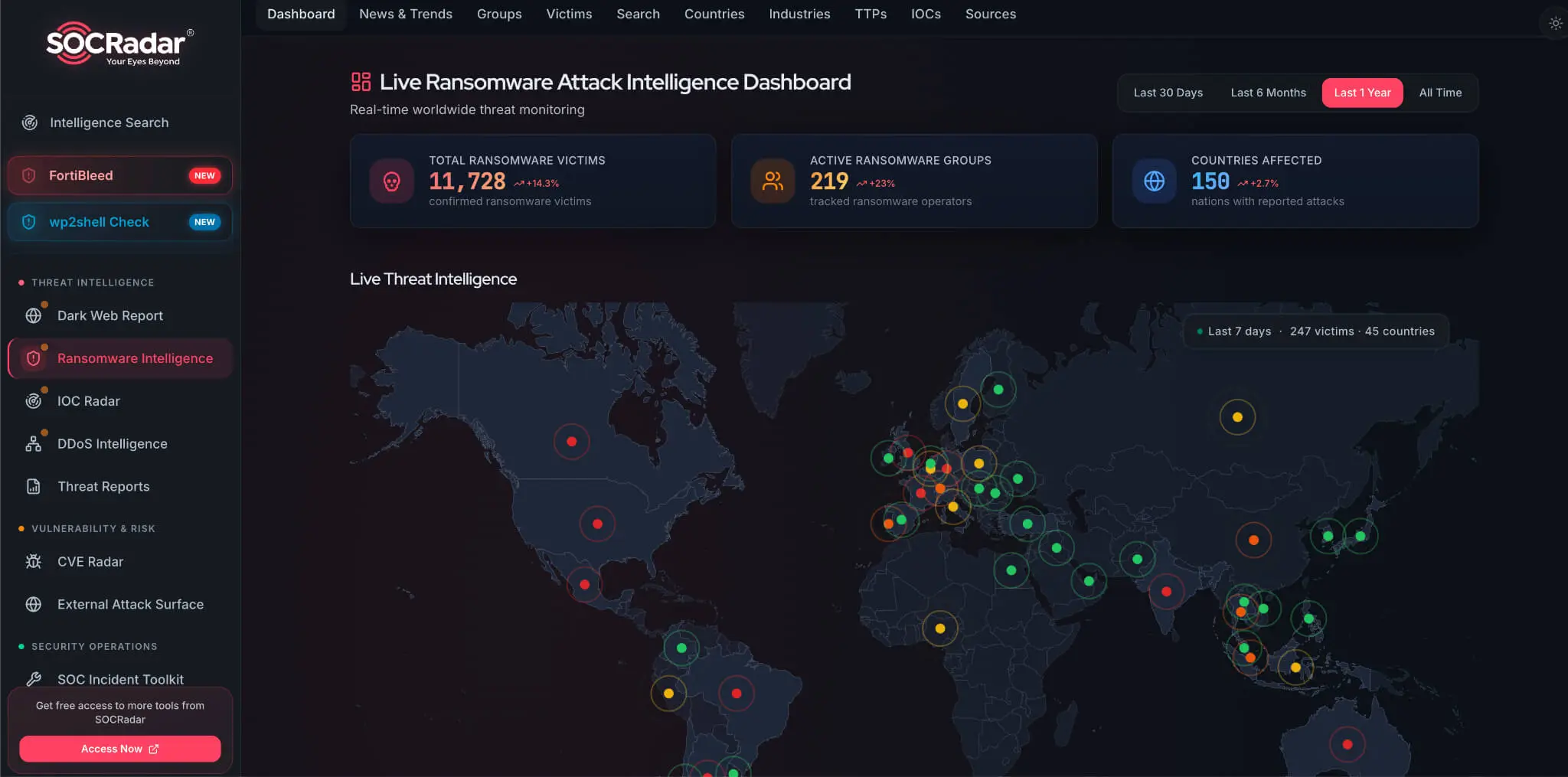
SOCRadar Free Tools Ransomware Intelligence
Its Advanced Dark Web Monitoring (ADWM) module surfaces new Section9 postings and leak-site infrastructure changes as they happen, rather than after public disclosure. For organizations concerned about credential- and RDP-facing exposure generally, SOCRadar’s Attack Surface Management module can identify exposed remote access services and stale or overly permissive accounts before they become an initial access point.
Conclusion
Section9 currently sits in the loud, unproven phase common to brand-new RaaS operations: broad, fast, cross-sector victim listing dominated by Brazilian entities; a leak-site model that asserts encryption and data theft without independently confirmed technical detail; and a credibility picture that is genuinely mixed, with real corroborated incidents sitting alongside listings flagged as possibly unverified. Because the group is so new, this profile deliberately avoids asserting a confirmed intrusion chain where none exists, leaning instead on the limited technique classification currently available and flagging it as preliminary. The responsible posture for now is active monitoring rather than either dismissal or overreaction: treat individual claims as unconfirmed until corroborated, and track whether the group’s activity develops into a sustained operation or fades as quickly as it appeared. This profile reflects a snapshot as of July 28, 2026, and will be revisited as claims are verified, disproven, or supported by new technical evidence.