What Is a Threat Actor?
A threat actor is a person, group, organization, or state-linked entity with the intent and capability to harm a digital environment. The term can describe an external attacker, malicious insider, criminal service, hacktivist collective, espionage group, or another operator behind malicious activity.
Actor names are analytical labels, not guaranteed legal identities. Different security vendors may assign different names to overlapping activity, while one operator may change brands or share tools with others. Defenders should track behavior, infrastructure, victimology, and confidence rather than rely on aliases alone.
Key Takeaways
- Cybercriminals and criminal service providers is one important form or technique.
- Detection depends on correlated technical and operational context.
- Prevention should reduce both initial access and post-compromise impact.
- Response must preserve evidence and remove every reusable access path.
How a Threat Actor Works
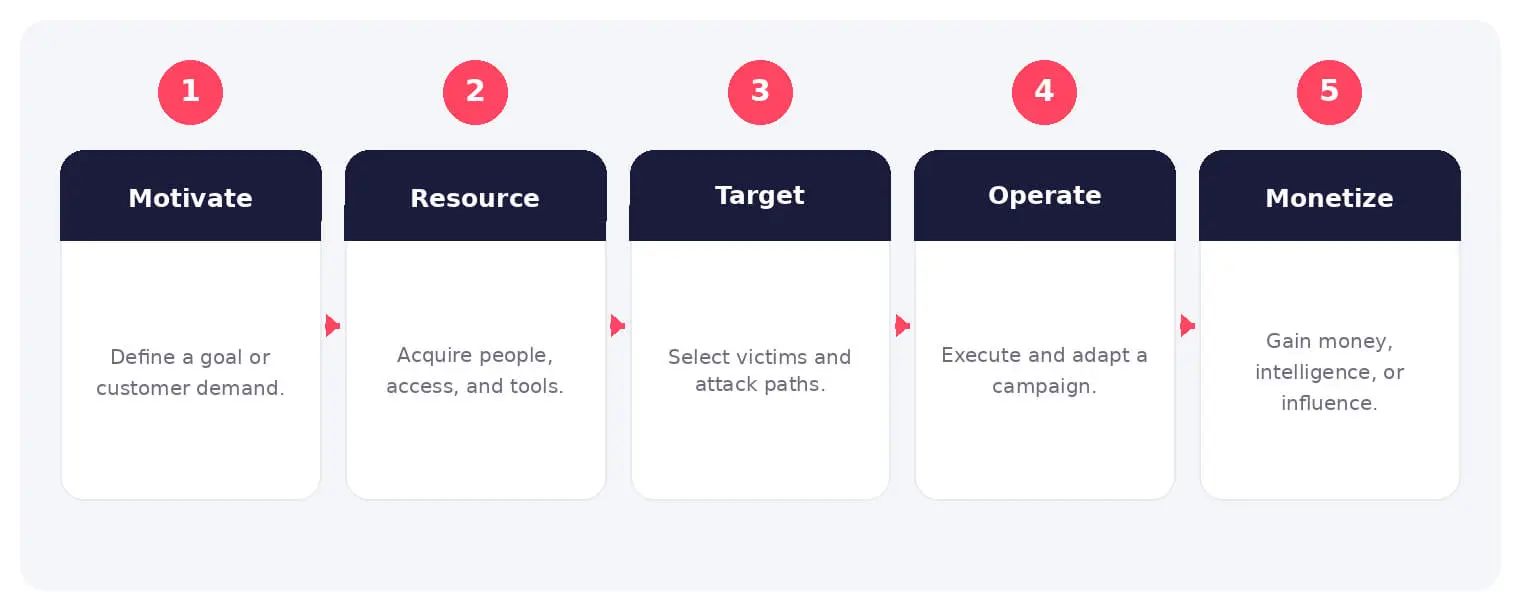
The sequence shown above is not mandatory in every case, but it provides a practical way to connect initial opportunity with the actor’s objective. Individual steps may occur in parallel, repeat, or be completed by different participants.
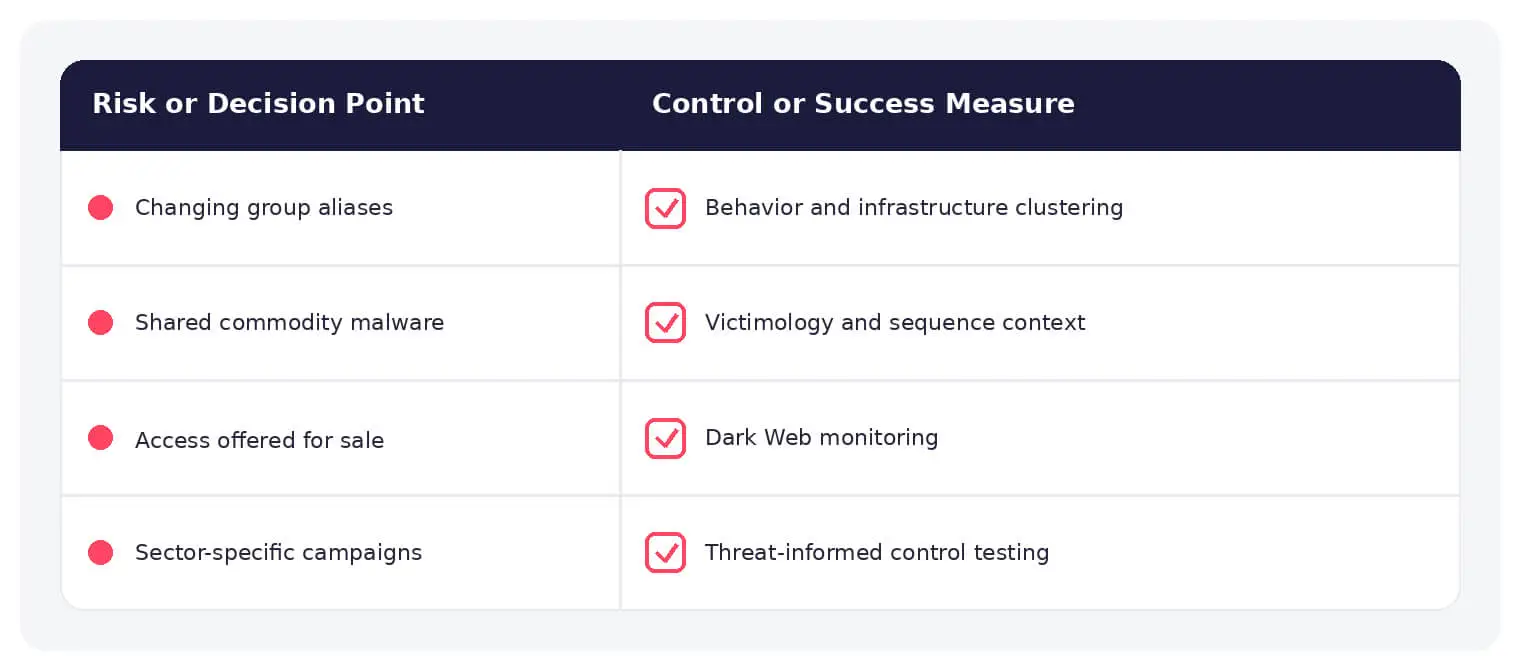
Actor names are analytical labels, not guaranteed legal identities. Different security vendors may assign different names to overlapping activity, while one operator may change brands or share tools with others. Defenders should track behavior, infrastructure, victimology, and confidence rather than rely on aliases alone.
Common Types and Techniques
- Cybercriminals and criminal service providers
- Nation-state and state-aligned operators
- Hacktivists and ideologically motivated groups
- Malicious insiders and compromised trusted users
Security and Business Risks
- Theft, fraud, extortion, and operational disruption
- Espionage and intellectual property loss
- Brand abuse, influence, and public pressure
- Repeated targeting based on sector, region, or technology
Warning Signs and Detection
Track TTPs, infrastructure, malware, targeting, marketplace activity, access sales, and public claims. Distinguish a stable behavioral cluster from a temporary campaign name and document competing attribution hypotheses.
Prevention and Response
Prioritize actors whose intent and capability overlap with the organization. Map their likely techniques to exposed assets and controls, build behavioral detections, and update assumptions when evidence changes.
How SOCRadar Can Help
SOCRadar combines external asset visibility, threat intelligence, Dark Web monitoring, vulnerability context, and indicator enrichment to help teams identify exposure and investigate activity connected to threat actor.
Explore SOCRadar Cyber Threat Intelligence or request a demo to strengthen threat-informed prevention and investigation.
Frequently Asked Questions
What Counts as a Threat Actor in Cybersecurity?
A threat actor is any person, group, or state-linked entity with both the intent and the capability to harm a digital environment. The label covers external attackers, malicious insiders, hacktivist collectives, espionage teams, and criminal service providers. Names used in reports are analytical labels rather than confirmed legal identities.
Is an Advanced Persistent Threat (APT) the Same as a Threat Actor?
No. APT describes a class of activity — sophisticated, persistent operations that are often state-linked — not every operator behind an intrusion. A financially motivated ransomware crew is a threat actor without meeting the APT bar, while a single espionage group may be tracked across many campaigns. The terms describe scope and sophistication, not interchangeable categories.
What Motivates Different Threat Actor Types?
Profit drives cybercriminal activity such as ransomware, fraud, and access sales. Nation-state teams pursue espionage and strategic disruption, hacktivists act on ideology or publicity, and insiders may be moved by grievance, coercion, or carelessness. Some operators blend motives, for example criminal groups that frame data leaks as political statements.
How Do Threat Actors Typically Gain Initial Access?
Common entry paths include phishing and credential harvesting, credentials pulled from infostealer logs, unpatched internet-facing vulnerabilities, exposed remote services, footholds purchased from brokers, and compromised third parties or software supply chains. Which path an actor uses depends on its skill, budget, and the target’s attack surface. Most intrusions rely on a small set of well-worn techniques rather than novel exploits.
Who Are Initial Access Brokers?
Access brokers obtain footholds such as VPN credentials, stolen session cookies, or backdoored accounts and sell them to other operators, frequently ransomware affiliates. This specialization means the group that breaches a network may not be the one that monetizes it. Underground access listings can signal that a network is being marketed before the follow-on attack appears.
Why Do Security Vendors Assign Different Names to the Same Activity?
Each vendor clusters activity with its own telemetry and rules, weighing infrastructure, tooling, victimology, or timing differently. The result is several aliases that may point to overlapping activity sets, and one operator may rebrand or share tooling with others. Treat names as references to assessed clusters and compare observed behavior and infrastructure before merging or separating activity.
What Warning Signs Point to a Specific Threat Actor?
Recurring TTPs, overlapping infrastructure, familiar malware families, consistent victimology, and campaign timing can link new activity to a known cluster. Chatter in underground marketplaces, posted access listings, or public leak claims can add corroborating context. Correlate several independent signals rather than relying on a single indicator or alias.
How Reliable Is Threat Actor Attribution?
Attribution is an assessment based on evidence, not a proven fact. Shared tooling, rebranded groups, and deliberate false flags can mislead analysts, and organizations working from the same evidence may reach different confidence levels. Document competing hypotheses and revise them as new indicators and context emerge.
What Should Incident Response Cover When a Known Actor Is Suspected?
Preserve forensic evidence before remediation, then remove every reusable access path: revoke active sessions and tokens, rotate credentials and keys where relevant, and clear persistence mechanisms, rogue accounts, and malicious inbox rules. Password resets alone may not end an intrusion if stolen sessions remain valid. Scope the investigation around the actor’s known techniques and what they could have reached in the environment.
How Can Organizations Reduce Exposure to the Actors That Matter Most?
Identify actors whose intent and capability overlap with your sector, region, and technology footprint, then map their common techniques to your exposed assets and controls. Closing those gaps with phishing-resistant MFA, timely patching of internet-facing systems, tighter remote-access controls, and monitoring of underground sources for leaked credentials shortens the window attackers have to operate. Revisit the actor list periodically, since groups evolve, rebrand, and shift targets.

Oct 27, 2026
Australia’s Annual Cyber Threat Report 2025-26 Shows Cyber Incidents Up 20%
Australia’s cyber security authority responded to 1,524 cyber security incidents in the 2025-26 financial year, a 20% increase from the previous year…

Oct 27, 2026
PHP2Shell Weaponized After Japanese Real Estate Extortion
An exposed server ties an extortion wave on about 20 Japanese property sites to an operator who later weaponized PHP2Shell (CVE-2026-109618, CVE-2026-109619)…

Oct 27, 2026
Wasmtime Sandbox Escape Flaws Patched in Cranelift
Two critical Wasmtime sandbox escape flaws, CVE-2026-115889 and CVE-2026-115893, let a crafted WebAssembly (Wasm) module push the Cranelift compiler into generating unsafe…
Intelligence in your inbox every Thursday.
Join 30,000+ security professionals reading SOCRadar research.
Subscribe