



Sep 24, 2026

Table Of Content
CVE-2026-20316: Cisco Secure FMC Static-Credential Flaw Exploited in Zero-Day Attacks
What Is CVE-2026-20316?
Which Cisco Secure FMC Software Versions Are Affected?
What Component Is Vulnerable, and Why Does It Matter?
How Could CVE-2026-20316 Be Exploited in Practice?
Is CVE-2026-20316 Actively Exploited?
How Can SOCRadar Help?
What Should Defenders Do Now?
Related Articles






Jul 30, 2026
6 Mins Read

Summarize with:
CVE-2026-20316: Cisco Secure FMC Static-Credential Flaw Exploited in Zero-Day Attacks
Cisco has confirmed that CVE-2026-20316 is actively exploited against Cisco Secure Firewall Management Center (FMC) Software.
The flaw has a CVSS 3.1 score of 5.3, which falls in the Medium range, while Cisco assigns it a High Security Impact Rating. Its operational risk is elevated because it requires no authentication, affects a management-plane product, and may provide access that attackers could combine with other FMC vulnerabilities.
This article covers the affected FMC release branches, the root cause, exploitation and public PoC status, available fixes, and detection guidance.
What Is CVE-2026-20316?
CVE-2026-20316 is a static credential vulnerability in the Cisco Secure FMC web interface that allows unauthenticated remote access via a built-in, low privilege account. Cisco maps the issue to CWE-259, Use of Hard-coded Password.
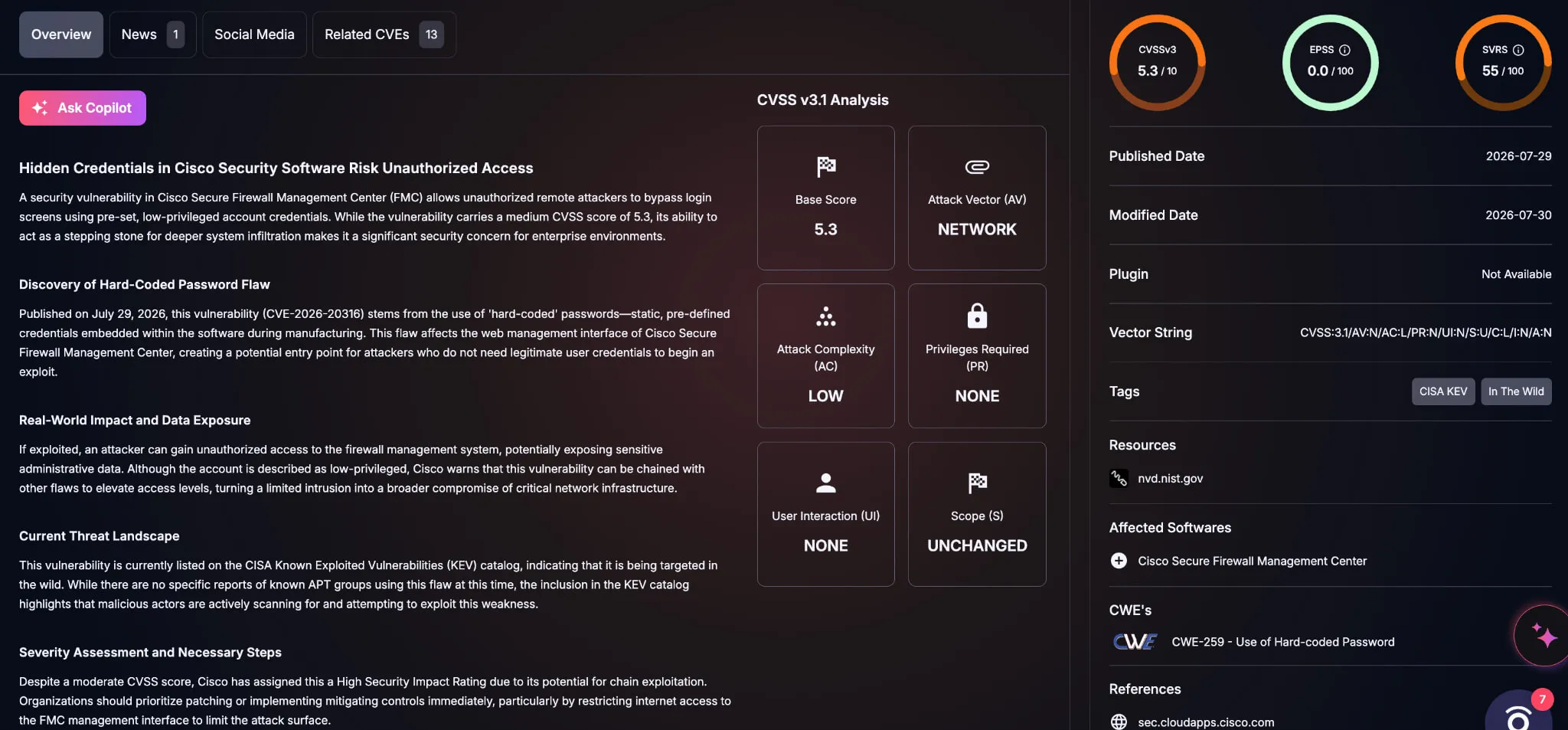
Details of CVE-2026-20316 (SOCRadar Vulnerability Intelligence)
The flaw is not described as a memory corruption or direct Remote Code Execution (RCE) issue. Its documented effect is unauthorized low privilege access and potential confidentiality loss. Cisco also warns that this access could be combined with other FMC vulnerabilities to elevate privileges.
While the CVSS score is 5.3, Cisco rates the vulnerability “High” due to active exploitation and the unauthenticated path into a security management component. The direct impact is confidentiality loss rather than code execution, though it still warrants urgent remediation.
Which Cisco Secure FMC Software Versions Are Affected?
The Cisco Secure FMC Software versions affected by CVE-2026-20316 include all release branches from 7.0 through 10.0 that have not yet applied the specific hot fixes. Cisco states that Secure FMC Software is affected regardless of device configuration. Administrators should use Cisco’s Software Checker and verify the fixed release for each deployment.
Cisco published hot fixes for these release branches:
| Affected Versions | Fixed In |
|---|---|
| 7.0 branch | Cisco_Firepower_Mgmt_Center_Hotfix_GB-7.0.9.1-3.sh.REL.tar |
| 7.2 branch | Cisco_Secure_FW_Mgmt_Center_Hotfix_HL-7.2.11.1-4.sh.REL.tar |
| 7.4 branch | Cisco_Secure_FW_Mgmt_Center_Hotfix_HG-7.4.7.1-3.sh.REL.tar |
| 7.6 branch | Cisco_Secure_FW_Mgmt_Center_Hotfix_CY-7.6.5.1-2.sh.REL.tar |
| 7.7 branch | Cisco_Secure_FW_Mgmt_Center_Hotfix_AM-7.7.12.1-2.sh.REL.tar |
| 10.0 branch | Cisco_Secure_FW_Mgmt_Center_Hotfix_P-10.0.1.1-2.sh.REL.tar |
Cisco lists these products as not affected:
- Cloud-Delivered FMC
- Firewall Device Manager
- Secure Firewall ASA Software
- Secure Firewall Threat Defense Software
- Security Cloud Control, formerly Defense Orchestrator
Organizations should not infer that a related Cisco firewall product is vulnerable simply because it connects to or is managed by FMC.
What Component Is Vulnerable, and Why Does It Matter?
The vulnerable component is the Cisco Secure FMC web interface, where a flaw in credential handling for CVE-2026-20316 allows attackers to bypass authentication using static, hard coded passwords. Because the credentials are static, an attacker does not need to obtain a legitimate user password before attempting access.
The prerequisite supported by Cisco’s description is network reachability to the affected FMC web interface. The attacker does not need prior authentication or user interaction. The resulting account has limited privileges, so the available information does not establish unrestricted administrative access from CVE-2026-20316 alone.
The management plane location increases the significance of the flaw. FMC can hold sensitive configuration and operational information for firewall environments. Unauthorized access could expose data and create a foothold for follow-on activity. Cisco’s warning about possible vulnerability chaining adds risk, although privilege escalation through this CVE alone has not been established.
How Could CVE-2026-20316 Be Exploited in Practice?
Exploiting CVE-2026-20316 in practice involves a remote attacker reaching the Cisco Secure FMC web interface and using built-in static credentials to gain unauthorized access. At a high level, the exploitation path is:
- An attacker identifies an FMC web interface reachable over the network.
- The attacker abuses static credentials associated with the built-in account.
- FMC grants access with that account’s low-level permissions.
- The attacker accesses sensitive information available to the account.
- If other weaknesses are present, the initial access may support a broader compromise attempt.
This sequence does not establish that every affected deployment exposes the same data or that every attack achieves privilege escalation. The direct outcome is unauthorized low privilege access to permitted sensitive data.
The lack of a required authentication step is important for prioritization. Exposing the management interface to untrusted networks increases the number of systems attackers can target, while restricting access can reduce exposure without correcting the underlying flaw.
Is CVE-2026-20316 Actively Exploited?
Yes. Cisco said its Product Security Incident Response Team became aware of active exploitation in July 2026 and strongly recommended upgrading to fixed software. Cisco published its security advisory on July 29, 2026.
We have not yet identified any credible public proof of concept or publicly available technical documentation. That does not establish that a private exploit or abuse method does not exist. Active exploitation confirms operational use by attackers, but it does not demonstrate that a reproducible public PoC is available.
How Can SOCRadar Help?
As CVE-2026-20316 undergoes active exploitation, maintaining visibility into management-plane exposure is critical for risk reduction. SOCRadar’s Cyber Threat Intelligence provides real-time monitoring of exploitation trends and new attack vectors associated with Cisco Secure FMC. Combined with Attack Surface Management (ASM), organizations can automatically identify vulnerable, internet-facing FMC assets and prioritize remediation efforts based on actual network reachability.
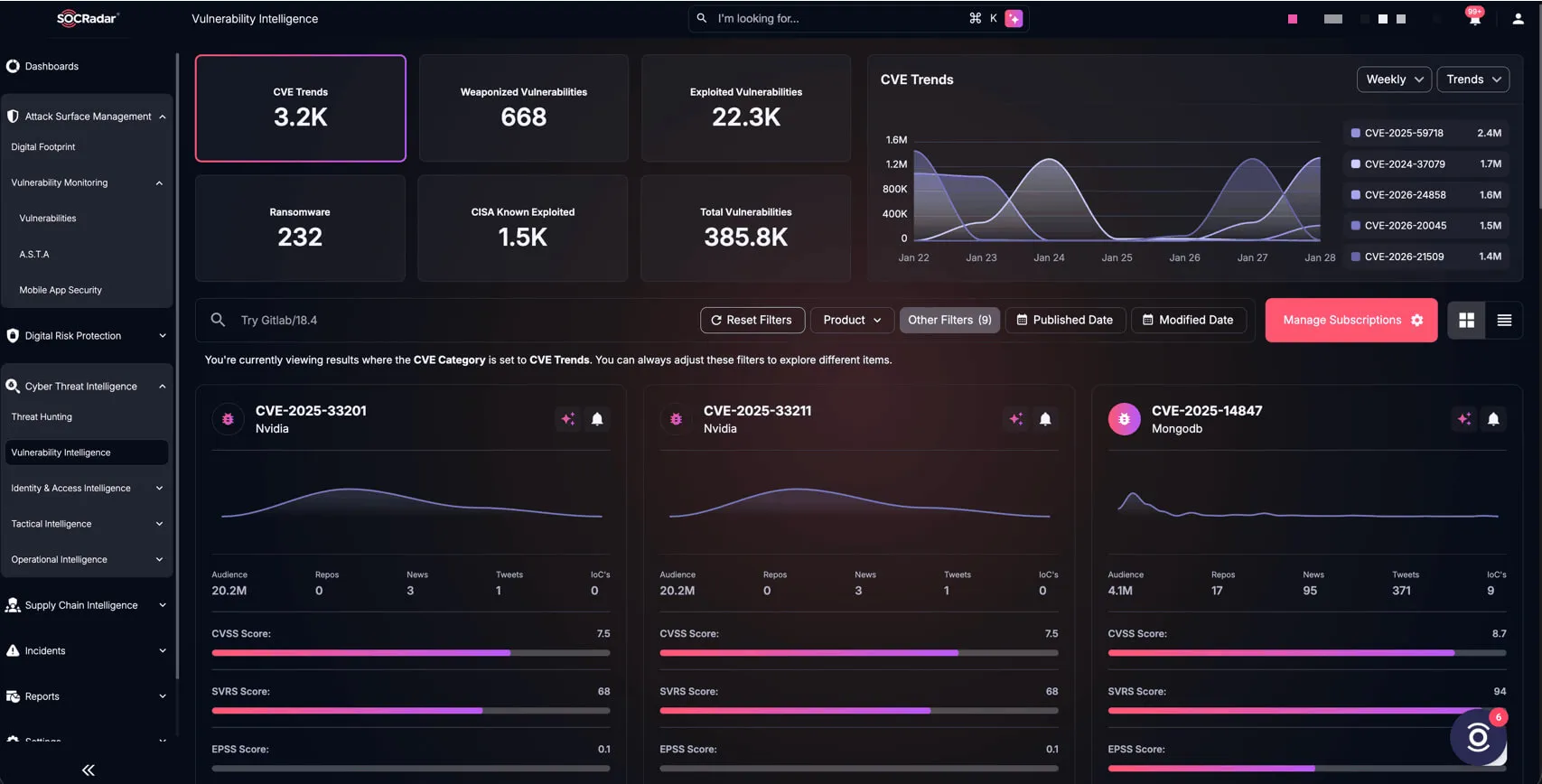
Track new CVEs & exposure with SOCRadar’s Vulnerability Intelligence
What Should Defenders Do Now?
To defend against CVE-2026-20316, security teams must immediately apply the relevant Cisco hot fixes to their Cisco Secure FMC deployments, as no official workarounds currently exist. The vendor recommends upgrading to fixed software.
Defenders should:
- Inventory all Cisco Secure FMC deployments, release branches, and network exposure.
- Use Cisco’s Software Checker to identify the correct fixed release for each system.
- Apply the appropriate hot fix as soon as operationally possible.
- Restrict FMC management interfaces from public or otherwise untrusted networks where feasible. Cisco states that this reduces the attack surface but does not replace patching.
- Review internet facing, externally reachable, and business critical FMC systems first.
- Treat exposed systems as potential incident response candidates until relevant logs have been reviewed.
- Contact Cisco TAC and rotate FMC user credentials, keys, and certificates if exploitation is suspected.
For detection, Cisco instructs administrators to review /var/log/messages in expert mode and search for license. An entry containing /var/tmp/license.tmp may indicate exploitation. Cisco provides this example:
sudo: www : PWD=/ ; USER=root ; COMMAND=/usr/local/sf/bin/package_info.pl /var/tmp/license.tmp –lsm
Security teams should search historical logs for any matches of the indicator and monitor for unexpected activity, such as unusual FMC logins, or suspicious outbound connections.