


Sep 28, 2026
Jul 29, 2026
5 Mins Read
Jul 30, 2026

Summarize with:
Russia Charges Pavel Durov: What It Means for Cybercrime
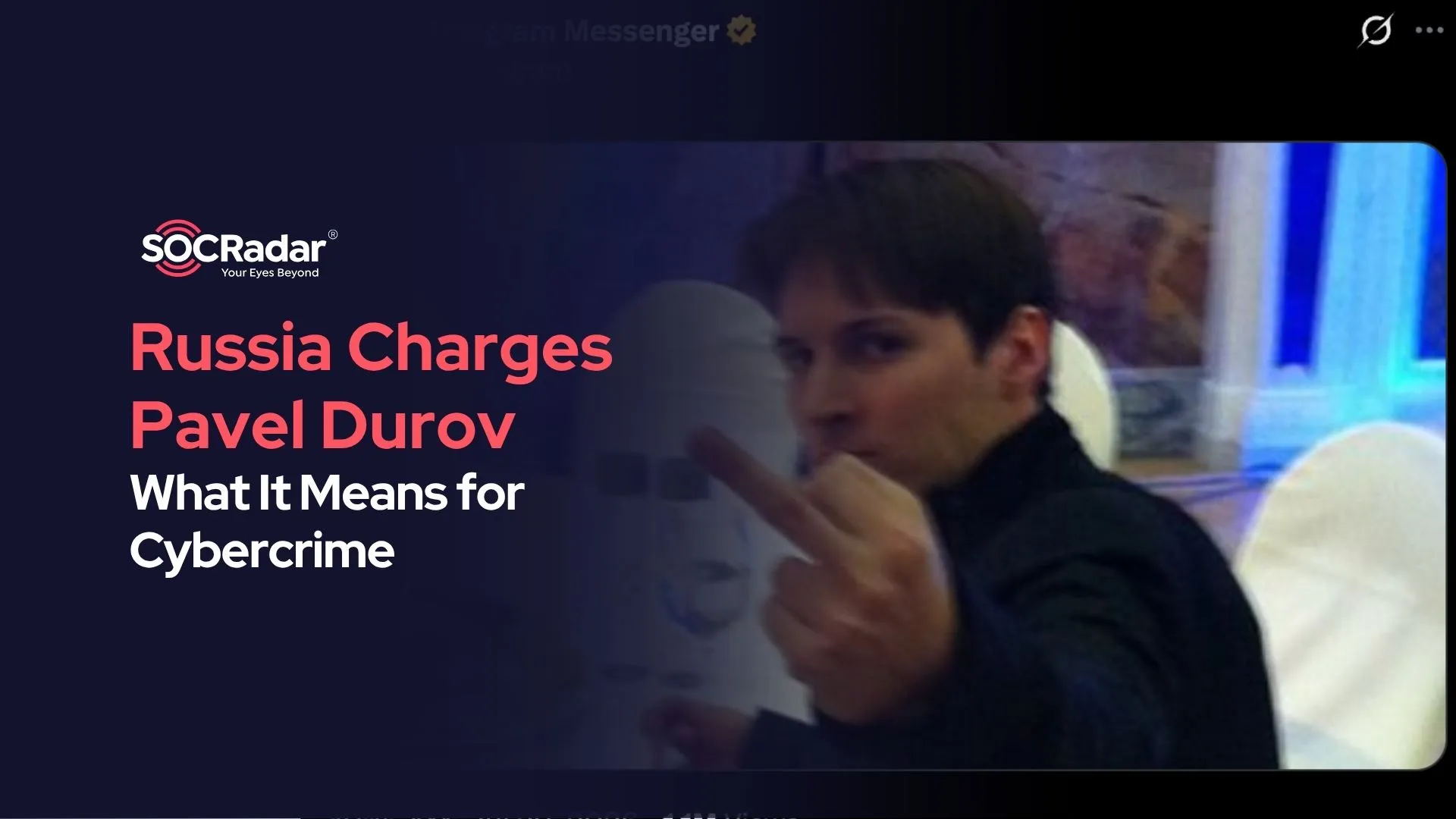
On July 29, 2026, Russia’s Federal Security Service charged Telegram founder Pavel Durov with aiding terrorist activity and placed him on an international wanted list. Telegram’s official response was a photo of Durov giving the middle finger, posted to X without comment. It was an absurd image for an absurd moment: a man now criminally prosecuted by two governments on opposite sides of a war, for opposite reasons. France wants him to moderate more. Russia wants him to censor more. And somewhere in Dubai, the founder of the world’s most contested messaging platform responded with a single gesture that captured his entire philosophy.
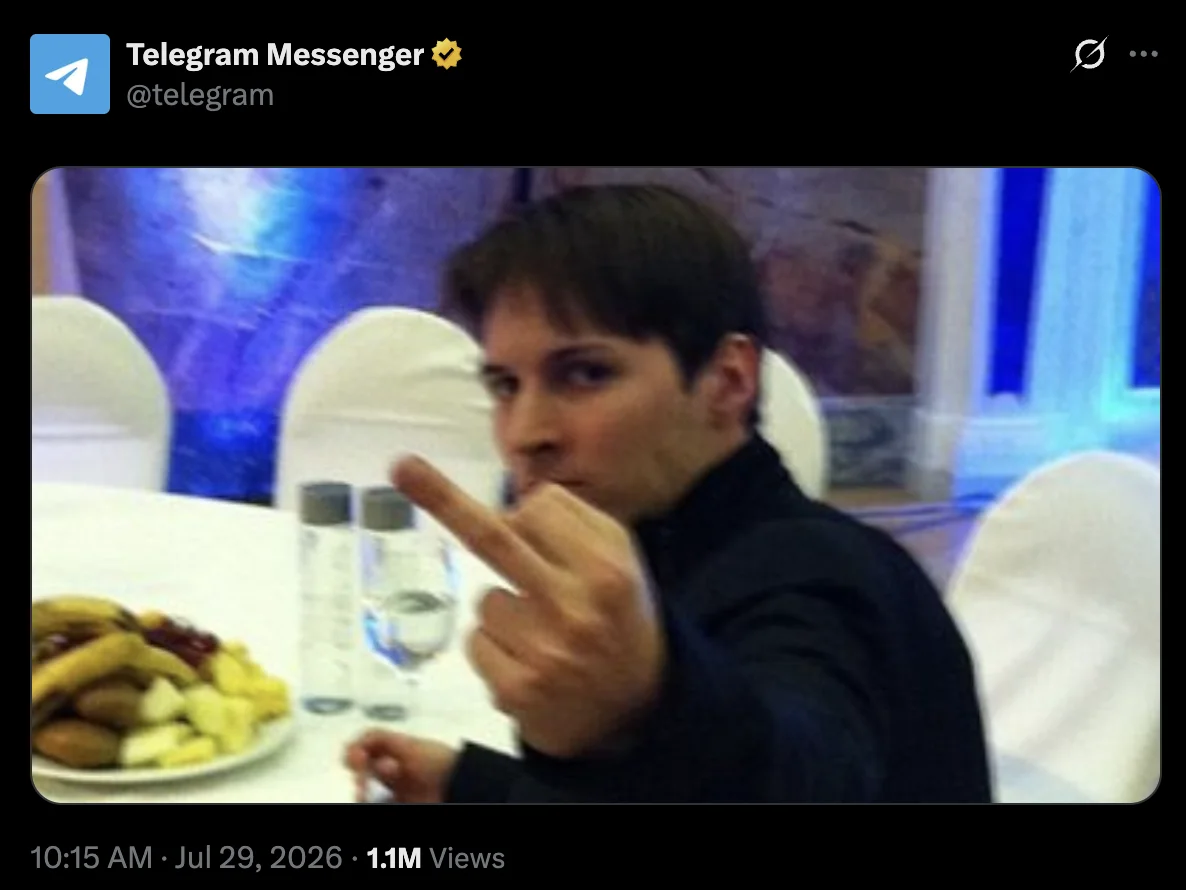
Telegram’s official X account sharing a photo of Durov giving the middle finger
The Man Who Wouldn’t Cooperate
Understanding the current crisis requires understanding the man at its center. Pavel Durov built VKontakte (VK) into Russia’s largest social network in the late 2000s, earning him the title of “Russia’s Zuckerberg.”
That comparison stopped being flattering around 2013, when the Kremlin began pressuring him to hand over data on Ukrainian Euromaidan protesters and shut down opposition pages linked to Alexei Navalny.
Durov refused and by April 2014, Kremlin-aligned investors had forced him out as CEO. He fled Russia, selling his stake under pressure in the company he built.
He and his brother Nikolai had already begun building their next project while still at VK. Telegram launched in 2013 as a messenger designed from the ground up to resist state pressure: encrypted, fast, and headquartered wherever governments could not easily reach it.
The company eventually settled in Dubai and Durov acquired citizenships from different parts of the world such as Saint Kitts and Nevis, the UAE, and France.
In early 2025 Telegram surpassed one billion monthly active users and reportedly turned its first profit in 2024, all while operating with roughly 30 full-time employees.
Two Prosecutions, Opposite Complaints
We first saw the French case. Durov was arrested at Le Bourget airport on August 24, 2024, and indicted on 12 charges including complicity in CSAM distribution, drug trafficking, and administering a platform enabling organized crime. The core allegation was that Telegram had nearly refused to respond to judicial requests. Durov posted €5 million bail and was placed under supervision. His travel restrictions were fully lifted in November 2025 after compliance with conditions, but the case remains active with no trial date.
The Russian charge inverts the complaint entirely. The FSB alleged that Telegram failed to remove channels and bots used by Ukrainian intelligence to recruit Russian citizens for sabotage. It centered on a dating chatbot called “Daivinchik,” which the FSB claimed was used to manipulate Russians aged 12 to 22 into attacking infrastructure. If convicted, Durov faces up to 15 years to life.
The practical enforceability of Russia’s charge is weak. The FSB did not specify the mechanism for its “international wanted list,” and Interpol has refused politically motivated Russian requests before.
Additionally, France does not extradite its citizens. The UAE, for its part, has little incentive to surrender a Dubai-based billionaire; doing so would undermine the sense of security that draws high-profile residents and capital to the country in the first place.
43.5 Million Channels Removed, Cybercrime Stays Put
The cybercrime ecosystem saw some serious changes after the France arrest. In September 2024, Telegram reversed years of policy by agreeing to share user IP addresses and phone numbers with law enforcement for cases beyond terrorism, covering fraud, cybercrime, and illegal goods. Data-sharing with U.S. authorities surged roughly 6,000% in Q4 2024 alone. Also, Telegram reported removing 15.4 million groups and channels in 2024, then 43.5 million in 2025.
These efforts definitely changed how threat actors operate but not where. Actors adapted with backup channels pre-created before takedowns, invite-only gating, and parallel redundant groups. When one tracked group tried relocating to SimpleX in early 2025, its followers simply didn’t migrate, and the group returned to Telegram within weeks.
What Comes Next
We think the most likely near-term future is continuity. Telegram’s network effects, bot automation, and user base keep the criminal ecosystem anchored even under growing pressure. Moderation will keep increasing but actors will keep adapting faster than enforcement scales.
Another slower but plausible trajectory is fragmentation. Sustained legal pressure on Durov, combined with Russia’s near-complete block of Telegram and its push toward the state-controlled MAX super-app, could gradually segment the user base. Hacktivists with state ties may drift toward state-aligned platforms even though it is a low possibility. Financially motivated actors will stay wherever the buyers are, which for now remains Telegram.
The least likely but highest-impact scenario is disruption. The platform can face with a confirmed Interpol Red Notice honored by a jurisdiction Durov travels to, a forced acquisition, or a shutdown. This would trigger the most significant realignment of cybercrime infrastructure since the repeated takedowns of major Dark Web forums. The probability is low, but the impact is high enough that defenders should have a monitoring plan ready.
What This Means for Defenders
For security teams, the operational takeaway is straightforward. Telegram should be treated as an intelligence source, monitored continuously for stealer log dumps, IAB listings, and ransomware claims mentioning your organization or third parties.
The platform where most cybercrime happens just became more politically unstable. That instability creates both risks and opportunities.

Table Of Content
Related Articles

Roundcube SQLi (CVE-2026-48842) Exploited
Sep 25, 2026
Check Point Pre-Auth Flaws Under Attack
Sep 24, 2026

ShinyHunters Claims Access to FBI Systems
Sep 24, 2026