

Oct 07, 2026
Table Of Content
Related Articles

NetScaler C2: CVE-2026-88771 Exploitation Operation



Aug 22, 2025
7 Mins Read

Summarize with:
Data Encryption: A Key Strategy in Protecting Sensitive Information
Data encryption has become necessary for protecting sensitive information. As cyber threats increase, individuals and organizations must prioritize strong data security measures. Encryption converts data into unreadable code that only authorized users can decipher, preventing unauthorized access and ensuring compliance with data protection regulations.
Sometimes explaining the fundamentals of encryption can help to clarify its significance. Encryption is the process of transforming data into a secret code that conceals the true meaning of the data. This process is underpinned by cryptography, or the study of encrypting and decrypting information. Encryption uses a cryptographic key, which is a set of mathematical values agreed upon by both the sender and receiver of the encrypted message.
Just as encryption converts readable information into secure code, decryption is the process that reverses this transformation. Only authorized users with the correct cryptographic key can decrypt the data, restoring it to its original, usable form. Without decryption, the encrypted information remains inaccessible.
Individuals and businesses use encryption to protect critical information from hackers. For instance, websites handling credit card and bank account numbers should always encrypt sensitive information to prevent identity theft and fraud.
According to The Business Research Company’s report, the global data encryption market is experiencing rapid growth, projected to expand from $20.72 billion in 2025 to $36.18 billion in 2029 at a compound annual growth rate of 15.0%. This surge is driven by growing data breaches, the increasing use of cloud-based services, and rising awareness of data protection needs. Encryption is critical for thwarting unauthorized access and ensuring the integrity of sensitive information across industries, from finance and healthcare to IT and manufacturing.
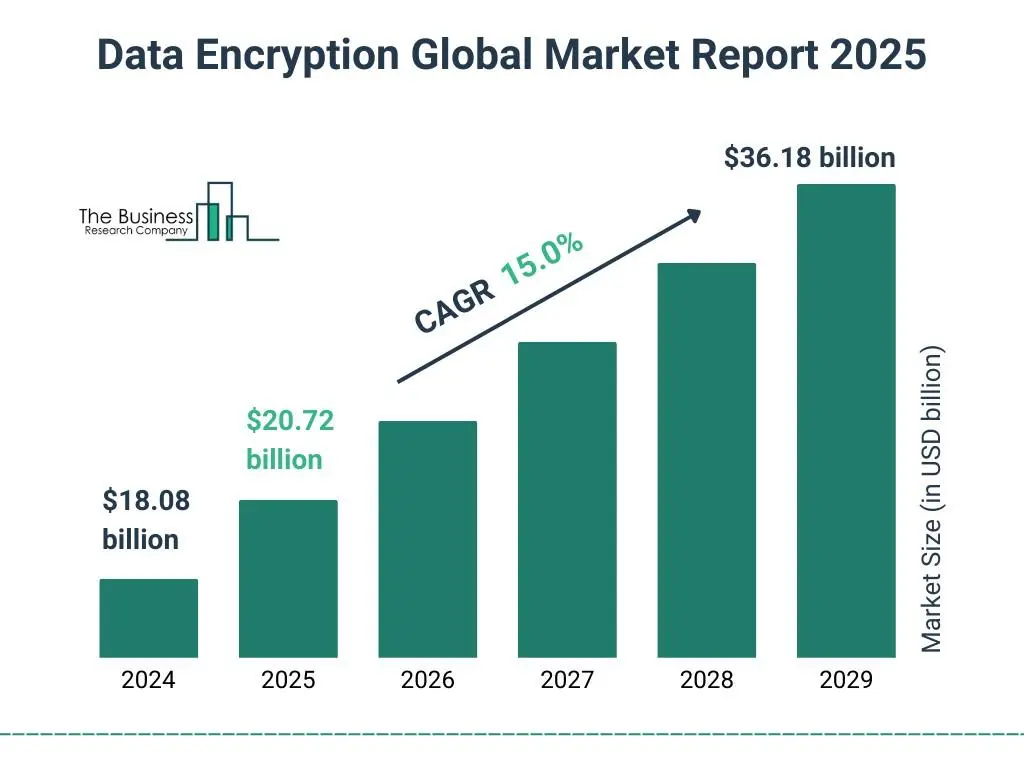
The market’s segmentation–by encryption method (asymmetric, symmetric), deployment model (cloud or on-premise), and end-user sector–reflects the widespread adoption of encryption as a key safeguard.

How Does Encryption Work?
The strength of encryption is determined by the length of the security key. In the past, web developers relied on 40-bit or 56-bit encryption, but advances in computing power eventually rendered these keys vulnerable to brute-force attacks. Today, the typical encryption length for web browsers is 128 bits.
One widely used encryption system is the Advanced Encryption Standard (AES), developed by the National Institute of Standards and Technology (NIST) in 2001. AES uses a symmetric-key algorithm, meaning the same key encrypts and decrypts data. AES supports key lengths of 128, 192, and 256 bits. While 128-bit encryption is the industry standard, banks, militaries, and governments often use 256-bit encryption for added security.
Types of Encryption
There are various types of encryption, each designed to address specific needs and security concerns:
- Data Encryption Standard (DES): Developed in 1977, DES has become largely obsolete due to advances in computing and lower hardware costs.
- Triple DES (3DES): An improvement over DES, Triple DES encrypts, decrypts, and re-encrypts data three times, strengthening security.
- RSA: Named after its inventors, RSA uses a robust and widely adopted asymmetric algorithm, making it ideal for secure data transmission.
- Advanced Encryption Standard (AES): As of 2002, AES became the official U.S. standard for data encryption and is widely used worldwide.
- Twofish: Recognized as one of the fastest encryption techniques, Twofish is freely available and implemented in both hardware and software.
Popular Encryption Tools Businesses Use
Beyond the algorithms themselves, organizations rely on practical tools and platforms to put encryption into action. Some widely adopted options include:
- BitLocker (Windows): Provides full-disk encryption to secure entire drives and prevent unauthorized access.
- VeraCrypt: An open-source tool that creates encrypted volumes, ideal for securing sensitive files or portable storage.
- PGP/GPG (Pretty Good Privacy): Commonly used for encrypting emails and files, leveraging both symmetric and asymmetric encryption.
- AWS Key Management Service (KMS): A cloud-based service that simplifies encryption and key management for organizations using Amazon Web Services.
Encryption in Securing Internet Browsing
Encryption is especially critical for secure internet browsing. When websites use HTTPS instead of HTTP, they employ encryption to secure data transfers. HTTPS is powered by Transport Layer Security (TLS), which replaced the older Secure Sockets Layer (SSL) protocol. A website using HTTPS will display a padlock in the address bar, signifying a secure connection.
TLS certificates deployed on servers ensure that data exchanged between browsers and websites remains secure and authenticated, protecting against eavesdropping and data tampering.
The Ransomware Connection
The evolution of ransomware highlights why encryption is not only a defense tool but also a weapon wielded by attackers. Early ransomware attacks, like the AIDS Trojan in 1989, were primitive compared to modern ransomware, which now uses advanced encryption techniques to lock victims out of their own data.
Today’s ransomware attacks often combine file encryption with double extortion—threatening to leak stolen data unless an additional ransom is paid. For instance, WannaCry and NotPetya in 2017 exploited vulnerabilities to target critical infrastructure, causing billions in damages. In 2023, ransomware strategies evolved further with triple extortion tactics and regulatory pressures, making data security an even greater challenge.
To explore the fascinating history of ransomware and its use of encryption, refer to the original article The Evolution of Ransomware: From Simple Encryption to Double Extortion Tactics.
Cactus Ransomware: Encryption as a Stealth Tactic
Although Cactus ransomware emerged in May 2023, it still highlights how attackers can use encryption in unique ways. Cactus initially gains access by exploiting known vulnerabilities in Fortinet VPN appliances. To avoid detection, it encrypts its own binary using a batch script and 7-Zip, then deploys the encryptor binary with an execution flag while deleting the original archive.
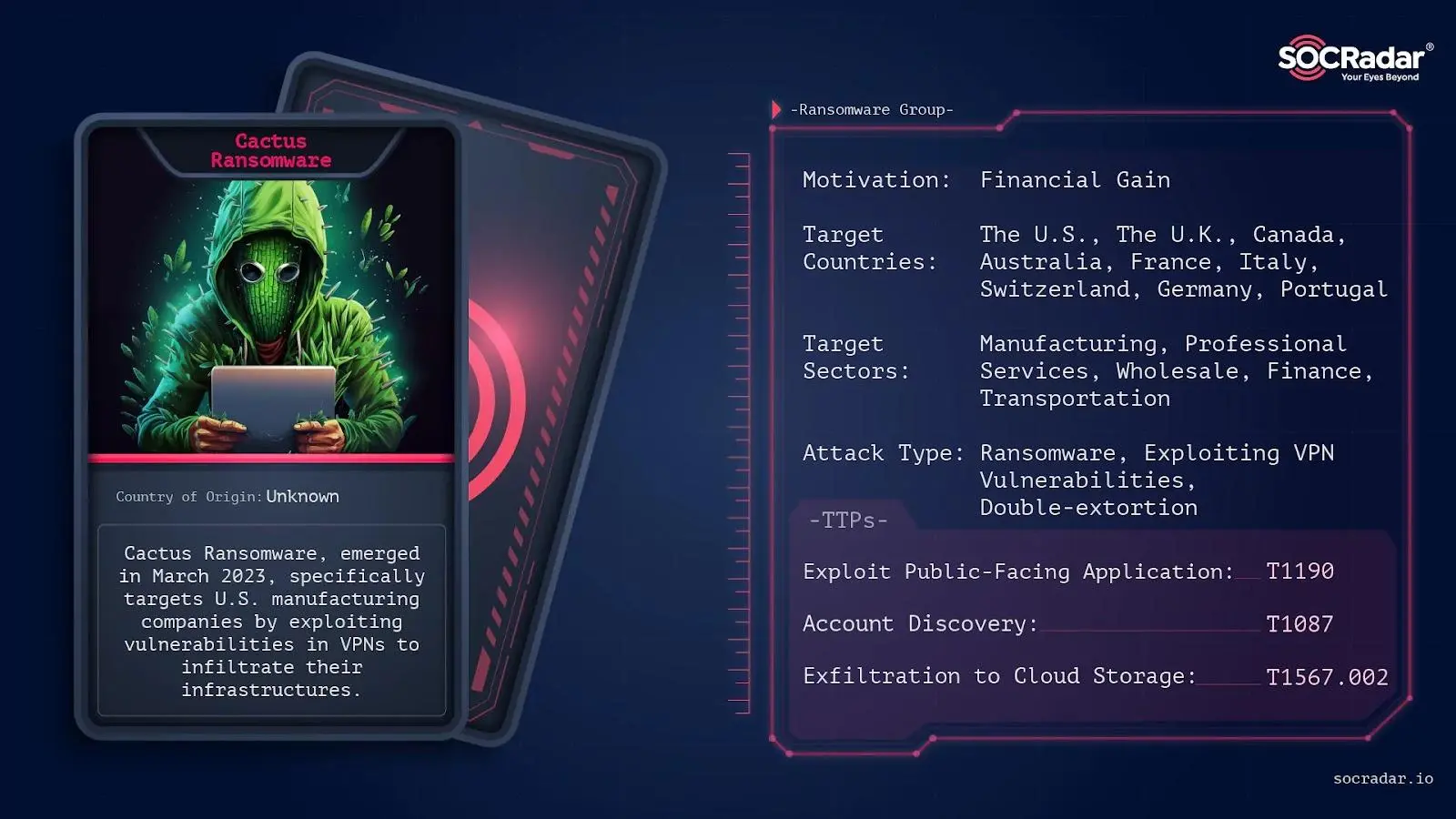
Cactus employs a unique AES key hardcoded in its binary for file encryption and uses separate file extensions before and after encryption to mask its activities further. It also leverages multiple legitimate remote access tools, including Splashtop and AnyDesk, alongside advanced scanning methods and PowerShell scripts for comprehensive data theft and encryption.
Despite threatening to publish stolen data, Cactus didn’t establish a leak site, making it a stealthy yet potent ransomware operation. This illustrates how encryption remains a key tool not just for protecting data, but also for cybercriminals to bypass security defenses.
Best Practices for Data Security
Implementing robust encryption is just one part of securing sensitive information. Here are some best practices to strengthen data security:
- Use Strong Encryption Tools: Choose reliable, industry-standard encryption algorithms and tools.
- Regularly Update Encryption Protocols: Keep encryption methods and systems current to stay ahead of evolving threats.
- Secure Key Management: Protect encryption keys with strict access controls and secure storage.
- Employee Training: Ensure that employees understand how encryption works and how to handle sensitive information.
- Monitor and Audit: Continuously monitor systems for threats and conduct regular security audits to identify and mitigate risks.
How Industries Apply Encryption and Decryption
Encryption and decryption are at work in nearly every industry today. Financial institutions encrypt ATM transactions and online banking sessions to protect customer funds. Healthcare organizations secure patient data with encryption to comply with HIPAA and other regulations. Technology firms encrypt proprietary data to safeguard intellectual property, while e-commerce businesses encrypt payment details to reduce fraud risk. Even consumer devices such as smartphones and laptops now use full-disk encryption by default, reflecting how deeply these practices are integrated into daily life.
Conclusion
Encryption is the cornerstone of modern data security, ensuring that sensitive information remains protected in the face of growing threats like ransomware. By understanding how encryption works and adopting best practices, organizations and individuals can build strong defenses against data breaches.
As cyber threats grow more advanced, pairing encryption with effective decryption processes, strong key management, and reliable encryption tools ensures that sensitive information remains not just concealed, but accessible only to the right people. By securing data at rest, in transit, and in use, organizations can maintain both security and usability. The future of digital trust depends on how well businesses and individuals integrate encryption into their broader security strategies.