

Oct 08, 2026
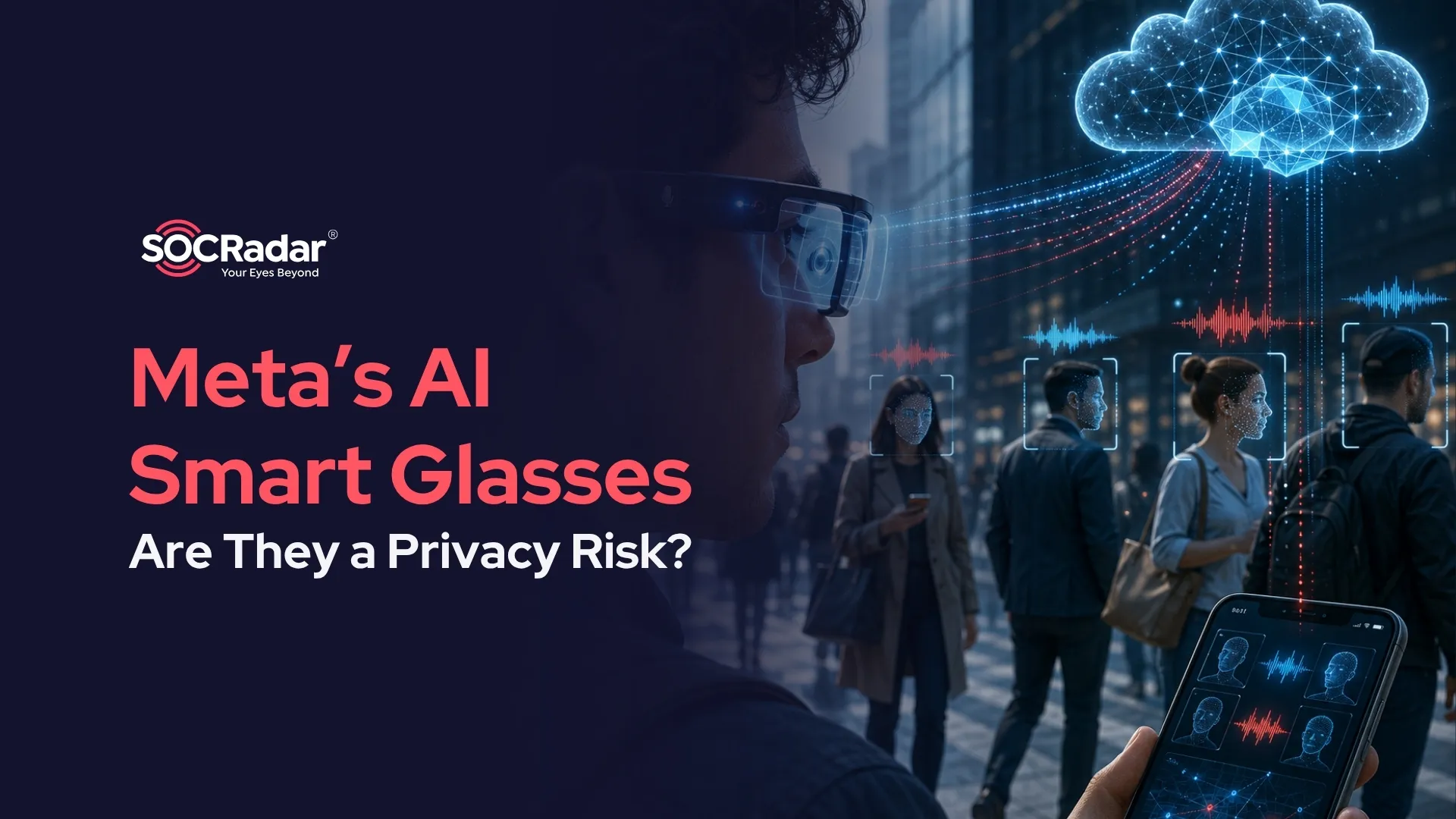
Table Of Content
Are Meta’s AI Smart Glasses a Privacy Risk?
What Are Meta’s AI Smart Glasses?
What Are the Main Data Privacy Concerns?
What Data Can Ray-Ban Meta Glasses Collect?
How Do On-Device, Phone, and Cloud Processing Differ?
Why Is Bystander Consent Harder with Smart Glasses?
What Has Changed Around the Privacy Light?
What Legal and Regulatory Scrutiny Should Users Watch?
What Should Individuals Do to Reduce Privacy Exposure?
How Should Organizations Manage Smart Glasses?
What Should a Privacy Assessment Include?
FAQ About Meta’s AI Smart Glasses and Data Privacy Concerns
Conclusion
Related Articles





Jul 28, 2026
13 Mins Read

Summarize with:
Are Meta’s AI Smart Glasses a Privacy Risk?
Meta’s AI smart glasses and data privacy concerns come from a simple issue: the device puts cameras, microphones, and AI assistant features into eyewear that can look like ordinary glasses. That makes capture easier for the wearer, but harder for bystanders to notice or understand.
This article focuses mainly on Ray-Ban Meta smart glasses, which can capture photos and videos, respond to voice commands, and support Meta AI features such as asking about what the wearer sees. The privacy questions go beyond hacking. They also include recording notice, cloud processing, AI training, human review, deletion controls, and how organizations should handle such wearable tech in sensitive spaces. These privacy concerns form part of the broader cyber risks affecting wearable technologies, including insecure companion apps, cloud dependencies, wireless exposure, and device vulnerabilities.
What Are Meta’s AI Smart Glasses?
They are consumer eyewear with a camera, microphones, open-ear audio, voice controls, and Meta AI features.
Meta previously used the Meta View companion app for Ray-Ban Meta glasses, but in April 2025 the company said it was merging the new Meta AI app with the Meta View companion app. Existing Meta View users can manage paired glasses, settings, and media through the Meta AI app after the update.
The glasses support both physical and voice-based capture. Users can press the capture button or use “Hey Meta” voice commands to take photos and videos. The FAQ also states that the capture LED activates when users take a photo or video to indicate to people nearby that recording may be happening.
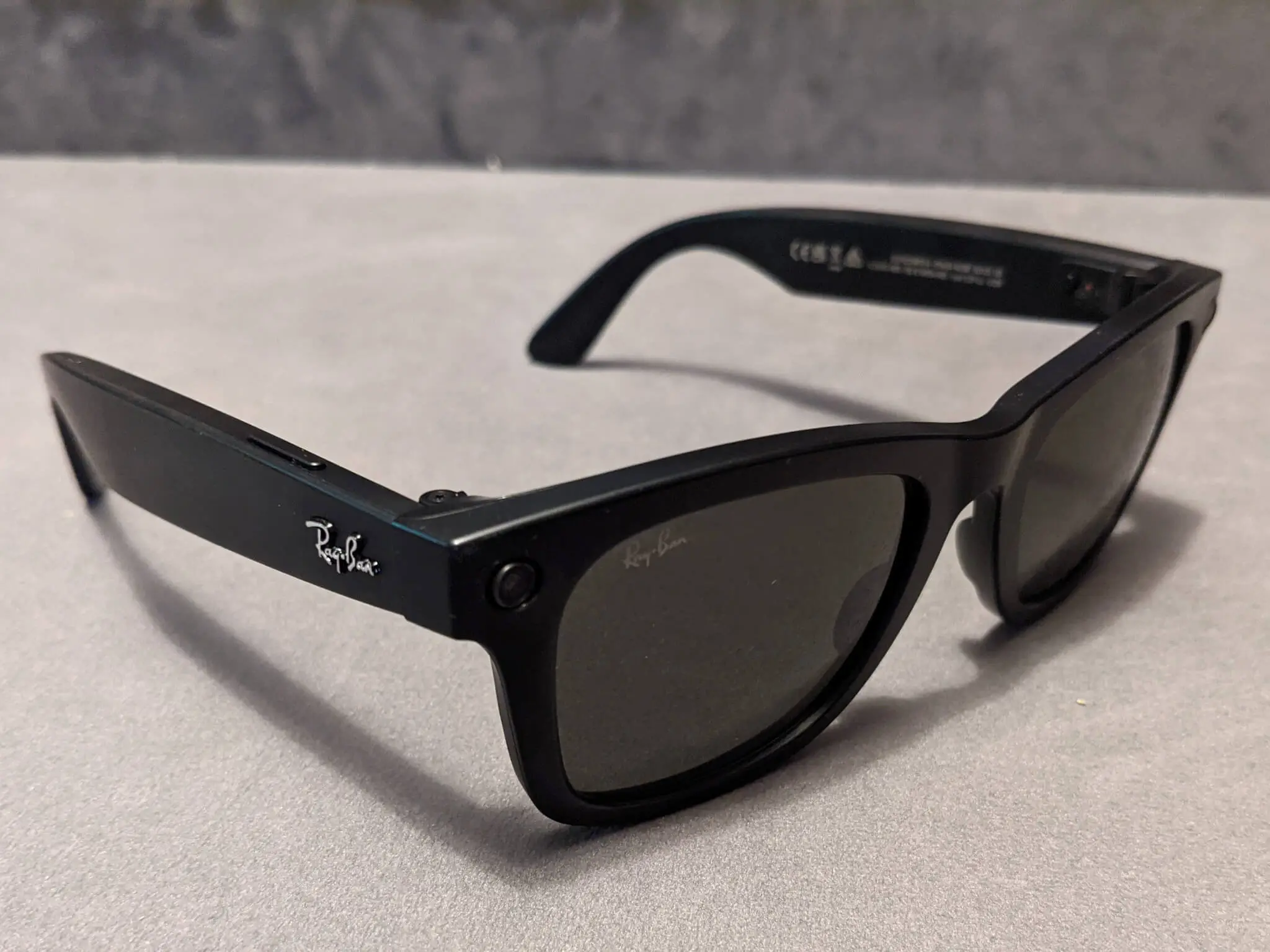
Ray-Ban Meta smart glasses (Wikimedia)
What Are the Main Data Privacy Concerns?
The biggest privacy concern is not one single data type. It is the combination of wearable capture, AI processing, cloud-connected accounts, and unclear bystander consent.
Meta’s AI smart glasses and data privacy concerns usually fall into five areas:
- Bystander notice: People nearby may not realize that camera or AI processing is active.
- Sensitive capture: The glasses can capture screens, documents, IDs, children, meetings, health information, or confidential workplace material.
- Cloud and AI use: Some AI features send data to Meta’s cloud for processing and may support product improvement or AI training workflows.
Ray-Ban’s FAQ says that when users ask Meta AI questions about what they are seeing, the glasses send a photo to Meta’s cloud for AI processing. The same FAQ says photos processed with AI are stored, used to improve Meta products, and used to train Meta’s AI with help from trained reviewers.
- Account and app exposure: Media and settings are tied to the paired phone, the Meta AI app, and the user’s Meta account.
- Biometric and facial-recognition exposure: Camera-based identity matching is a different risk category from ordinary photo or video capture, since it can turn a bystander’s face into a searchable data point without their knowledge or consent.
Earlier in 2026, reporting revealed that Meta had been developing an internal facial-recognition feature for its glasses, capable of identifying people and surfacing information about them through the AI assistant; the underlying code was later found in the companion app and removed following public scrutiny. Meta has publicly said its AI glasses do not have facial recognition and has not confirmed plans to ship the feature, but the episode is a good example of why “the camera is on” and “the camera can identify you” need separate governance thinking.
What Data Can Ray-Ban Meta Glasses Collect?
Ray-Ban Meta glasses can involve several categories of data depending on the feature, region, settings, and device generation.
| Data type | How it is created | Privacy concern | User control to check |
|---|---|---|---|
| Photos and videos | User captures media with the button or voice command | Bystanders or sensitive material may be captured unintentionally | Review imported media and delete unnecessary captures |
| Voice commands | User activates voice controls or Meta AI interactions | Voice recordings or transcripts may be retained depending on settings and policy | Review voice settings and deletion options |
| AI-processed images | User asks Meta AI about what they are seeing | Images may be sent to the cloud and used for improvement or AI training in some contexts | Review Meta AI and camera-use settings |
| App and device telemetry | Glasses and app generate diagnostic or usage data | Device and account activity may create additional metadata | Review account, app, and privacy settings |
| Cloud-processed media | Cloud media processing or syncing features are enabled | Media may be temporarily stored or processed outside the device | Review cloud media processing and auto-import settings |
It was reported in April 2025 that Meta’s wearable voice-services notice allowed voice transcripts and recordings to be stored for up to one year to help improve Meta products, and that users who did not want voice data used for AI training needed to manually delete recordings from the companion app.
How Do On-Device, Phone, and Cloud Processing Differ?
Smart glasses privacy depends heavily on where processing happens. The same pair of glasses may use different processing paths for different features.
- On-device processing covers local actions such as capture controls, basic device behavior, and short-term handling before content moves to the phone. This can reduce some cloud exposure, but it does not remove the risk of accidental capture.
- Phone-based processing involves the Meta AI app, imported media, settings, and account controls. The paired phone becomes part of the privacy boundary because someone with access to the phone may also access imported media or settings.
- Cloud processing adds the broadest privacy surface. Ray-Ban’s FAQ says AI “look” requests send a photo to Meta’s cloud for processing. Ray-Ban’s regional FAQ also describes cloud media processing for higher-quality media and curated suggestions, with temporary cloud storage for 30 days when that feature is enabled.
Users should not assume that every AI interaction stays on the glasses or phone.
Why Is Bystander Consent Harder with Smart Glasses?
Bystander consent is difficult because smart glasses reduce the visual distance between a person and a recording device. A phone held up in someone’s direction is obvious. Glasses can be much harder to read in a hallway, meeting room, classroom, clinic, or public space.
Ray-Ban says the capture LED signals when the glasses are capturing photos, videos, or livestreams. However, it is also stated that in newer models, the LED does not light up for some AI features that rely on the camera, such as identifying a landmark or plant, because that content is not intended for sharing.
People in the nearby area might identify a visible recording light as a picture or video signal, but they might not recognize when visual information is used for an AI interaction, which makes this distinction important.
Regulatory Pushback and What’s Next
Regulators have raised similar concerns before. In 2021, Ireland’s Data Protection Commission and Italy’s Garante asked Facebook to demonstrate that the LED indicator was effective and to run an information campaign explaining how the product could create less obvious recording of people’s images.
This tension is likely to grow rather than resolve. Separate reporting this July described an internal Meta prototype built for continuous, ambient capture (audio recorded automatically and stills taken every few seconds throughout the day) with the recording indicator reportedly not planned to activate during that mode. Neither represents a shipping product, and Meta has stated it does not comment on internal prototypes. Still, it points to where the real pressure sits: a visible light only works as a bystander safeguard as long as capture stays deliberate.
What Has Changed Around the Privacy Light?
Meta has recently added stronger controls around privacy-light tampering. Most recently, it was reported that Meta is rolling out an update that disables the camera when the glasses detect that someone has tampered with or destroyed the privacy LED.
This is an important improvement, but it does not solve every privacy issue. A visible indicator helps with recording notice, while AI processing, data retention, account access, and bystander consent still require clear settings, policy, and user behavior.
It’s worth being precise about what this update actually covers. It’s mandatory rather than opt-in, and it reaches back into hardware already physically modified – tape stopped working a while ago, and now damaging the LED itself doesn’t work either. That’s a real fix for a specific tampering problem. It can’t, however, protect against a future capture mode designed from the outset not to use that LED at all. “The light turns on” is worth treating as a current-generation assumption to verify, not a permanent guarantee to build long-term policy around.
What Legal and Regulatory Scrutiny Should Users Watch?
The legal implications of smart glasses vary significantly depending on the specific country, state, workplace, and use case, as these devices operate at the convergence of recording laws, privacy, workplace monitoring, and consumer protection. Recent scrutiny has included several signals:
- EU privacy questions: European regulators have previously questioned whether recording indicators are effective enough for bystander notice.
- Reported contractor review concerns: Documentation from March 2026 indicates Meta was subject to legal action following claims that external personnel inspected private recordings originating from the smart glasses.
- Texas investigation: CBS Texas reported in May 2026 that the Texas attorney general opened an investigation into Meta’s AI-powered smart glasses, citing concerns about audio, video, facial geometry, and the recording indicator. Meta told CBS Texas that privacy and data protection are core to its products and that it was ready to address the questions raised.
What This Means for Governance
Organizations should treat these developments as risk signals. They do not mean smart glasses are automatically prohibited, but they show why governance matters.
The more telling signal isn’t any single case, but that several independent authorities are converging on the same two questions at once. Texas’s inquiry leans on a state biometric-data law the same office has used against Meta before, having secured a $1.4 billion settlement in 2024 over an earlier facial-recognition matter. Around the same time, the UK’s data-protection regulator requested details on how Meta meets its obligations, and a group of European Parliament members pressed Ireland’s regulator – the lead EU authority for Meta’s cases – on the same product. That kind of convergence usually points to the underlying design choice rather than any one company’s response to it, which argues for setting policy now rather than waiting on a single regulatory outcome.
What Should Individuals Do to Reduce Privacy Exposure?
Users can reduce exposure by treating smart glasses like a wearable camera and microphone, not like ordinary eyewear.
Practical steps include:
- Review Meta AI settings after updates. Product and policy changes can affect defaults or available controls.
- Avoid AI “look” features in sensitive spaces. Do not use visual AI features around screens, documents, patients, children, or confidential meetings.
- Delete unnecessary voice and media history. Use available deletion tools for recordings, transcripts, AI interactions, and imported media.
- Protect the paired phone and account. Use multi-factor authentication (MFA), a strong phone lock, and session review to reduce account-takeover risk.
- Tell people when recording. Do not rely only on the LED, especially in settings where bystanders may not recognize what the glasses are doing.
How Should Organizations Manage Smart Glasses?
Organizations should treat AI smart glasses as a data capture endpoint. That means they deserve policy coverage similar to phones, cameras, voice recorders, and unmanaged personal devices.
Recommended controls include:
- Define no-recording zones for secure offices, labs, clinics, customer areas, and confidential meeting rooms.
- Update bring your own device (BYOD) and acceptable-use policies to cover wearable cameras, microphones, and AI assistant features.
- Train employees on bystander consent, recording laws, and company expectations.
- Require MFA and strong locks for paired phones and associated accounts.
- Establish an incident process for lost glasses, account compromise, unauthorized recording, or policy violations.
- Revisit the policy after firmware, app, or privacy-term changes.
For regulated industries, smart glasses may also touch healthcare privacy, financial confidentiality, workplace monitoring, trade-secret protection, and customer-data obligations.
What Should a Privacy Assessment Include?
A practical privacy assessment should answer seven questions:
| Assessment area | Key question |
|---|---|
| Data types | What media, voice, AI, telemetry, and account data can the device create? |
| Sensitive locations | Where should recording or AI camera use be restricted? |
| Affected people | Who could be captured: employees, customers, patients, visitors, or minors? |
| Processing path | Does the feature stay local, move to the phone, or go to cloud services? |
| Retention | What data is stored, for how long, and what requires manual deletion? |
| Secondary use | Can data support product improvement, AI training, or human review? |
| Controls | Which settings, policies, training, and incident processes reduce exposure? |
Exact retention windows and processing locations should always be validated against the latest official Meta, Ray-Ban, and regional policy documents.
FAQ About Meta’s AI Smart Glasses and Data Privacy Concerns
Are Meta AI smart glasses unsafe for privacy?
They are not automatically unsafe, but they create higher privacy risk in sensitive or crowded environments. The main concern is that wearable cameras and microphones make capture less obvious to bystanders.
Can users preserve privacy while using Ray-Ban Meta glasses?
Users can reduce risk by limiting AI and voice interactions, deleting stored items, protecting the paired account, and avoiding sensitive locations. Some risks, such as bystander consent and accidental capture, depend heavily on user behavior.
Do Ray-Ban Meta glasses always record everything?
Ray-Ban Meta glasses do not constantly record and store everything around the wearer. The reporting says the device stores speech after the “Hey Meta” wake word, and Ray-Ban describes user-triggered capture and AI interactions.
Does the privacy LED always turn on?
The capture LED turns on for photo and video capture. However, Ray-Ban’s regional FAQ says newer models may not turn on the LED for some AI camera features because the content is not intended for sharing.
What should organizations do first?
Organizations should define no-recording zones, update acceptable-use policies, train users, require account security controls, and create a response process for unauthorized recording or device compromise.
Conclusion
Meta’s AI smart glasses and data privacy concerns come down to visibility, control, and secondary use. A wearable camera and microphone can capture sensitive moments more quietly than a phone, while AI features may add cloud processing, retention, training, and review considerations.
For individuals, the safest approach is to review settings often, avoid AI camera features in sensitive environments, and delete stored content that is no longer needed. For organizations, smart glasses should be governed like any other data capture endpoint: define restricted spaces, train users, secure accounts, and revisit policies as the product and privacy terms evolve.
One last point worth sitting with: several of the developments covered in this piece – a paused facial-recognition feature, a mandatory hardware fix, and reported prototypes for always-on capture – surfaced within a matter of months of each other. A policy or assessment written today is worth revisiting sooner than an annual cycle would suggest.