What Is Dark Web Monitoring?
Dark web monitoring is the continuous collection and analysis of content from hidden forums, marketplaces, leak sites, paste services, and criminal channels to identify threats connected to an organization. Findings may include credentials, internal documents, source code, access offers, customer data, or attack planning.
Monitoring extends visibility outside the enterprise, but it does not guarantee access to every closed community or prove every criminal claim. Valuable programs combine automated collection, structured parsing, enrichment, analyst validation, and clear response ownership.
Key Takeaways
- Credential and stealer-log monitoring is a central category or use case.
- Reliable assessment depends on source, timing, ownership, and operational context.
- Detection should connect external findings with identity, device, network, and business signals.
- Response should protect affected people and remove every reusable access path.
How Dark Web Monitoring Works
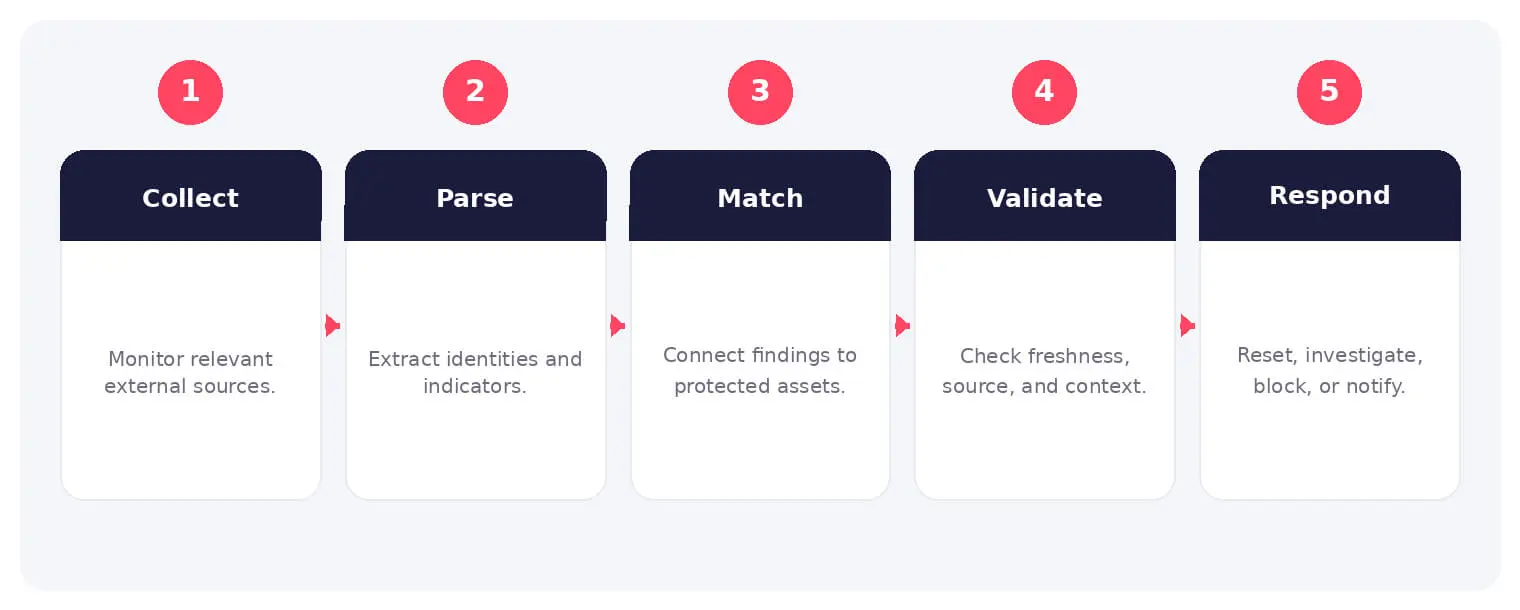
The sequence shown above provides a practical operating model. Individual steps may overlap, repeat, or involve different services and participants, so analysts should validate each stage against available evidence.
Monitoring extends visibility outside the enterprise, but it does not guarantee access to every closed community or prove every criminal claim. Valuable programs combine automated collection, structured parsing, enrichment, analyst validation, and clear response ownership.
Common Types and Use Cases
- Credential and stealer-log monitoring
- Ransomware leak-site and extortion tracking
- Initial-access and vulnerability discussions
- Brand, executive, customer, and supplier exposure
Security, Privacy, and Business Risks
- Account takeover from exposed credentials
- Delayed discovery of a breach or access sale
- Fraud and impersonation against customers
- Unverified alerts that waste response capacity
Warning Signs and Validation
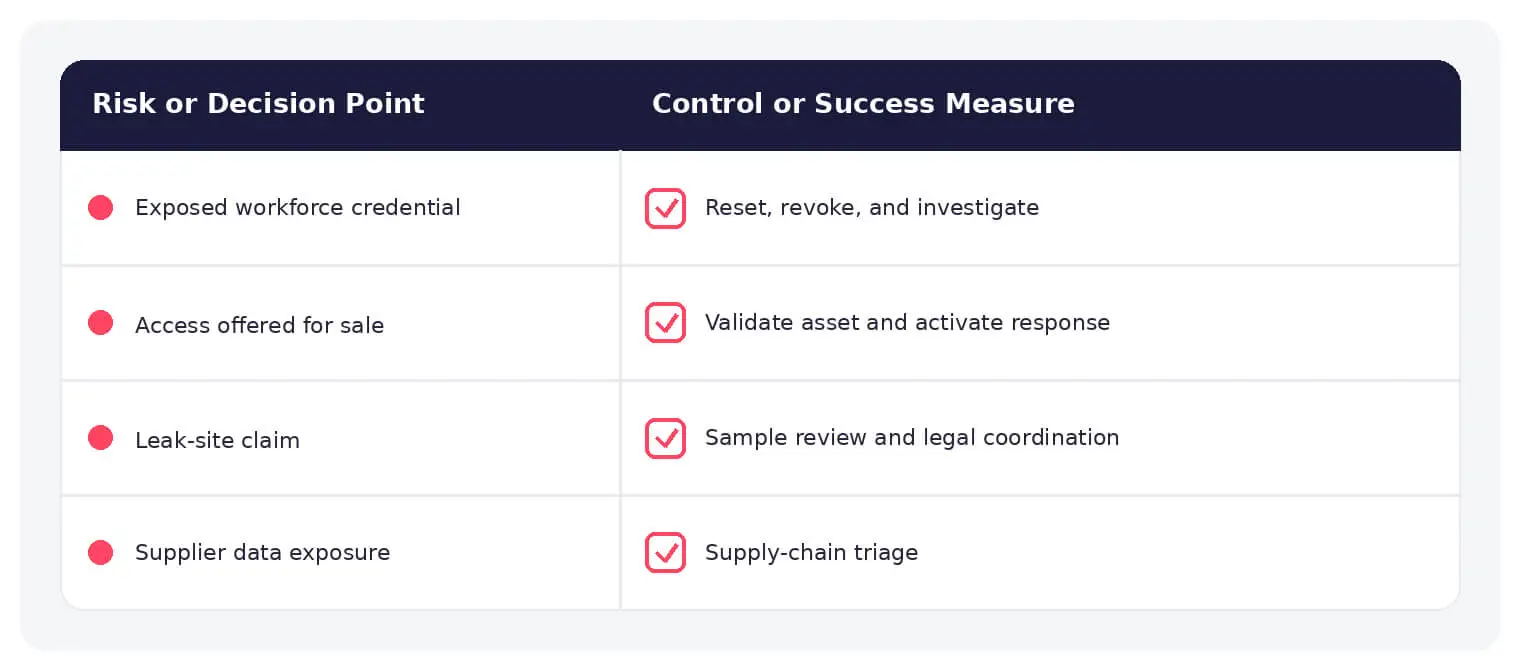
Validate format, source reliability, timestamps, sample records, known breach relationships, identity ownership, and overlap with internal events. High-impact findings should receive analyst review before action.
Prevention and Response
Monitor continuously, define keywords and assets carefully, protect sensitive findings, integrate alerts with SIEM and SOAR, assign response playbooks, and measure validation and containment time rather than raw alert volume.
How SOCRadar Can Help
SOCRadar combines external intelligence, Dark Web visibility, brand monitoring, attack-surface discovery, and contextual enrichment to help teams identify exposure and investigate activity connected to dark web monitoring.
Explore SOCRadar Dark Web Monitoring or request a demo to strengthen external threat detection and response.
Frequently Asked Questions
What Sources Does Dark Web Monitoring Cover?
Typical programs collect from hidden forums, marketplaces, ransomware leak sites, paste services, Telegram channels, and stealer-log dumps. Coverage is never complete: invite-only communities may require established trust and can exclude automated collection, so findings should be treated as a sample of criminal activity rather than a full record.
What Findings Matter Most to Security Teams?
The most actionable categories include:
- Credentials and stealer logs tied to corporate email domains
- Initial-access offers and discussions of unpatched vulnerabilities
- Ransomware leak-site claims and extortion posts
- Leaked internal documents, source code, or customer records
- Mentions of the brand, executives, customers, or suppliers
Why Are Stealer Logs a Serious Risk?
Infostealer logs capture saved passwords, cookies, and session tokens from infected devices. An attacker who obtains them may reuse a valid session and bypass the login form entirely, which is why log-based findings usually warrant session revocation and endpoint review in addition to a password reset.
How Does Dark Web Monitoring Work?
Automated collectors gather content from monitored sources, and structured parsing extracts emails, domains, credentials, and file references. Enrichment adds timestamps, breach relationships, and source context, and analyst review confirms whether a finding is relevant and current before it enters a response workflow.
How Do You Verify Whether a Finding Is Real?
Check the source’s reliability, when the data first appeared, whether record formats match a known breach, and whether sample records actually belong to your organization rather than a similarly named domain. Comparing findings against internal signals, such as recent login anomalies or infected endpoints, helps confirm relevance before action.
What Should You Do After a Confirmed Credential Exposure?
Reset the affected credentials, revoke active sessions and tokens where the platform supports it, and enforce phishing-resistant MFA on the accounts. A password reset alone may not invalidate a stolen session cookie, so review login history and device health before closing the case.
How Quickly Should Fresh Exposures Be Handled?
Recent findings, such as credentials posted within days or an active access sale, deserve same-day triage because criminals often act on stolen access quickly. Older records that overlap with known breaches can be handled in batches, though reused passwords still warrant remediation.
Can Dark Web Monitoring Prove a Breach Occurred?
No. Data appearing on a criminal channel indicates exposure but does not establish how it leaked, when it happened, or whether the seller’s claims are accurate. Some listings recycle old breaches or exaggerate their contents to attract buyers, so findings need internal correlation before being treated as incident confirmation.
What Is the Difference Between the Dark Web and the Deep Web?
The deep web is simply content not indexed by standard search engines, including ordinary pages behind logins. The dark web is a smaller portion that requires specific software such as Tor, and it hosts many criminal forums and leak sites. Monitoring focuses on the dark web, but leaked corporate data can surface in either layer.
How Should Dark Web Alerts Fit Into Security Operations?
Verified findings should feed into SIEM and SOAR platforms through APIs or webhooks so they correlate with identity, endpoint, and network signals. Assigning clear response playbooks and measuring how long findings take to confirm and contain, rather than counting raw alerts, keeps the program tied to outcomes.

Oct 27, 2026
Australia’s Annual Cyber Threat Report 2025-26 Shows Cyber Incidents Up 20%
Australia’s cyber security authority responded to 1,524 cyber security incidents in the 2025-26 financial year, a 20% increase from the previous year…

Oct 27, 2026
PHP2Shell Weaponized After Japanese Real Estate Extortion
An exposed server ties an extortion wave on about 20 Japanese property sites to an operator who later weaponized PHP2Shell (CVE-2026-109618, CVE-2026-109619)…

Oct 27, 2026
Wasmtime Sandbox Escape Flaws Patched in Cranelift
Two critical Wasmtime sandbox escape flaws, CVE-2026-115889 and CVE-2026-115893, let a crafted WebAssembly (Wasm) module push the Cranelift compiler into generating unsafe…
Intelligence in your inbox every Thursday.
Join 30,000+ security professionals reading SOCRadar research.
Subscribe