

Mar 10, 2026
Apr 17, 2026
6 Mins Read
Sep 11, 2026
Table Of Content
Related Articles
SMS Bombing
Threat Actors
Jan 08, 2026
Dark Web Monitoring
Feb 19, 2026
Ransomware
Jan 31, 2026
Dark Web
Jan 31, 2026
What is the OSINT Framework?
The OSINT Framework is a free, web-based directory that organizes open source intelligence tools into a structured, browsable tree. It was created by security researcher Justin Nordine and is available at osintframework.com.
The framework does not collect data or run searches itself. It points investigators to tools that do. It is a categorized index of publicly available resources organized by the type of data you are trying to find.
Open Source Intelligence (OSINT) is the practice of collecting and analyzing information from publicly available sources to produce actionable intelligence. The framework provides a structured reference map for that work.
How the OSINT Tree Works
The framework displays as an interactive tree. Each branch represents a major data category. Clicking expands it into sub-categories, which link to specific tools or resources.
| Branch | What It Covers |
| Username | Finding accounts across platforms by handle |
| Email Address | Verification, breach lookups, header analysis |
| Domain Name | WHOIS records, DNS history, hosting information |
| IP Address | Geolocation, ASN lookup, reverse DNS |
| Social Networks | Platform-specific search and archiving tools |
| Search Engines | Advanced operators, cached pages, dorking |
| Dark Web | Onion search engines, paste site monitors, leak indexes |
| Metadata | Extracting hidden data from files and documents |
| People Search | Public records, aggregator sites, people-finder databases |
Each node links to a specific tool or resource. Some are free, some commercial. The framework does not maintain or endorse the linked tools.
Who Uses It and Why
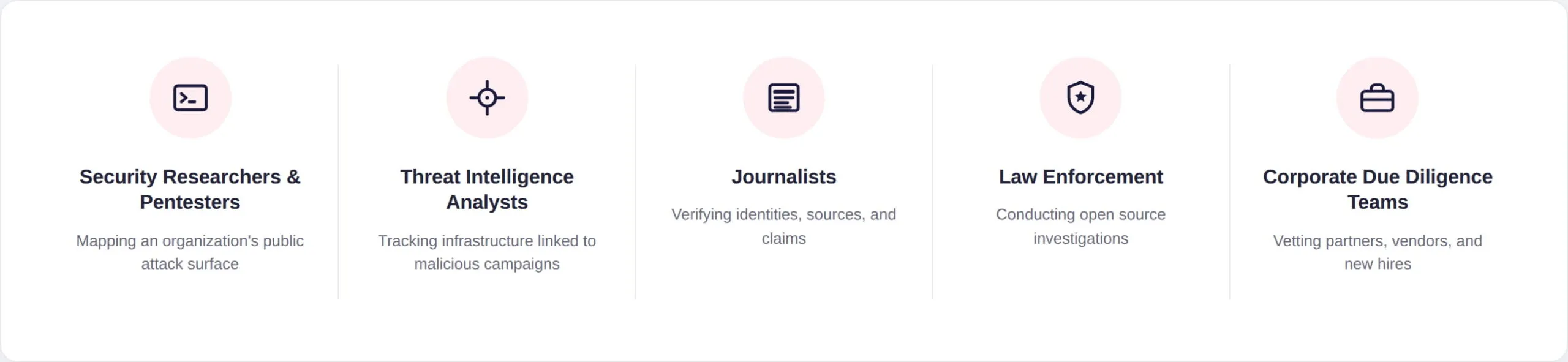
The OSINT Framework is used by security researchers and penetration testers mapping an organization’s public attack surface, threat intelligence analysts tracking infrastructure linked to malicious campaigns, journalists verifying identities, law enforcement conducting open source research, and corporate due diligence teams.
Because all tools draw from publicly available data, use is legally accessible in most jurisdictions, though how you use the results is still subject to legal and ethical standards.
Key Categories for Security Professionals
Email Address: Tools including breach lookup databases and email header analyzers help map an organization’s exposed email footprint, a core part of external attack surface research.
Metadata: Tools like ExifTool extract hidden data from documents and images including author names, GPS coordinates, software versions, and edit timestamps. This data is frequently overlooked but can be significant in an investigation.
Domain Name and IP Address: These branches support infrastructure analysis, helping analysts link IP addresses to hosting providers, map historical DNS records, and trace domain ownership changes over time.
Dark Web: Links to Tor-based search engines and paste site monitors that can surface leaked credentials and threat actor activity.
OSINT Framework vs. Commercial Threat Intelligence Platforms
| Feature | OSINT Framework | Commercial Platforms |
| Cost | Free | Subscription |
| Data freshness | Depends on linked tools | Continuous, real-time feeds |
| Coverage | Public sources only | Proprietary, dark web, partner data |
| Automation | Manual navigation | API-driven with automated alerting |
| Best for | Individual researchers, small teams, training | Enterprise security operations |
OPSEC When Using the Framework
- Use a VPN or Tor when accessing linked tools so your IP is not logged by the tool provider
- Use isolated browser profiles for OSINT work, separate from personal browsing
- Use dedicated accounts not linked to your real identity when searching social platforms
- Prefer passive tools that do not send traffic to the target when stealth matters
- Document sources and steps throughout for reproducibility and legal defensibility
Key Takeaways
- The OSINT Framework is a free directory of open source intelligence tools organized as a browsable tree, not a tool itself
- Created by Justin Nordine, available at osintframework.com
- Major categories include email, domain, IP, social media, dark web, metadata, and people search
- Used by security researchers, threat analysts, journalists, and investigators
- Apply OPSEC practices to limit your digital footprint when conducting OSINT research
FAQs
1. Is OSINT legal, and what are its ethical boundaries?
OSINT is generally lawful when it uses information that can be legally accessed, but public availability does not mean unrestricted use. Investigators must consider privacy law, data-protection rules, intellectual-property rights, terms of service, authorization, proportionality, data minimization, and the risk of harm. Deception, unauthorized access, or bypassing technical restrictions may cross legal and ethical boundaries.
2. What sources of data does OSINT use?
OSINT may draw from search engines, websites, social media, public records, corporate filings, news, academic publications, maps, satellite imagery, code repositories, domain and certificate records, DNS data, exposed services, breach reporting, and publicly accessible forums. Some dark-web material may also be used when access is lawful and collection is handled safely.
3. How is OSINT used in cybersecurity?
Security teams use OSINT to identify exposed assets, leaked credentials, vulnerable services, phishing infrastructure, malicious domains, threat-actor activity, supply-chain relationships, brand abuse, and information that could help an attacker. It also supports threat intelligence, incident response, penetration testing, fraud investigations, and attack-surface management.
4. Do threat actors use OSINT?
Yes. Attackers use public information to identify employees, technologies, suppliers, email formats, exposed services, cloud resources, credentials, business processes, and high-value individuals. This information can support phishing, password attacks, social engineering, vulnerability exploitation, impersonation, and physical targeting.
5. How do ethical hackers and penetration testers use OSINT?
Authorized testers use OSINT during reconnaissance to understand the target’s public attack surface before interacting more directly with systems. They may map domains, subdomains, technologies, employees, code repositories, certificates, exposed documents, and third parties. The scope and methods should be approved in writing to avoid collecting unnecessary personal data or exceeding authorization.
6. What is the difference between passive and active OSINT collection?
Passive collection uses existing sources without directly interacting with the target’s systems, such as reviewing search results, archives, public records, and third-party datasets. Active collection sends requests, queries services, contacts people, or interacts with target infrastructure. Active methods may create logs, alert the target, or require explicit authorization.
7. What tools are used for OSINT?
Common tools include search engines, the OSINT Framework directory, Shodan, Censys, Maltego, SpiderFoot, WHOIS and DNS services, certificate-transparency search, GitHub search, web archives, metadata tools, mapping platforms, and social-media research tools. Tool choice should follow the investigation goal, data quality, authorization, and privacy requirements.
8. What is the OSINT intelligence cycle?
The cycle normally includes planning and direction, collection, processing, analysis, dissemination, and feedback. Analysts first define the question, collect relevant information, organize and validate it, assess meaning and confidence, deliver findings to the appropriate audience, and refine future collection based on gaps or new requirements.
9. How is OSINT different from HUMINT, SIGINT, and SOCMINT?
OSINT uses lawfully accessible open sources. HUMINT relies on information from people and human relationships. SIGINT involves intercepted signals or communications under an applicable legal authority. SOCMINT focuses on information from social-media platforms and is often treated as a specialized part of OSINT, although access method, privacy, and platform restrictions still matter.
10. What skills does an OSINT analyst need?
Useful skills include search strategy, source evaluation, verification, geolocation, chronology, metadata analysis, technical research, scripting, data organization, documentation, privacy awareness, operational security, and clear writing. Analysts also need to distinguish fact from inference, record confidence levels, and avoid confirmation bias.
11. What are common OSINT use cases outside cybersecurity?
OSINT supports journalism, law enforcement, human-rights investigations, due diligence, fraud detection, competitive intelligence, sanctions screening, crisis response, disaster assessment, missing-person investigations, brand monitoring, academic research, and verification of images, videos, locations, and events.
12. What are the main challenges and risks of OSINT?
OSINT investigations face data overload, outdated or manipulated information, false identities, deleted content, duplicated sources, algorithmic bias, translation errors, and uncertain attribution. Analysts must verify evidence across independent sources, preserve context, document methods, protect sensitive findings, and avoid exposing themselves or the people they are researching.