

Oct 09, 2026
Table Of Content
WordPress wp2shell Vulnerability (CVE-2026-63030): Quick FAQ for CISOs
Key Takeaways
What Is wp2shell (CVE-2026-63030)?
wp2shell at a Glance
How Does the wp2shell Exploit Chain Work?
Which WordPress Versions Are Affected?
Is wp2shell Being Exploited in the Wild?
How to Mitigate wp2shell
How SOCRadar Helps
wp2shell FAQ for CISOs
Related Articles

Critical Cisco NX-OS Flaws Threaten Nexus Switches
CVE-2026-21589: Critical Atlassian File Access
Oct 07, 2026

CVE-2026-88779: Citrix NetScaler Zero-Day
Oct 06, 2026

CVE-2026-90970: GitLab AI Gateway RCE
Oct 05, 2026

FortiMail Zero-Day Under Active Exploitation
Oct 02, 2026

Jul 18, 2026
12 Mins Read
Aug 03, 2026

Summarize with:
WordPress wp2shell Vulnerability (CVE-2026-63030): Quick FAQ for CISOs
Updated July 20, 2026: In-the-wild exploitation confirmed. Public proof-of-concept exploits for the full chain are now circulating on GitHub.
WordPress patched wp2shell (CVE-2026-63030) on July 17, 2026, a critical pre-authentication RCE in core that lets an anonymous attacker run code on a default install with no plugins and no login. The fix ships in versions 6.9.5 and 7.0.2, and WordPress has enabled forced automatic updates. This FAQ walks CISOs and security teams through what wp2shell is, which versions are exposed, whether it is being exploited, and how to patch fast.
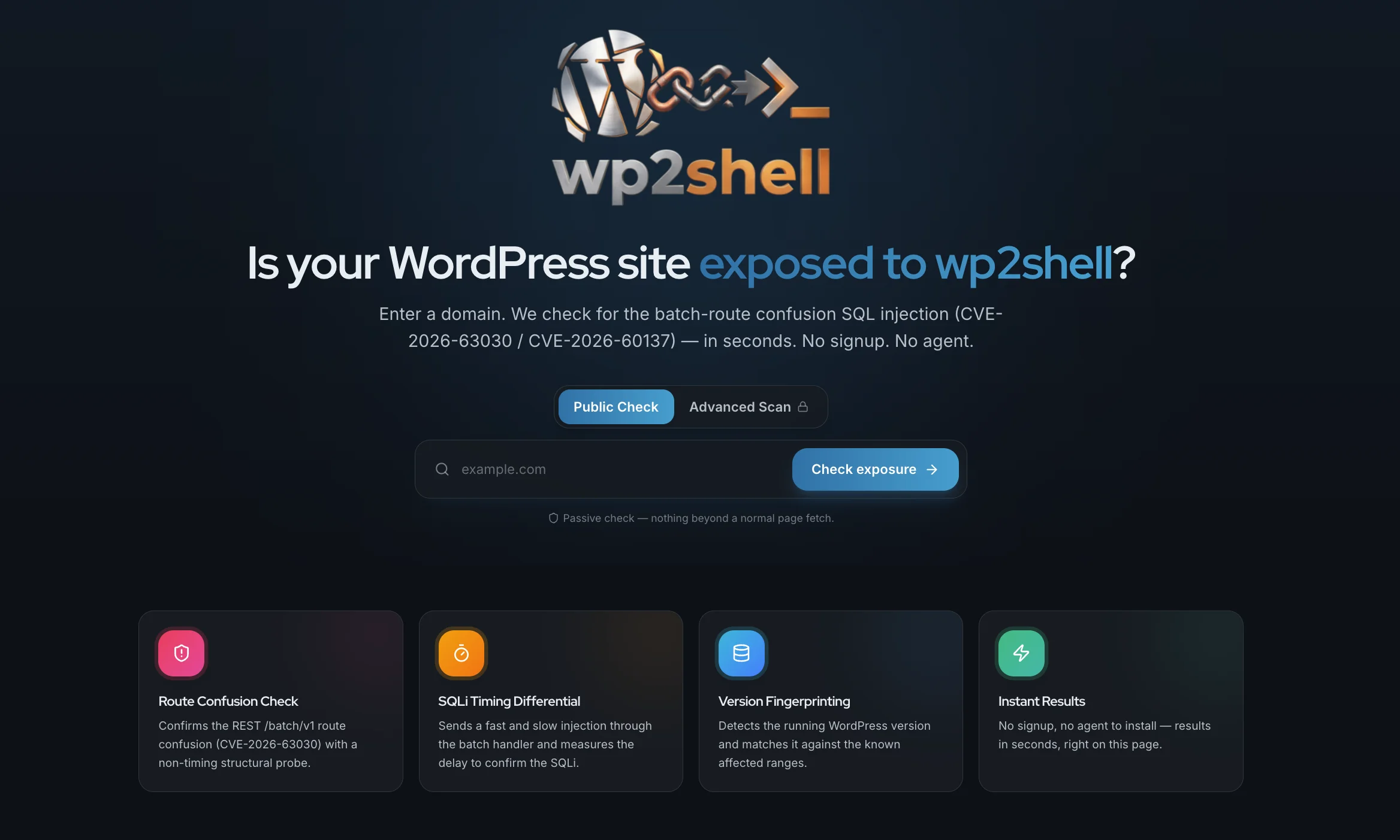
SOCRadar’s free wp2shell checker helps identify WordPress sites exposed to the wp2shell vulnerability chain
Key Takeaways
- wp2shell (CVE-2026-63030) is a critical pre-authentication RCE in WordPress core. No login, no plugins, no special configuration required.
- It chains a REST API batch-route confusion (CVE-2026-63030) with a SQL injection in WP_Query (CVE-2026-60137).
- Affected: WordPress 6.9.0-6.9.4 and 7.0.0-7.0.1. Fixed in: 6.9.5 and 7.0.2, released July 17, 2026.
- WordPress enabled forced automatic updates, but administrators should confirm the patch actually applied.
- A public PoC demonstrates the SQL injection and can read the database, including admin password hashes. In-the-wild exploitation is now confirmed as of July 18-20, 2026.
- Action: Update to 6.9.5, 7.0.2, or newer today. Sites on 6.8.x should apply 6.8.6 for the separate SQL injection issue.
What Is wp2shell (CVE-2026-63030)?
wp2shell is a critical pre-authentication Remote Code Execution vulnerability in WordPress core that lets an anonymous attacker run code on a default installation with no plugins and no preconditions. WordPress released versions 6.9.5 and 7.0.2 on July 17, 2026 to fix it and enabled forced automatic updates.
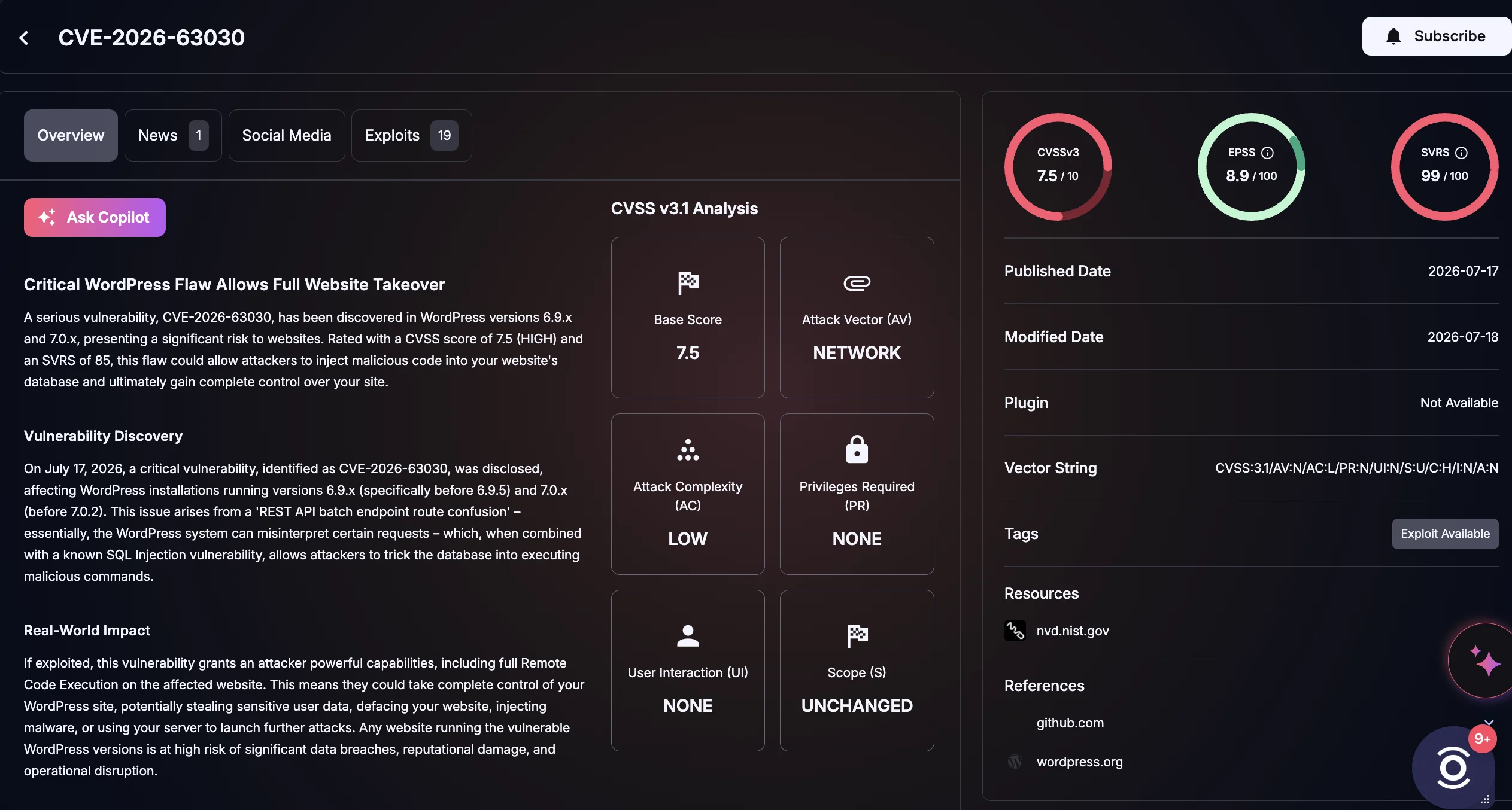
Details of CVE-2026-63030 in SOCRadar Vulnerability Intelligence
The vulnerability was discovered by Adam Kues at Assetnote, the attack surface management arm of Searchlight Cyber, and responsibly disclosed through WordPress’s HackerOne program. The researchers describe the attack as having “no preconditions” and being exploitable “by an anonymous user” against a stock install. Searchlight Cyber withheld full technical details to give defenders time to patch and published a public checker at wp2shell[.]com.
wp2shell at a Glance
| Attribute | Detail |
| Name | wp2shell |
| CVE (RCE chain) | CVE-2026-63030 |
| CVE (SQL injection) | CVE-2026-60137 |
| GitHub advisories | GHSA-ff9f-jf42-662q, GHSA-fpp7-x2x2-2mjf |
| Type | Pre-authentication Remote Code Execution (via chained SQL injection) |
| Affected | WordPress 6.9.0-6.9.4, 7.0.0-7.0.1 |
| Patched | 6.9.5, 7.0.2, 7.1 beta2 (6.8.6 for the SQLi-only branch) |
| Severity | Critical (GitHub advisory) |
| Authentication | None required |
| Public PoC | Yes |
| In-the-wild exploitation | Yes, confirmed as of July 18-20, 2026 |
How Does the wp2shell Exploit Chain Work?
wp2shell is a chain of two core vulnerabilities that together produce unauthenticated code execution:
- CVE-2026-63030 – a REST API batch-route confusion weakness in WP_REST_Server::serve_batch_request_v1(). This is the entry point rated Critical in the GitHub advisory GHSA-ff9f-jf42-662q, introduced in WordPress 6.9.
- CVE-2026-60137 – a SQL injection in the author__not_in parameter of the internal WP_Query class, where unsanitized input reaches the database query. This flaw has been present since WordPress 6.8 and is tracked under GHSA-fpp7-x2x2-2mjf.
An anonymous attacker reaches the vulnerable REST API batch endpoint (/wp-json/batch/v1), uses the route confusion to slip a rogue parameter into WP_Query, and drives the SQL injection toward code execution. According to Cloudflare’s analysis, the RCE path is reachable when a persistent object cache is not enabled, which is a common default. The batch endpoint has shipped with WordPress since version 5.6 (November 2020); the batch-route confusion that opens the chain arrived in version 6.9, released December 2, 2025.
The 7.0.2 release modified three core files covering both fixes: /wp-includes/rest-api/class-wp-rest-server.php, /wp-includes/class-wp-query.php, and /wp-includes/rest-api.php.
Which WordPress Versions Are Affected?
| Version range | Status |
| 6.8.0 – 6.8.5 | SQL injection only (CVE-2026-60137) – fixed in 6.8.6 |
| 6.9.0 – 6.9.4 | Full RCE chain – update to 6.9.5 |
| 7.0.0 – 7.0.1 | Full RCE chain – update to 7.0.2 |
| 7.1 beta2 | Contains the fix |
| 6.8.5 and earlier | Not exposed to the RCE chain |
Although WordPress enabled forced updates through its auto-update system, it has not confirmed whether the forced push reaches sites with auto-updates disabled. Verify the version you are actually running rather than assuming the update landed.
Is wp2shell Being Exploited in the Wild?
Yes. As of July 20, 2026, in-the-wild exploitation has been confirmed by multiple independent security firms. WordPress security company Patchstack has logged exploitation attempts, and Hexastrike reported seeing attacks in its honeypots over the weekend of July 18-19, later confirming it had assisted with incident response on several active compromises. watchTowr has also observed in-the-wild exploitation attempts; its CEO, Benjamin Harris, has said the disclosure-to-exploitation window has collapsed, with proof-of-concept exploits appearing within hours rather than the day-plus that was historically typical.
Public proof-of-concept exploits for the full RCE chain have since been published on GitHub. Some published PoCs extract password hashes via SQL injection and then crack an administrator password to gain access; others claim a more direct pre-authentication path to code execution without needing a cracked password, which would be a shorter and more dangerous chain.
If your site has not yet been patched to 6.9.5, 7.0.2, or 6.8.6, treat it as actively targeted, not merely theoretically at risk.
How to Mitigate wp2shell
- Use SOCRadar’s free wp2shell checker to confirm whether your instance is vulnerable.
- Update immediately to WordPress 6.9.5 or 7.0.2 (or 6.8.6 on the 6.8 branch). This is the only complete fix.
- If you cannot update today, block anonymous access to the batch API as a temporary stopgap:
- At the WAF level, block both /wp-json/batch/v1 and ?rest_route=/batch/v1. Blocking only the /wp-json path leaves the query-string route open.
- Alternatively, install a plugin that disables anonymous REST API access, or use the drop-in plugin published at wp2shell[.]com that rejects anonymous /batch/v1 requests at rest_pre_dispatch.
- Both approaches may break legitimate integrations and should be treated as emergency measures only.
- A persistent object cache (for example Redis or Memcached) can block the exploit path, per Cloudflare’s analysis, but treat this as incidental hardening only. It is not a substitute for patching, so update regardless.
- Use the public checker at wp2shell[.]com to verify whether your instance is vulnerable.
- Monitor traffic against the /batch/v1 endpoint and for anomalous author__not_in parameters, which will be the earliest indicators of exploitation attempts.
- Inventory every WordPress instance across your organization, including staging, marketing, and subsidiary sites, and confirm their versions. Forgotten installations are the most likely to remain unpatched.
How SOCRadar Helps
SOCRadar’s Attack Surface Management continuously discovers internet-facing WordPress instances across your organization and flags version-based exposure, which matters here because no CVE-keyed scanner detection existed at disclosure. You can also run SOCRadar’s free wp2shell checker to test a domain directly on this page.
SOCRadar’s Vulnerability Intelligence tracks CVE-2026-63030 and CVE-2026-60137 with exploit status and mitigation guidance as the situation develops, so security teams can prioritize patching before attackers weaponize the full chain further.
wp2shell FAQ for CISOs
What is wp2shell?
wp2shell is a critical pre-authentication Remote Code Execution vulnerability in WordPress core. It chains a REST API batch-route confusion flaw (CVE-2026-63030) with a SQL injection issue (CVE-2026-60137). An unauthenticated attacker can exploit it with crafted HTTP requests against a default WordPress install, with no plugins and no login required. Successful exploitation gives full server control.
Which versions are affected?
WordPress 6.9.0 to 6.9.4 and 7.0.0 to 7.0.1 are exposed to the full RCE chain. Versions 6.8.0 to 6.8.5 carry only the SQL injection component, fixed in 6.8.6. Versions at or below 6.8.5 are not affected by the RCE chain. Update to 6.9.5, 7.0.2, or newer.
How critical is it?
Very high. The GitHub advisory rates the RCE chain Critical, and Rapid7 lists CVSS 7.5 for the batch-route confusion. WordPress enabled forced automatic updates, the attack needs zero credentials, and it works on stock installs. A public proof-of-concept for the SQL injection component has already appeared.
Is there a public exploit?
Yes. Public proof-of-concept exploits for the full wp2shell chain have been released on GitHub, and in-the-wild exploitation has been confirmed by Patchstack, Hexastrike, and watchTowr as of July 18-20, 2026. Some PoCs combine the SQL injection with a cracked administrator password; others claim a more direct unauthenticated path to code execution. Do not treat the absence of a public technical write-up from Searchlight Cyber as an indication of low risk — working exploit code already exists in the wild.
How do I check if my sites are vulnerable?
Check your version in wp-admin under “At a Glance” or in the readme.html file. Run SOCRadar’s free wp2shell checker → (socradar.io/free-tools/wp2shell-checker) to test your domain directly, or use the original checker at wp2shell.com from Searchlight Cyber / Assetnote. Confirm the actual running version rather than relying on scheduled-update assumptions, since forced updates can fail to apply.
How do I test safely?
Never test in production. Use an isolated staging environment running the exact vulnerable version, and only use PoC code inside a sealed-off lab against systems you own or are authorized to test. Watch for unusual POST activity to the /wp-json/batch/v1 endpoint during testing.
How do I check logs for exploitation attempts?
Review these sources:
- Web server logs (Apache/Nginx): search for requests to /wp-json/batch/v1 or ?rest_route=/batch/v1, especially with author__not_in parameters or unusual payloads.
- WordPress debug/error logs: enable WP_DEBUG_LOG and look for SQL errors or unexpected queries.
- WAF / security plugin logs (Cloudflare, Sucuri, Wordfence): look for blocked or suspicious REST API activity.
- File integrity: check timestamps in /wp-content/ for new or modified PHP files, a common artifact after RCE.
There are no wp2shell-specific published indicators (filenames or IPs) in the primary disclosures, so do not rely on a fixed IoC list. Preserve logs before any cleanup.
What should I do right now?
- Update all WordPress sites to the patched versions.
- Verify the update actually applied, since forced updates can fail.
- Enable automatic minor updates where not already on.
- Review and harden REST API exposure if the batch endpoint is not needed.
- Scan for web shells and backdoors, and review admin accounts and application passwords against an approved inventory.
- Monitor logs closely for the next 48-72 hours.
Do I need to worry about older sites?
Only sites on 6.9.0-6.9.4 or 7.0.0-7.0.1 face the full RCE chain. Sites on 6.8.0-6.8.5 carry only the SQL injection issue (patch with 6.8.6). Pre-6.8 installs are not affected by this chain but may have other unrelated security issues.
Is this related to the WP-SHELLSTORM webshell campaign?
No. wp2shell is a WordPress core vulnerability requiring no plugins. The WP-SHELLSTORM campaign exploited an already-public, already-patched caching-plugin flaw that only worked on a non-default setting, reportedly compromising over 17,000 sites. The two are unrelated, though both reinforce the need to keep core, plugins, and themes patched.
What are the prevention tips going forward?
Keep core, plugins, and themes updated automatically where possible; deploy a capable WAF; limit REST API exposure when it is not needed; run regular vulnerability scans; enable a persistent object cache where practical (which incidentally closes this exploit path); and use hosting with strong tenant isolation.
Bottom line: patch today. The SQL injection half is already demonstrated in a public PoC, and the full chain is expected to follow.