

Mar 10, 2026
May 15, 2026
5 Mins Read
Sep 13, 2026
Table Of Content
Related Articles

SMS Bombing

Threat Actors
Jan 08, 2026
Dark Web Monitoring
Feb 19, 2026

Ransomware
Jan 31, 2026
OSINT Framework
Apr 17, 2026

What Is SQL Injection (SQLi)?
SQL injection (SQLi) is a vulnerability in which untrusted input changes the structure or meaning of a database query. An attacker may read or modify records, bypass an application check, perform administrative database actions, or in some configurations reach the underlying operating system.
SQL injection is not prevented by hiding error messages or filtering a few characters. The primary defense is to keep data separate from query instructions through parameterized statements, supported by least-privilege database accounts, safe error handling, and security testing.
Key Takeaways
- SQL injection occurs when application input is combined unsafely with a database command.
- Parameterized queries are the primary control across input fields, headers, cookies, APIs, and background jobs.
- Blind SQLi can extract information through content differences, timing, or out-of-band requests.
- A web application firewall can reduce attacks but does not replace secure query construction.
How SQL Injection (SQLi) Works
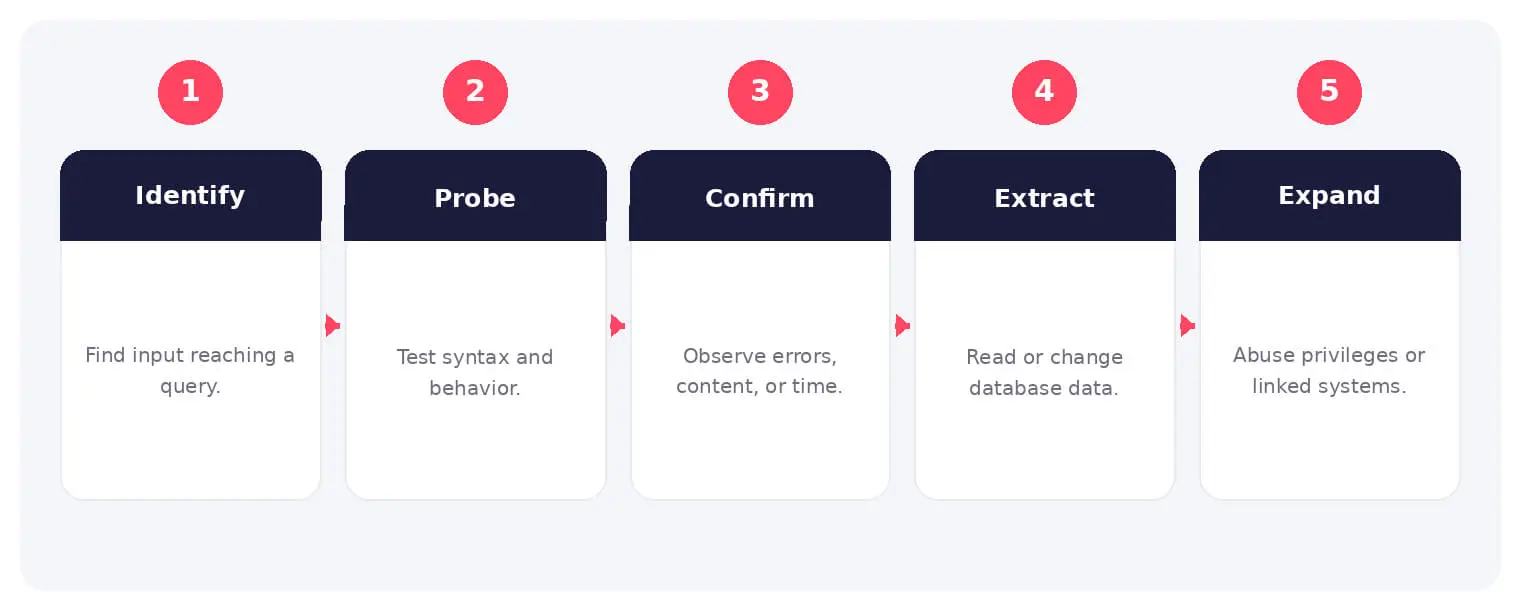
The attacker identifies input that reaches a database query and submits characters or expressions that alter the query logic. Error messages, response differences, or timing can reveal whether the input changed execution.
Depending on database permissions and query design, the attacker may enumerate schema, extract records, change data, bypass authentication, or trigger additional functions. Automated tools can scale extraction after a reliable technique is found.
Common Types and Techniques
- Union-based and error-based SQL injection
- Boolean-based and time-based blind SQL injection
- Second-order SQL injection
- Out-of-band and stacked-query techniques
Security and Business Risks
- Exposure of customer, employee, or payment data
- Authentication bypass and privilege abuse
- Unauthorized record modification or deletion
- Application disruption and possible server compromise
Warning Signs and Detection
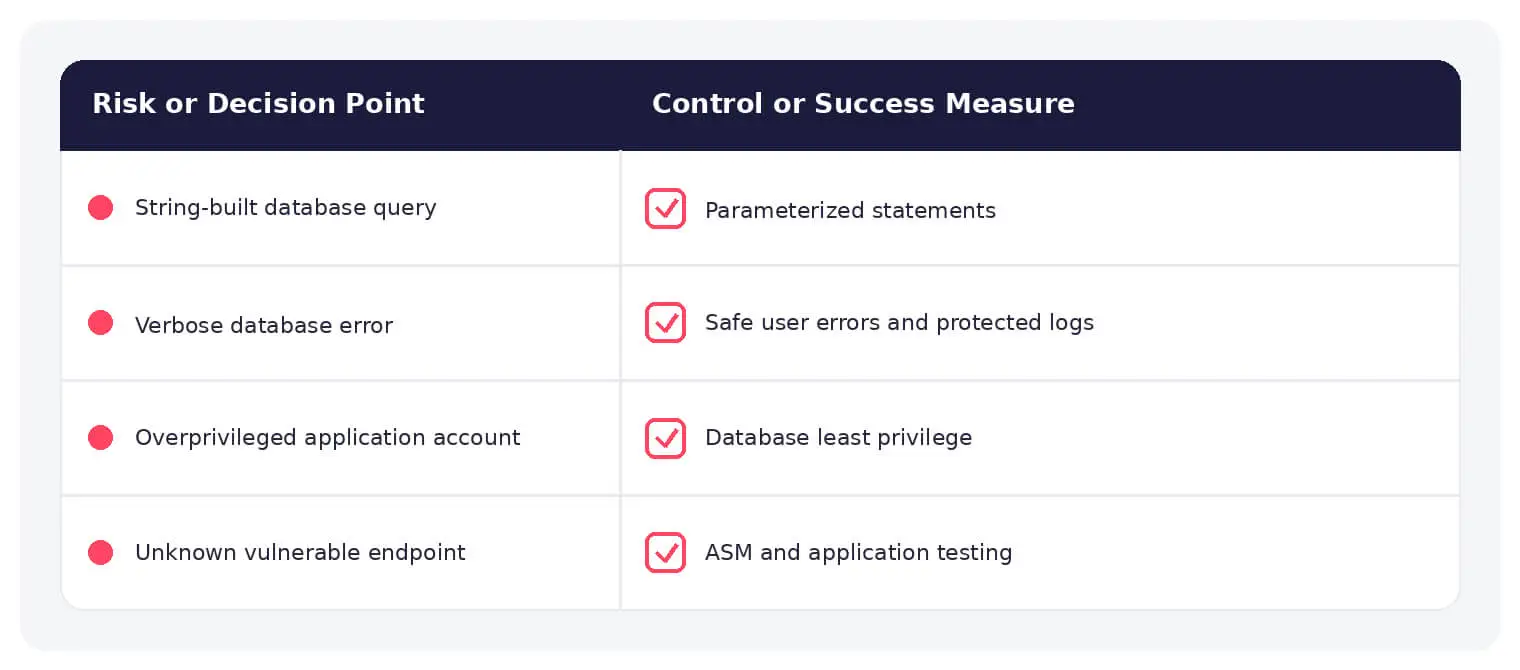
Monitor repeated syntax errors, unusual operators and encodings, abnormal query timing, large responses, sequential record extraction, and unexpected database functions. Application and database logs should preserve the request, parameter, identity, query template, and outcome.
Prevention and Response
Use parameterized queries or prepared statements, avoid dynamic SQL, validate input by expected type, apply least privilege, suppress detailed errors from users, test every data path, and include negative authorization and injection cases in development and review.
How SOCRadar Can Help
SOCRadar combines external asset visibility, threat intelligence, Dark Web monitoring, vulnerability context, and indicator enrichment to help teams identify exposure and investigate activity connected to SQL injection.
Explore SOCRadar Attack Surface Management or request a demo to strengthen threat-informed prevention and investigation.
Frequently Asked Questions
Which Inputs Can Trigger SQL Injection?
Any value that reaches a query can become an injection point: form fields, URL parameters, cookies, HTTP headers, JSON and API payloads, and data processed by background jobs. Treat every code path that builds a database statement as testable, not only the visible web forms.
What Is the Difference Between Union-Based and Error-Based SQL Injection?
Union-based injection appends a SELECT statement so attacker-chosen rows appear inside the legitimate response. Error-based injection forces the database to raise an error that leaks data in the message, which only works when detailed errors reach the attacker. Both rely on the response channel, which is why blind techniques matter when neither is available.
How Does Blind SQL Injection Extract Data?
When responses hide both errors and results, attackers infer answers indirectly. Boolean-based blind SQLi compares page content between true and false conditions, time-based SQLi measures delays caused by database sleep functions, and out-of-band SQLi triggers DNS or HTTP requests to attacker-controlled infrastructure. One reliable signal is enough to enumerate a schema record by record.
How Can SQL Injection Bypass a Login Form?
Crafted input can change the structure of a login query so the password comparison always succeeds, typically by appending a condition that is always true and commenting out the rest of the statement. An attacker who knows or guesses a valid username may need nothing else. Login logic built through string concatenation remains exposed even when other parts of the application are secure.
What Is Second-Order SQL Injection?
A payload is stored safely during the first submission, for example in a profile field, and executes later when a different function places that stored value into a new query without parameterization. The delay defeats filters that only inspect input at entry. It also demonstrates why data already in the database cannot be assumed to be harmless.
What Log Details Support SQL Injection Detection?
Application records should preserve the full request, the affected parameter, the authenticated identity, the query template involved, and the outcome. On the database side, capture failed statements, unusual function calls, and abnormal query latency. Correlating both sources helps separate routine scanning from successful extraction.
What Should You Do After Discovering a SQL Injection Vulnerability?
Review database and application logs to determine whether enumeration, modification, or exfiltration occurred, then fix the affected statements with parameterization rather than additional filtering. Confirm the application’s database account runs with least privilege, and reset exposed credentials while revoking active sessions for affected accounts where the platform supports it. Keep the timeline documented for disclosure and regulatory steps when personal data was reachable.
Why Are Parameterized Queries the Primary Defense Against SQLi?
Parameterized statements transmit the query structure and the data separately, so untrusted input is bound as a value and never parsed as SQL syntax. This holds regardless of encoding or context, which is why it is preferred over character filtering. Dynamic elements that cannot be bound, such as table or column names, should be controlled with allowlists instead.
Do ORMs and Frameworks Eliminate SQL Injection Risk?
No. ORMs parameterize values by default, but raw SQL fragments, string-built filters, dynamic sorting clauses, and reporting code that bypasses the binding layer can reintroduce injection. Review any path that constructs SQL manually, including stored procedures called with concatenated arguments.
Can SQL Injection Reach the Operating System?
It can in some configurations. Database features that read or write files, execute commands, or run multiple statements in one call become dangerous when the application account holds excessive privileges. Restricting permissions and disabling unused database features narrows these escalation paths.