

| WordPress branch | Fixed version |
|---|---|
| 7.0 | 7.0.3 |
| 6.9 | 6.9.6 |
| 6.8 | 6.8.7 |
| 6.7 | 6.7.6 |
| 6.6 | 6.6.6 |
| 6.5 | 6.5.9 |
| 6.4 | 6.4.9 |
| 6.3 | 6.3.9 |
| 6.2 | 6.2.10 |
| 6.1 | 6.1.11 |
| 6.0 | 6.0.13 |
| 5.x | Fixed backports available by branch |
| 4.7–4.9 | Fixed backports available by branch |

Aug 07, 2026
5 Mins Read

Summarize with:
XSS2Shell (CVE-2026-64638): Patch WordPress Now
A new WordPress Core vulnerability chain called XSS2Shell turns a login page XSS bug into a much more serious risk for exposed WordPress sites. The issue is tracked as CVE-2026-64638 and affects a broad range of supported WordPress versions before the latest security updates.
The risk starts on the WordPress login screen, but it does not necessarily stop there. Public research shows how the bug can be chained against a logged-in administrator to reach higher impact actions, including potential PHP code execution under specific conditions.
What Is XSS2Shell (CVE-2026-64638)?
XSS2Shell is the name given to a WordPress pre-authentication “XSS to code execution” vulnerability chain. The underlying WordPress Core vulnerability is CVE-2026-64638, a reflected cross-site scripting issue on the login screen.
The important point for defenders is that the first stage does not require an attacker account. A crafted failed login flow can cause JavaScript to run in the WordPress origin. When combined with administrator interaction and the right site conditions, that browser-side foothold may be escalated into more damaging actions.
WordPress rates CVE-2026-64638 as High with a CVSS 4.0 score of 8.9. The official WordPress advisory states that the issue can potentially be escalated to Remote Code Execution (RCE) through a malicious third-party website, but that escalation requires social engineering and explicit victim interaction.
How Does CVE-2026-64638 Affect WordPress Login?
CVE-2026-64638 affects how WordPress handles failed login input. According to the technical analysis of XSS2Shell, the issue comes from inconsistent parsing between WordPress and PHP sanitization routines. In simple terms, one part of the process treats crafted input as harmless text, while a later WordPress HTML handling step can interpret it as allowed markup.
That mismatch allows attacker controlled elements to appear on the login page as active content. Because the login page is usually internet facing, this creates a broad exposure surface for public WordPress sites.
This should not be described as a simple unauthenticated one request server side RCE. The XSS is pre-authentication, but the higher-impact chain depends on user interaction, administrator session context, Application Password behavior, and site configuration.
Which WordPress Versions Are Affected by XSS2Shell?
The official advisory lists affected WordPress releases from 4.7.0 through 7.0.2 and says the issue affects all WordPress versions, with fixes released in 7.0.3 and backported to eligible branches back to 4.7.
Key fixed versions include:
WordPress notes that backports apply to branches eligible to receive security fixes, currently through 4.7. Sites older than that should be treated as unsupported exposure and upgraded, isolated, or retired.
How Can XSS2Shell Lead to PHP Code Execution?
The demonstrated XSS2Shell chain begins with JavaScript execution in the WordPress origin. From there, the research shows how an attack against a logged-in single-site administrator can abuse WordPress Application Password approval, REST API behavior, and plugin upload functionality to reach PHP execution under suitable conditions.
At a high level, the chain depends on:
- A logged-in administrator interacting with attacker-controlled content
- Application Password functionality being available
- Administrator capabilities that allow content and plugin changes
- Plugin upload and file-write behavior
- A deployment where uploaded PHP files can be accessed and executed
These conditions matter. The XSS stage is broadly relevant across affected WordPress sites, but the PHP execution path depends on the administrator’s session and the site’s configuration.
Is XSS2Shell Being Exploited?
The official WordPress advisory and release notice do not report confirmed exploitation in the wild. The public research timeline says the issue was discovered and reproduced on July 26, 2026, reported to WordPress on July 27, patched in WordPress 7.0.3 on August 6, and publicly disclosed on August 7.
Even without confirmed exploitation, this should be treated as urgent. Public technical details are available, the login surface is widely exposed, and the escalation path gives attackers a clear model to adapt.
What Should WordPress Admins Do Now?
Patch WordPress Core Immediately
WordPress fixed the issue in WordPress 7.0.3 and backported security fixes to eligible branches. Site owners should update immediately, as WordPress recommends in its WordPress 7.0.3 release notice.
Upgrade to WordPress 7.0.3 or the fixed release for your supported branch. Do not rely only on automatic background updates; confirm the installed version through the dashboard, hosting panel, WP-CLI, or asset inventory.
Identify Unsupported WordPress Sites
Find WordPress installations older than 4.7 and any sites that cannot receive current backports. These should be upgraded, isolated, or removed from public exposure.
Reduce XSS2Shell Escalation Paths
Where feasible, restrict Application Passwords, limit administrator sessions, prevent unauthorized file modifications, and block direct PHP execution from plugin upload locations where this does not break legitimate functionality.
Also, you can access a free XSS2Shell checker tool through the research blog.
Review Administrator and Plugin Activity
Check for unexpected Application Password creation, unusual REST API activity, new administrator accounts, role changes, unapproved plugin uploads, modified plugin directories, and PHP files added after suspicious login-page activity.
Which XSS2Shell Detection Signals Matter?
Security teams should focus on behavior instead of relying on one static exploit pattern. Prioritize:
- Unusual wp-login.php requests with abnormal username input
- Failed-login activity followed by administrator actions
- REST API activity involving callback-style behavior
- Unexpected Application Password creation or use
- New administrator users or privilege changes
- Unapproved plugin uploads
- New PHP files in plugin paths
- Suspicious web-server activity after administrator sessions
There are no stable campaign indicators available, such as attacker IP addresses or file hashes. Version validation, log correlation, and administrator-session review should come first.
How Can SOCRadar Help Prioritize XSS2Shell Response?
SOCRadar’s Cyber Threat Intelligence helps teams track updates around XSS2Shell and CVE-2026-64638, including advisory changes, exploit developments, severity context, and emerging exploitation signals.
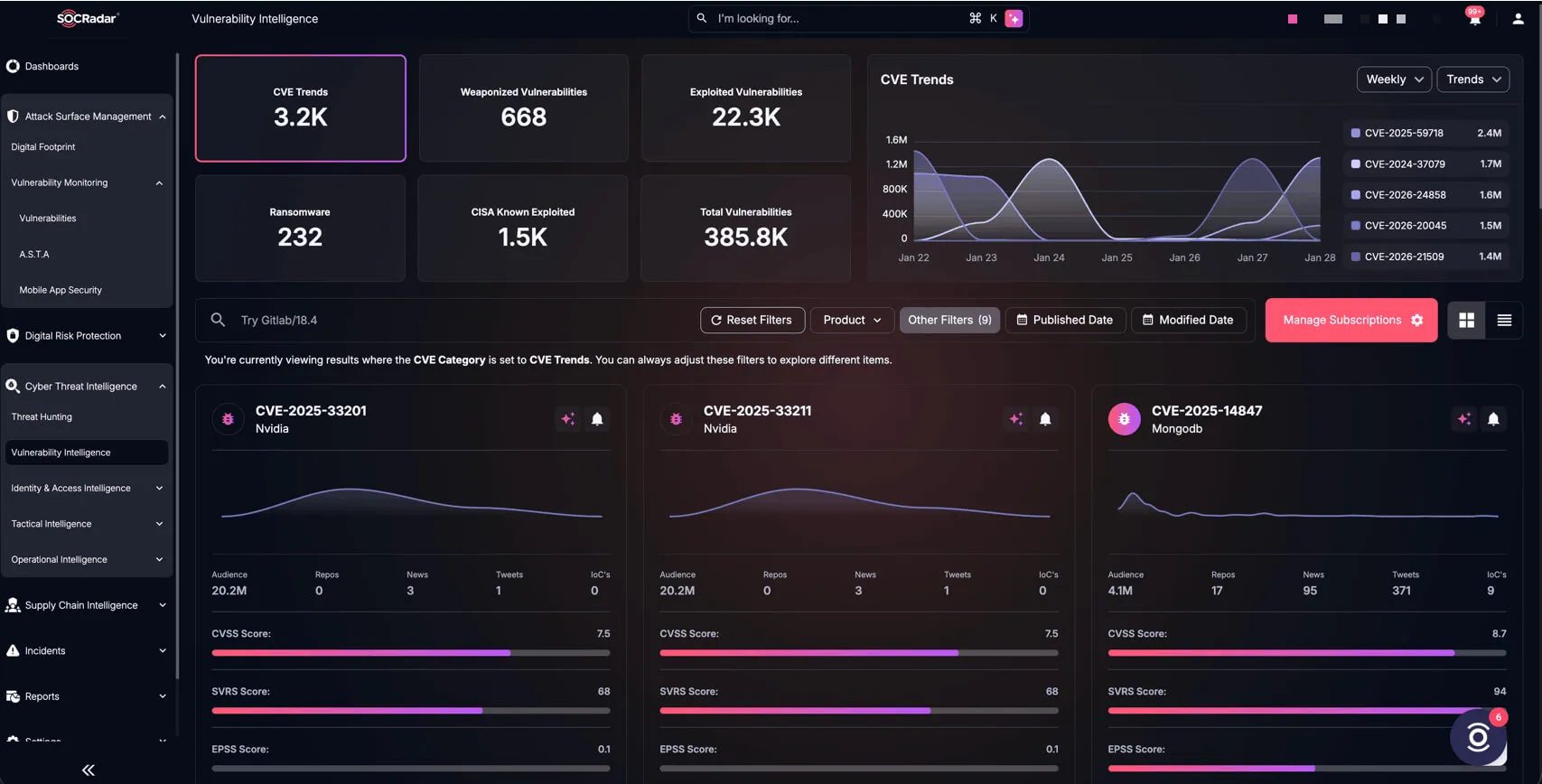
SOCRadar’s Vulnerability Intelligence
SOCRadar’s Attack Surface Management (ASM) adds exposure visibility by helping identify internet-facing WordPress assets and prioritize sites that remain on vulnerable Core branches. Combining CTI with ASM helps teams focus first on public WordPress deployments where delayed patching creates the highest operational risk.

Table Of Content
XSS2Shell (CVE-2026-64638): Patch WordPress Now
What Is XSS2Shell (CVE-2026-64638)?
How Does CVE-2026-64638 Affect WordPress Login?
Which WordPress Versions Are Affected by XSS2Shell?
How Can XSS2Shell Lead to PHP Code Execution?
Is XSS2Shell Being Exploited?
What Should WordPress Admins Do Now?
Which XSS2Shell Detection Signals Matter?
How Can SOCRadar Help Prioritize XSS2Shell Response?
Related Articles


CVE-2026-97229: Critical GitLab RCE
Oct 13, 2026


CVE-2026-102255: Critical SonicWall SMA1000 SSRF
Oct 12, 2026

Critical Cisco NX-OS Flaws Threaten Nexus Switches
Oct 09, 2026