

Oct 15, 2026
Table Of Content
7-Zip CVE-2026-14266 RCE Risk Explained
What Is CVE-2026-14266?
Why Does This 7-Zip Vulnerability Matter?
Which 7-Zip Versions Are Affected?
How Could CVE-2026-14266 Be Exploited?
Is There Evidence of Exploitation or Public PoC?
How Can SOCRadar Support Vulnerability Intelligence?
What Should Defenders Do Now?
Related Articles
Cisco Secure Email & PAN-OS Zero-Days Exploited

CVE-2026-105445: Docker Hub PAT Reassignment Flaw
Oct 14, 2026

CVE-2026-89111: Critical SAP Cloud SDK SSRF
Oct 14, 2026
October 2026 Patch Tuesday: 1,413 Flaws, 3 Zero-Days
Oct 14, 2026

Jul 20, 2026
5 Mins Read

Summarize with:
7-Zip CVE-2026-14266 RCE Risk Explained
CVE-2026-14266 is a heap-based buffer overflow in 7-Zip’s XZ decompression logic. If a user opens or extracts specially crafted compressed content with an affected 7-Zip version, the flaw may allow code execution in the context of the current process.
The issue was fixed in 7-Zip 26.02, released on June 25, 2026, while the Zero Day Initiative (ZDI) later published advisory ZDI-26-444 on July 15, 2026. At the time of writing, technical details remain limited, and advisories have not fully clarified the complete vulnerable version range or confirmed in-the-wild exploitation status.
What Is CVE-2026-14266?
CVE-2026-14266 (CVSS 7.0) is a memory corruption vulnerability in how 7-Zip processes XZ chunked data during decompression. The advisory describes the flaw as a heap-based buffer overflow triggered by crafted XZ-compressed data.
In practical terms, an attacker would need to get a target to process malicious compressed content. The issue is classified as Remote Code Execution (RCE), but the ZDI advisory also states that user interaction is required, such as opening a malicious file or visiting a malicious page.
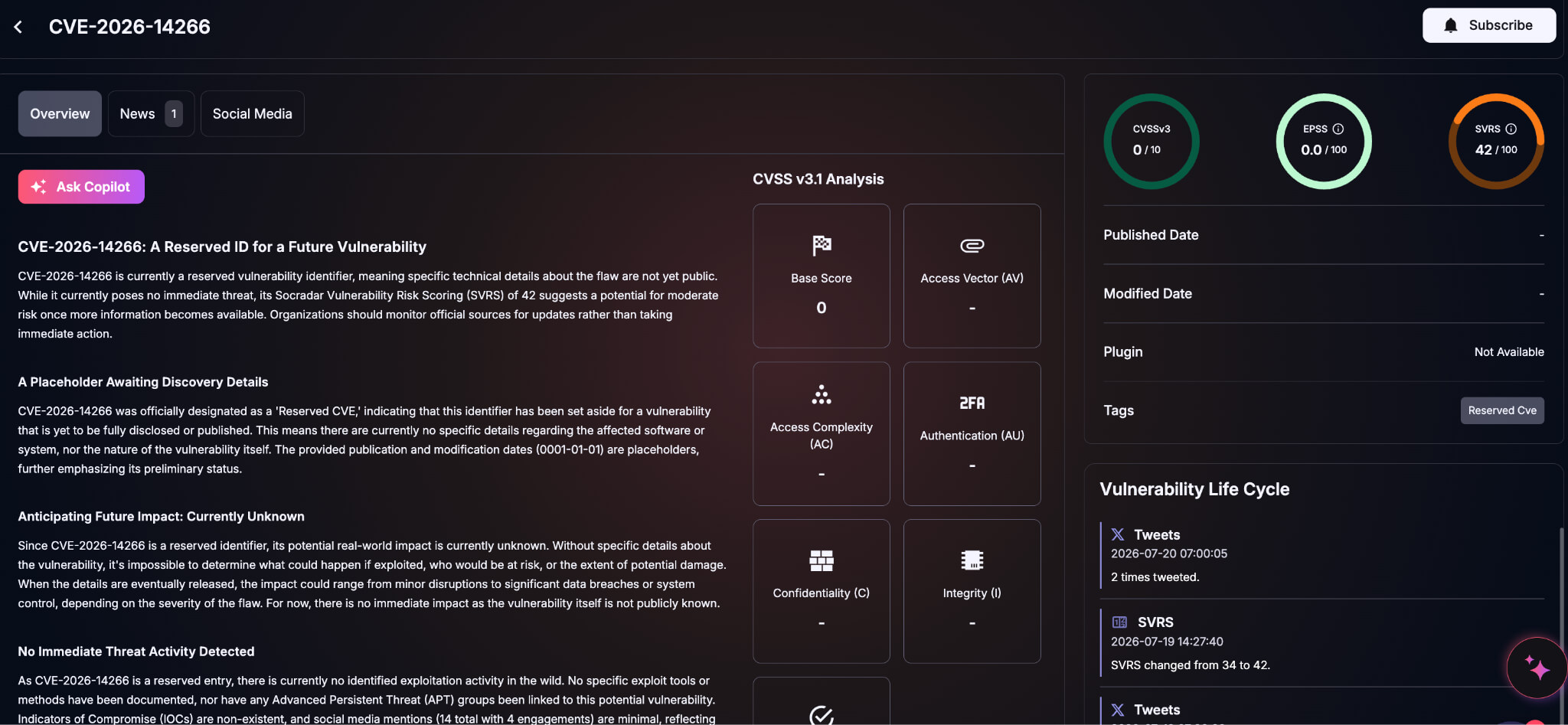
Details of CVE-2026-14266 (SOCRadar Vulnerability Intelligence)
Why Does This 7-Zip Vulnerability Matter?
7-Zip is commonly used to handle compressed files from email attachments, downloads, shared archives, software packages, and support portals. That reach makes archive-handling flaws a reliable delivery vector in phishing and malware campaigns.
CVE-2026-14266 does not appear to be a no-click remote exploit based on current information. However, user interaction is still a realistic condition because attackers frequently rely on users opening archive files during malware delivery campaigns.
If exploitation succeeds, the impact depends on the user context. Code execution as a standard user can still support malware installation, credential theft, persistence, or follow-on activity if the endpoint has access to sensitive files or internal systems.
Which 7-Zip Versions Are Affected?
The advisory confirms that CVE-2026-14266 is fixed in 7-Zip 26.02, and the official 7-Zip site lists version 26.02 as released on June 25, 2026.
| Product | Affected versions | Fixed version | Notes |
|---|---|---|---|
| 7-Zip | Not fully specified publicly | 26.02 or later | The advisory confirms the issue is fixed in 26.02 |
| Downstream packages | Distribution-dependent | Distribution-dependent | Validate through the relevant Linux or software package source |
Until a complete upstream affected-version range is available, defenders should treat 7-Zip versions earlier than 26.02 as potentially affected and validate installed versions through software inventory.
How Could CVE-2026-14266 Be Exploited?
Technical details are limited, so defenders should avoid assuming specific exploit steps beyond what the advisory supports.
A high-level exploitation path would look like this:
- An attacker prepares crafted XZ-compressed content.
- The target opens, extracts, or otherwise processes the content with an affected 7-Zip version.
- 7-Zip mishandles the XZ chunked data during decompression.
- The resulting heap-based buffer overflow may allow code execution in the current process context.
Reports suggest that the patch in version 26.02 introduces additional checks to prevent the decoder from writing beyond the remaining available space in an output buffer.
Is There Evidence of Exploitation or Public PoC?
As of July 20, 2026, there is no confirmed evidence of active exploitation of CVE-2026-14266 in the wild. There is also no publicly confirmed proof-of-concept (PoC) exploit. This could change as researchers continue analyzing the 26.02 patch and advisory details, so security teams should monitor for updated exploitability signals.
How Can SOCRadar Support Vulnerability Intelligence?
CVE-2026-14266 has limited technical detail, an incomplete affected-version picture, and user-interaction-based exploitability. That makes context important for prioritization.
Your security team can use SOCRadar’s Cyber Threat Intelligence module to keep track of updates to CVE-2026-14266, such as new references, exploit claims, PoC developments, severity changes, and remediation guidance as they become available. In addition, the Attack Surface Management (ASM) module alerts to critical vulnerabilities and exploits that affect public-facing services and technologies.
For operational response, teams should combine vulnerability context with asset visibility. Endpoints that routinely process external archives should move higher in the remediation queue, including:
- Help desk systems
- Analyst workstations
- IT administrator machines
- File intake environments
- Shared triage or sandbox systems
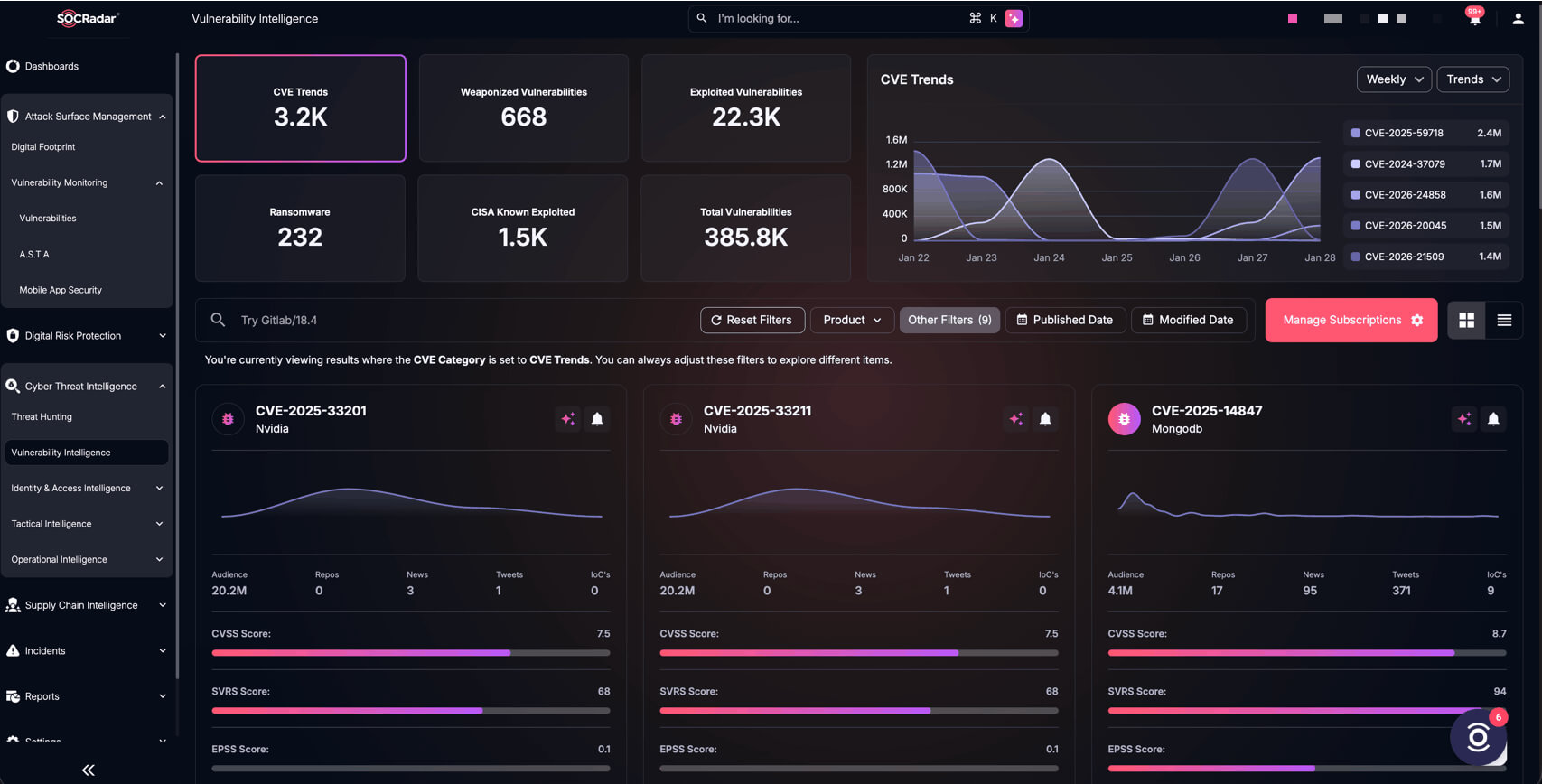
SOCRadar Vulnerability Intelligence
What Should Defenders Do Now?
1. Update 7-Zip to Version 26.02 or Later
Update 7-Zip to 26.02 or later. This is the primary mitigation for CVE-2026-14266.
This step requires active validation because 7-Zip does not include a built-in automatic update feature. Updates must be installed manually from the official site or through an organization’s software management process.
2. Confirm Rollout Through Inventory
Security teams should not rely on users to update 7-Zip themselves. Confirm installed versions through endpoint management, software inventory, or vulnerability management tooling.
Prioritize:
- Devices running 7-Zip versions earlier than 26.02
- Systems that process inbound files
- Help desk and support workstations
- Administrator and developer endpoints
- Shared file triage environments
3. Reduce Archive-Handling Exposure
While patching is underway, reduce opportunities for users or automated workflows to process malicious archives.
Useful controls include:
- Quarantine or sandbox externally sourced archives
- Detonate suspicious archives before analyst review
- Block unexpected compressed attachments where business rules allow
- Apply stricter handling for files from email, shared links, and support portals
- Limit archive processing on high-privilege systems where possible
4. Monitor for Suspicious 7-Zip Activity
There are no widely established indicators of compromise specific to CVE-2026-14266. Detection should focus on behavior around archive handling and post-execution activity.
Security teams should watch for:
- 7z.exe, 7za.exe, or 7zr.exe launched soon after downloads or email attachment access
- 7-Zip spawning unusual child processes
- Command shells or scripting engines launched from archive extraction paths
- Unexpected execution from temporary directories or user download folders
- Archive activity followed by credential access, persistence, or outbound connections
These signals do not prove exploitation on their own, but they can help teams triage suspicious archive-driven activity.