

| Release family | Patched version |
|---|---|
| Brazil | Brazil EA and Brazil GA |
| Australia | Australia Patch 2 |
| Zurich | Zurich Patch 7b and Zurich Patch 9 |
| Yokohama | Yokohama Patch 12 Hot Fix 1b and Yokohama Patch 13 |

Jul 21, 2026
5 Mins Read

Summarize with:
CVE-2026-6875 Hits ServiceNow AI Platform
Attackers are reportedly exploiting CVE-2026-6875, a critical pre-authentication vulnerability in the ServiceNow AI Platform. The flaw can allow an unauthenticated attacker, under certain conditions, to execute code inside a vulnerable ServiceNow instance.
ServiceNow has addressed the issue in hosted instances and provided relevant updates to self-hosted customers and partners. Public technical details show that the vulnerability affects sandboxed scripting behavior, making patch validation especially important for self-hosted or partner-managed environments.
What Is CVE-2026-6875?
CVE-2026-6875 (CVSS 9.5) is a code injection vulnerability in the ServiceNow AI Platform. NVD describes it as a Remote Code Execution (RCE) issue that could allow an unauthenticated user to execute code within the ServiceNow platform in certain circumstances.
The issue is tied to a sandbox escape. ServiceNow uses script sandboxing to restrict what certain inputs and scripts can do. In this case, the flaw creates a path from restricted script execution toward a more powerful code-execution primitive.
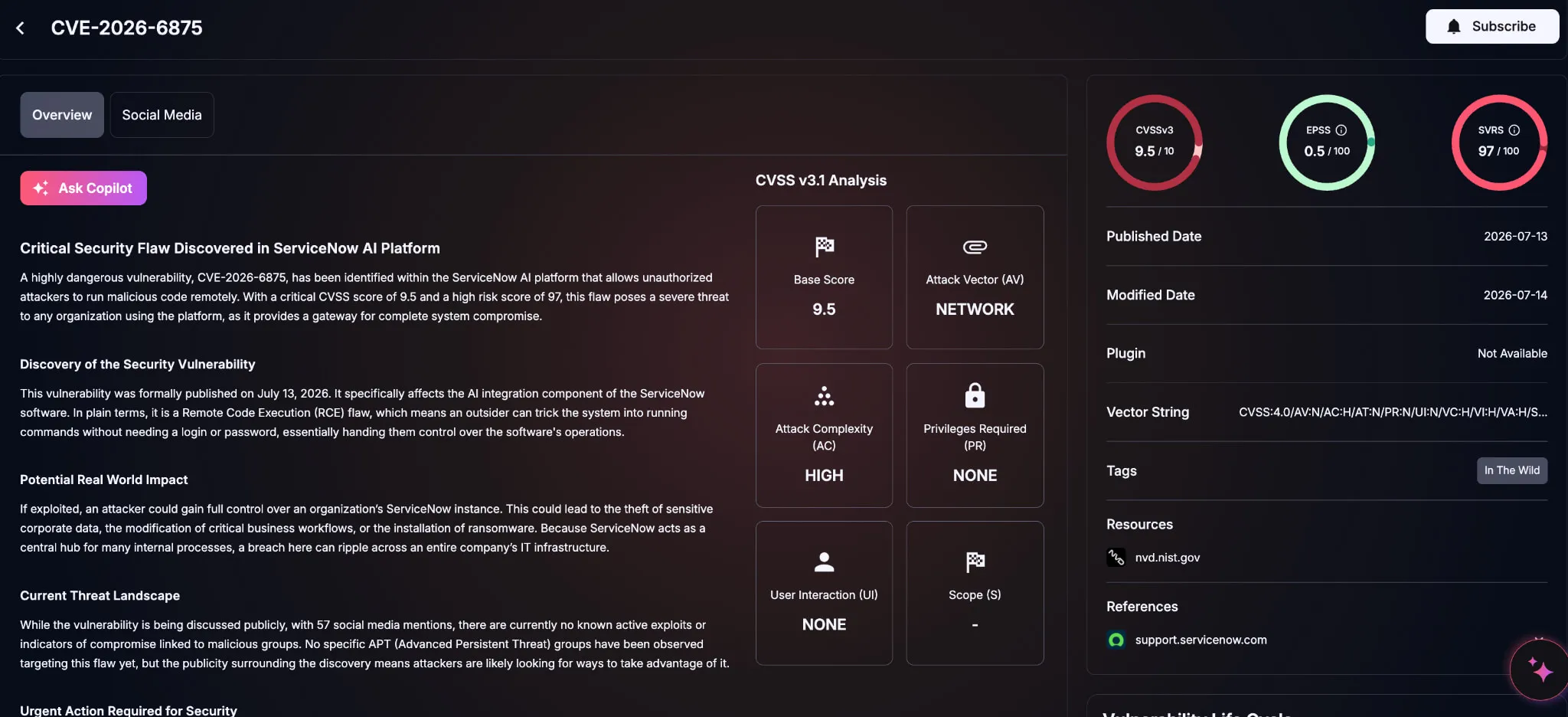
Details of CVE-2026-6875 (SOCRadar Vulnerability Intelligence)
How Does the Sandbox Escape Work?
Public technical research identifies /assessment_thanks.do as a pre-authentication sink that accepts user-controlled input. The issue starts with script-like behavior inside a query context, but the more serious risk comes from escaping the stricter sandbox that should limit what unauthenticated input can do.
Searchlight Cyber, which reported the vulnerability to ServiceNow on April 1, 2026, said successful sandbox escape could allow access to ServiceNow’s Rhino engine. Their analysis states that this level of access may let an attacker read data from tables, create administrator users, and run shell commands on configured proxy servers.
The public proof path is technically complex, so defenders should avoid treating this as a simple one-request exploit. However, pre-authentication code execution against a workflow platform still creates serious risk.
Which ServiceNow Versions Are Patched?
Official documentation from ServiceNow details that the flaw is addressed within these specific release families and associated patches:
ServiceNow’s public documentation also lists available patches and hotfixes by release family, and customers should confirm upgrade availability through official ServiceNow support channels.
Is CVE-2026-6875 Being Exploited in ServiceNow AI Platform?
Defused has reported in-the-wild exploitation attempts against CVE-2026-6875. The observed activity reportedly targets the same pre-authentication endpoint documented in public research, but uses a different sandbox-escape route than the published technical walkthrough.
That distinction matters for detection: teams should not rely only on exact proof-of-concept matching. Similar endpoint activity, unusual script behavior, or unexpected changes following requests to /assessment_thanks.do should receive closer review.
ServiceNow was not aware of active exploitation when the CVE record was first published. Organizations should treat newer exploitation reporting as a reason to validate patch status quickly, especially for self-hosted environments.
Why Does This ServiceNow AI Platform RCE Matter?
ServiceNow often connects workflows, approvals, identity data, ticketing, integrations, and automation across an organization. A pre-authentication code execution flaw can therefore create risk beyond a single application page.
If exploitation succeeds, attackers may access sensitive workflow data, create privileged users, abuse integrations, or pivot through connected proxy servers. The highest concern applies to environments where self-hosted or partner-managed instances have not received the relevant patches.
What Is Guarded Script?
ServiceNow has introduced Guarded Script as an additional security control for sandboxed contexts. ServiceNow documentation describes Guarded Script as a restricted evaluator that supports only a limited set of JavaScript syntax and server-side APIs, while rejecting unsupported features such as variable declarations, assignments, control-flow statements, function declarations, and multiple statements.
This helps reduce future sandbox-escape opportunities, but it should not be treated as a substitute for applying the relevant security updates.
What Should Security Teams Do Now?
Security teams should prioritize validation and hunting for self-hosted or partner-managed ServiceNow environments.
Recommended actions include:
- Confirm patch status: Verify that your instance is on a patched release family and version.
- Review pre-authentication activity: Look for unusual POST activity or repeated access to /assessment_thanks.do.
- Check for privilege changes: Review new administrator users, role changes, business rules, and unexpected workflow modifications.
- Validate proxy exposure: Review configured proxy servers, MID Server activity, and unusual outbound connections.
- Monitor integrations: Look for suspicious API activity, unexpected data access, or changes to connected automation.
How Can SOCRadar Help Prioritize Response?
Active exploitation of CVE-2026-6875 creates two urgent questions for security teams: where ServiceNow exposure exists, and whether threat activity around the vulnerability is escalating.
SOCRadar’s Cyber Threat Intelligence module helps teams follow exploit activity, public proof-of-concept developments, dark web mentions, and attacker interest around newly disclosed vulnerabilities. For CVE-2026-6875, this context can help security teams understand whether exploitation is expanding, which technical indicators matter, and how quickly response priorities should shift.
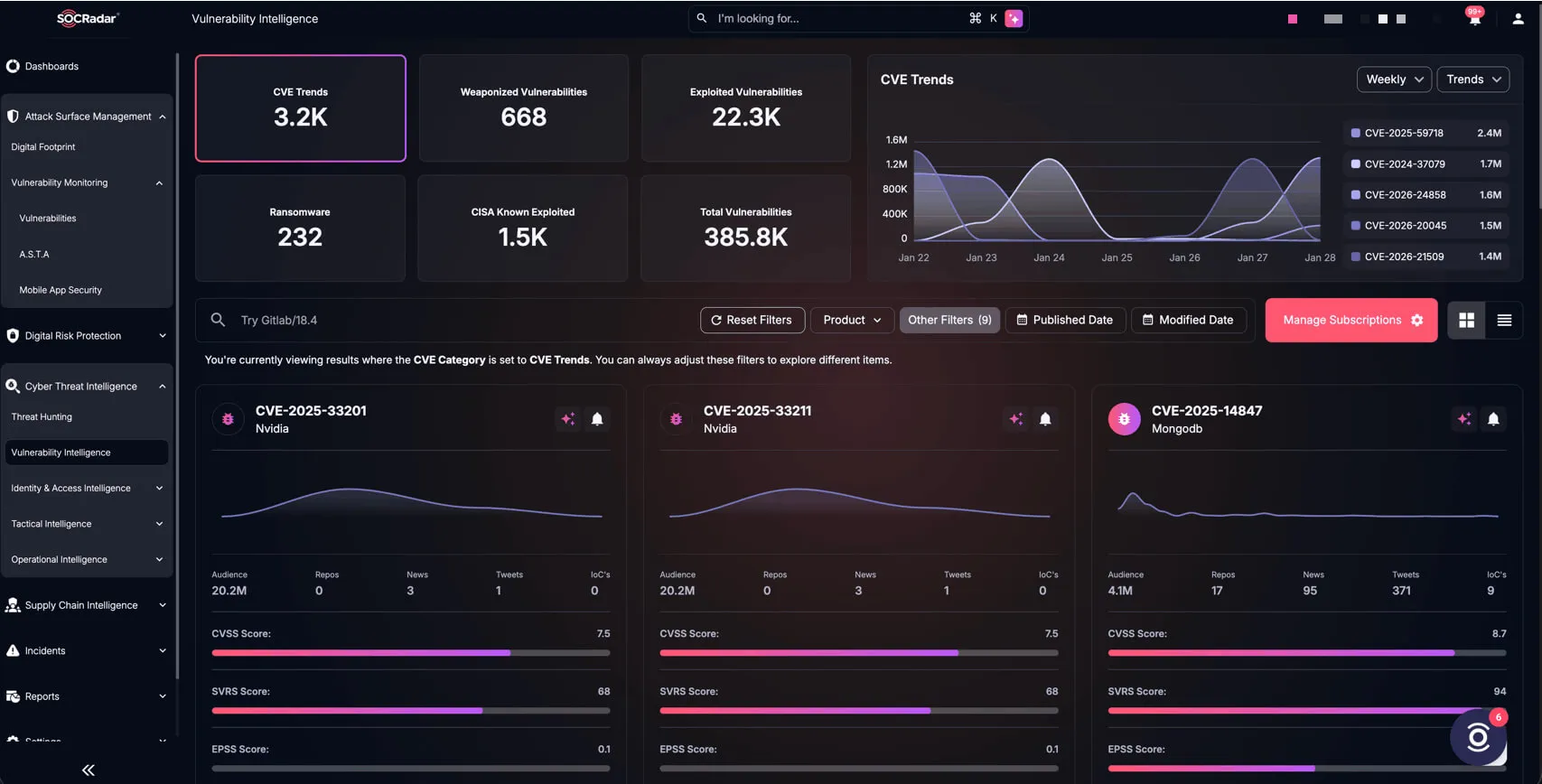
SOCRadar’s Vulnerability Intelligence
The Attack Surface Management (ASM) module adds the exposure layer by identifying internet-facing assets, misconfigured services, and ServiceNow-related infrastructure that may require immediate review. When CTI signals are combined with external exposure visibility, teams can prioritize the ServiceNow instances most likely to carry real operational risk, rather than treating every asset with the same urgency.
What Should Defenders Take Away?
CVE-2026-6875 is a critical ServiceNow AI Platform vulnerability because it combines pre-authentication access, sandbox escape behavior, and potential code execution. ServiceNow has released updates, but self-hosted and partner-managed environments still require direct validation.
Organizations should confirm patch levels, review logs for suspicious pre-authentication activity, check for unexpected privilege or workflow changes, and keep monitoring for new exploitation signals.

Table Of Content
CVE-2026-6875 Hits ServiceNow AI Platform
What Is CVE-2026-6875?
How Does the Sandbox Escape Work?
Which ServiceNow Versions Are Patched?
Is CVE-2026-6875 Being Exploited in ServiceNow AI Platform?
Why Does This ServiceNow AI Platform RCE Matter?
What Is Guarded Script?
What Should Security Teams Do Now?
How Can SOCRadar Help Prioritize Response?
What Should Defenders Take Away?
Related Articles

Roundcube SQLi (CVE-2026-48842) Exploited
Sep 25, 2026

Check Point Pre-Auth Flaws Under Attack
Sep 24, 2026


ShinyHunters Claims Access to FBI Systems
Sep 24, 2026

CVE-2026-87902 in WordPress Enables Conditional RCE
Sep 23, 2026