Security Information and Event Management, or SIEM, is the technology at the center of most modern Security Operations Centers (SOC). It collects log data from across an organization’s environment, normalizes it into a common format, applies correlation rules to identify suspicious patterns, and generates alerts for analysts to investigate.
SIEM emerged from the convergence of two earlier categories: Security Information Management (SIM), which handled long-term log storage and compliance reporting, and Security Event Management (SEM), which focused on real-time monitoring and alerting. The combination created a platform that could do both: store and search historical data while detecting threats in the present.
In 2026, SIEM has evolved significantly beyond its original rule-based architecture. AI-native capabilities, cloud-native deployment, and integration with adjacent technologies have changed what organizations expect from their SIEM and how they evaluate it.
How SIEM Works? The Data Pipeline
A SIEM platform processes security data through several sequential stages, each of which determines the quality of the intelligence it ultimately delivers.
Data collection
This is the first stage. Agents installed on endpoints, network devices, applications, and cloud services forward log data to the SIEM. Syslog remains a common transport protocol for network devices. Cloud-native SIEMs ingest data directly from cloud provider APIs.
Parsing and normalization
This converts raw log entries from dozens of different formats into a common schema. A Windows event log and a firewall deny record look nothing alike in their native formats. Normalization makes them comparable.
Correlation rules
This step define the logic that identifies suspicious patterns across normalized events. A single failed login is not an alert. Five hundred failed logins across ten accounts in three minutes, followed by one successful login, is an alert. Correlation rules encode this kind of conditional logic.
Alerting and visualization
This step presents findings to analysts through dashboards, case management queues, and notification systems. The alert is the output of the pipeline, but the quality of alerts depends on the quality of every stage before them.
The Evolution: From Legacy SIEM to AI-Native SIEM
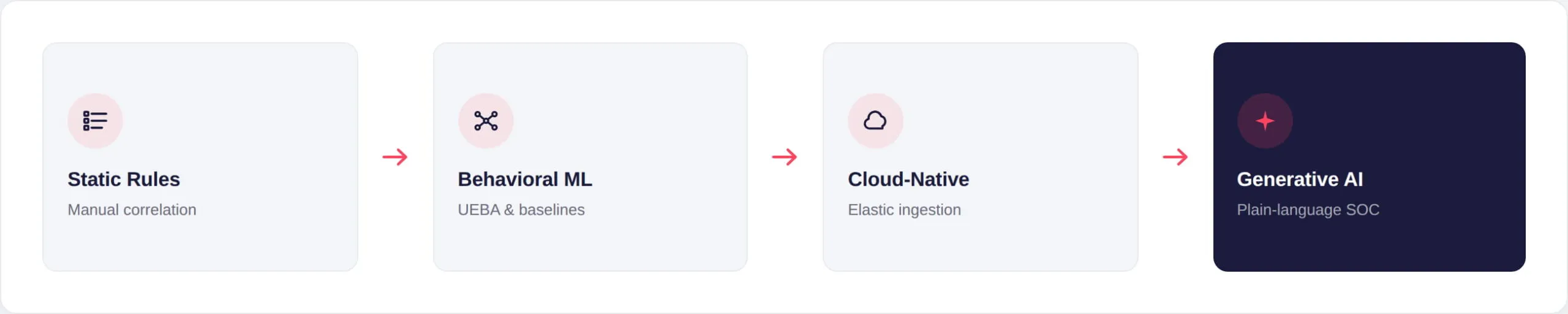
SIEM evolution flow
Early SIEM platforms relied entirely on static, manually written correlation rules. Security teams spent substantial effort tuning rules, and the result was still a high volume of alerts, many of them false positives. Analysts spent more time dismissing noise than investigating real threats.
Next-generation SIEM platforms address this through behavioral machine learning models. Rather than applying fixed rules, these systems build baseline profiles for users, devices, and network segments. Deviations from baseline trigger alerts regardless of whether a specific rule anticipated the behavior. This is the foundation of User and Entity Behavior Analytics (UEBA), which is now a standard component of competitive SIEM offerings.
Cloud-native SIEM architecture removes the on-premises hardware constraint and scales data ingestion elastically. Organizations no longer need to predict log volume years in advance and purchase hardware accordingly.
Generative AI in security has introduced a new capability: natural language incident summaries. Instead of presenting analysts with raw log correlations, AI-native SIEMs now generate plain-language descriptions of what happened, why it was flagged, and what the likely next steps are. This reduces time-to-understanding for analysts and makes the SOC more effective under high-alert conditions.
SIEM vs. SOAR vs. XDR
These three categories are often discussed together and sometimes confused. Each addresses a distinct need within the security operations environment.
Dimension
SIEM
SOAR
XDR
Primary function
Data aggregation, correlation, compliance
Workflow automation, response playbooks
Unified detection across endpoints, network, cloud
Core strength
Log management, threat detection, audit trails
Reducing analyst workload through automation
Deep telemetry visibility and cross-layer correlation
Alert handling
Generates alerts for analyst review
Automates response to defined alert types
Correlates signals natively across integrated data sources
Integration model
Ingests from many sources
Orchestrates across security tools
Typically vendor-specific deep integration
2026 direction
AI-native analytics, security data lakes
LLM-driven playbook generation
Expanding to cloud workloads
SIEM remains the data foundation. SOAR adds the automation layer on top of SIEM-generated alerts. XDR provides deeper native visibility within a specific vendor’s product ecosystem. These platforms increasingly overlap, and many vendors now offer combined offerings.
Incident response automation is where the three most visibly converge: SIEM detects, SOAR responds, and XDR provides the endpoint and network context that makes the response accurate.
Key Benefits and Use Cases of SEIM
Real-time threat detection
Real-time threat detection across all log sources gives security teams visibility they cannot achieve through individual tool consoles. A SIEM correlates a cloud access anomaly, a VPN login from an unusual geography, and a large file transfer within the same session, something no single-tool view can do.
Regulatory compliance
Regulatory compliance is a primary driver of SIEM adoption. Regulations including GDPR, HIPAA, and NIS2 require organizations to demonstrate that they log security events, retain them for defined periods, and can produce audit trails on demand. SIEM handles all three requirements in a single platform.
Threat hunting
Threat hunting uses the SIEM as a query engine. Analysts search historical log data for indicators of compromise associated with known threat actors or newly published vulnerability exploits. This proactive approach finds threats that rule-based alerting misses.
MTTD & MTTR
Mean Time to Detect (MTTD) and Mean Time to Respond (MTTR) are the operational metrics that SIEM investments are expected to improve. Organizations use these benchmarks to measure whether their SIEM configuration, their correlation rules, and their analyst workflows are performing effectively.
Implementation Challenges and Best Practices
Alert fatigue
This is the most common operational problem SIEM teams encounter. A poorly tuned SIEM generates so many alerts that analysts cannot investigate them effectively. Threats hide inside the noise. Addressing alert fatigue requires disciplined rule tuning, UEBA integration to raise the quality of detections, and regular review of which alerts are generating value.
Data ingestion cost
This is a practical challenge for cloud-native SIEMs that price by volume. A data tiering strategy separates high-value sources, such as authentication logs and endpoint telemetry, from lower-priority sources and applies different retention policies accordingly. This controls cost without sacrificing detection quality where it matters most.
Integration depth
It determines how much context analysts see when they investigate an alert. A SIEM that receives a raw syslog from an endpoint provides less investigative value than one integrated with an EDR platform that supplies process trees, file hashes, and network connection history alongside the original event.
Security Operations Center (SOC) alignment
SOC alignment ensures that the SIEM configuration reflects the organization’s actual threat model. Generic default rule sets produce generic results. Tuning correlation rules to the organization’s specific environment, user population, and risk priorities produces detection that is meaningfully better.
SOCRadar’s Cyber Threat Intelligence feeds integrate with SIEM platforms to enrich alerts with threat actor context, indicator of compromise (IoC) matching, and campaign attribution, giving analysts the intelligence they need alongside the technical detection data their SIEM generates.