What Is a Data Lake?
A data lake is a centralized repository designed to store large volumes of structured, semi-structured, and unstructured data in its original or lightly processed form.
Data lakes support analytics, machine learning, security operations, and long-term retention through schema-on-read. Without ownership, metadata, lineage, and access controls, a lake can become an opaque store of duplicated and sensitive data.
Key Takeaways
- A data lake is a centralized repository designed to store large volumes of structured, semi-structured, and unstructured data in its original or lightly processed form.
- Data lakes support analytics, machine learning, security operations, and long-term retention through schema-on-read. Without ownership, metadata, lineage, and access controls, a lake can become an opaque store of duplicated and sensitive data.
- Sensitive-data sprawl is a primary concern.
- Strong programs combine prevention, continuous visibility, ownership, and tested response.
How It Works
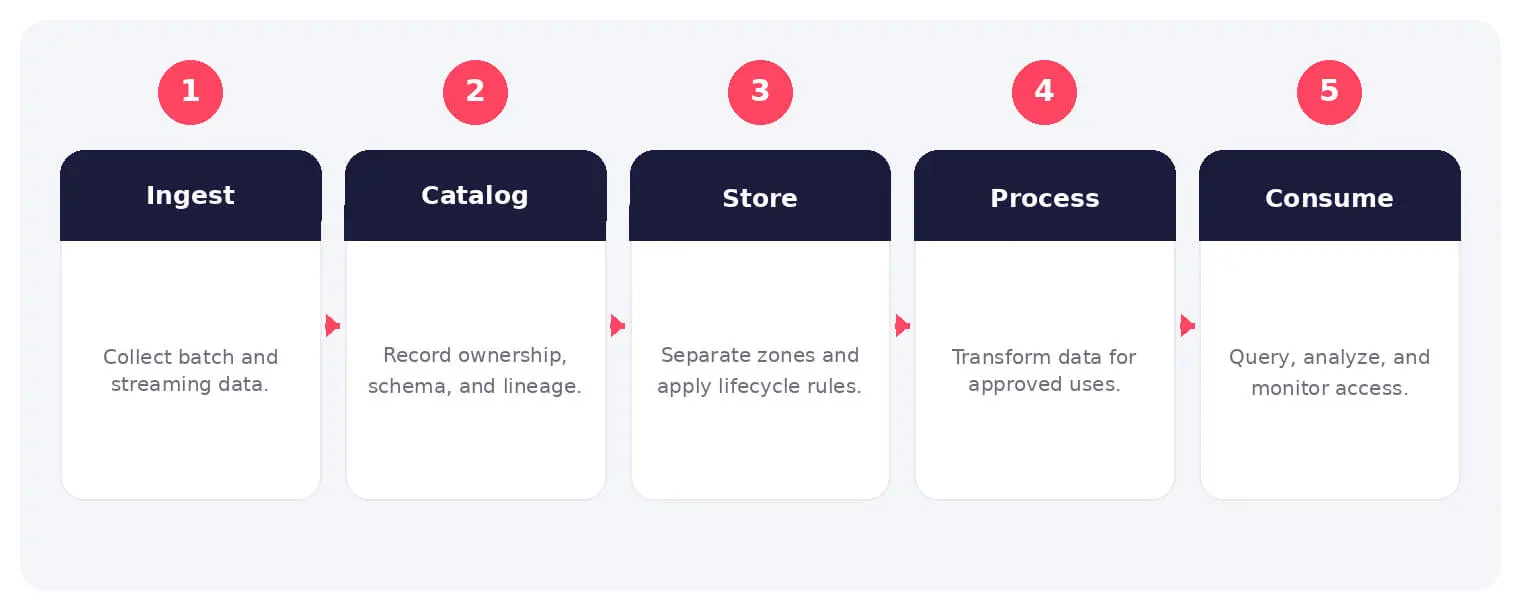
The operating flow above turns a broad security objective into observable steps. Exact implementations vary, but each stage needs an owner, trusted inputs, documented policy, and evidence that analysts can use during investigation and review.
Data lakes support analytics, machine learning, security operations, and long-term retention through schema-on-read. Without ownership, metadata, lineage, and access controls, a lake can become an opaque store of duplicated and sensitive data.
Common Types and Capabilities
- Raw, curated, and consumption zones
- Object storage and open table formats
- Batch and streaming ingestion
- Catalog, governance, and analytics services
Security and Business Risks
- Sensitive-data sprawl
- Excessive permissions and public access
- Poisoned, incomplete, or low-quality data
- Uncontrolled retention and rising cost
Warning Signs and Detection
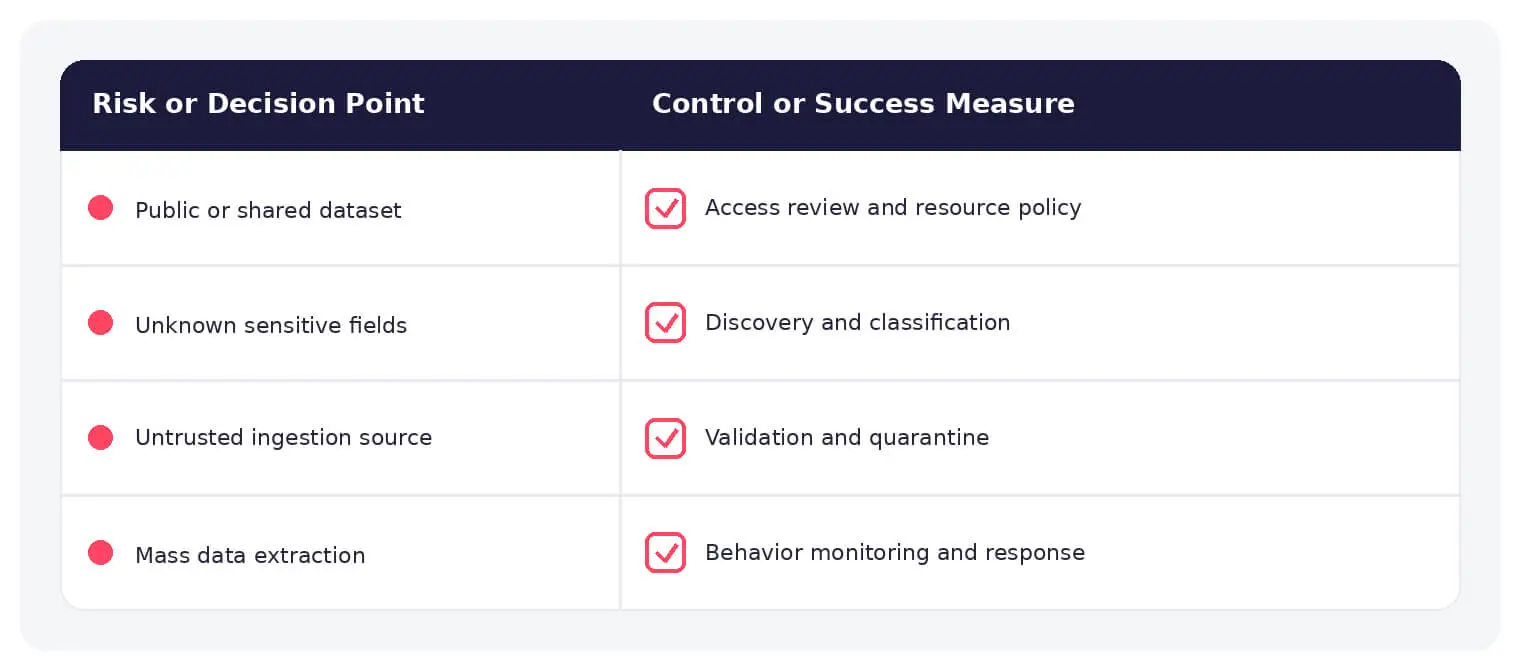
Monitor anonymous or cross-account access, bulk downloads, unusual queries, new ingestion sources, missing classifications, permission changes, disabled logging, failed pipelines, and unexplained data-volume growth.
Best Practices
Classify data at ingestion, use least privilege and separate zones, encrypt data and keys, mask nonproduction datasets, preserve lineage, validate pipelines, log access, and enforce retention.
How SOCRadar Can Help
SOCRadar adds outside-in asset visibility, threat intelligence, exposure context, and continuous monitoring that help security teams validate and prioritize risks related to data lake. This context complements internal cloud, data, network, and identity controls.
Explore SOCRadar Attack Surface Management or request a demo to strengthen threat-informed prevention and response.
Frequently Asked Questions
What Is a Data Lake?
A data lake is a centralized repository that stores large volumes of structured, semi-structured, and unstructured data in its original or lightly processed form. It relies on schema-on-read, meaning data is interpreted only when queried, which makes it suitable for analytics, machine learning, security operations, and long-term retention.
How Is a Data Lake Different From a Data Warehouse?
A data warehouse stores processed, structured data with a schema defined before ingestion, while a data lake keeps raw data in native formats and applies structure at query time. Lakes offer flexibility and lower storage costs; warehouses deliver stronger performance for predefined reporting. Many organizations use both, moving curated subsets from the lake into the warehouse.
Why Are Data Lakes a Security Concern?
Lakes often accumulate sensitive data from many sources, and duplicated copies with unclear ownership are easy to overlook. Excessive permissions, public object storage settings, and weak classification can expose regulated data at scale. Because one lake may feed dozens of pipelines, a single misconfiguration can affect far more records than an isolated database.
What Is Schema-on-Read and Why Does It Matter for Security?
Schema-on-read means data is stored in raw form and structured only when queried. This speeds up ingestion, but it makes the true contents of a lake harder to determine, so sensitive fields can go unidentified for long periods. Classifying data at ingestion and maintaining metadata reduce that blind spot.
What Are Data Lake Zones?
Zones split the lake into stages such as raw, curated, and consumption. Raw zones preserve original data, curated zones hold cleaned and validated datasets, and consumption zones serve specific analytics or security use cases. This separation supports least privilege by restricting who can access each stage.
What Warning Signs Suggest a Data Lake Is Being Misused?
Monitor signals such as:
- Anonymous or cross-account access and bulk downloads
- Unusual query patterns or newly added ingestion sources
- Permission changes or disabled logging
- Failed pipelines and unexplained data-volume growth
Missing classifications are also a red flag, since unclassified data is difficult to protect and audit.
How Should Teams Respond to a Suspected Data Lake Compromise?
Contain access first by revoking suspicious credentials and tightening permissions on affected zones, then review access and query logs to scope what was touched. Identify the datasets and classifications involved, notify data owners, and follow breach-notification obligations if regulated data is affected. Preserve logs as evidence before retention policies expire them.
How Can Organizations Prevent Sensitive-Data Sprawl in a Data Lake?
Classify data at ingestion, apply least-privilege access across separated zones, and encrypt data at rest with controlled key management. Mask nonproduction datasets, preserve lineage so data can be traced to its source, and enforce retention rules so obsolete copies are removed. Logging access and validating pipelines keep these controls verifiable over time.
What Is a Data Swamp?
A data swamp is a lake that has lost governance: data is duplicated, undocumented, and lacks clear ownership, lineage, or access controls. Swamps are difficult to query reliably and raise security and compliance risk because sensitive content becomes hard to locate. Cataloging, metadata management, and assigned ownership keep a lake usable and auditable.
Do Data Lakes Create Compliance and Cost Risks?
They can. Retaining raw copies of regulated data may conflict with obligations around data minimization and deletion under frameworks such as GDPR, HIPAA, or PCI DSS, and unclear lineage makes audits harder. Duplicate and low-value data also drives storage costs upward, so lifecycle and retention policies serve both compliance and budget goals.
Oct 23, 2026
CVE-2026-114625: Actively Exploited VeloCloud Orchestrator Flaw Grants Superuser Access
CVE-2026-114625 is an actively exploited SQL injection flaw in VeloCloud Orchestrator that lets authenticated users gain superuser operator privileges…

Oct 22, 2026
PHP2Shell Exploit Tooling Found on Exposed Attacker Server
SOCRadar Threat Intelligence Unit (STRU) researchers found PHP2Shell exploit tooling on an attacker-controlled server whose working directory was exposed…
Oct 22, 2026
New LiteLLM Supply Chain Attack Hits PyPI and Docker
A new LiteLLM supply chain attack has turned version 1.107.0, an official release of the popular open-source LLM gateway, into a credential…
Intelligence in your inbox every Thursday.
Join 30,000+ security professionals reading SOCRadar research.
Subscribe