

Mar 10, 2026

Jan 08, 2026
6 Mins Read
Sep 13, 2026
Table Of Content
Related Articles

SMS Bombing
Threat Actors
Jan 08, 2026
Dark Web Monitoring
Feb 19, 2026

Ransomware
Jan 31, 2026
OSINT Framework
Apr 17, 2026
What Is a Security Operations Center (SOC)?
A Security Operations Center (SOC) monitors, detects, investigates, and coordinates response to cybersecurity threats affecting an organization.
A SOC combines people, processes, telemetry, technology, threat intelligence, and business context. Its success should be measured by risk reduction and response quality, not by alert volume or the number of tools analysts operate.
Key Takeaways
- A Security Operations Center (SOC) monitors, detects, investigates, and coordinates response to cybersecurity threats affecting an organization.
- A SOC combines people, processes, telemetry, technology, threat intelligence, and business context. Its success should be measured by risk reduction and response quality, not by alert volume or the number of tools analysts operate.
- Alert fatigue and missed incidents is a primary concern.
- Effective programs combine prevention, continuous visibility, accountable ownership, and tested response.
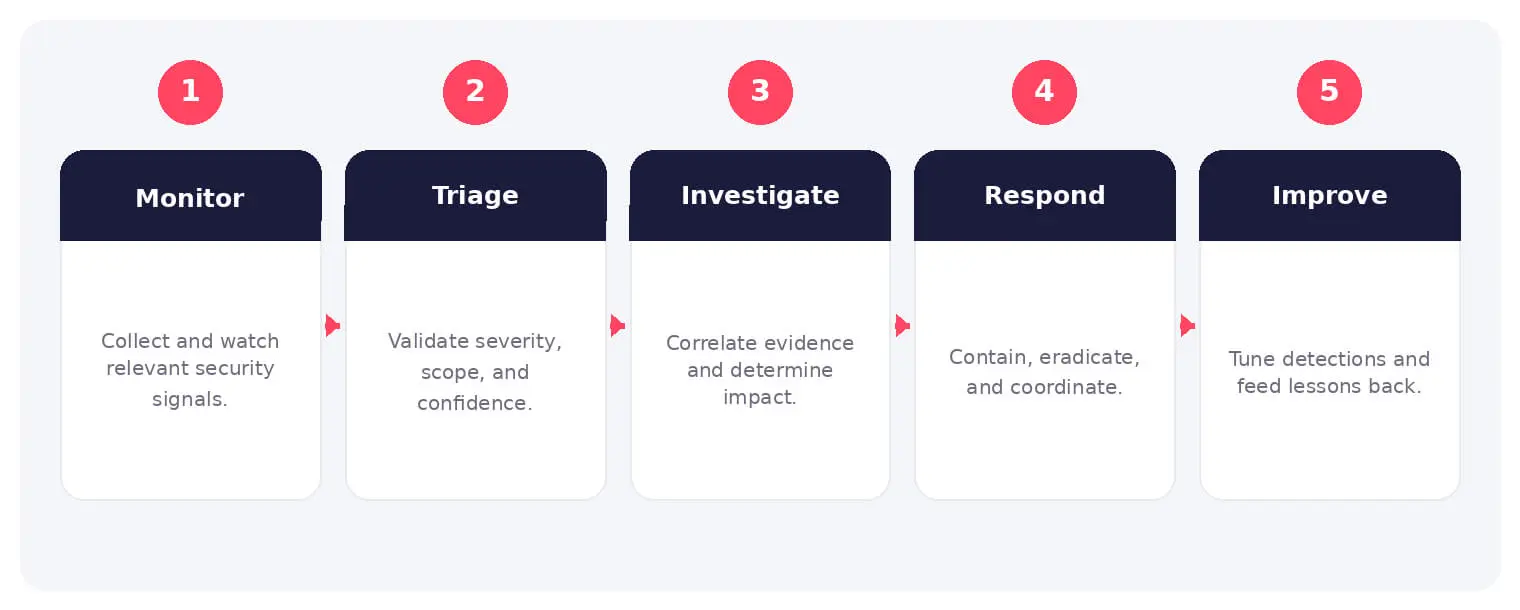
How It Works
The operating flow above turns the concept into observable steps. Exact implementations vary, but each stage needs accountable ownership, trusted inputs, documented policy, and evidence that analysts can use during investigation and review.
A SOC combines people, processes, telemetry, technology, threat intelligence, and business context. Its success should be measured by risk reduction and response quality, not by alert volume or the number of tools analysts operate.
Common Types and Capabilities
- Internal and centralized SOCs
- Distributed and virtual SOCs
- Managed SOC and MDR services
- Hybrid and follow-the-sun models
Security and Business Risks
- Alert fatigue and missed incidents
- Telemetry gaps and poor data quality
- Unclear escalation and response authority
- Burnout, skill gaps, and weak measurement
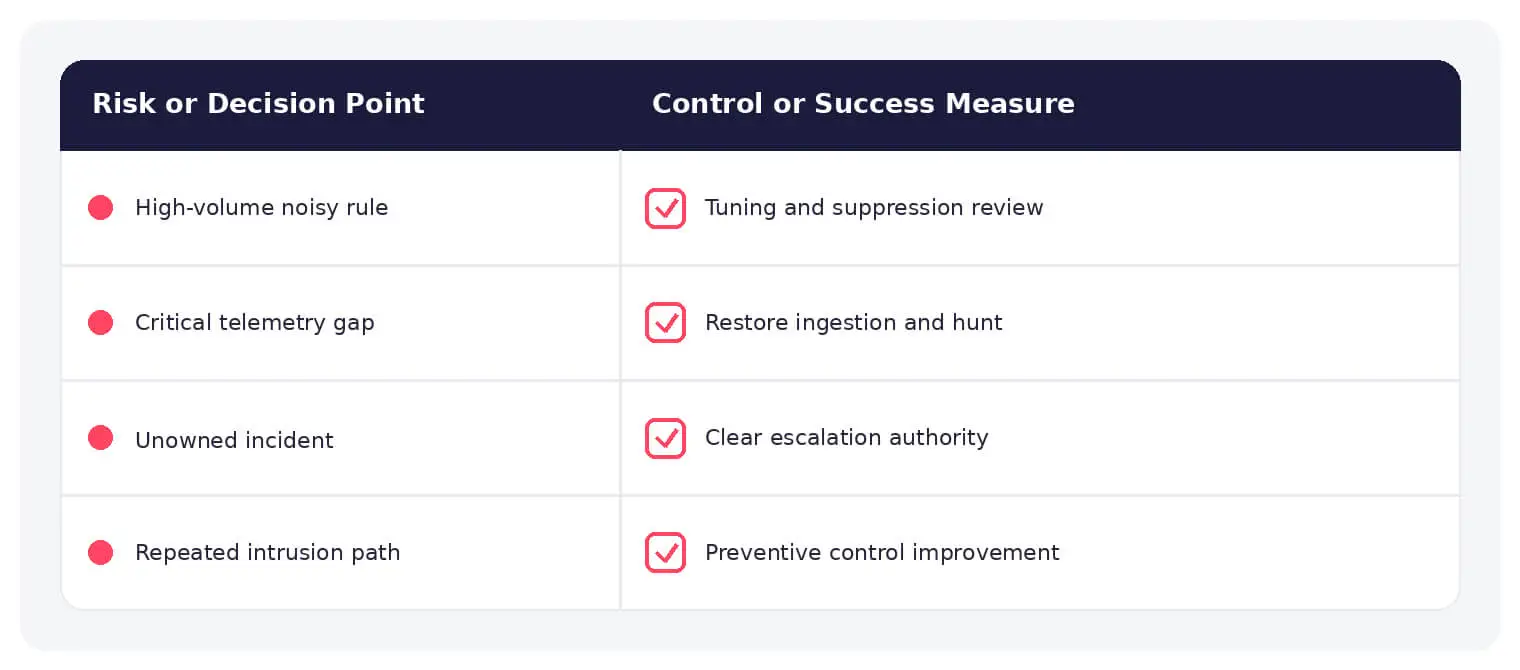
Warning Signs and Detection
Monitor detection coverage, ingestion failures, alert aging, queue depth, escalation delays, repeat incidents, false-positive trends, missing asset context, unowned cases, response control failures, analyst workload, and findings that never change a preventive control.
Best Practices
Define mission and service levels, map critical use cases, maintain reliable telemetry, enrich with asset and threat context, document escalation, rehearse response, protect analysts from noise, measure outcomes, and continuously tune controls.
How SOCRadar Can Help
SOCRadar adds external visibility, threat intelligence, exposure context, and continuous monitoring to help teams validate and prioritize risks related to security operations center. This context complements internal security operations, identity, response, and governance controls.
Explore SOCRadar Cyber Threat Intelligence or request a demo to strengthen threat-informed prevention and response.
Frequently Asked Questions
What Is a Security Operations Center (SOC)?
A Security Operations Center (SOC) is a dedicated function that monitors, detects, investigates, and coordinates response to cybersecurity threats affecting an organization. It combines people, processes, telemetry, technology, and threat intelligence with business context. Its success is measured by risk reduction and response quality rather than alert volume or the number of tools in use.
What Are the Main Roles Within a SOC?
Typical SOC staffing separates duties so that every stage of an investigation has a clear owner:
- Tier 1 analysts triage alerts and filter false positives
- Tier 2 and Tier 3 analysts run deeper investigations and threat hunting
- Detection engineers build and tune detection rules
- A SOC manager owns escalation, service levels, and reporting
Smaller teams often combine these duties, but each function still needs accountable ownership.
What Are the Main SOC Operating Models?
Common options include internal and centralized teams, distributed or virtual SOCs, managed SOC and MDR services, and hybrid or follow-the-sun arrangements. Each model balances cost, control, and coverage differently, and many organizations pair a small internal team with external detection and response support. The right choice depends on budget, regulatory obligations, and available in-house expertise.
What Does a Typical SOC Workflow Look Like?
Telemetry from SIEM platforms, endpoint detection tools, identity systems, and cloud logs is collected and correlated. Analysts triage alerts for validity and severity, investigate confirmed events with asset and threat context, and escalate when needed. Response ends with containment, recovery, and a review that feeds lessons back into detections and preventive controls.
What Technologies Does a SOC Typically Use?
Core tooling usually includes a SIEM for log aggregation and correlation, EDR or XDR for endpoint visibility, SOAR for automating repetitive tasks, and threat intelligence feeds for enrichment. Network detection, identity analytics, and vulnerability management tools are also common depending on scope. Tools support the process, but they do not replace accountable ownership or reliable telemetry.
Why Is Alert Fatigue a Serious Problem for SOCs?
A constant stream of low-value alerts makes it easier for genuine attacks to be missed and pushes analysts toward burnout and turnover. Over time this weakens both coverage and institutional knowledge. Tuning detections, suppressing known-benign patterns, and reviewing alert quality help protect analyst attention without sacrificing coverage.
What Warning Signs Suggest a SOC Is Underperforming?
Frequent indicators include growing alert backlogs, slow escalations, unowned cases, and telemetry gaps from assets that never report in. Repeat incidents with the same root cause, and findings that never change a preventive control, are also strong signals. Rising analyst workload and false-positive trends often appear before a major miss.
What Metrics Show Whether a SOC Is Effective?
Useful measures include mean time to detect (MTTD), mean time to respond (MTTR), detection coverage for critical use cases, escalation delays, and repeat incident rates. Operational health signals such as alert aging, queue depth, and false-positive trends show whether the process is keeping up. Outcomes tied to risk reduction matter more than raw alert or tool counts.
How Should an Organization Start Building a SOC?
Start by defining the mission, service levels, and the critical use cases the team must cover, such as ransomware, credential compromise, and email-based attacks. Establish reliable telemetry and documented escalation paths for those scenarios first, then rehearse response through tabletop exercises. Coverage can expand iteratively as processes and detections mature.
Does a SOC Prevent Attacks or Replace Incident Response?
No. A SOC improves detection and coordinates response, but prevention still depends on controls such as patching, phishing-resistant MFA, and secure configuration. Major incidents also draw in stakeholders beyond the SOC, including legal, communications, and executive leadership.
How Does a SOC Differ from a NOC?
A Network Operations Center (NOC) focuses on the availability and performance of IT systems, while a SOC focuses on security threats and incidents. The two may share tooling and staff in smaller organizations, but their missions, metrics, and escalation paths differ. Blurring the two often leaves no clear owner when a security incident occurs.