
What Is Cybersecurity?
Cybersecurity protects systems, networks, applications, identities, and data from unauthorized access, misuse, disruption, alteration, and destruction.
It is an organizational risk discipline, not only a technical function. Effective programs connect governance, architecture, engineering, operations, resilience, legal obligations, people, suppliers, and measurable business priorities.
Key Takeaways
- Cybersecurity protects systems, networks, applications, identities, and data from unauthorized access, misuse, disruption, alteration, and destruction.
- It is an organizational risk discipline, not only a technical function. Effective programs connect governance, architecture, engineering, operations, resilience, legal obligations, people, suppliers, and measurable business priorities.
- Data breaches and financial loss is a primary concern.
- Effective programs combine prevention, continuous visibility, accountable ownership, and tested response.
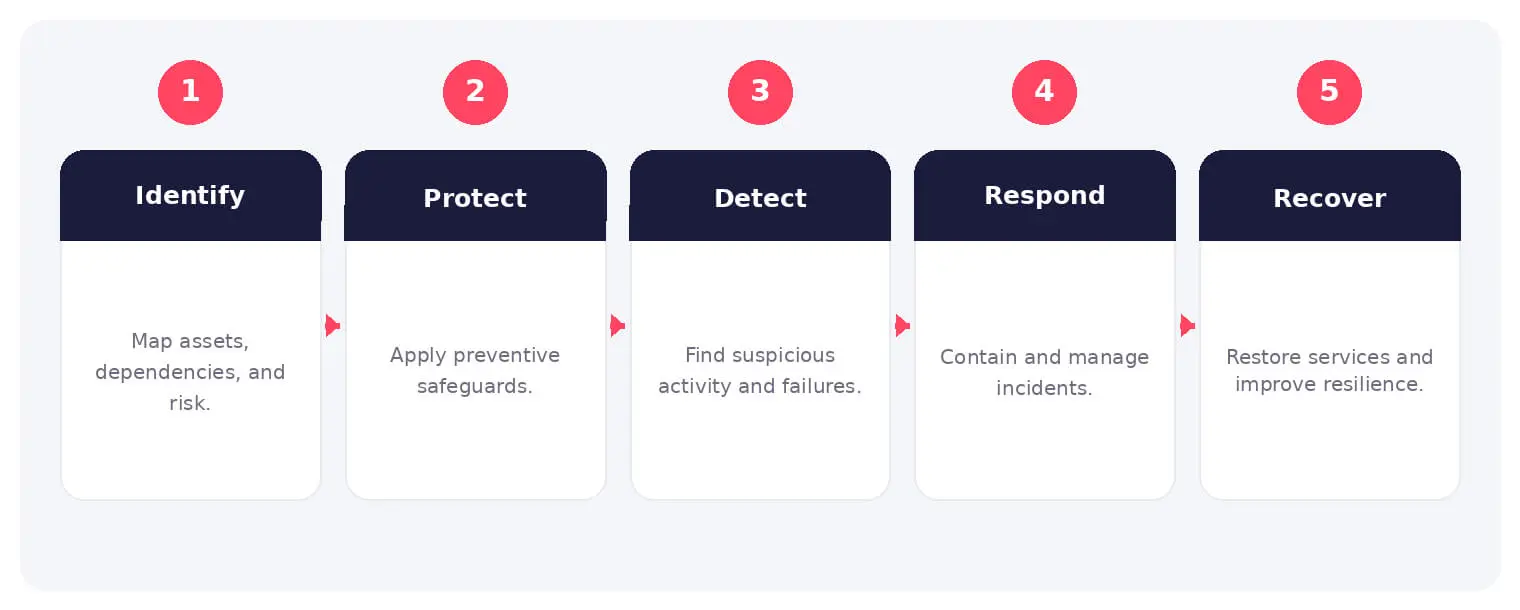
How It Works
The operating flow above turns the concept into observable steps. Exact implementations vary, but each stage needs accountable ownership, trusted inputs, documented policy, and evidence that analysts can use during investigation and review.
It is an organizational risk discipline, not only a technical function. Effective programs connect governance, architecture, engineering, operations, resilience, legal obligations, people, suppliers, and measurable business priorities.
Common Types and Capabilities
- Governance, risk, and compliance
- Identity, endpoint, network, and cloud security
- Application and data security
- Security operations and incident response
Security and Business Risks
- Data breaches and financial loss
- Operational disruption and safety impact
- Fraud, extortion, and intellectual-property theft
- Legal, regulatory, and reputational consequences
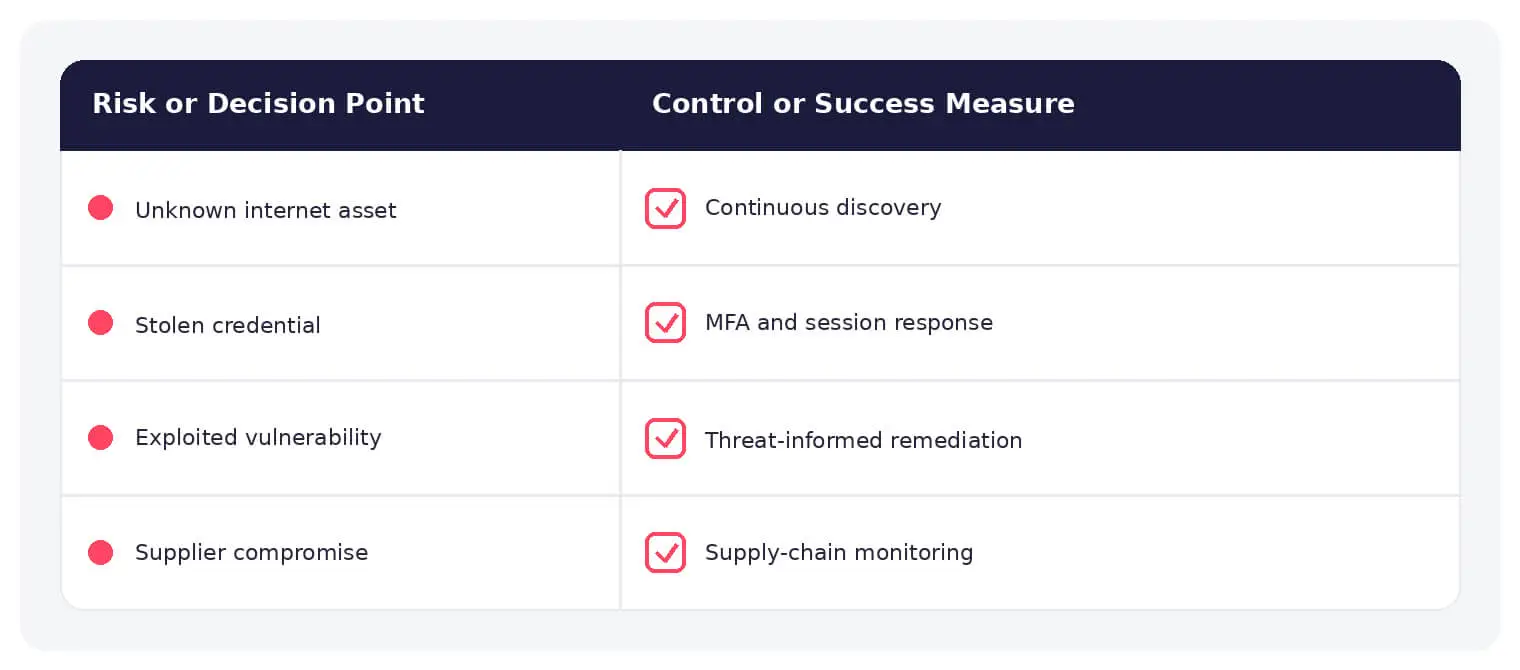
Warning Signs and Detection
Monitor changes in exposure, authentication anomalies, vulnerable assets, malicious network activity, endpoint behavior, data movement, cloud control-plane events, supplier incidents, threat actor targeting, and failures of critical safeguards.
Best Practices
Prioritize critical services and data, maintain asset and identity inventories, apply least privilege, patch by risk, segment networks, secure development, protect backups, centralize useful telemetry, test response, and manage third-party exposure.
How SOCRadar Can Help
SOCRadar adds external visibility, threat intelligence, exposure context, and continuous monitoring to help teams validate and prioritize risks related to cybersecurity. This context complements internal AI, cloud, security operations, and governance controls.
Explore SOCRadar Extended Threat Intelligence or request a demo to strengthen threat-informed prevention and response.
Frequently Asked Questions
What Does Cybersecurity Cover?
Cybersecurity covers systems, networks, applications, identities, and data, defending them against unauthorized access, misuse, disruption, alteration, and destruction. In practice, the scope extends to cloud environments, remote workforces, third-party connections, and the operational processes that keep these assets running.
Why Is Cybersecurity a Business Risk Rather Than Only a Technical Issue?
Security failures lead to operational disruption, financial loss, fraud, extortion, regulatory penalties, and reputational damage that affect the entire organization. Because executives and boards are increasingly held accountable for cyber risk, security decisions should connect to measurable business priorities rather than sitting solely with the IT team.
How Does a Typical Cyberattack Unfold?
Most incidents start with initial access through phishing, stolen credentials, exposed internet-facing services, or unpatched vulnerabilities. Attackers then establish persistence, escalate privileges, move laterally, and work toward objectives such as data theft, extortion, or disruption. The gap between initial access and visible damage can be short, which is why continuous visibility matters.
What Are the Warning Signs of a Possible Compromise?
Teams should watch for authentication anomalies, unexpected data movement, malicious network activity, unusual endpoint behavior, and unexpected cloud control-plane changes. Failures in critical safeguards, such as disabled logging or backup jobs, are also strong indicators. Supplier incidents and known threat actor targeting of your sector can raise baseline risk.
What Should an Organization Do After Detecting a Security Incident?
Activate the incident response plan, contain affected systems, and preserve evidence for investigation. Establish scope, eradicate the root cause, recover services from trusted backups, and meet notification obligations where breach disclosure laws apply. A lessons-learned review afterward should feed concrete updates to controls, playbooks, and ownership.
Which Controls Form the Foundation of a Strong Cybersecurity Program?
Foundational controls include maintaining asset and identity inventories, applying least privilege, patching by risk, segmenting networks, securing development, protecting backups, and centralizing telemetry that analysts can actually use. No single control is sufficient on its own; layered defenses reduce the chance that one failure becomes a full compromise. Third-party exposure management belongs in the same program.
How Does Cybersecurity Relate to Compliance and Regulation?
Frameworks and regulations such as ISO 27001, NIST CSF, GDPR, and sector-specific rules define baseline expectations for governance, risk management, and incident handling. Meeting them helps structure a program and demonstrate accountability, but passing an audit does not guarantee resilience against every threat, so programs should be judged by tested outcomes as well as documentation.
What Is the Difference Between Cybersecurity and Information Security?
Information security protects information in any form, including paper records and physical archives, while cybersecurity focuses on digital systems, networks, and data. The two overlap heavily in modern organizations, and many programs treat them as connected disciplines under one governance model rather than separate silos.
Why Do Suppliers and Third Parties Increase Cyber Risk?
Vendors, contractors, and partners often hold privileged access or sensitive data, so their weaknesses can become your incident. Software supply chain compromises, shared credentials, and forgotten contractor accounts are common entry points. Contractual security requirements, access reviews, and supplier monitoring help keep this exposure manageable.
Is Antivirus Software Enough on Its Own?
No. Endpoint protection addresses one layer of a broader problem, while modern attacks also target identities, cloud misconfigurations, unpatched services, and people through social engineering. Effective programs combine layered prevention with continuous monitoring and tested response, because no single tool covers every attack path.
Oct 26, 2026
Node2Shell: Brotli Flaw Hits Python Packages
The Node2Shell Brotli flaw (CVE-2026-111497), disclosed alongside Node.js fixes on October 21, 2026, also reaches Python through the PyPI Brotli and brotlicffi…
Oct 26, 2026
Finaxis, WoWInstaller, Moodle, MyHairCare & HT Médica Leaks
SOCRadar Dark Web Team identified several underground posts, including an alleged Finaxis.cloud data sale involving 400GB of information, a resurfaced WoWInstaller database…
Oct 23, 2026
CVE-2026-114625: Actively Exploited VeloCloud Orchestrator Flaw Grants Superuser Access
CVE-2026-114625 is an actively exploited SQL injection flaw in VeloCloud Orchestrator that lets authenticated users gain superuser operator privileges…
Intelligence in your inbox every Thursday.
Join 30,000+ security professionals reading SOCRadar research.
Subscribe