What Is Cloud Security?
Cloud security is the set of people, processes, and technologies used to protect cloud identities, data, applications, workloads, networks, and management services.
Security responsibility is shared between the cloud provider and customer, but the boundary changes with IaaS, PaaS, and SaaS. Customers must understand what they configure, who can access it, and which evidence is available during an incident.
Key Takeaways
- Cloud security is the set of people, processes, and technologies used to protect cloud identities, data, applications, workloads, networks, and management services.
- Security responsibility is shared between the cloud provider and customer, but the boundary changes with IaaS, PaaS, and SaaS. Customers must understand what they configure, who can access it, and which evidence is available during an incident.
- Exposed storage or services is a primary concern.
- Strong programs combine prevention, continuous visibility, ownership, and tested response.
How It Works
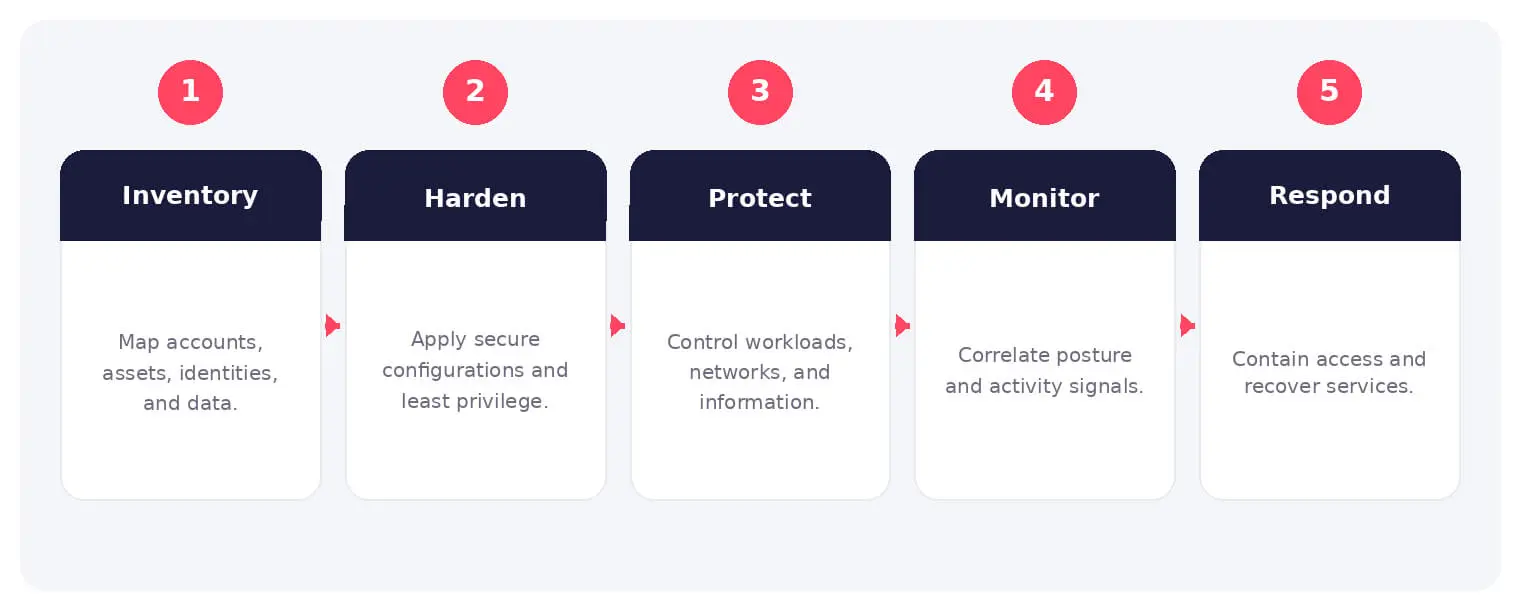
The operating flow above turns a broad security objective into observable steps. Exact implementations vary, but each stage needs an owner, trusted inputs, documented policy, and evidence that analysts can use during investigation and review.
Security responsibility is shared between the cloud provider and customer, but the boundary changes with IaaS, PaaS, and SaaS. Customers must understand what they configure, who can access it, and which evidence is available during an incident.
Common Types and Capabilities
- Identity and access security
- Data and key protection
- Network and workload protection
- Posture, logging, and incident response
Security and Business Risks
- Exposed storage or services
- Stolen credentials and excessive privileges
- Vulnerable workloads and supply-chain compromise
- Data loss, disruption, and unexpected cost
Warning Signs and Detection
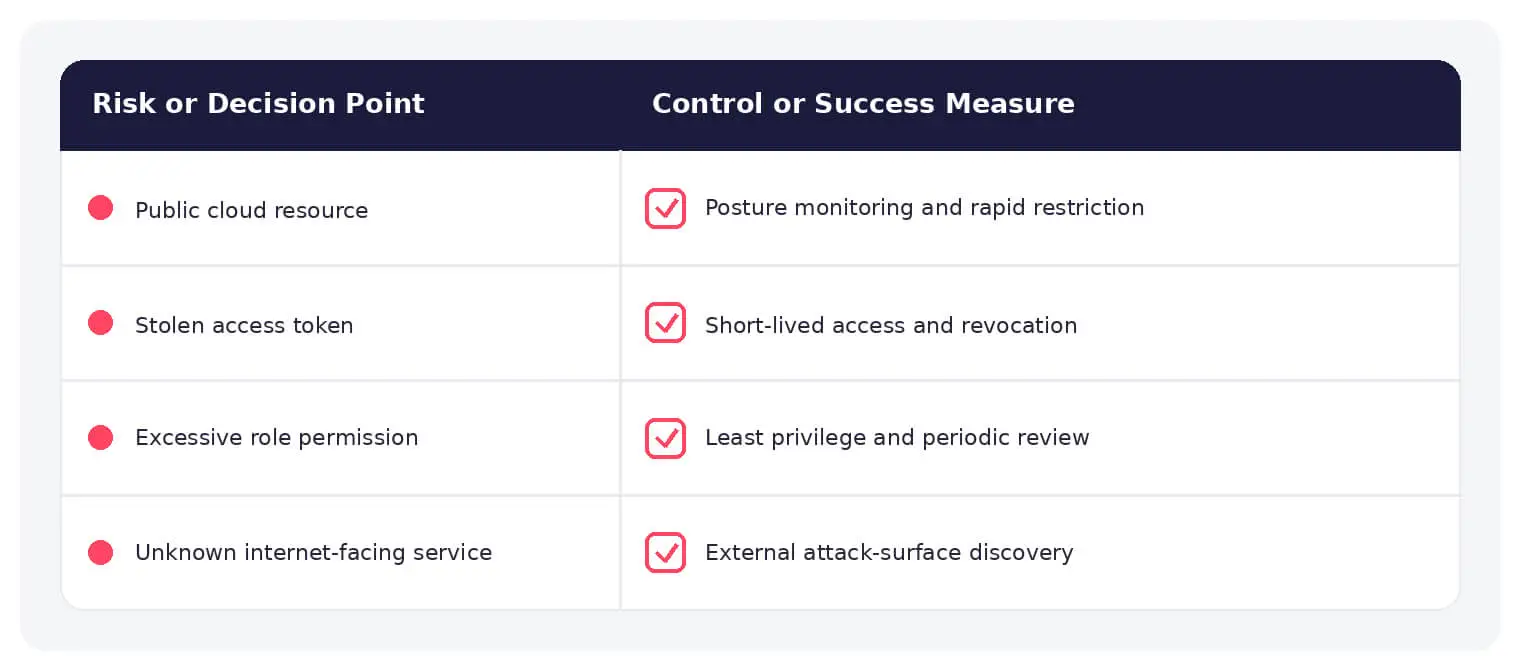
Watch for public resources, new access keys, risky role changes, disabled logging, unusual regions, secret access, unexpected deployments, and anomalous cross-account activity.
Best Practices
Use phishing-resistant MFA, short-lived credentials, least privilege, secure baselines, encryption, segmentation, protected logs, continuous posture review, and tested cloud response playbooks.
How SOCRadar Can Help
SOCRadar adds outside-in asset visibility, threat intelligence, exposure context, and continuous monitoring that help security teams validate and prioritize risks related to cloud security. This context complements internal cloud, data, network, and identity controls.
Explore SOCRadar Attack Surface Management or request a demo to strengthen threat-informed prevention and response.
Frequently Asked Questions
What Is Cloud Security?
Cloud security is the combination of people, processes, and technologies that protect identities, data, applications, workloads, networks, and management services running in cloud environments. It covers both the controls a customer configures and the protections built into the provider platform.
What Is the Shared Responsibility Model?
The shared responsibility model defines which security tasks belong to the cloud provider and which belong to the customer. In general, the provider secures the underlying infrastructure, while the customer secures what they deploy and configure on top of it, such as identity settings, data permissions, and network rules.
How Does Responsibility Change Across IaaS, PaaS, and SaaS?
As you move from IaaS to PaaS to SaaS, the provider manages more of the stack, so the customer controls less. However, identity configuration, data access, and application settings remain customer obligations in nearly every model. Misunderstanding this boundary is a frequent cause of cloud incidents.
What Are the Most Common Cloud Security Risks?
Frequent risks include exposed storage or services, stolen credentials combined with excessive privileges, vulnerable workloads, and supply chain compromise. Left unaddressed, these can lead to data loss, service disruption, and unexpected cloud spending from abused resources.
Why Is Identity Security So Important in the Cloud?
Cloud identities hold access to infrastructure, data, and management services, so a single overprivileged account can cause broad damage. Limiting privileges, using short-lived credentials, and monitoring for risky role or key changes reduces that blast radius.
What Warning Signs Suggest a Cloud Environment Has Been Compromised?
Indicators include:
- Resources that become publicly accessible
- New or unrecognized access keys
- Risky role changes or excessive privilege grants
- Disabled or altered logging
- Activity from unusual regions
- Unexpected deployments or secret access
- Anomalous cross-account activity
Any of these deserves prompt log review to determine whether the change was authorized.
What Should You Do First During a Suspected Cloud Incident?
Start with a log review to establish what changed, which identities were involved, and which resources were touched. Then contain the activity by disabling compromised access, rotating keys, and tightening permissions, keeping in mind that some platforms keep existing sessions valid until they are explicitly revoked. Preserve relevant logs before making changes so evidence remains available for investigation.
Which Cloud Security Best Practices Should Teams Apply?
Effective programs rely on phishing-resistant MFA, short-lived credentials, least privilege, secure baselines, encryption, and segmentation. Protected logging, continuous posture review, and tested response playbooks round out the program so misconfigurations and intrusions can be found and handled quickly.
What Business Impact Can Weak Cloud Security Cause?
Beyond data loss and downtime, weak cloud security can drive unexpected costs from abused compute or storage resources, regulatory penalties, and reputational harm. Supply chain compromise that spreads through cloud-hosted workloads can also extend the impact to customers and partners.
Is the Cloud Provider Responsible for Securing All of My Data?
No. The provider secures the platform, but customers remain responsible for access controls, encryption choices, sharing settings, and misconfigurations in their own accounts. A publicly exposed bucket or permissive role assignment is a customer-side failure even on a fully compliant platform.
Oct 15, 2026
Cisco Secure Email & PAN-OS Zero-Days Exploited
Cisco Secure Email & PAN-OS Zero-Days Exploited Cisco and Palo Alto Networks have patched two actively exploited zero-day vulnerabilities that can lead…
Oct 15, 2026
SOCRadar Splunk Integration: New MSSP and Vulnerability Apps
SOCRadar Splunk Integration: New MSSP and Vulnerability Apps Your analysts live in Splunk. Your external risk does not: SOCRadar alarms for dozens…
Oct 14, 2026
CVE-2026-105445: Docker Hub PAT Reassignment Flaw
CVE-2026-105445: Docker Hub PAT Reassignment Flaw Docker has disclosed CVE-2026-105445 , a critical privilege assignment flaw in Docker Hub that could allow…
Intelligence in your inbox every Thursday.
Join 30,000+ security professionals reading SOCRadar research.
Subscribe