What Is Cloud Infrastructure Security?
Cloud infrastructure security protects cloud identities, networks, workloads, data, management planes, and configurations from unauthorized access, misuse, disruption, and exposure.
Responsibility is shared between the provider and customer, but the exact boundary varies by service model. Customers remain responsible for identities, permissions, data, configurations, workloads, and the secure use of provider capabilities.
Key Takeaways
- Identity and access management is a central category or capability.
- Reliable assessment requires identity, timing, source, and operational context.
- Detection should correlate external, identity, device, network, and cloud evidence.
- Response should preserve evidence and remove every reusable access path.
How Cloud Infrastructure Security Works
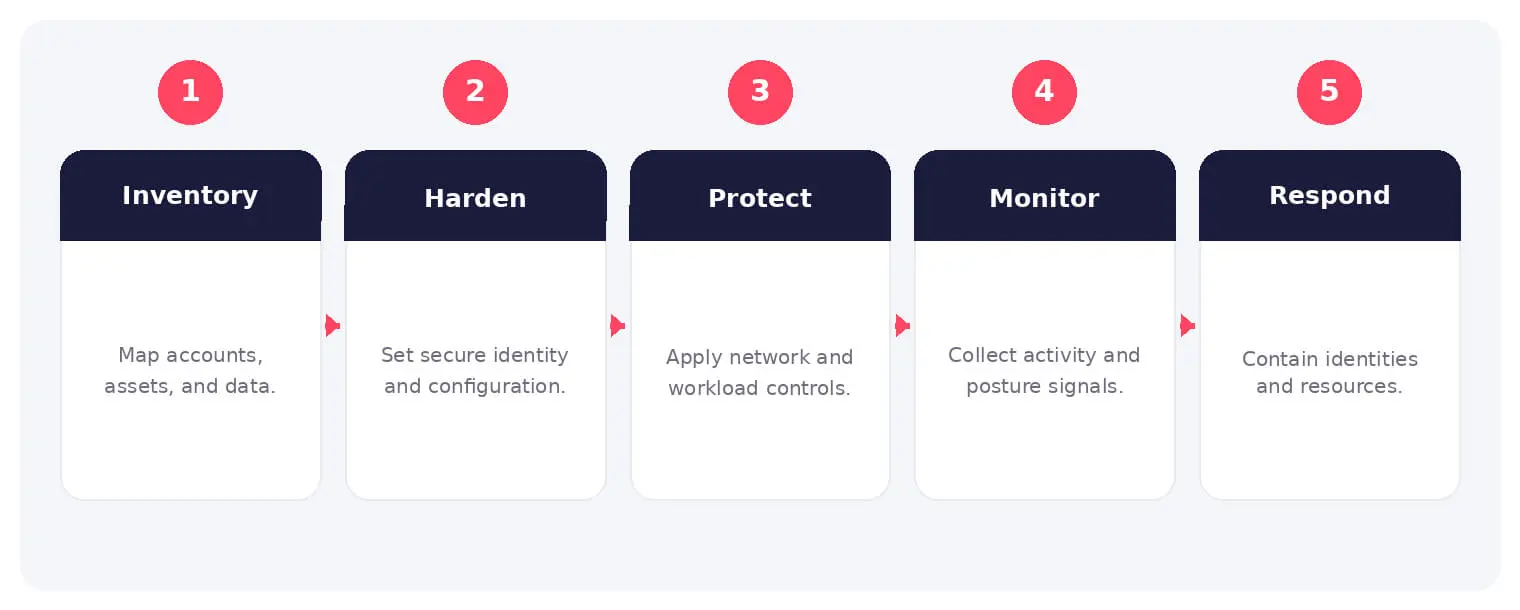
The sequence above provides a practical operating model. Individual stages may overlap, repeat, or involve different people and services, so analysts should validate each step against the available evidence.
Responsibility is shared between the provider and customer, but the exact boundary varies by service model. Customers remain responsible for identities, permissions, data, configurations, workloads, and the secure use of provider capabilities.
Common Types and Techniques
- Identity and access management
- Network and perimeter controls
- Workload, container, and serverless security
- Data, secrets, and management-plane protection
Security and Business Risks
- Public data and service exposure
- Credential and cloud-token theft
- Privilege escalation and lateral movement
- Resource abuse, disruption, and unexpected cost
Warning Signs and Detection
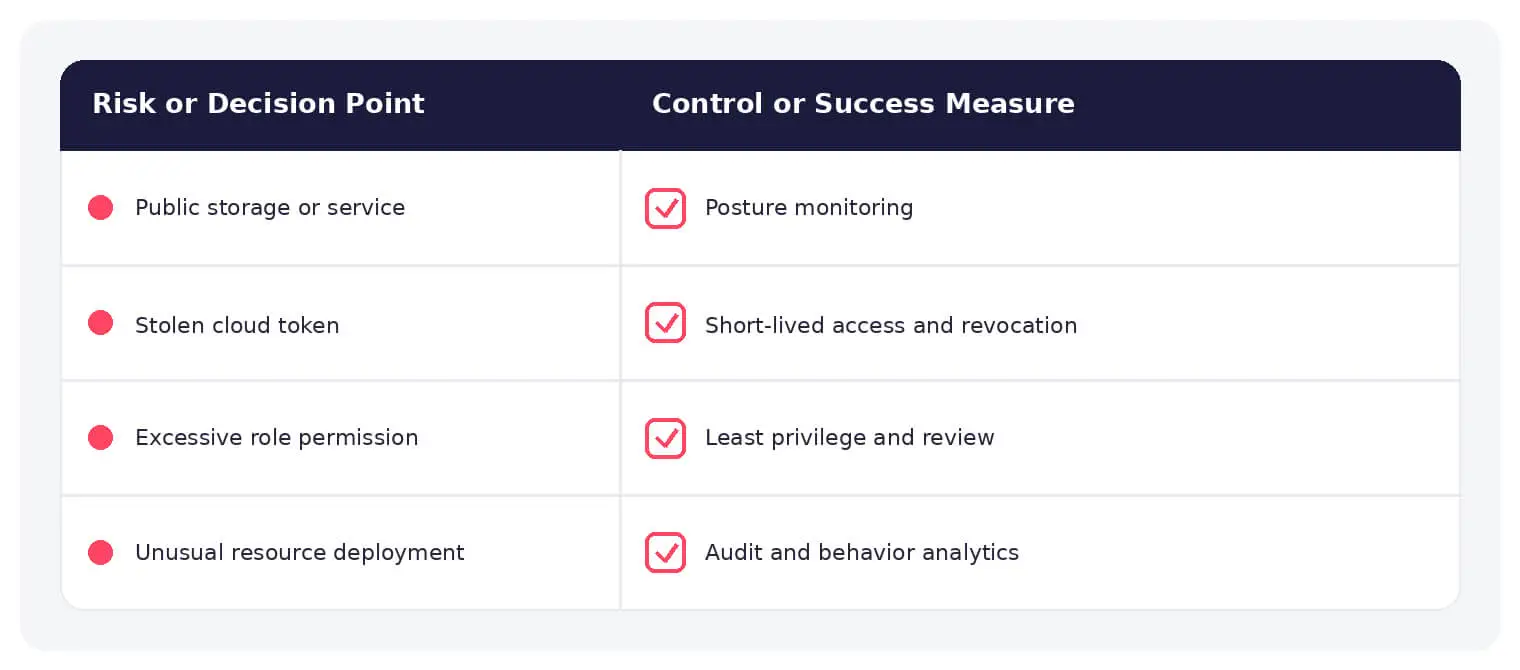
Monitor cloud audit logs, new keys and applications, privileged changes, public storage, security-group changes, unusual deployments, secret access, and cross-account activity.
Prevention and Response
Use phishing-resistant MFA, short-lived credentials, least privilege, organization policies, secure defaults, segmentation, encryption, posture management, protected logging, and tested cloud response.
How SOCRadar Can Help
SOCRadar combines external visibility, threat intelligence, Dark Web monitoring, brand protection, vulnerability context, and indicator enrichment to help teams investigate exposure connected to cloud infrastructure security.
Explore SOCRadar Attack Surface Management or request a demo to strengthen threat-informed prevention and response.
Frequently Asked Questions
What Is Cloud Infrastructure Security?
Cloud infrastructure security protects the identities, networks, workloads, data, management planes, and configurations that run in cloud environments from unauthorized access, misuse, disruption, and exposure. It spans both the controls a provider operates and the settings, permissions, and workloads a customer configures.
What Are the Main Risks in Cloud Infrastructure Security?
The most common risks include public exposure of data and services, theft of credentials and cloud tokens, privilege escalation and lateral movement across accounts, and resource abuse that causes disruption or unexpected cost. Many of these stem from misconfiguration or over-permissive access rather than flaws in the cloud platform itself.
How Does the Shared Responsibility Model Work?
The provider secures the underlying infrastructure, while the customer is responsible for identities, permissions, data, configurations, and workloads. The exact boundary shifts with the service model, so teams should map responsibilities for each service they use instead of assuming the provider covers everything.
Why Are Cloud Credentials and Tokens Attractive to Attackers?
Stolen access keys, OAuth tokens, and session credentials let attackers operate through legitimate APIs, often without deploying malware, and can be used from any location. Because these credentials may not expire quickly, a single leaked key can support persistence, data access, and resource abuse until every path it enables is revoked.
What Warning Signs Suggest a Cloud Environment Is Compromised?
Watch for privileged role changes, new access keys or OAuth applications, public storage buckets, security-group changes, unusual deployments, secret access, and cross-account activity with no matching change request. Correlating cloud audit logs with identity, network, and endpoint evidence helps separate legitimate change from abuse.
How Should Teams Respond to a Cloud Infrastructure Incident?
Remove every reusable access path, including access keys, tokens, OAuth grants, and active sessions, not just the initial credential used for entry. Preserve audit logs before rotation or expiry, scope what the compromised identity could reach, rotate exposed secrets, and review for attacker-created persistence such as new users, roles, or federation settings.
Which Controls Help Prevent Cloud Security Incidents?
High-value controls include phishing-resistant MFA, short-lived credentials, least-privilege access, organization-wide policies with secure defaults, network segmentation, encryption, and continuous posture management. Protected logging and regularly tested response playbooks shorten detection and recovery when prevention falls short.
What Business Impact Can Cloud Security Failures Cause?
Beyond data breaches and service disruption, cloud incidents can drive significant unexpected costs through abused compute and storage resources, along with regulatory and contractual exposure when customer data is affected. Investigation and recovery also divert engineering time away from planned work.
Is Cloud Security the Provider’s Responsibility Alone?
No. Providers secure the platform, but many cloud breaches involve customer-side issues such as misconfigured storage, over-privileged identities, or leaked keys. Treating cloud security as the vendor’s job leaves the areas attackers most often exploit unmonitored.
Oct 27, 2026
Australia’s Annual Cyber Threat Report 2025-26 Shows Cyber Incidents Up 20%
Australia’s cyber security authority responded to 1,524 cyber security incidents in the 2025-26 financial year, a 20% increase from the previous year…

Oct 27, 2026
PHP2Shell Weaponized After Japanese Real Estate Extortion
An exposed server ties an extortion wave on about 20 Japanese property sites to an operator who later weaponized PHP2Shell (CVE-2026-109618, CVE-2026-109619)…
Oct 27, 2026
Wasmtime Sandbox Escape Flaws Patched in Cranelift
Two critical Wasmtime sandbox escape flaws, CVE-2026-115889 and CVE-2026-115893, let a crafted WebAssembly (Wasm) module push the Cranelift compiler into generating unsafe…
Intelligence in your inbox every Thursday.
Join 30,000+ security professionals reading SOCRadar research.
Subscribe