
What Is Cloud Security Posture Management (CSPM)?
Cloud Security Posture Management (CSPM) continuously discovers cloud resources and evaluates their configurations against security, compliance, and organizational policies.
CSPM helps identify misconfiguration, excessive exposure, drift, and missing controls across cloud accounts. It improves posture visibility, but it does not replace identity protection, runtime detection, vulnerability management, or incident response.
Key Takeaways
- Cloud Security Posture Management (CSPM) continuously discovers cloud resources and evaluates their configurations against security, compliance, and organizational policies.
- CSPM helps identify misconfiguration, excessive exposure, drift, and missing controls across cloud accounts. It improves posture visibility, but it does not replace identity protection, runtime detection, vulnerability management, or incident response.
- Alert overload without risk context is a primary concern.
- Strong programs combine prevention, continuous visibility, ownership, and tested response.
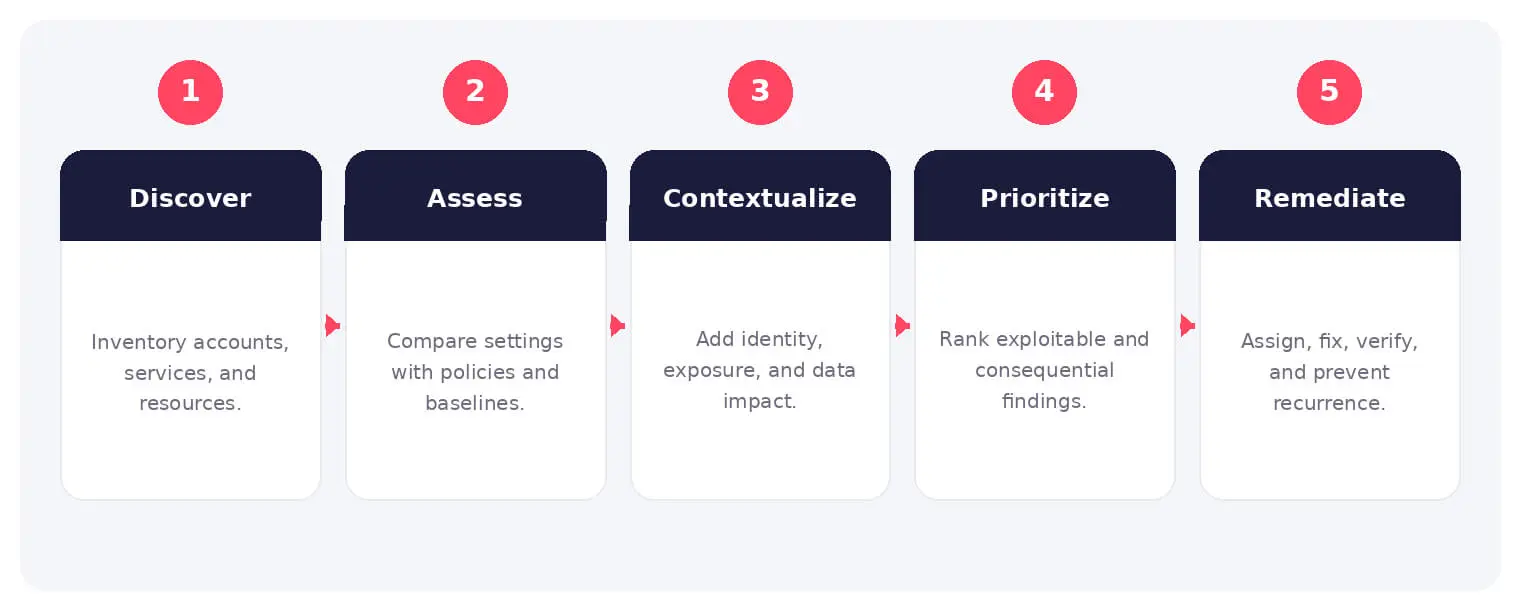
How It Works
The operating flow above turns a broad security objective into observable steps. Exact implementations vary, but each stage needs an owner, trusted inputs, documented policy, and evidence that analysts can use during investigation and review.
CSPM helps identify misconfiguration, excessive exposure, drift, and missing controls across cloud accounts. It improves posture visibility, but it does not replace identity protection, runtime detection, vulnerability management, or incident response.
Common Types and Capabilities
- Resource discovery and inventory
- Configuration and compliance assessment
- Exposure and attack-path context
- Remediation workflows and policy as code
Security and Business Risks
- Alert overload without risk context
- Public resources and insecure defaults
- Configuration drift across accounts
- Incomplete coverage and unmanaged exceptions
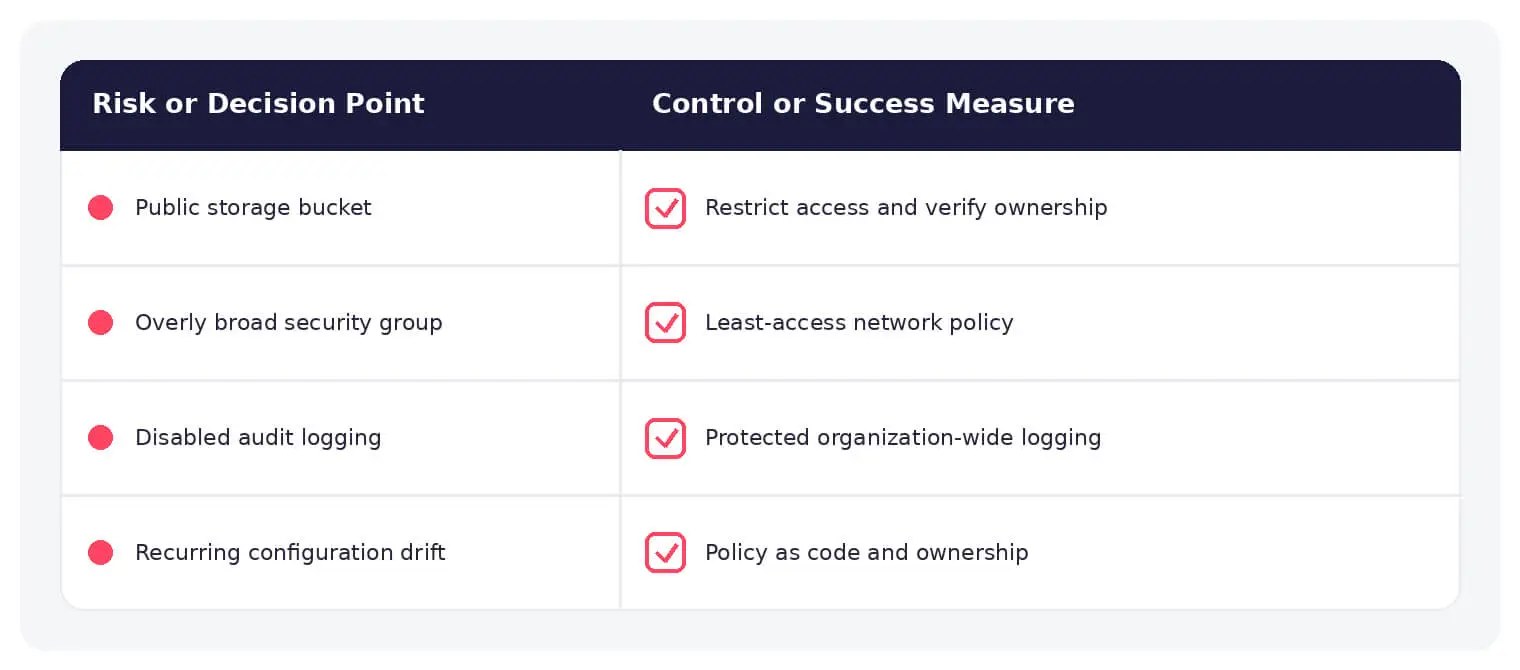
Warning Signs and Detection
Look for new public endpoints, open storage, permissive security groups, disabled encryption or logging, unused privileged roles, policy drift, failed connectors, and recurring findings.
Best Practices
Establish secure baselines, cover every account and region, prioritize reachability and impact, automate safe fixes, manage exceptions, scan infrastructure as code, and measure recurrence.
How SOCRadar Can Help
SOCRadar adds outside-in asset visibility, threat intelligence, exposure context, and continuous monitoring that help security teams validate and prioritize risks related to cloud security posture management. This context complements internal cloud, data, network, and identity controls.
Explore SOCRadar Attack Surface Management or request a demo to strengthen threat-informed prevention and response.
Frequently Asked Questions
What Is Cloud Security Posture Management (CSPM)?
Cloud Security Posture Management (CSPM) is a security practice and tool category that continuously discovers cloud resources and evaluates their configurations against security, compliance, and organizational policies. Its goal is to surface misconfigurations, excessive exposure, drift, and missing controls across cloud accounts before attackers can exploit them.
How Does CSPM Work?
Most CSPM platforms connect to cloud providers through API integrations, build a continuous inventory of resources across accounts and regions, and evaluate configurations against baselines and frameworks such as the CIS Benchmarks. Findings are then scored and routed to owners, often with remediation guidance or policy-as-code fixes that can be applied automatically.
What Kinds of Misconfigurations Does CSPM Detect?
Typical findings include:
- Public object storage buckets
- Permissive security groups and open management ports
- Disabled encryption or logging
- Overprivileged or unused IAM roles
- Resources unintentionally exposed to the internet
Many tools also flag missing backups, weak key management, and deviations from internal tagging or network standards.
Does CSPM Replace Identity Security or Runtime Protection?
No. CSPM improves posture visibility, but it does not replace identity protection, runtime workload detection, vulnerability management, or incident response. Attackers frequently combine misconfigurations with stolen credentials or vulnerable workloads, so these controls should operate alongside CSPM rather than be replaced by it.
What Is Configuration Drift and Why Does It Matter?
Drift occurs when live cloud resources gradually deviate from approved baselines through manual console changes, emergency fixes, or exceptions that are never cleaned up. It often goes unnoticed until an audit or an incident, which is why continuous comparison against baselines is a core CSPM function.
What Warning Signs Suggest a Declining Cloud Security Posture?
Recurring signals include newly public endpoints or storage, open management ports, disabled logging, unused privileged roles, failed provider connectors, and findings that reappear after remediation. These patterns usually point to gaps in ownership or exception handling rather than isolated mistakes.
How Should Teams Respond to CSPM Findings?
Assign each finding an owner, prioritize it by reachability and business impact instead of raw severity alone, and automate safe, well-understood fixes such as enabling encryption or removing unused public access. Document exceptions with review dates and track recurrence so the same issue does not resurface every scan cycle.
Why Should Infrastructure as Code Be Scanned Before Deployment?
Evaluating IaC templates before deployment catches misconfigurations at the source, before resources ever exist in the cloud. This reduces drift between declared and live environments and helps stop known-bad patterns from being copied across projects.
Does CSPM Support Multi-Cloud Environments?
Most CSPM platforms support major providers such as AWS, Azure, and Google Cloud, although the depth of checks varies by service. The practical challenge is usually onboarding: every account, subscription, project, and region — including newly created ones — needs to be connected so coverage stays complete.
Which Compliance Frameworks Does CSPM Help Address?
CSPM tools commonly map configurations to frameworks such as CIS Benchmarks, NIST, PCI DSS, HIPAA, ISO 27001, and GDPR requirements. This simplifies audit evidence collection, though automated checks support rather than replace the broader processes that certification requires.
Can CSPM Prevent Cloud Data Breaches?
CSPM meaningfully reduces the risk of breaches caused by misconfigurations, which are a recurring factor in public cloud incidents, but no configuration tool can guarantee prevention. Compromised credentials, vulnerable workloads, and application-layer attacks still require complementary identity, runtime, and vulnerability management controls.
What Is the Difference Between CSPM and CNAPP?
CSPM is one pillar of the broader Cloud-Native Application Protection Platform (CNAPP) category. CNAPP solutions typically combine CSPM with cloud workload protection (CWPP), cloud infrastructure entitlement management (CIEM), and infrastructure as code scanning, while standalone CSPM concentrates on configuration and compliance assessment.

Oct 16, 2026
CVE-2026-102764: BeyondTrust Zero-Day Exploited
BeyondTrust has disclosed CVE-2026-102764, a critical Remote Support vulnerability exploited as a zero-day weeks before customers received a patch. The attack began…

Oct 15, 2026
Cisco Secure Email & PAN-OS Zero-Days Exploited
Cisco Secure Email & PAN-OS Zero-Days Exploited Cisco and Palo Alto Networks have patched two actively exploited zero-day vulnerabilities that can lead…
Oct 15, 2026
SOCRadar Splunk Integration: New MSSP and Vulnerability Apps
SOCRadar Splunk Integration: New MSSP and Vulnerability Apps Your analysts live in Splunk. Your external risk does not: SOCRadar alarms for dozens…
Intelligence in your inbox every Thursday.
Join 30,000+ security professionals reading SOCRadar research.
Subscribe