

Mar 10, 2026
Jul 10, 2026
5 Mins Read
Sep 13, 2026
Table Of Content
Related Articles

SMS Bombing

Threat Actors
Jan 08, 2026
Dark Web Monitoring
Feb 19, 2026

Ransomware
Jan 31, 2026
OSINT Framework
Apr 17, 2026
What Is Cloud Incident Response?
Cloud incident response is the coordinated process of detecting, containing, investigating, eradicating, and recovering from security incidents in cloud environments.
Cloud response differs from traditional response because identities, APIs, control planes, ephemeral workloads, managed services, and provider evidence shape every action. Teams must preserve logs and snapshots without destroying volatile context or causing uncontrolled service disruption.
Key Takeaways
- Cloud incident response is the coordinated process of detecting, containing, investigating, eradicating, and recovering from security incidents in cloud environments.
- Cloud response differs from traditional response because identities, APIs, control planes, ephemeral workloads, managed services, and provider evidence shape every action. Teams must preserve logs and snapshots without destroying volatile context or causing uncontrolled service disruption.
- Stolen tokens that survive password reset is a primary concern.
- Effective programs combine prevention, continuous visibility, accountable ownership, and tested response.
How It Works
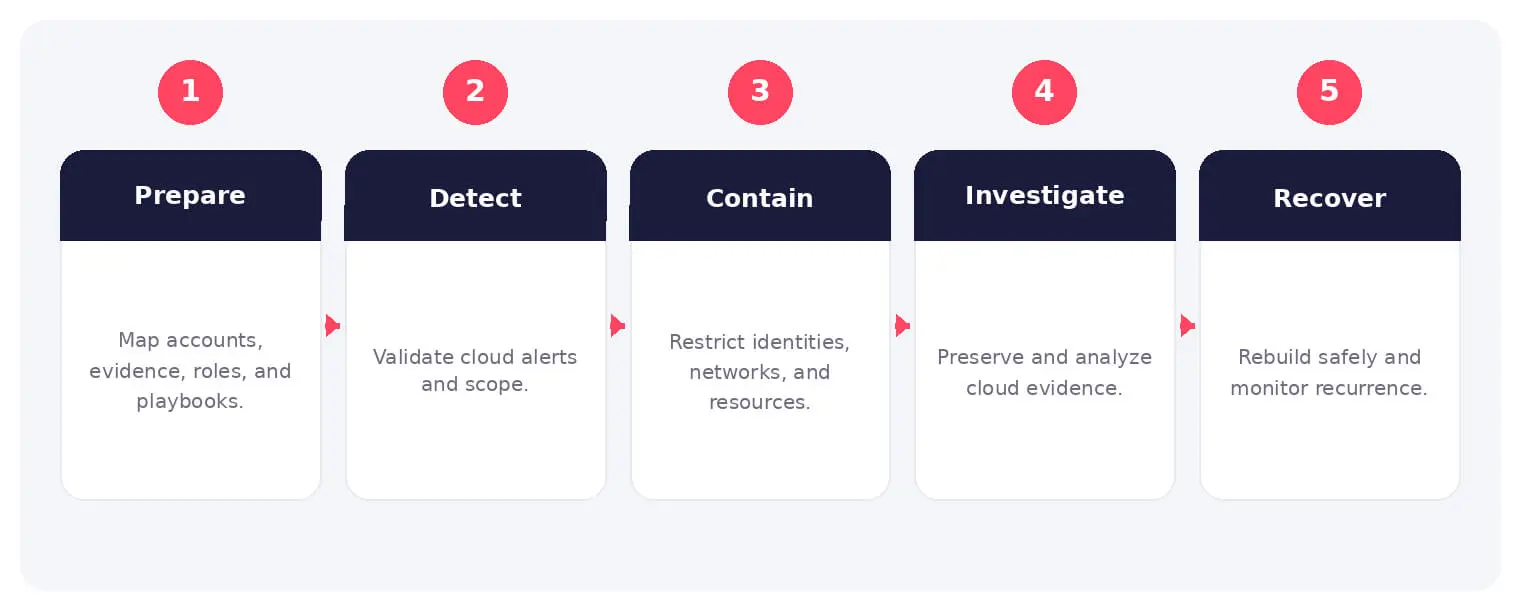
The operating flow above turns the concept into observable steps. Exact implementations vary, but each stage needs accountable ownership, trusted inputs, documented policy, and evidence that analysts can use during investigation and review.
Cloud response differs from traditional response because identities, APIs, control planes, ephemeral workloads, managed services, and provider evidence shape every action. Teams must preserve logs and snapshots without destroying volatile context or causing uncontrolled service disruption.
Common Types and Capabilities
- Compromised cloud identities
- Public data and resource exposure
- Workload and container compromise
- Control-plane and supply-chain incidents
Security and Business Risks
- Stolen tokens that survive password reset
- Destructive changes through privileged APIs
- Evidence loss from short retention or deletion
- Cross-account spread and service disruption
Warning Signs and Detection
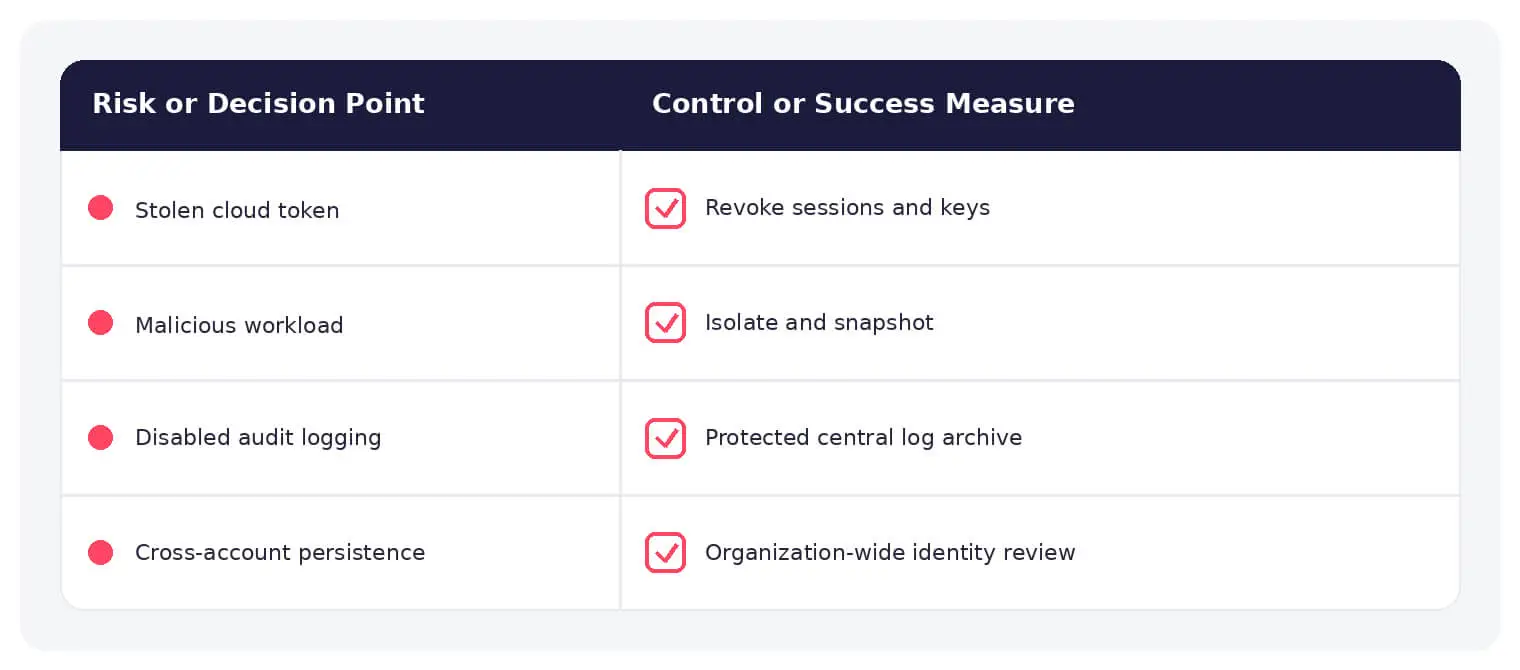
Monitor new access keys, unusual API calls, privilege changes, disabled logging, public storage, unexpected deployments, snapshot activity, security-group changes, new federation, secret access, and activity from unfamiliar regions or automation identities.
Best Practices
Preconfigure organization-wide logging, protect evidence accounts, use short-lived access, maintain emergency roles, isolate without deleting, capture snapshots and metadata, rotate credentials, rebuild from trusted sources, and rehearse cloud-specific playbooks.
How SOCRadar Can Help
SOCRadar adds external visibility, threat intelligence, exposure context, and continuous monitoring to help teams validate and prioritize risks related to cloud incident response. This context complements internal AI, cloud, security operations, and governance controls.
Explore SOCRadar Attack Surface Management or request a demo to strengthen threat-informed prevention and response.
Frequently Asked Questions
What Is Cloud Incident Response and How Does It Differ From Traditional Incident Response?
Cloud incident response is the coordinated process of detecting, containing, investigating, eradicating, and recovering from security incidents in cloud environments. Unlike traditional response, identities, APIs, control planes, ephemeral workloads, managed services, and provider-held evidence shape every action, and teams operate through the provider’s control plane rather than direct physical access.
How Does the Shared Responsibility Model Affect Cloud Incident Response?
Providers secure the underlying infrastructure, but customers generally remain responsible for identities, configurations, data protection, and response decisions inside their own accounts. A response plan should map which party controls logging, isolation, and recovery for each managed service so no critical action depends on an undefined owner.
Why Do Stolen Cloud Tokens Remain Dangerous After a Password Reset?
Depending on the platform and session controls, resetting a password may not invalidate active sessions, refresh tokens, or access keys issued before the change. An attacker holding those artifacts can continue operating with the same permissions. Response should include revoking sessions, rotating keys, and checking for persistence such as new federation or added credentials.
Which Warning Signs Indicate a Possible Cloud Compromise?
Watch for new access keys, unusual API calls, privilege changes, disabled logging, newly public storage, unexpected deployments, snapshot activity, security-group changes, new federation, secret access, and activity from unfamiliar regions or automation identities. Individual events can be benign, so investigate combinations and out-of-pattern timing rather than any single signal.
Which Logs and Data Sources Support a Cloud Incident Investigation?
Control-plane audit logs, identity and federation logs, storage and data-access logs, network flow records, and workload snapshots or memory captures form the core evidence base. Provider-side records can add context, although access procedures and retention periods differ by service. Prioritize the sources tied to the suspected identity and the path the data took.
How Should Teams Preserve Evidence Without Disrupting Cloud Services?
Export logs and copy disk, memory, and configuration snapshots into a protected evidence account before altering resources. Deleting instances or exceeding short retention windows can remove context permanently, so isolate first and collect second. Avoid actions such as stopping instances until you confirm whether volatile memory still needs to be captured.
What Containment Actions Apply to Compromised Cloud Identities and Workloads?
Useful options include isolating instances through security groups, disabling or downscoping credentials, revoking active sessions, and detaching resources from shared networks or accounts. Deletion should wait until snapshots and logs are secured because it destroys evidence. Quarantine accounts or networks allow investigation to continue while limiting wider disruption.
What Preparation Reduces the Impact of a Cloud Security Incident?
Preconfigure organization-wide logging with retention that outlasts typical investigation timelines, maintain protected evidence accounts, issue short-lived access, and keep emergency roles ready. Rehearsed cloud-specific playbooks shorten containment time and reduce the mistakes teams make under pressure.
What Business and Security Risks Do Cloud Incidents Create?
- Data exposure: public storage buckets and over-shared resources can leak sensitive information.
- Service disruption: destructive changes through privileged APIs can take workloads offline.
- Cross-account spread: compromised credentials can move laterally between accounts and projects.
- Evidence loss: short log retention or deletion can leave an organization unable to establish incident scope.
What Misconceptions Surround Cloud Incident Response?
Common ones include assuming the provider runs the entire investigation, that password resets revoke stolen tokens, and that cloud forensics mirrors on-premises disk forensics. In practice, evidence types, retention limits, and control-plane actions differ, and shared responsibility leaves core response duties with the customer. Plans should be tested against cloud-specific scenarios rather than adapted unchanged from data center playbooks.