

Oct 06, 2026

Table Of Content
Related Articles

CVE-2026-88779: Citrix NetScaler Zero-Day

CVE-2026-90970: GitLab AI Gateway RCE
Oct 05, 2026

FortiMail Zero-Day Under Active Exploitation
Oct 02, 2026

TeamViewer Fixes Five Remote Access Flaws
Oct 01, 2026

CVE-2026-76504: Cisco SD-WAN Flaw Exploited
Oct 01, 2026

Oct 07, 2026
4 Mins Read

Summarize with:
CVE-2026-21589: Critical Atlassian File Access
Atlassian has disclosed CVE-2026-21589, a critical unauthenticated arbitrary file-access vulnerability affecting eight self-hosted products. The flaw carries a CVSS v4.0 score of 9.3 and can expose specific files within an application’s web root.
What Is CVE-2026-21589?
CVE-2026-21589 allows an unauthenticated remote attacker to access specific files within the web application root of:
- Bitbucket Data Center
- Confluence Data Center
- Jira Service Management Data Center
- Jira Software Data Center
- Bamboo Data Center
- Crowd Data Center
- Crucible
- Fisheye
Atlassian’s CVE-2026-21589 security advisory stresses an important limitation: attackers must already know the exact filename and path. The flaw does not provide directory listing or enumeration capabilities.
The CVSS vector is:
CVSS:4.0/AV:N/AC:L/AT:N/PR:N/UI:N/VC:H/VI:N/VA:N/SC:H/SI:H/SA:H
Atlassian notes that its 9.3 rating is an internal assessment and organizations should evaluate risk within their own environments. Sensitive files stored within the web root can substantially increase impact.
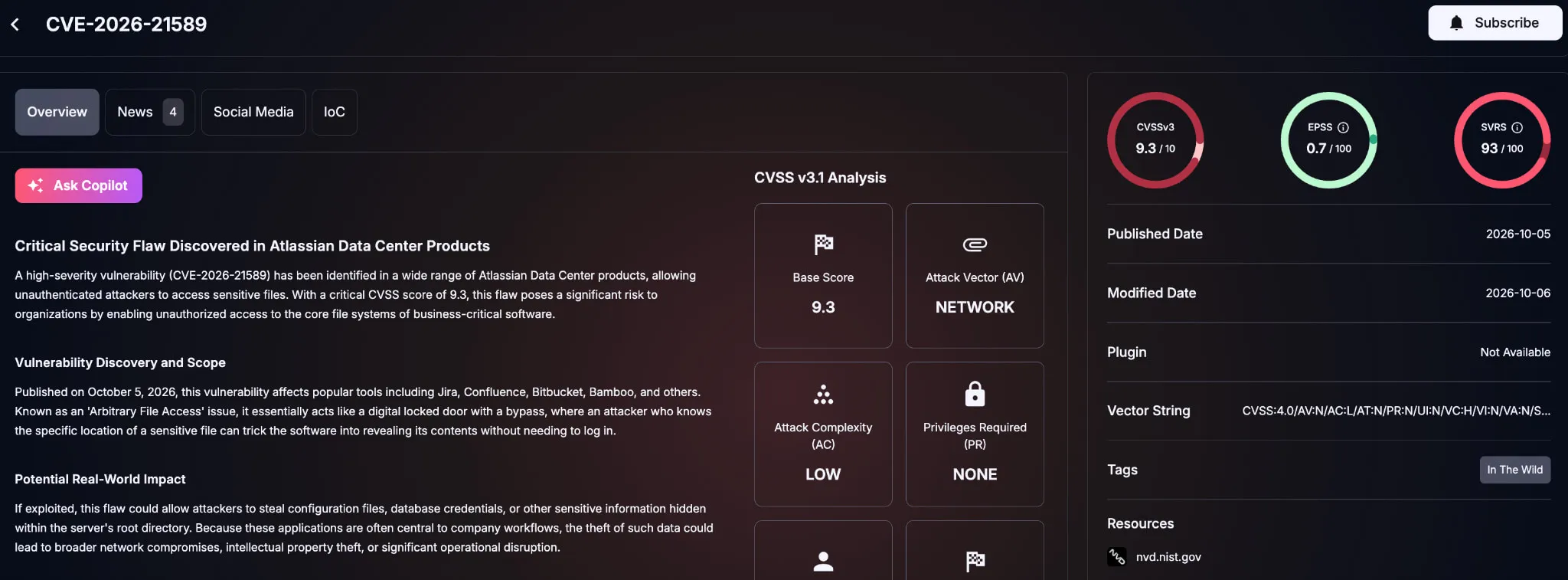
Details of CVE-2026-21589 (SOCRadar Vulnerability Intelligence)
Which Atlassian Versions Are Affected?
Atlassian says all versions before the listed fixes are affected:
| Product | Fixed Versions |
|---|---|
| Bitbucket Data Center | 9.4.26, 10.2.8, 10.5.1 |
| Confluence Data Center | 9.2.26, 10.2.19 |
| Jira Service Management | 5.12.40, 10.3.26, 11.3.12 |
| Jira Software | 9.12.40, 10.3.26, 11.3.12 |
| Bamboo Data Center | 10.2.24, 12.1.12 |
| Crowd Data Center | 6.3.7, 7.0.3, 7.1.7, 7.2.4 |
| Crucible | 4.9.15 |
| Fisheye | 4.9.15 |
Atlassian recommends upgrading to the appropriate fixed LTS release or later. Cloud products have already been patched, and Atlassian says Cloud customers do not need to take action.
What Causes CVE-2026-21589?
Atlassian has not published a detailed code-level root cause. However, watchTowr’s technical analysis identified the shared atlassian-plugins-webresource component across several affected products and found path-handling logic involving alternate separator representations.
In practical terms, inconsistent path processing can allow file-serving logic to reach a file outside the intended resource directory, while remaining within the application’s web root.
Potentially exposed content may include configuration data, integration information, credentials, or tokens depending on the deployment. The vulnerability itself provides file access, not remote code execution or arbitrary file modification.
Is CVE-2026-21589 Being Exploited?
No confirmed in-the-wild exploitation has been established as of October 7.
Atlassian says its investigation found no evidence of exploitation. CVE-2026-21589 is also not currently listed in CISA KEV. Public exploit availability has changed quickly, however. Multiple GitHub repositories are now associated with the CVE.
Track CVE-2026-21589 with SOCRadar
Powered by SOCRadar’s Cyber Threat Intelligence module, Vulnerability Intelligence tracks severity, public exploit availability, affected products, remediation information, and changes in exploitation status. Combined with Attack Surface Management, this can help teams prioritize externally exposed Atlassian instances while monitoring for new exploitation evidence.
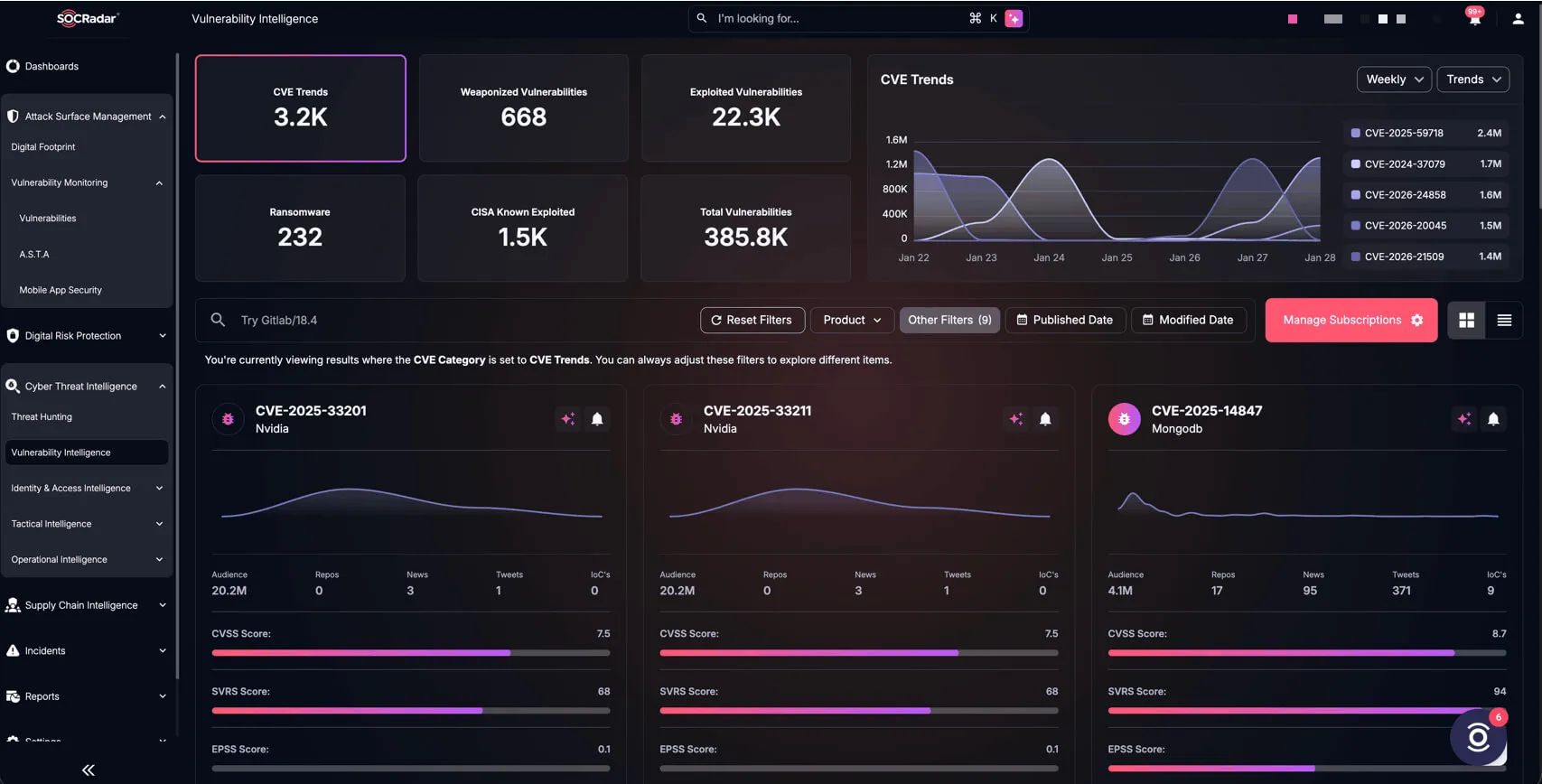
SOCRadar’s Vulnerability Intelligence
What Should Defenders Do?
Patch or Restrict Exposure
Upgrade every affected product and node to a fixed release. Until patching is complete, Atlassian recommends removing affected instances from public internet access—even when the application normally requires authentication.
If immediate upgrading is impossible, Atlassian provides three temporary options:
- A WAF or reverse-proxy rule for all affected products.
- Tomcat RewriteValve controls for Confluence, Jira, Jira Service Management, Bamboo, and Crowd.
- A Bitbucket URL-rewrite rule, which must also cover cluster nodes, mirrors, and mirror-farm nodes.
These controls are temporary mitigations, not replacements for upgrading.
Hunt for Exploitation Attempts
Atlassian recommends examining access logs for traversal-like requests. Defenders can URL-decode request paths up to twice and look for .. immediately adjacent to /, , or ::, or search raw logs using Atlassian’s published detection regex.
Also review reverse-proxy, WAF, load-balancer, web-server, and application logs for encoded path separators, unusual file-serving requests, repeated attempts against precise filenames, or unexpected unauthenticated responses.
Prioritize internet-facing systems and deployments containing sensitive integrations. Correlate suspicious requests with authentication anomalies, new administrator accounts, configuration changes, or unusual outbound activity.
Clean logs alone do not confirm a system was unexploited where historical log coverage is incomplete. Given the unauthenticated attack path, broad product coverage, and newly available public proof-of-concept (PoC) material, organizations should patch rapidly, restrict exposure while remediation proceeds, and review historical traffic for suspicious file-access attempts.