| Affected Period | Fix |
|---|---|
| August 26, 2024, 20:33 UTC to September 30, 2026, ~19:10 UTC | Server-side fix deployed September 30 |

Oct 14, 2026
4 Mins Read

Summarize with:
CVE-2026-105445: Docker Hub PAT Reassignment Flaw
Docker has disclosed CVE-2026-105445, a critical privilege assignment flaw in Docker Hub that could allow an attacker to reuse a personal access token (PAT) after it was reassigned to another user during account-to-organization conversion.
The vulnerability carries a CVSS 4.0 score of 9.4 and is classified as CWE-266: Incorrect Privilege Assignment. Within the transferred token’s scope, an attacker could potentially pull, push, or delete images under repositories accessible to the new owner, creating a significant software supply chain risk.
What Is CVE-2026-105445?
The flaw affected Docker Hub’s personal-account-to-organization conversion process.
Beginning on August 26, 2024, converting an account could also reassign its PATs to the newly designated organization owner. Docker Hub changed the token’s ownership record but did not rotate or revoke the underlying token secret.
An attacker who created the original token could therefore retain the secret even after Docker Hub treated the PAT as belonging to another user. That token could then authenticate to the registry with the recipient’s applicable permissions.
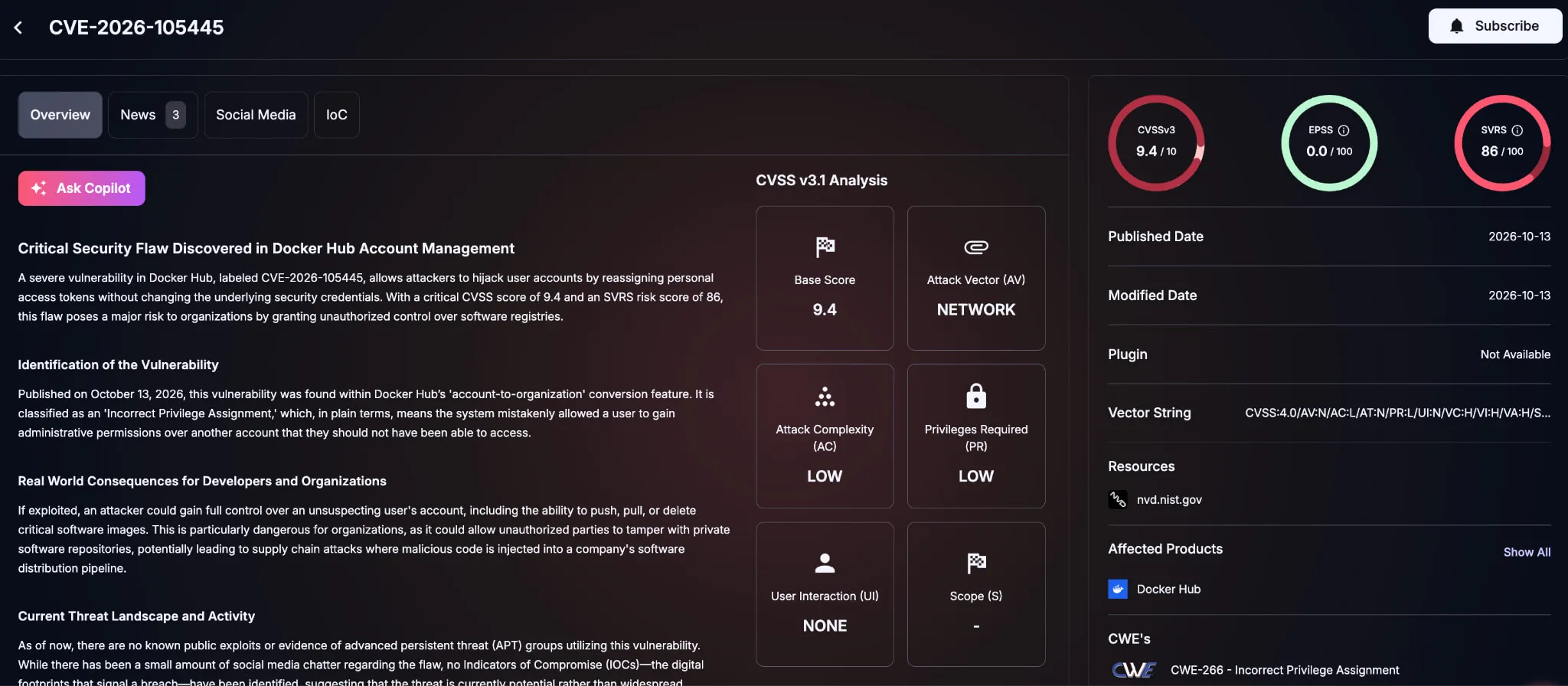
SOCRadar Vulnerability Intelligence card for CVE-2026-105445
Docker’s security advisory for CVE-2026-105445 stresses that this was registry level impersonation, not full Docker Hub account takeover. The flaw did not provide web-interface access or allow attackers to change passwords, email addresses, or MFA settings.
Who Was Affected?
CVE-2026-105445 affected the hosted Docker Hub service, not Docker Engine, Docker Desktop, or another locally installed package.
The exposure window was:
Docker no longer transfers PATs during account conversion. New organization owners must recreate the appropriate access credentials.
Docker notified potentially affected users and organization owners by email on October 2. The company says that if a user did not receive that notification, their account was not exposed through this vulnerability and no action is required.
Why Does the Flaw Matter?
The primary concern is container-image integrity. A reassigned PAT could inherit access to repositories available to the target user, including organization repositories. Depending on its scope, an attacker could potentially read private images, push altered images, delete content, or publish under a trusted namespace.
That creates downstream supply chain risk because CI/CD pipelines and users may trust image names and tags associated with legitimate publishers.
The impact remained limited by the target user’s registry permissions. The vulnerability did not automatically provide control over every repository or organization.
Was CVE-2026-105445 Exploited?
Docker says it found no evidence of exploitation.
The company reviewed every account conversion since the vulnerability was introduced and correlated conversion records with registry authentication, IAM token data, and Docker Hub activity.
Docker examined approximately 304,000 image pushes made with transferred PATs. It found that those pushes went only to repositories belonging to the converted organization or new owner, not unrelated accounts. Docker also reported no malware, cryptomining, command and control (C2) activity, credential theft, persistence, or image tampering in its review of higher-risk public images.
There is one limitation: an unused transferred token would not necessarily appear in registry-use logs. Docker therefore treated every PAT transferred during the exposure period as potentially affected.
The researchers who reported the flaw reproduced the behavior using test accounts, providing a public proof of impact. That is different from evidence of widespread malicious exploitation.
Track Docker Vulnerabilities with SOCRadar
SOCRadar’s Vulnerability Intelligence, powered by its Cyber Threat Intelligence capabilities, can help teams monitor CVE-2026-105445 alongside other risks affecting container registries, CI/CD infrastructure, and software supply chains. Organizations can combine vulnerability intelligence with internal registry and pipeline inventories to prioritize high value Docker Hub publishers and automation accounts.
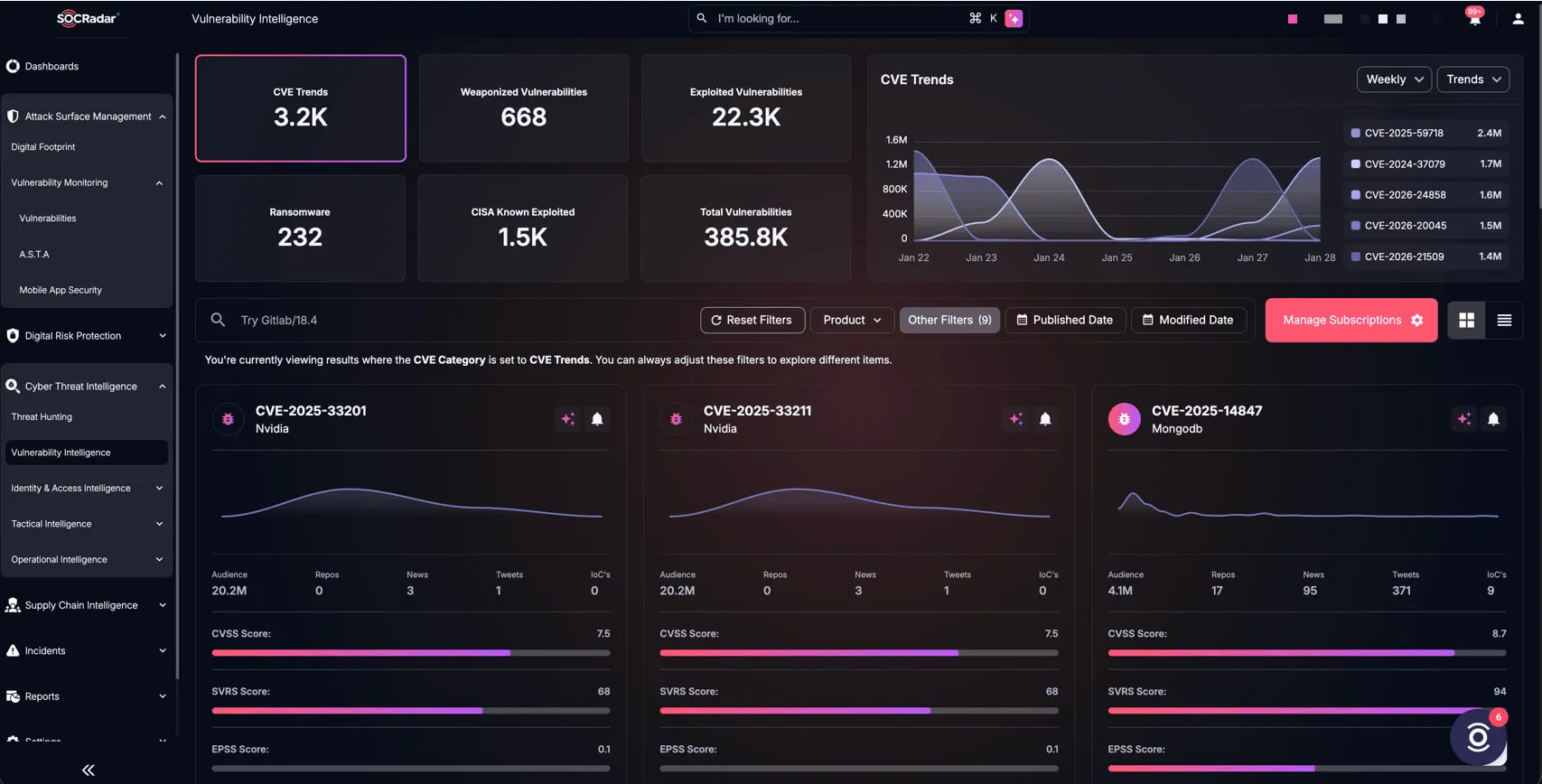
SOCRadar’s Vulnerability Intelligence
What Should Defenders Do?
Docker force-deactivated identified transferred PATs on October 8, except where owners explicitly chose to retain them.
Affected organizations should:
- Review Docker’s October 2 exposure notification.
- Inventory PATs and revoke obsolete or unfamiliar tokens.
- Rotate credentials used by CI/CD pipelines where appropriate.
- Review image push, pull, delete, tag, and manifest activity.
- Validate image digests, signatures, SBOMs, and provenance.
- Check organization membership and repository changes.
- Review CI/CD logs for unexpected publishing activity.
- Prefer organization access tokens for organization-owned automation rather than individual PATs.
Because unused transferred tokens may leave no registry activity, token inventory and conversion history are as important as push-event analysis.
Consumers that only pull images face lower direct exposure, but organizations relying on potentially affected publishers should validate image digests and provenance before trusting previously published artifacts.

Table Of Content
Related Articles

CVE-2026-89111: Critical SAP Cloud SDK SSRF
Oct 14, 2026
October 2026 Patch Tuesday: 1,413 Flaws, 3 Zero-Days
Oct 14, 2026



CVE-2026-97229: Critical GitLab RCE
Oct 13, 2026