

Oct 05, 2026
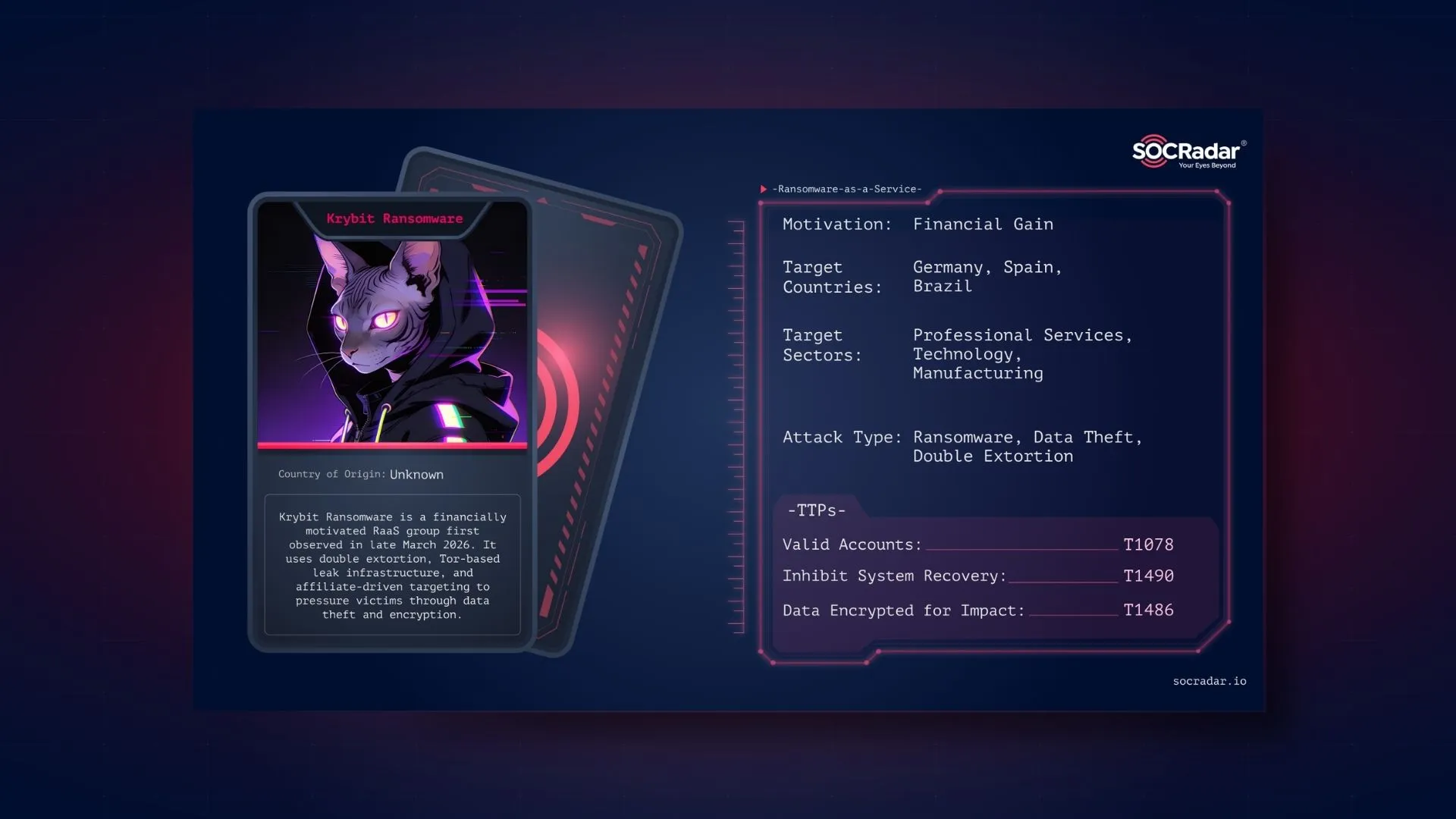
Table Of Content
Dark Web Profile: Krybit Ransomware
Who Is Krybit Ransomware?
What Are Krybit Ransomware's Targets?
What Are Krybit Ransomware's Techniques?
What Are the Mitigation Tactics Against Krybit Ransomware?
What Are the MITRE ATT&CK TTPs of Krybit Ransomware?
What Are the Indicators of Compromise (IOCs) for Krybit Ransomware?
Related Articles


Dark Web Profile: Blue Locker Ransomware
Sep 25, 2026

ShinyHunters Claims Access to FBI Systems
Sep 24, 2026

Clop Hack: ShinyHunters Hijacks Data Leak Site
Sep 21, 2026

Jul 13, 2026
12 Mins Read

Summarize with:
Dark Web Profile: Krybit Ransomware
Emerging from an increasingly crowded and combative ransomware ecosystem, Krybit Ransomware operates as a financially motivated, opportunistic Ransomware-as-a-Service (RaaS) threat. Within weeks of launch, the group found itself at the center of a public feud with a rival RaaS operator, a clash that exposed both sides’ internal infrastructure and left Krybit reputationally bruised but operationally undeterred.
Who Is Krybit Ransomware?
Krybit is a RaaS operation first observed in the wild in late March 2026, with independent underground monitoring recording initial detections on April 3, 2026. The group targets organizations for financial gain through a double-extortion model, exfiltrating sensitive data before encrypting victim systems, and pressures payment via a dedicated Tor-based data leak site (DLS).
Unlike more theatrical RaaS brands, Krybit’s operators have not published any explanation of the name’s origin, and no symbolic branding, mascot, or manifesto has surfaced in the group’s communications. That may simply reflect the group’s youth and small operational footprint relative to longer-running, higher-profile operations.
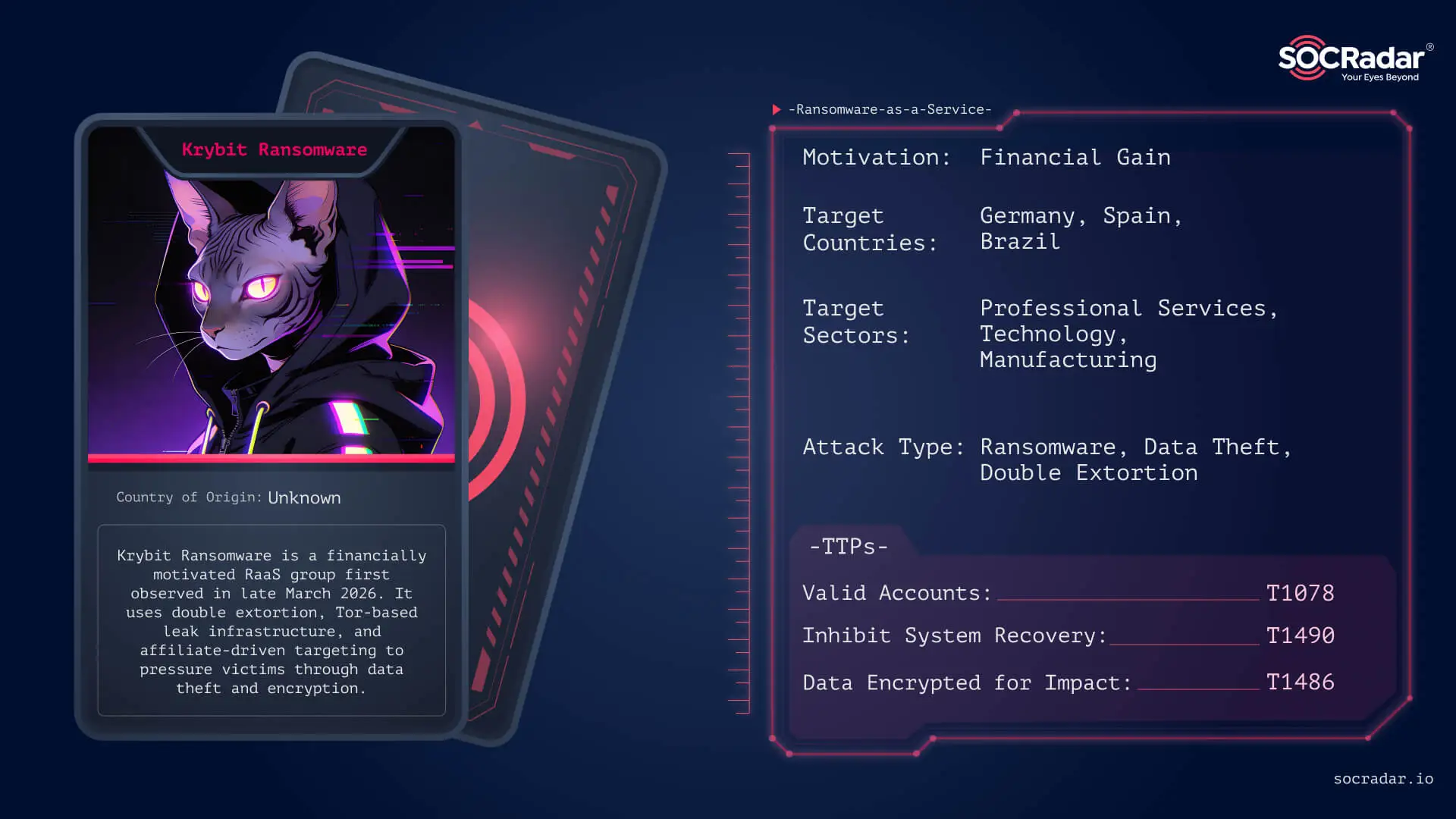
Threat actor card of Krybit Ransomware
Almost everything publicly known about Krybit comes from two sources: direct monitoring of its leak site, and one unusual event in which a rival RaaS operator, 0APT, breached Krybit’s affiliate panel in April 2026 and published its contents, giving researchers an unfiltered look inside the group’s internal structure less than a month after launch.
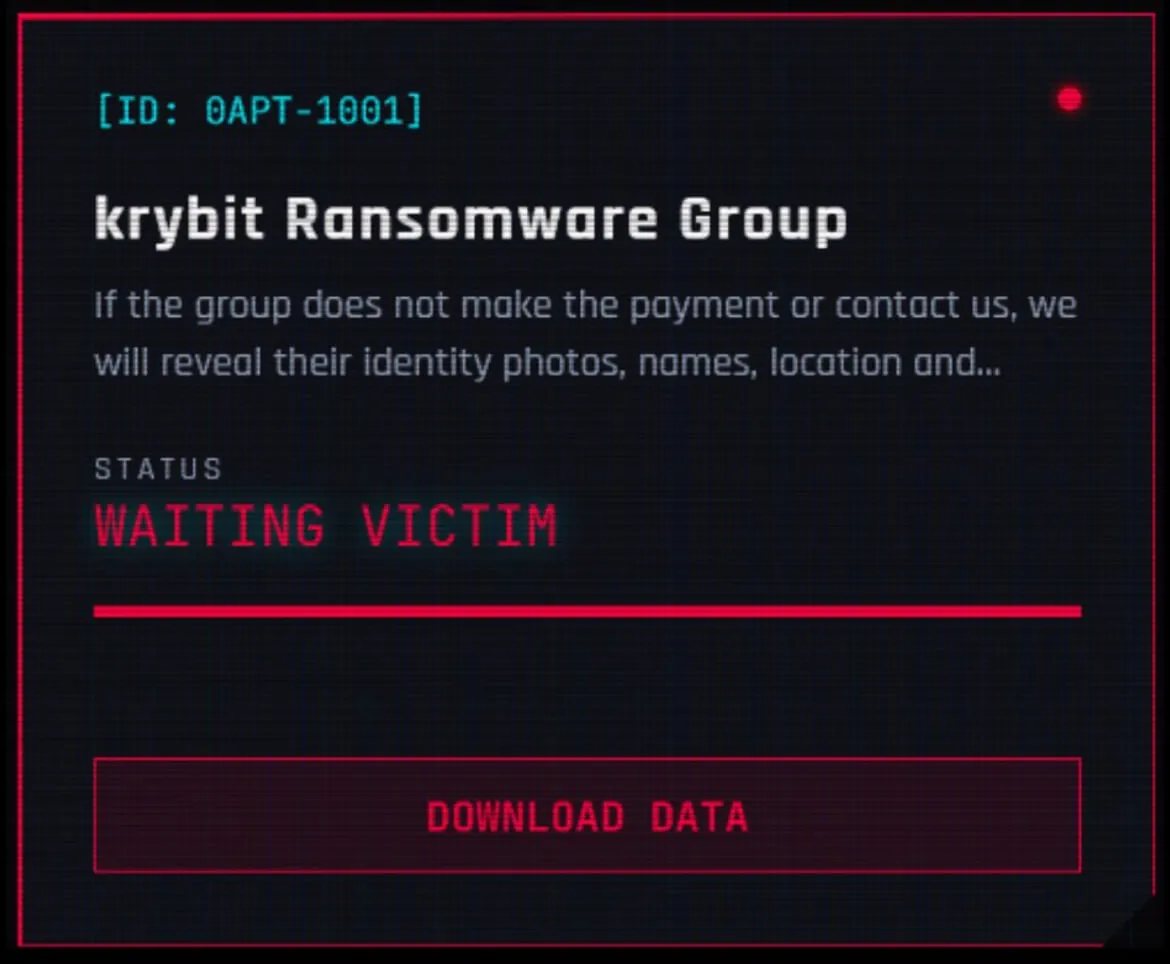
0APT’s listing of Krybit Ransomware group data
Krybit responded by breaching its rival in turn, escalating into one of the more closely documented ransomware-on-ransomware conflicts of 2026.
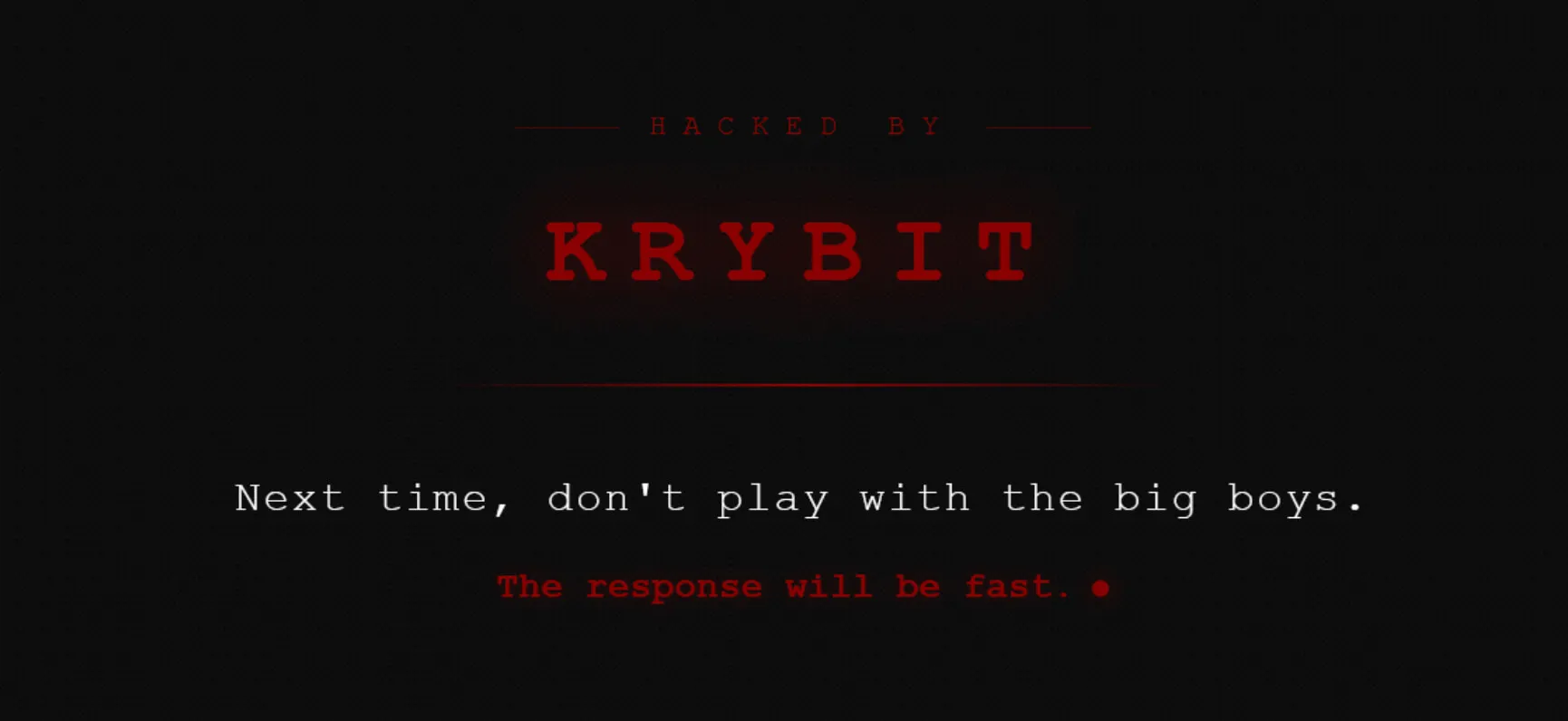
0APT’s data leak site, defaced by Krybit Ransomware
No confirmed ties to an established ransomware gang or nation-state have been identified. Captured samples are flagged by antivirus engines as Babuk derivatives (ESET: Filecoder.Babyk.A; Microsoft: Babuk!ic; Combo Cleaner: Ransom.Babuk), consistent with the large population of RaaS strains built on Babuk’s leaked 2021 source code rather than custom-engineered ransomware.
Observed Ransomware-as-a-Service (RaaS) Activity
Krybit runs a structured affiliate program built around an 80/20 revenue split in affiliates’ favor, with the operator retaining 20%, a standard incentive structure for RaaS platforms competing for affiliate talent. The group provides builders for Windows, Linux, VMware ESXi, and Network Attached Storage (NAS) devices, giving affiliates coverage across an organization’s server and storage estate rather than Windows endpoints alone.
The clearest picture of Krybit’s internal operations comes from the administrator panel leaked by rival group 0APT in April 2026, covering activity between March 28 and April 12, 2026. At that time, the leaked data showed:
- 2 administrators and 5 affiliates operating the platform
- 20 victims in active negotiation
- 10–250GB of staged exfiltration data per victim
- Ransom demands ranging from $40,000 to $100,000
- 5 Bitcoin wallet addresses, none showing any incoming or outgoing transactions, meaning Krybit had not collected a single confirmed ransom payment at the time of the leak
- Credentials stored in plaintext across both a password field and a plain_password field, with no hashing or salting
Named aliases identified in the leaked panel included the primary operator (“KRYBIT”), a secondary administrator (“GREP”), and five affiliate handles of varying activity levels, the most productive tied to 5 confirmed victims. All are pseudonymous handles; no real identities have been confirmed publicly.
Affiliate and victim communications run through Tor-based infrastructure, with each operator and affiliate assigned an individual Tox messaging ID. The leaked panel-database analysis showed 7 registered users across two privilege levels, 2 operators and 5 affiliates, each tied to a distinct Tox handle (full IDs listed in the IOC section below).
Data Leak Site and Infrastructure
Krybit operates a Data Leak Site (DLS) on the Tor network. Analysis of the leaked panel data identified five distinct Krybit .onion domains, each tied to a different operator or affiliate group.
The site’s operational history is closely tied to Krybit’s April 2026 conflict with 0APT:
- Late March 2026: DLS goes live alongside the group’s launch; the first legitimate victims are posted within two weeks
- April 12–13, 2026: Rival group 0APT breaches Krybit’s affiliate panel and threatens to publicly dox Krybit’s operators (names, photos, and locations) unless a ransom is paid. Krybit’s own site goes offline, replaced with a placeholder apologizing for the disruption
- April 14–15, 2026: Krybit retaliates, compromising 0APT’s server and defacing 0APT’s leak site with the message “HACKED BY KRYBIT — Next time, don’t play with the big boys.” Krybit then lists 0APT as a victim on its own DLS and publishes 0APT’s full operational dataset
- Late April 2026 onward: Krybit’s DLS resumes normal victim-posting operations; no further rebrand or takedown has been publicly documented as of this writing
Unlike the reciprocal breach of 0APT, which exposed a full server compromise (source code, bash history, nginx logs, system files), no comparable operational security failure on Krybit’s own hosting has been independently documented. The only public exposure of Krybit’s infrastructure to date is the affiliate panel data taken during the April breach, not a direct compromise of Krybit’s live servers.
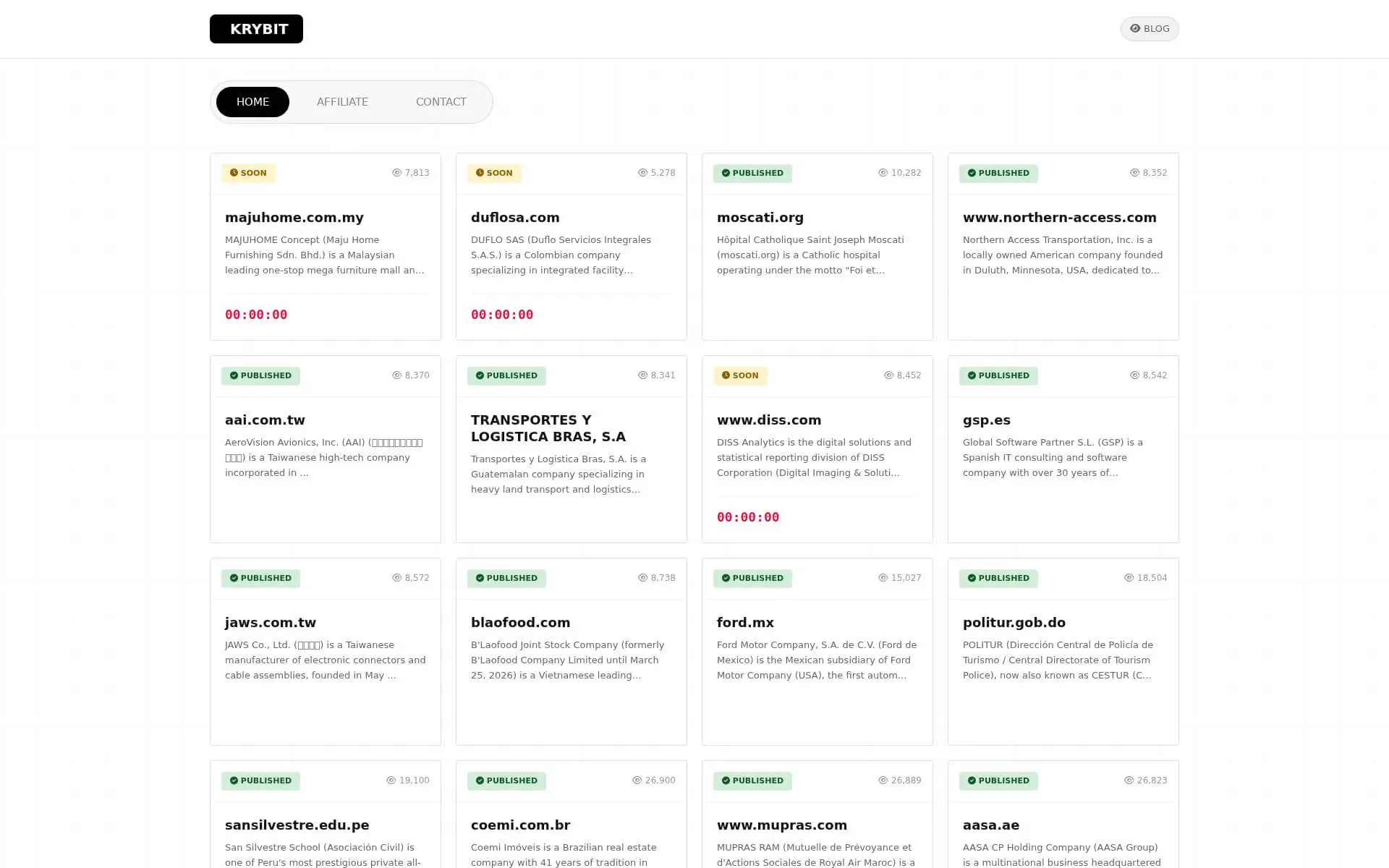
Krybit’s data leak site (SOCRadar Threat Actor Intelligence)
What Are Krybit Ransomware’s Targets?
Krybit’s targeting pattern is broad and opportunistic rather than tied to a specific sector or region, consistent with an affiliate-driven RaaS model, where each affiliate brings their own access and target selection.
Geography: The top targeted countries are Germany (10.0%), followed by a tie between Spain and Brazil for second (7.1% each). Krybit’s affiliates have claimed victims across 43 countries in total, spanning every populated continent, with most countries outside the top tier contributing only a single victim each.
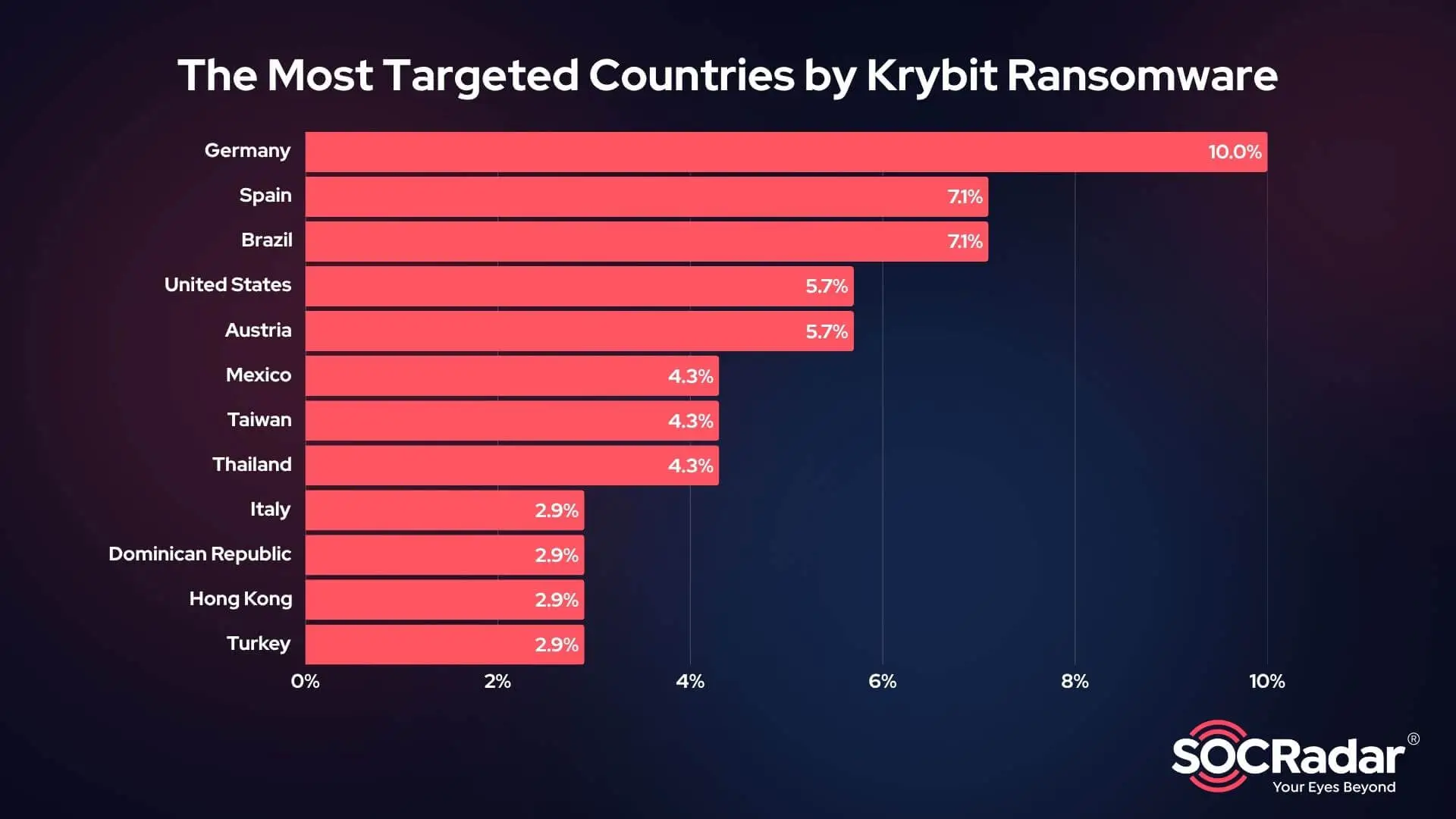
Top 10 countries targeted by Krybit Ransomware
The top targeted sectors are Professional Services (21.4%), Technology (17.1%), and Manufacturing (14.3%). A further 11.4% fall under an unclassified “Other” bucket, with the remaining share split across Healthcare, Government & Defense, Education, Transportation, Retail & E-Commerce, Energy & Utilities, Financial Services, and Hospitality.
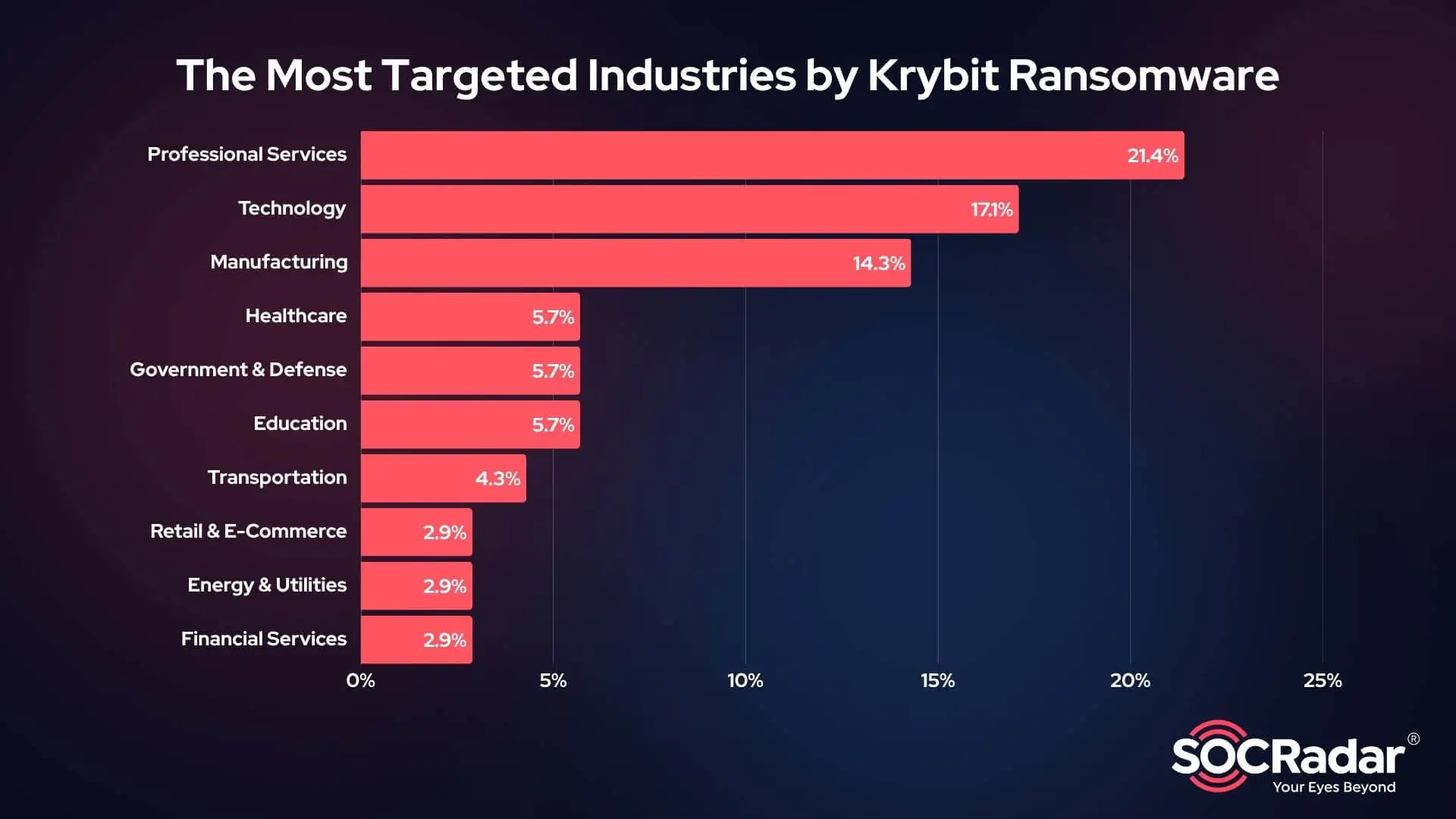
Top 10 industries targeted by Krybit Ransomware
Claims Linked to Krybit Ransomware
- March 28, 2026: Earliest confirmed operational activity recorded in Krybit’s affiliate panel data
- April 3, 2026: Underground monitoring records the first observed detection of the KRYBIT strain
- Early–mid April 2026: First victims posted on Krybit’s DLS; the leaked panel later showed 20 victims in active negotiation as of April 12
- April 12–13, 2026: Rival RaaS 0APT breaches Krybit’s affiliate panel, leaks plaintext credentials and Bitcoin wallet data, and threatens to dox Krybit’s operators
- April 14–15, 2026: Krybit retaliates, compromises 0APT’s server, defaces 0APT’s leak site, and publishes proof that 0APT’s earlier 190+ claimed victims were fabricated
- Late April–May 2026: Incident covered extensively across security research reports and industry press; researchers assess the exposure raises Krybit’s law-enforcement takedown risk and may push the group toward a future rebrand
- June 25, 2026: Dominican Republic’s tourism authority (politur.gob.do) claimed as a victim
- July 1, 2026: A cluster of new claims posted in a single day, including DISS Corporation (US), JAWS Co., Ltd. (Taiwan), AeroVision Avionics/AAI (Taiwan), B’Laofood Joint Stock Company (Vietnam), Ford Motor Company S.A. de C.V. (Mexico), San Silvestre School (Peru), Global Software Partner S.L. (Spain), and moscati.org (Italy)
- July 3, 2026: MAJUHOME Concept (Malaysia) and DUFLO SAS (Colombia) added to the leak site
SOCRadar’s live ransomware tracking lists 70 attributed victims, with new claims continuing to appear on a near-weekly basis; the group shows no sign of slowing despite April’s infrastructure exposure.
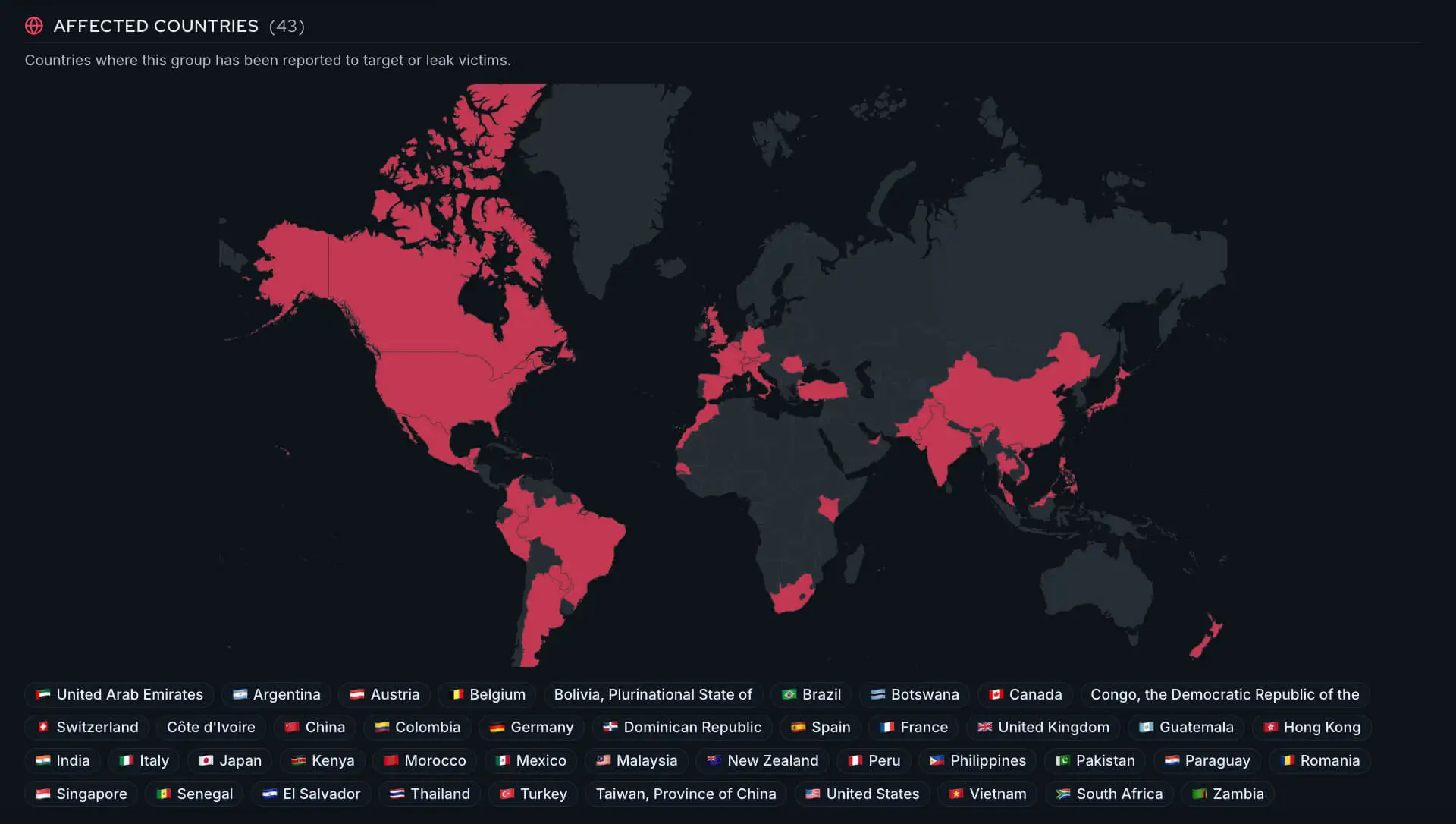
Affected Countries by Krybit Ransomware, Ransomware Intelligence Dashboard (SOCRadar Free Tools)
What Are Krybit Ransomware’s Techniques?
Public technical analysis of Krybit remains limited compared to more extensively reverse-engineered RaaS strains. Most available detail comes from independent malware behavior analysis and the MITRE ATT&CK techniques researchers have tagged against the group’s tracked activity, rather than a full forensic breakdown of a captured sample’s execution chain. What has been documented is consistent with a functional but unremarkable RaaS payload.
Initial Access
No single entry vector is consistently tied to Krybit Ransomware. Because affiliates supply their own access, initial intrusion methods vary from case to case. Tracked ATT&CK activity includes Valid Accounts (T1078) and Remote Services (T1021/T1021.001), pointing to compromised credentials and Remote Desktop Protocol (RDP) as common entry points, consistent with other affiliate-model ransomware operations. That said, no specific phishing lure, exploited CVE, or exposed service has been publicly attributed to this group.
Execution and Persistence
Tracked activity includes Command and Scripting Interpreter (T1059), pointing to script-based execution, though the specific interpreter has not been confirmed in public reporting. Persistence is tagged via Boot or Logon Autostart Execution (T1547) and Boot or Logon Initialization Scripts (T1037).
Defense Evasion
Researcher analysis describes defense evasion through obfuscation, process injection, and abuse of legitimate system processes, mapping to Impair Defenses (T1562). No specific security-tool-disabling binary or endpoint detection and response (EDR)-killer has been named for Krybit, in contrast to groups where such a tool has been isolated and hashed.
Discovery and Credential Access
Reports assess that Krybit demonstrates capabilities aligned with credential access, system and network discovery, and data staging, indicating a multi-stage intrusion lifecycle consistent with typical pre-encryption reconnaissance. Specific tools or techniques used for credential harvesting have not been publicly isolated.
Command and Control / Exfiltration
Victim communication and leak-site activity route through Tor hidden services, tagged as Application Layer Protocol (T1071) and Ingress Tool Transfer (T1105), anonymizing the group’s infrastructure. Exfiltration is tagged as Exfiltration Over C2 Channel (T1041), with 10–250GB of staged data per victim documented in the leaked affiliate panel. No specific exfiltration tool (comparable to Rclone, WinSCP, or a custom uploader seen in other RaaS operations) has been named for Krybit in current reporting.
Encryption and Impact
Prior to encryption, Krybit executes vssadmin.exe delete shadows /all /quiet to delete Volume Shadow Copies, disabling built-in Windows recovery (mapped to Inhibit System Recovery, T1490). The final payload appends the .KRYBIT extension to encrypted files (mapped to Data Encrypted for Impact, T1486) and drops a ransom note named RECOVER-README.txt, which directs victims to a Tor-based negotiation portal and claims exfiltration of employee data, credentials, financial records, and technical design files.
What Are the Mitigation Tactics Against Krybit Ransomware?
Block Initial Access
- Enforce multi-factor authentication (MFA) on RDP, VPN, and remote administration interfaces: Valid Accounts (T1078) and Remote Services (T1021) are both tagged techniques for this group
- Eliminate unnecessary internet exposure of RDP/remote management ports; place any that must remain behind a VPN or jump host
- Monitor for credential-stuffing and brute-force patterns against externally facing authentication portals
Protect Backups and Recovery
- Maintain immutable or offline backups unreachable from the production network: Krybit’s shadow-copy deletion (T1490) specifically targets built-in Windows recovery options
- Alert immediately on execution of vssadmin.exe delete shadows /all /quiet
- Regularly test backup restoration, including for ESXi and NAS environments, given Krybit’s cross-platform builder support
Cover Non-Windows Assets
- Extend endpoint and monitoring coverage to Linux hosts, VMware ESXi hypervisors, and NAS devices: Krybit is not a Windows-only threat, and hypervisor/storage layers are frequently under-monitored relative to Windows endpoints
Monitor for Defense Evasion
- Alert on process injection and unusual invocation of legitimate system utilities, consistent with Krybit’s documented Impair Defenses (T1562) behavior
- Enable comprehensive process-creation and script-execution logging; since specific Living Off the Land Binaries (LOLBins) used by Krybit haven’t been isolated in public reporting, broad behavioral coverage compensates for that intelligence gap
Apply Threat Intelligence
- Ingest known Krybit .onion infrastructure into blocklists and Tor-traffic monitoring
- Cross-reference any organization flagged on Krybit’s DLS against internal telemetry before treating the claim as confirmed: the 0APT episode is a reminder that leak-site claims in this ecosystem aren’t uniformly reliable, though Krybit’s own claims have held up better under scrutiny than its rival’s
- Track affiliate tradecraft migration: if Krybit rebrands or affiliates move to other platforms following the April exposure, their access methods and staging behavior are likely to persist under a new name
What Are the MITRE ATT&CK TTPs of Krybit Ransomware?
| Tactic | Technique ID | Technique Name |
|---|---|---|
| Initial Access | T1078 | Valid Accounts |
| Execution | T1059 | Command and Scripting Interpreter |
| Persistence | T1547 | Boot or Logon Autostart Execution |
| Persistence | T1037 | Boot or Logon Initialization Scripts |
| Defense Evasion | T1562 | Impair Defenses |
| Lateral Movement | T1021 | Remote Services |
| Lateral Movement | T1021.001 | Remote Services: Remote Desktop Protocol |
| Command and Control | T1105 | Ingress Tool Transfer |
| Command and Control | T1071 | Application Layer Protocol |
| Exfiltration | T1041 | Exfiltration Over C2 Channel |
| Impact | T1490 | Inhibit System Recovery |
| Impact | T1486 | Data Encrypted for Impact |
What Are the Indicators of Compromise (IOCs) for Krybit Ransomware?
Krybit’s April 2026 panel leak provided sourced financial and communications indicators (wallets, Tox IDs) not typically available for a group this young. Sample hashes and attack-source IPs, however, still are not published at the granularity available for more heavily reverse-engineered strains. The indicators below reflect what has been independently corroborated across available reporting.
File System
- Encrypted file extension: .KRYBIT
- Ransom note filename: RECOVER-README.txt
Data Leak Site (Tor)
- krybieodq754vlwufrsuxaswxb5zpxyibaawmed2jaduoz2e5m56hmid[.]onion
- krybitqsdzwmhnitvwuhvsntfgf2wrhxveyxroxpc44c6gkft2cqldyd[.]onion
- krybitx3fh5krdnhegyp2ob3lhizsaiadturtio3ginf7it5gsdgu2yd[.]onion
- krybitxdpxohsmjooeb3gbgpmdddreh6mnflzac6bnezz74b7yje67yd[.]onion
- krybivdln3oc3twbin4budgznzq7dmcolldnsx455lspxxe23b56y5qd[.]onion
Financial
Analysis of the leaked panel database identified 5 Bitcoin wallet addresses, reused across victims, an operational security failure that links Krybit’s cashout paths across its entire victim list for blockchain-tracing purposes. None showed any incoming or outgoing transactions as of the April 2026 leak.
| Wallet Address | Victims Tied to Wallet |
|---|---|
| bc1ql2f3mhw6yxammrs9ufklpqf9qlcwrr85u72v4h | secran.com.br, L’Hirondelle, bjgrupo.com.br |
| bc1q5fvym0l0vvzhenhynzduf3qyp85zjdsrn7j8ju | kramer-nsc.at, fraper.com |
| bc1qznfsaeyd4j4mzcsgu2a4m0sj5pw6tvrx2vdscl | whiskey.co.jp, Cubyn |
| bc1q7uhjsc6qtx933v2wjgmevh63yssjvzfx7cegud | lkc.ac.bw, STRONGIGA |
| bc1qvd3ucrrgzq5eyay5xxn8jerjh669ua6qyz3urk | ccckeito.edu.hk |
Tox Messenger IDs
| Username | Role | Last Active | Tox ID |
|---|---|---|---|
| KRYBIT | Operator | 2026-04-12 | F65E1621B7A5DC0139FE108B9CD48404082951E7E7F421A07A7B88A8E8111C13C552EA2B0C4C |
| GREP | Operator | 2026-03-28 | 48B547A7A6195593B9158E4B6160ED0310B2F9AD080992D44EA299878DCCD0551CC7CAD168CD |
| D9D938D9AC9 | Affiliate | 2026-04-11 | 590586B43A7F5101002EA0167A6E627402512D50B41E1178E484B3DB9616F31ABD9D938D9AC9 |
| fsociety | Affiliate | 2026-03-31 | 0D72935BE65992C164D5BFAFD668ACE2004A317859E360A0851B864AA422EA2E43179699DBE3 |
| M*A*R*S | Affiliate | 2026-03-29 | B7EA3E6CD89496CDC27FC7A4010DCA634D8EED1282EFD5E1FF876C91DD4AA94193403F29B58C |
| 464D03CA2AF05 | Affiliate | 2026-04-10 | AD8A7E310F6A6DA2D39A57B1EB034A28EBD35367FA4CCD832CF74F80C464D03CA2AF0547CBCF |
| 753766EFA0462B | Affiliate | 2026-04-06 | 515C7E4F8048813CAFCDEBD915D72E9ACDEC588201B6E941422717D4F80753766EFA0462B8BD |
Important Note: The affiliate alias “fsociety” shares its name with an unrelated, independently established RaaS operation (also tracked as “Flocker,” active since around April 2024 and allied with FunkSec). No public reporting ties the two together; “fsociety” is a common handle in the cybercrime underground, borrowed from the hacker collective in the TV series Mr. Robot and reused independently by multiple unrelated actors since at least 2016.