

Oct 12, 2026
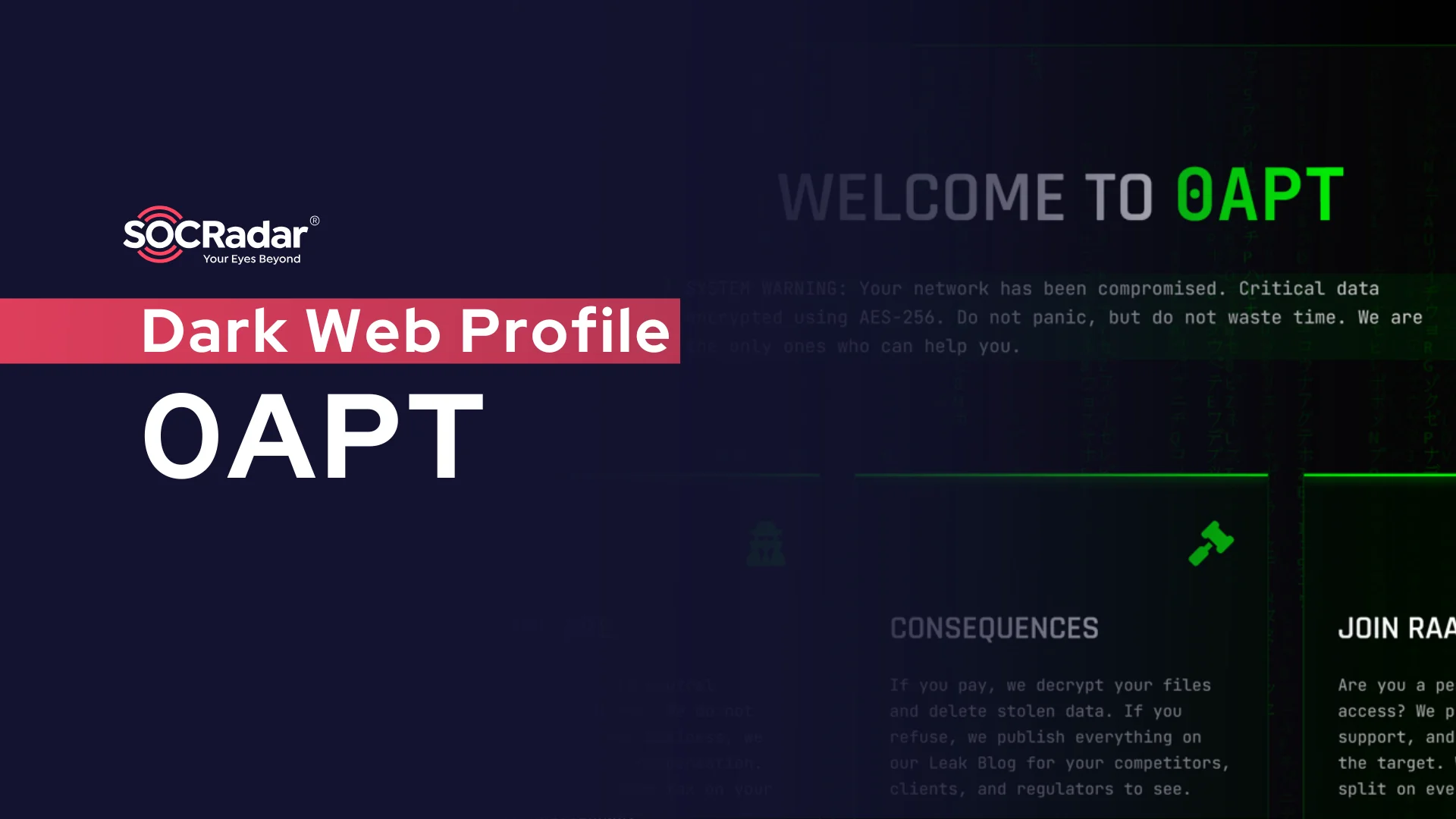
Table Of Content
Related Articles
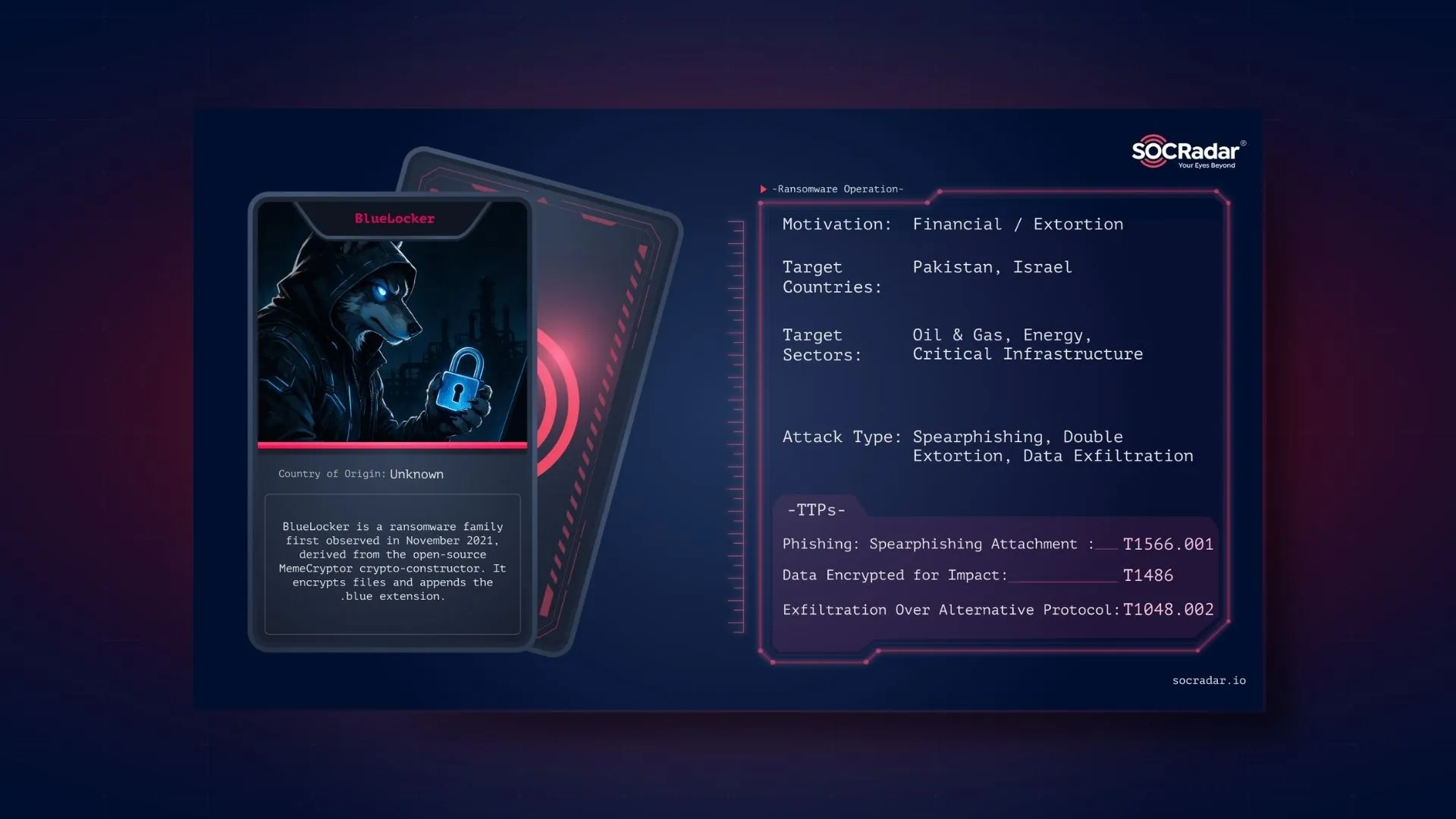
Dark Web Profile: Blue Locker Ransomware
Sep 25, 2026
ShinyHunters Claims Access to FBI Systems
Sep 24, 2026
Feb 05, 2026
6 Mins Read
Jun 19, 2026

Summarize with:
Dark Web Profile: 0APT Ransomware
0APT, also recognized as the 0APT Syndicate, is a controversial Ransomware-as-a-Service operation that surfaced in late January 2026. The group rapidly gained notoriety by listing hundreds of high-profile victims on its dark web leak site within an exceptionally short timeframe. However, emerging technical analysis has cast significant doubt on the group’s sophistication, suggesting that 0APT may be operating a deceptive scam-as-a-service model rather than functioning as a traditional, high-capability ransomware group.
Who is 0APT Ransomware?
The group first appeared publicly around January 28, 2026, positioning itself as a politically neutral business syndicate. They initially projected the image of a powerful global threat actor targeting major entities across critical sectors. Their rapid ascent and claim of hundreds of victims in just a few days challenged the typical operational tempo of established ransomware groups, leading to immediate scrutiny by the cybersecurity community.
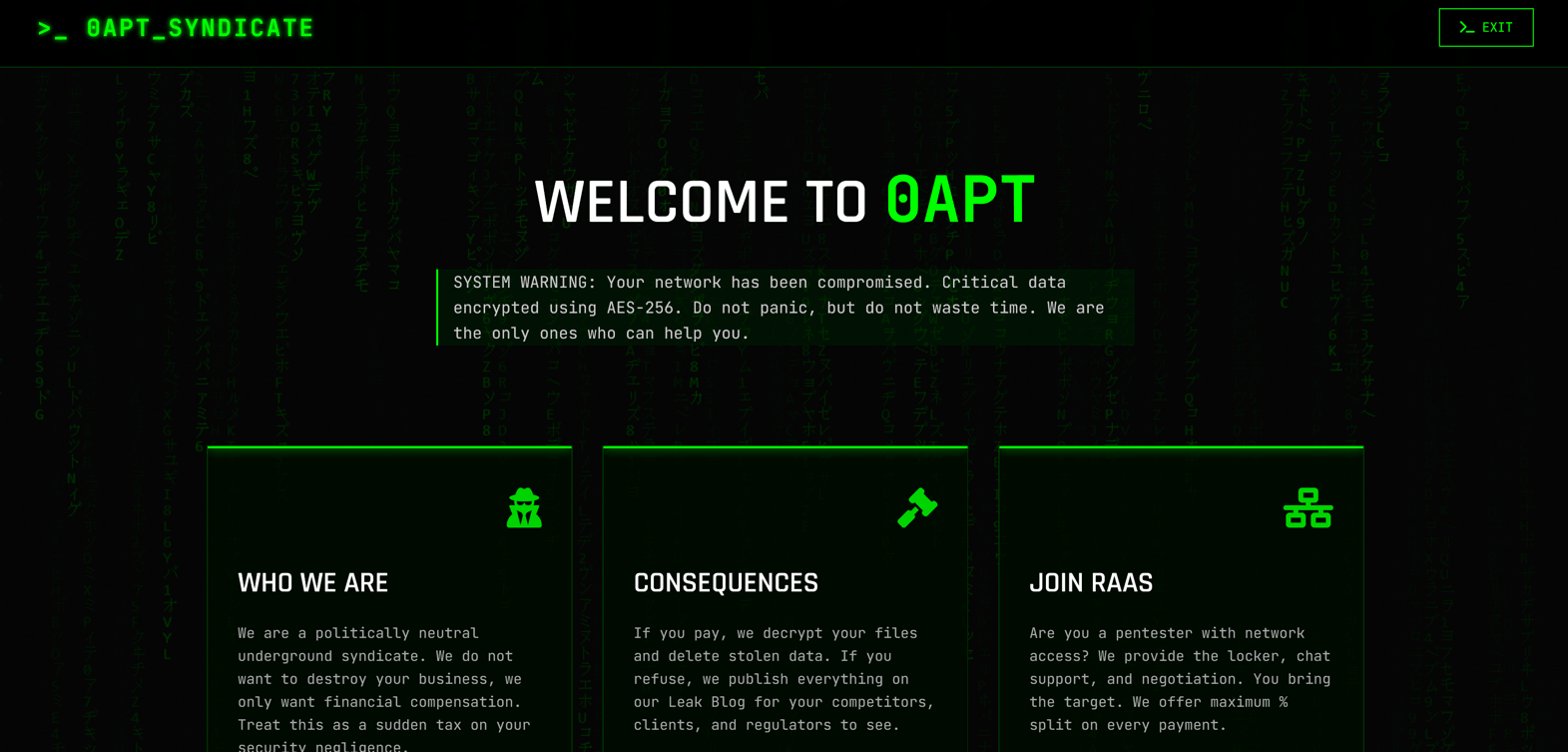
0APT Ransomware’s DLS site, About us tab
0APT does not appear to discriminate based on geography or industry, claiming attacks on a wide variety of high-value targets:
Which Sectors and Organizations Does 0APT Target?
0APT casts a remarkably wide net, focusing on volume rather than specific vertical specialization. By targeting entities across North America, Europe, Asia, and the Middle East simultaneously, the group aims to establish a global reputation of fear. Their victimology suggests an opportunistic “spray and pray” approach, likely leveraging automated vulnerability scanners to identify weak points in diverse infrastructures ranging from critical national grids to financial institutions.
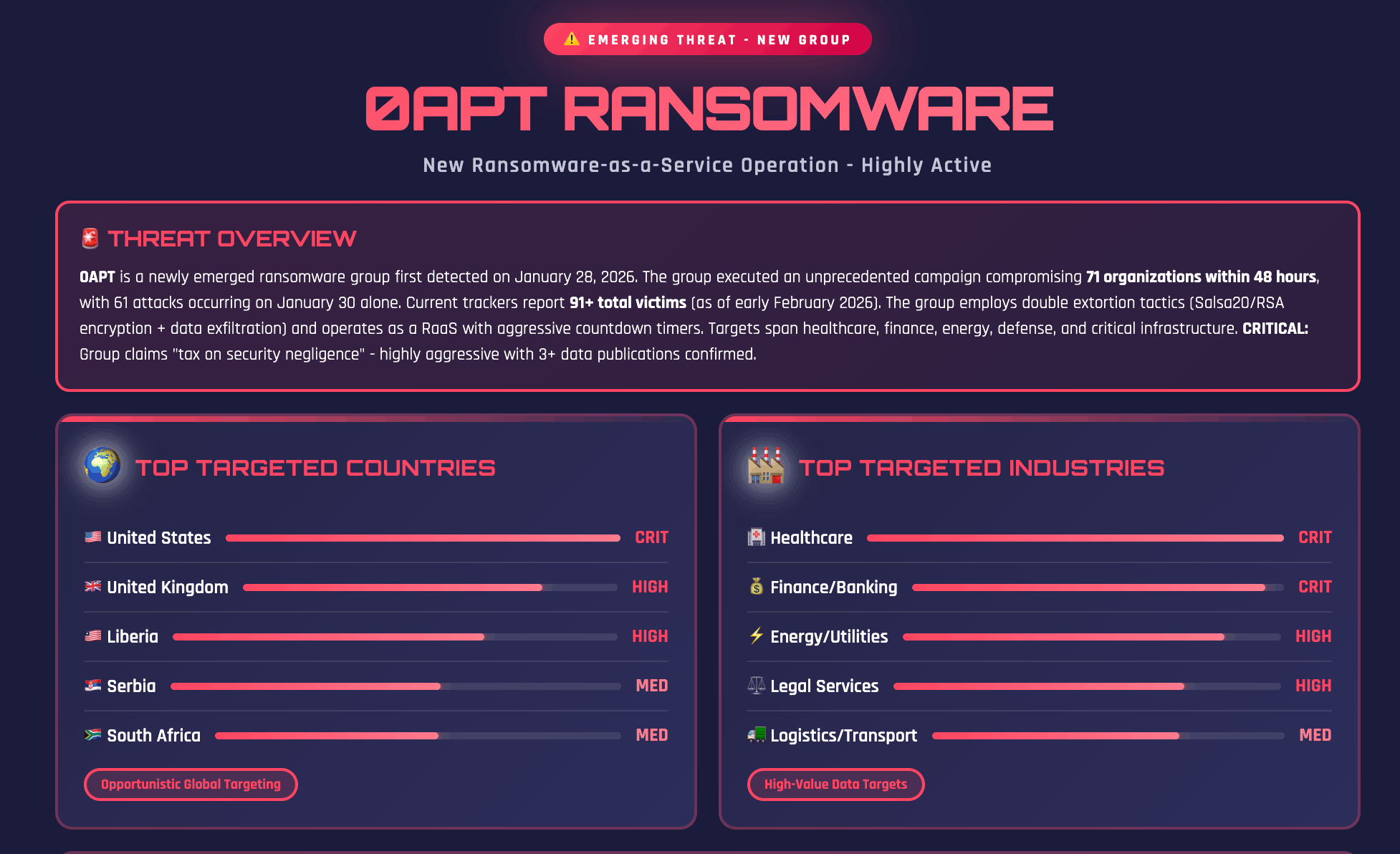
0APT Ransomware Threat Intelligence Report (Source: SOCRadar MCP)
The group has listed claims against organizations in the following key sectors:
- Critical Infrastructure & Energy: High-stakes targets where downtime is intolerable, such as Solstice Energy Grid, where the group purported to compromise critical SCADA logs.
- Healthcare & Pharma: Major providers and research entities, including alleged breaches of the Mayo Clinic and HCA Healthcare UK, threatening the exposure of sensitive patient data.
- Finance & Banking: Institutions holding highly regulated data, exemplified by the claim against Quantum Financial Corp, involving the alleged theft of SWIFT logs and KYC documents.
- Industrial & Manufacturing: Global giants like BASF, Honeywell Aerospace, and Linde, where intellectual property theft is the primary extortion lever.
- Logistics & Supply Chain: Companies like, Global Logistics Hub.
How Does 0APT Ransomware Operate?
0APT utilizes a strategy centered on psychological pressure and volume rather than technical precision. Their operational model resembles a smash-and-grab scheme designed to exploit the fear of reputational damage.
- Psychological Warfare: Their primary tactic involves populating the “Wall of Shame” on their Tor leak site with a massive number of victim names daily. By flooding the news cycle with victims, they create a sense of inevitability and panic, forcing organizations to negotiate to avoid being added to the list.
- Cryptographic Implementation: The group claims to employ a hybrid encryption scheme to lock victim data. They purportedly utilize AES-256 for robust file encryption, often supplemented by the Salsa20 algorithm to increase speed when processing large data streams or backups. This combination is intended to make unauthorized decryption mathematically impossible without the private keys held by the operators.
- Communication Channels: Unlike groups that rely on email or custom web portals, 0APT prefers Session Messenger for all negotiations. This decentralized platform allows them to maintain higher anonymity and operational security (OPSEC).
- Exfiltration Bluffs & Technical Anomalies: Despite the high-level cryptographic claims, technical analysis reveals significant inconsistencies. The prevalence of 0-byte (empty) sample files in their data leaks suggests that their exfiltration tools may be non-functional, fabricated, or that the group is simply bluffing about the extent of the stolen data to expedite ransom payments.
Is 0APT Ransomware a Legitimate Threat or a Scam?
While the group claims to compromise high-value targets globally, technical evidence strongly suggests that 0APT might be a “fake” ransomware operation or a low-tier scam. Security researchers analyzing the group’s data leaks and infrastructure have identified several anomalies that contradict the profile of a sophisticated threat actor:
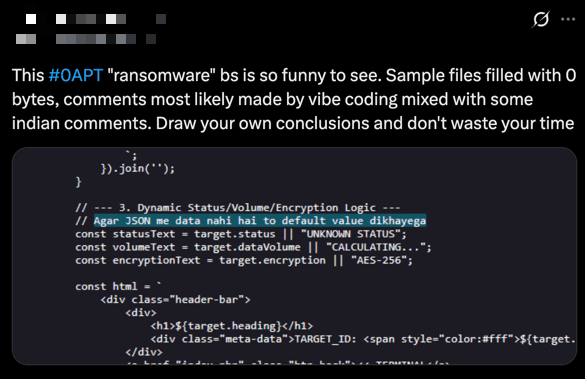
Leak site source code snippet containing developer comments in Hindi/Urdu, pointing to low-tier outsourcing or specific regional origins. (Source: X)
- 0-Byte Dummy Files: Analysis of the data samples provided by the group revealed that many files are filled with zero bytes. This effectively makes them empty shells, indicating the group likely does not possess the stolen data they claim to have.
- Linguistic & Regional Indicators: Source code analysis of the attacker’s panel uncovered internal comments written in Hindi or Urdu, such as instructions on handling default JSON values. This points towards operators or developers from South Asia rather than the Russian-speaking core typical of top-tier ransomware cartels.
- Low-Quality Coding: The infrastructure appears to be a chaotic mix of AI-generated scripts and amateur web development, suggesting the group prioritizes the visual appearance of a threat over actual cryptographic capability.
How Can Organizations Defend Against 0APT?
Defense against 0APT requires a strategy of “Verify then React.” Since the group is known to exaggerate its capabilities, security teams must rigorously validate any claims before taking action.
- Verify Data Integrity: Before engaging in any negotiation, confirm the validity of leaked files. Be wary of 0-byte files or generic file lists that do not prove actual data theft.
- Check Internal Logs: Verify internal network logs for evidence of large-scale data exfiltration (e.g., massive outbound traffic) or actual encryption events before assuming a breach has occurred based solely on a leak site listing.
- Harden External Access: Even if their ransomware is fake, their initial access is real. Aggressively patch internet-facing vulnerabilities in VPNs and Firewalls, and enforce strict Multi-Factor Authentication (MFA) to prevent unauthorized entry.
- Network Segmentation: Isolate critical assets like SCADA systems and financial logs to ensure that even if a breach occurs, the attackers cannot access the “crown jewels.”
How Can SOCRadar Support Your Defense?
SOCRadar leverages its Extended Threat Intelligence (XTI) capabilities to provide a proactive shield against ransomware threats. The platform supports security operations by:
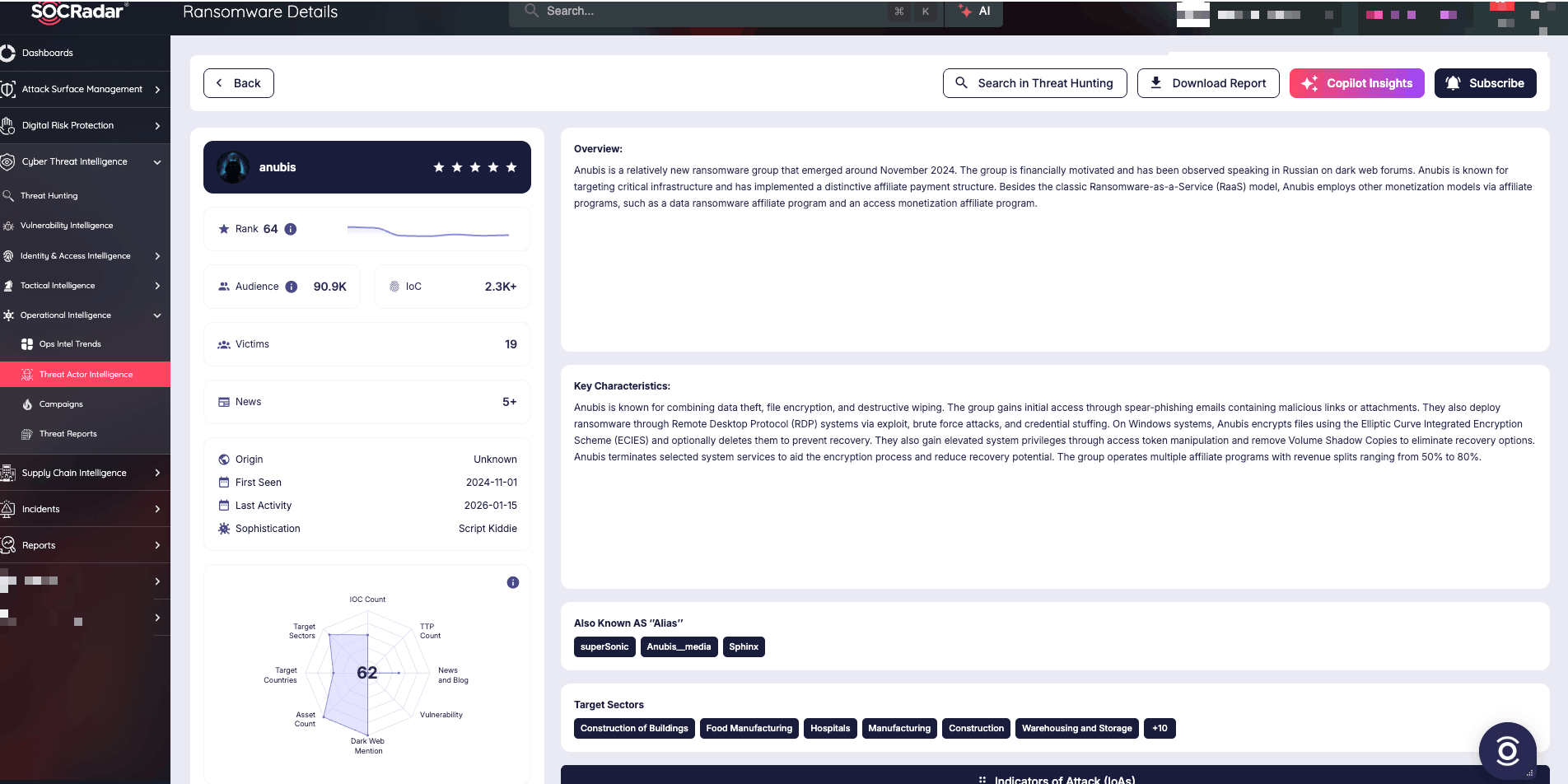
SOCRadar Threat Actor Intelligence
- Real-Time Tracking: Monitoring new ransomware variants, victim claims, and attacker communications in real-time.
- Breach Validation: Helping teams quickly assess whether a claimed attack is a genuine data breach or a bluff designed to cause panic.
- Exposure Management: Automatically scanning the Dark Web for exposed employee credentials or leaked internal documents that could serve as entry points.
- Supply Chain Visibility: Alerting you instantly if a vendor or partner appears on a ransomware leak site, securing your third-party ecosystem.