

Oct 09, 2026
Table Of Content
Epstein Files Guide: How to Reliably Search the Epstein Files?
Understanding the Epstein Files Release
Official Government Sources
Third-Party Search Interfaces
Warning: Torrent and Peer-to-Peer Sources
GitHub Repositories and Technical Tools
Identifying Fake and Manipulated Content
How to Verify Information?
Best Practices for Researchers and Journalists
What's Still Missing?
Conclusion
Frequently Asked Questions (FAQs)
Related Articles

Critical Cisco NX-OS Flaws Threaten Nexus Switches

CVE-2026-21589: Critical Atlassian File Access
Oct 07, 2026

CVE-2026-88779: Citrix NetScaler Zero-Day
Oct 06, 2026

CVE-2026-90970: GitLab AI Gateway RCE
Oct 05, 2026

FortiMail Zero-Day Under Active Exploitation
Oct 02, 2026

Feb 02, 2026
9 Mins Read
Jun 09, 2026

Summarize with:
Epstein Files Guide: How to Reliably Search the Epstein Files?
This guide is for informational purposes only.
The release of Jeffrey Epstein’s investigative files has been one of the most significant transparency efforts in recent years. However, navigating these millions of documents, images, and videos can be overwhelming. This guide will help you understand how to access these files reliably, identify trustworthy sources, and avoid misinformation.
Understanding the Epstein Files Release
Following the passage of the Epstein Files Transparency Act in November 2025, the U.S. Department of Justice has been releasing documents related to Jeffrey Epstein and Ghislaine Maxwell’s criminal cases. As of January 30, 2026, the DOJ has released approximately 3.5 million pages, including:
- Over 3 million pages of documents
- 2,000+ videos
- 180,000+ images
- Court records, FBI documents, emails, and investigative materials
The DOJ identified over 6 million potentially responsive pages but stated that only about 3.5 million would be released after review and redactions to protect victim identities. This has drawn bipartisan criticism from lawmakers who question what’s being withheld.
Official Government Sources
This is the most authoritative source for the files. The DOJ has organized releases into multiple datasets:
- Data Sets 1-12 containing court records, evidence lists, flight logs, contact books, and investigation materials
- Full-text search capability (though the DOJ notes some documents may not be electronically searchable)
- Direct download options via ZIP files for each dataset
Advantages:
- Official, unaltered documents
- Legally authenticated source
- Complete metadata and chain of custody
Disadvantages:
- Poor user interface and limited search functionality
- Some files have been temporarily removed and re-uploaded
- No context or organization beyond basic categorization
- Large file sizes can be difficult to download
There have been documented instances of files being temporarily removed from the DOJ website, including documents mentioning President Trump. While most were restored, this raises concerns about transparency and completeness.
Third-Party Search Interfaces
Created by Riley Walz and Luke Igel, Jmail presents Epstein’s emails in a familiar Gmail-like interface.
Features:
- Searchable email database with Gmail-style interface
- Uses OCR (Optical Character Recognition) via Google’s Gemini AI
- Includes verification links to original government documents
- Covers emails from 2009-2019 from Epstein’s account ([email protected])
- JDrive component for browsing document archives
- Jemini AI interface for natural language searches
Data Sources:
- November 2025 House Oversight Committee release (20,000+ pages)
- Ongoing indexing of new DOJ releases as of early 2026
Advantages:
- Extremely user-friendly interface
- Fast search functionality
- Contextual email threads
- Links back to source documents for verification
Disadvantages:
- Limited to email content (not comprehensive of all file types)
- OCR may introduce errors in text interpretation
- Still being updated with latest releases (February 2, 2026)
- Does not include all 3.5 million pages released
Always use the verification links provided to cross-reference with official government sources.
- Contains searchable database of DOJ releases
- Has preserved some files that were temporarily deleted by DOJ
- Status as of Jan 31, 2026: Uploaded Data Sets 1-8 and 12; working on uploading Data Sets 9-11 from the January 30 release
- Note: COURIER maintains a separate database for the Epstein Estate documents released by House Oversight Committee
Warning: Torrent and Peer-to-Peer Sources
Several torrent magnet links have been shared on Reddit’s r/DataHoarder and other platforms, claiming to contain complete or “unredacted” versions of the Epstein files.
CRITICAL SAFETY WARNINGS:
- Malware Risk: Torrent files from unknown sources can contain malicious software, ransomware, or viruses
- Legal Concerns: Some torrents may claim to contain illegally obtained or “leaked” materials
- Difficult Verification: Difficult to verify authenticity or completeness without comparing to official sources
- Potential for Tampering: Files could be altered, fabricated, or include false information
- Privacy Risk: Downloading torrents exposes your IP address to other peers
Deleted Documents: Some sources claim to have preserved documents that were deleted by the DOJ. While there is documented evidence of files being temporarily removed from the DOJ website (such as file EFTA0000468 showing photos of Trump), these instances were largely temporary, and most files were restored.
Recommendation:
- Avoid downloading from torrents unless you have technical expertise to verify file integrity and scan for malware
- Use official government sources or verified third-party interfaces instead
- If you must use torrents, verify checksums (SHA256/MD5 hashes) if provided
- Never open executable files from torrents
- Use virtual machines or sandboxed environments
- Cross-reference any information with official sources
GitHub Repositories and Technical Tools
For those with technical expertise, several GitHub repositories provide tools for downloading and organizing the files:
- These are open source projects, so users should still be very cautious.
Epstein Files Downloader (Surebob/epstein-files-downloader)
This is a command-line tool for systematic downloading:
- Provides Python-based download tools
- Can download via direct ZIP files or torrent magnets
- Includes torrent magnet links sourced from Archive.org and r/DataHoarder
- Provides checksum verification (SHA256/MD5) for some datasets
- Open source and reviewable code
Use Cases:
- Researchers needing systematic access
- Automated batch downloading
- Verification of file integrity
Requirements:
- Python programming knowledge
- Command-line experience
- Sufficient storage (some datasets exceed 80GB)
Epstein Docs Website (epstein-docs/epstein-docs.github.io)
This is a searchable website project that:
- Uses AI-powered OCR to extract text from document images
- Automatically indexes entities (people, organizations, locations, dates)
- Groups individual scanned pages into complete documents
- Generates AI summaries and analysis of documents
- Browsable static website
Note: Not updated with the latest release yet.(February 2, 2026)
Identifying Fake and Manipulated Content
The massive public interest in the Epstein files has led to significant misinformation on social media platforms, particularly Twitter/X.
Common Types of Misinformation:
1. Fabricated Screenshots
- Fake emails or documents made to look official
- Photoshopped images
- Altered PDFs with falsified content

Social media posts claim a leaked photo shows Epstein with his arm around Melania Trump. That is false. The image is edited. It comes from a real DOJ photo of Epstein with Ghislaine Maxwell from a 2019 case. The image was flipped, and Trump’s head replaced Maxwell’s and was shared on X
2. Out-of-Context Information
- Real documents presented with misleading captions
- Cherry-picked quotes without surrounding context
- Misidentification of people in photos
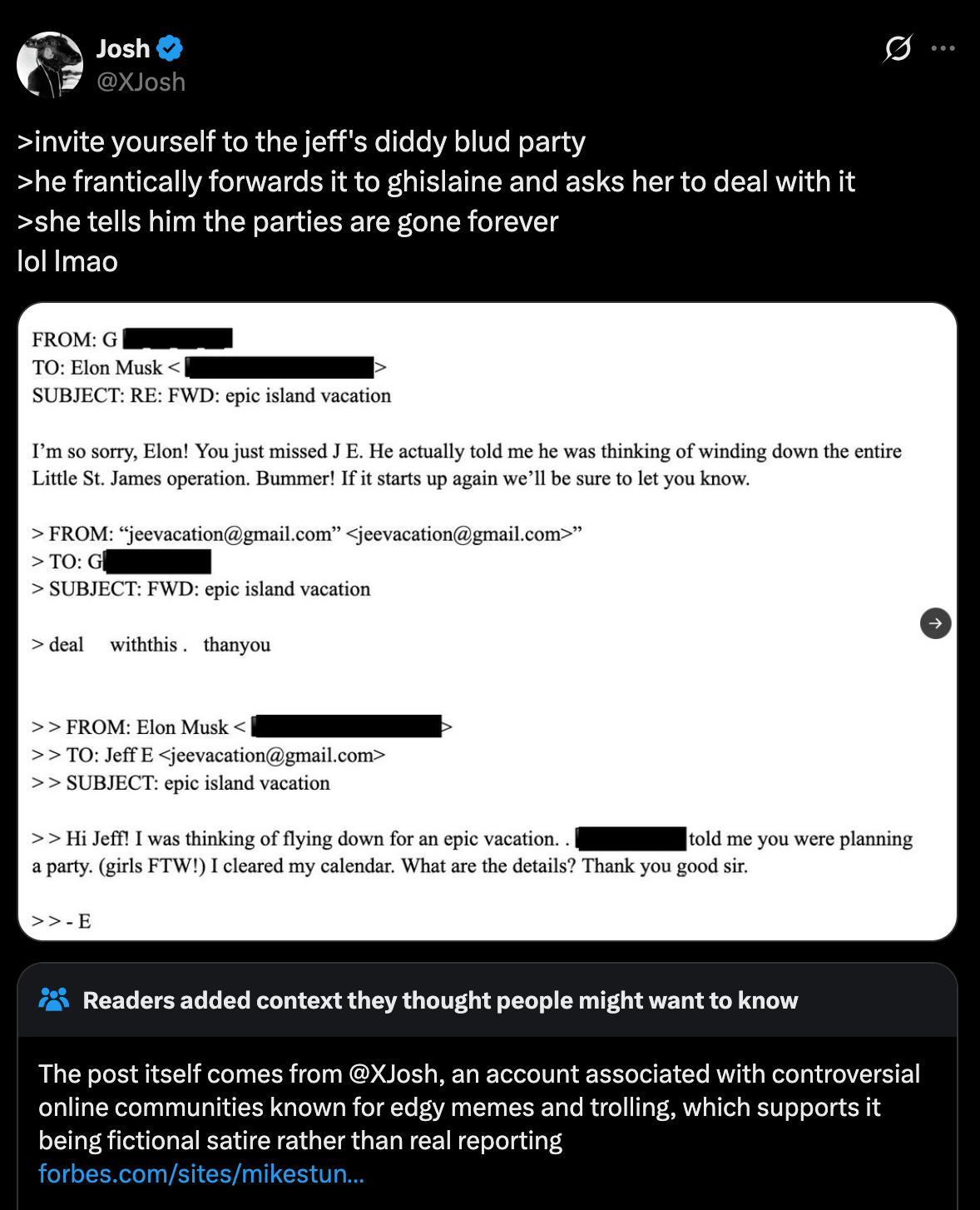
While DOJ’s searchable Epstein archive has multiple “Elon” hits there are still generated ‘’memes’’ shared on X
3. Unverified FBI Tip Line Reports
- The January 30, 2026 release included a spreadsheet of unsubstantiated tips from an FBI hotline
- These tips are not evidence and many are secondhand or unverified
- Media outlets have reported on these, but they should not be treated as facts
How to Verify Information?
Step 1: Check the Source
- Is it from justice.gov, oversight.house.gov, or another official .gov site?
- Can you trace it back to an official release?
Step 2: Use Verification Links
- Tools like Jmail.world provide links to original documents
- Cross-reference document numbers (e.g., EFTA########) with DOJ library
Step 3: Look for File Metadata
- Official documents have specific formatting and metadata
- Check document properties for creation dates and source information
Step 4: Consult Multiple Sources
- Reputable news organizations vet information before publication
- Be skeptical of sensational claims from single sources
- Look for corroboration across multiple independent outlets
Step 5: Be Aware of Temporary Removals
- Some files have been temporarily removed and then restored by DOJ
- A file being “deleted” doesn’t always mean a cover-up; it may be correcting redaction errors or addressing technical issues
Best Practices for Researchers and Journalists
- Always cite original sources
- Reference DOJ document numbers
- Provide direct links when possible
- Note any redactions or limitations
- Understand context
- Many documents are investigative materials, not proven facts
- FBI tips and allegations are not the same as evidence
- Redactions protect victim privacy and should be respected
- Respect victim privacy
- Do not attempt to identify redacted victims
- Focus on accountability for perpetrators
- Consider the trauma of survivors
- Be transparent about limitations
- Acknowledge when information is incomplete
- Note that some files remain unreleased
- Distinguish between allegations and proven facts
What’s Still Missing?
According to congressional leaders and victim advocates, notable omissions from the releases include:
- FBI interview forms (302s) with victims
- Draft indictments from the 2007 Florida investigation
- 82-page prosecution memorandum
- Unredacted names of non-victim individuals
- Approximately 2.5 million pages identified but not released
The House Oversight Committee has issued a subpoena for unredacted files, but this has not been fulfilled as of early February 2026.
Conclusion
Searching the Epstein files reliably requires:
- Prioritizing official government sources (justice.gov)
- Using verified third-party tools like Jmail.world for better search functionality
- Avoiding unverified torrents and P2P sources due to safety and authenticity concerns
- Being extremely skeptical of social media claims and screenshots
- Cross-referencing all information with multiple authoritative sources
- Understanding the difference between allegations, tips, and verified evidence
As more files are potentially released and indexed, maintaining source verification and critical evaluation will be essential for anyone seeking to understand this complex case.
This guide is for informational purposes only. Always verify information through official sources and exercise caution when downloading files from the internet. Respect the privacy of victims and survivors.
Frequently Asked Questions (FAQs)
What Are The Epstein Files?
The Epstein Files are official records linked to the criminal investigations of Jeffrey Epstein and his network. Courts, law enforcement agencies, and legal teams collected these materials during civil and criminal proceedings. Authorities later released many of these records to the public through court orders and government transparency actions.
What Is In The Epstein Files?
The files contain a wide range of materials, including:
- Court filings and legal motions
- Deposition transcripts
- Flight logs
- Contact books and address records
- Emails and other communications
- Financial records
- Evidence collected during investigations
Many documents include redactions to protect victims and third parties.
Are All Epstein-Related Documents Public?
No. Courts have released many records, but some materials remain sealed. Judges restrict access to protect ongoing legal matters, victim privacy, or sensitive investigative details.
Why Are Some Names Redacted In The Files?
Courts often redact names to protect victims, witnesses, or individuals who were not charged with crimes. A redacted name does not automatically imply guilt or innocence.
Do The Files Prove Criminal Involvement For Everyone Mentioned?
No. Being mentioned in a document does not equal wrongdoing. Names might appear in contact lists, flight logs, or testimony without evidence of criminal conduct.