

Oct 13, 2026
Sep 01, 2026
6 Mins Read

Summarize with:
Langflow and Rails Exploitation Raises Credential Risks
Attackers are exploiting two separate critical vulnerabilities affecting Langflow and Ruby on Rails. CVE-2026-0768 allows unauthenticated attackers to execute Python code on affected Langflow deployments, while CVE-2026-66066 can expose files and application secrets through Rails Active Storage.
The exploitation activity is not known to be connected. The operational overlap is that both flaws affect application layer components that may hold powerful credentials, making patching or restricting the exposed service only the first part of containment.
What Is CVE-2026-0768 in Langflow?
CVE-2026-0768 is a critical code-injection vulnerability in Langflow’s handling of the code parameter submitted to a validation endpoint. Insufficient validation allows an unauthenticated attacker to execute arbitrary Python code, potentially in the context of the root user. The flaw carries a CVSS score of 9.8.
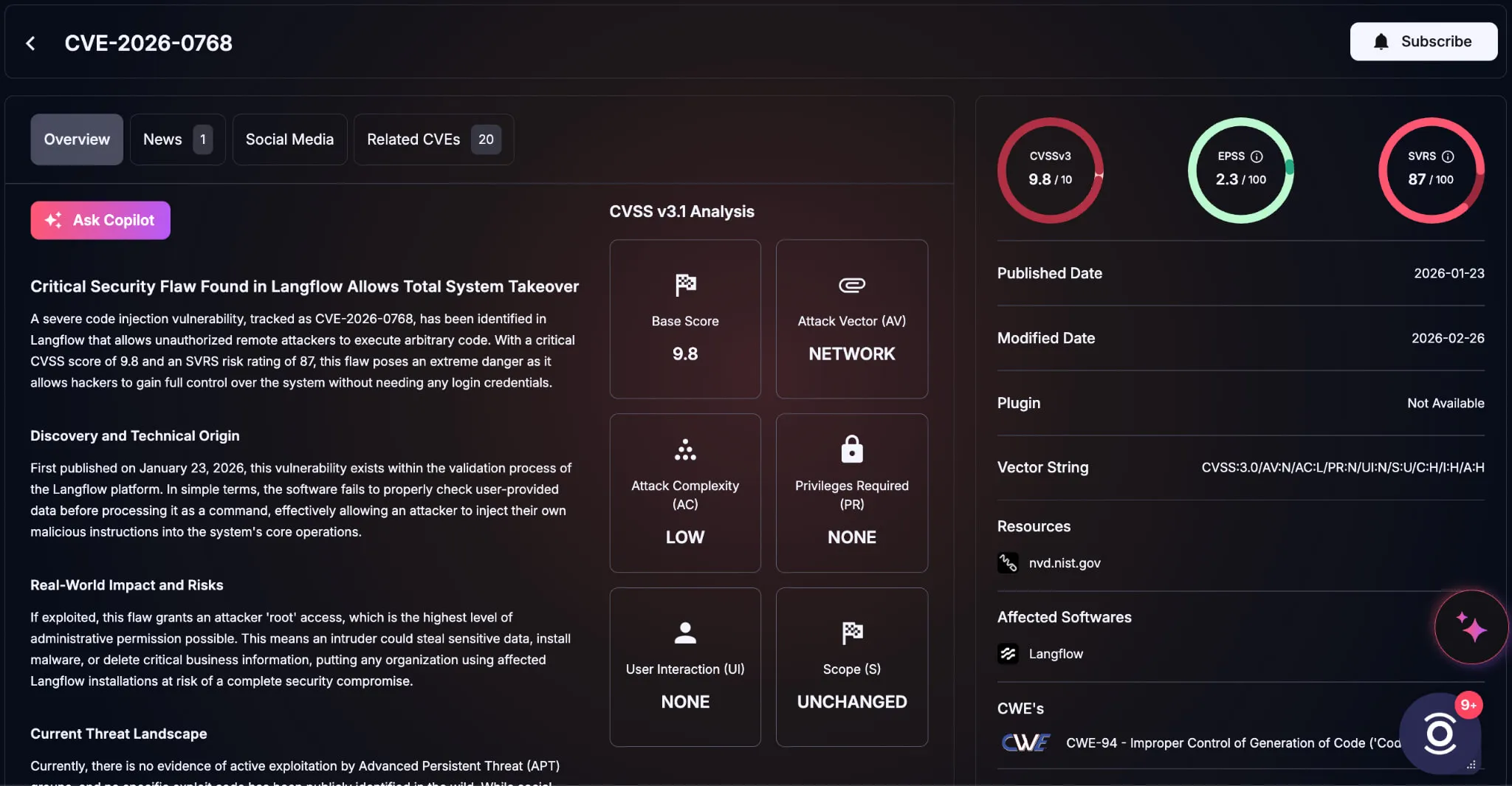
Details of CVE-2026-0768 (SOCRadar Vulnerability Intelligence)
Public vulnerability records specifically identify Langflow 1.4.2 as affected, but they do not provide a reliable, comprehensive affected-version range or a confirmed fixed version. Organizations should therefore identify exposed Langflow deployments, compare their versions and configurations against current vendor guidance, and restrict access to untrusted networks until they can confirm remediation.
VulnCheck initially observed more than 50 detections targeting the flaw within several hours on August 30. The Hacker News later reported that the figure had risen to 360 by August 31. The requests searched for Langflow secrets, model-provider API keys, AWS credentials, SSH access, shell history, and other information that could support lateral movement. The observed Langflow traffic primarily originated from Russia and targeted canary systems in the United Kingdom.
What Is CVE-2026-66066 in Ruby on Rails?
CVE-2026-66066, also known as KindaRails2Shell, affects Rails applications that use libvips for Active Storage image processing and allow untrusted users to upload images. A crafted upload can invoke unsafe libvips operations and read files accessible to the Rails process.
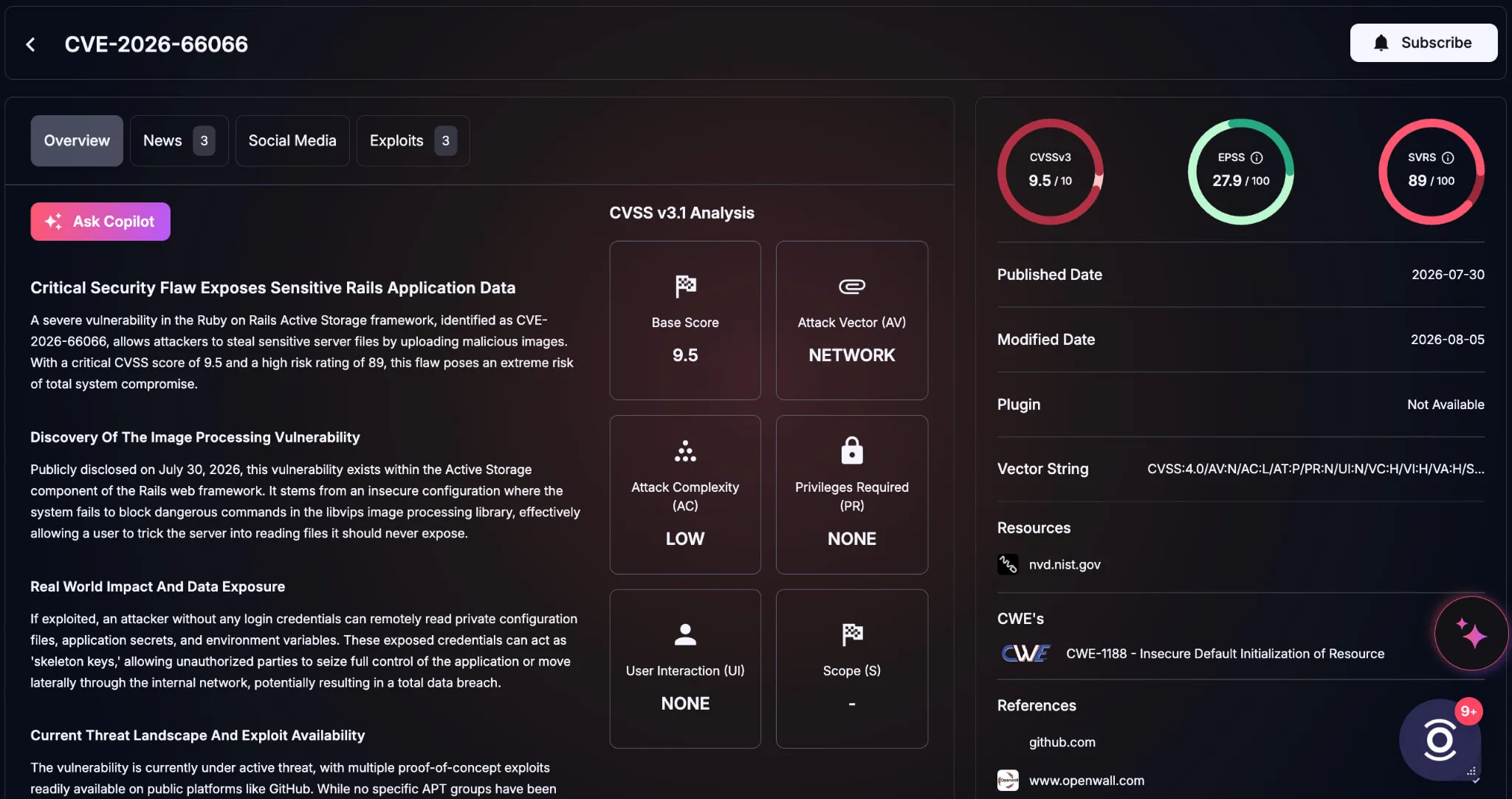
Details of CVE-2026-66066 (SOCRadar Vulnerability Intelligence)
The immediate result is arbitrary file disclosure, but the more serious risk comes from what may be read. Exposure of secret_key_base, the Rails master key, database credentials, cloud-storage keys, or third-party tokens can enable session forgery, credential decryption, remote code execution, or access to connected services.
Affected Active Storage versions are earlier than 7.2.3.2, 8.0.0.beta1 through 8.0.5, and 8.1.0.beta1 through 8.1.3. Fixed releases are 7.2.3.2, 8.0.5.1, and 8.1.3.1. The corrected releases also require libvips 8.13 or later, so updating the gem while leaving an older system library in place is not sufficient.
VulnCheck later reported active exploitation against canary systems in Singapore, Israel, and the United Kingdom. According to the company, the activity originated from a single IP address in France and established command-and-control communication with a host in Israel.
Why Do These Flaws Create Risk Beyond the Initial Server?
Both vulnerabilities sit at trust boundaries. Langflow runs user-defined AI workflows and often has credentials for external data and model services. Rails Active Storage processes untrusted files inside an application context that may also hold signing keys and infrastructure credentials.
This creates a credential blast-radius problem. If attackers retrieve reusable secrets before an update is installed, the compromise can persist through valid sessions, cloud access, or connected applications even after the vulnerable endpoint has been fixed. Forensics and secret rotation therefore matter as much as version verification.
Why the Rails Fix Must Be Accompanied by Secret Rotation
The corrected Active Storage releases block the libvips file read path, but installing the update does not invalidate secrets that may already have been stolen. VulnCheck also reported that code execution remained possible on a patched Rails 8.1.3.1 server when the attacker already possessed a valid signing key.
This makes CVE-2026-66066 a patch-and-rotate event. Organizations that operated an exposed application before patching should replace secret_key_base, the Rails master key, database credentials, storage keys, and accessible third-party tokens. Changing secret_key_base also invalidates active sessions, signed cookies, signed global IDs, and Active Storage URLs.
The Rails advisory itself explicitly recommends changing every secret readable by the application process, not merely updating Active Storage and libvips.
What Should Defenders Do Now?
- Restrict and assess Langflow deployments: Remove direct internet exposure, limit access to trusted users and networks, and review the current vendor guidance for the deployed version. Available records do not provide a dependable fixed version range for CVE-2026-0768.
- Update the complete Rails image processing stack. Install the corrected Active Storage release for the deployed branch and confirm libvips is version 8.13 or later.
- Reduce exposure. Remove unnecessary public access to Langflow, its validation functionality, Rails upload routes, and Active Storage processing endpoints.
- Hunt for exploitation. Review requests to Langflow’s code validation functionality, unexpected Python or shell execution, access to environment variables and sensitive files, suspicious uploads, unusual variant-generation errors, and unexpected outbound connections.
- Rotate potentially exposed secrets. Replace API keys, database credentials, Rails signing material, storage credentials, and service tokens if compromise cannot be ruled out. Revoke affected sessions as part of the rotation.
- Investigate connected systems. Check cloud, database, model-provider, source-code, and identity logs for activity using credentials available to either application.
What Should Teams Learn From These Vulnerabilities?
The shared lesson is not simply to patch faster. Internet facing AI and application frameworks can become credential brokers because they connect to many other services. Security reviews should therefore track what each workload can reach and which secrets it can read, not only its CVSS score.
The Rails case also shows why dependency inventory must include native libraries. A package manager may show a corrected Rails component while the container or host still carries a vulnerable libvips version. Langflow highlights a different gap: development and validation functionality can become a production attack surface when the platform is exposed to untrusted networks.
How Can SOCRadar Support Vulnerability Prioritization?
SOCRadar Vulnerability Intelligence can help teams distinguish actively exploited flaws from routine patch backlogs, while External Attack Surface Management can identify internet-facing assets that may expose vulnerable services. Threat intelligence can add exploitation context and support faster prioritization when a weakness affects credential-rich application infrastructure.
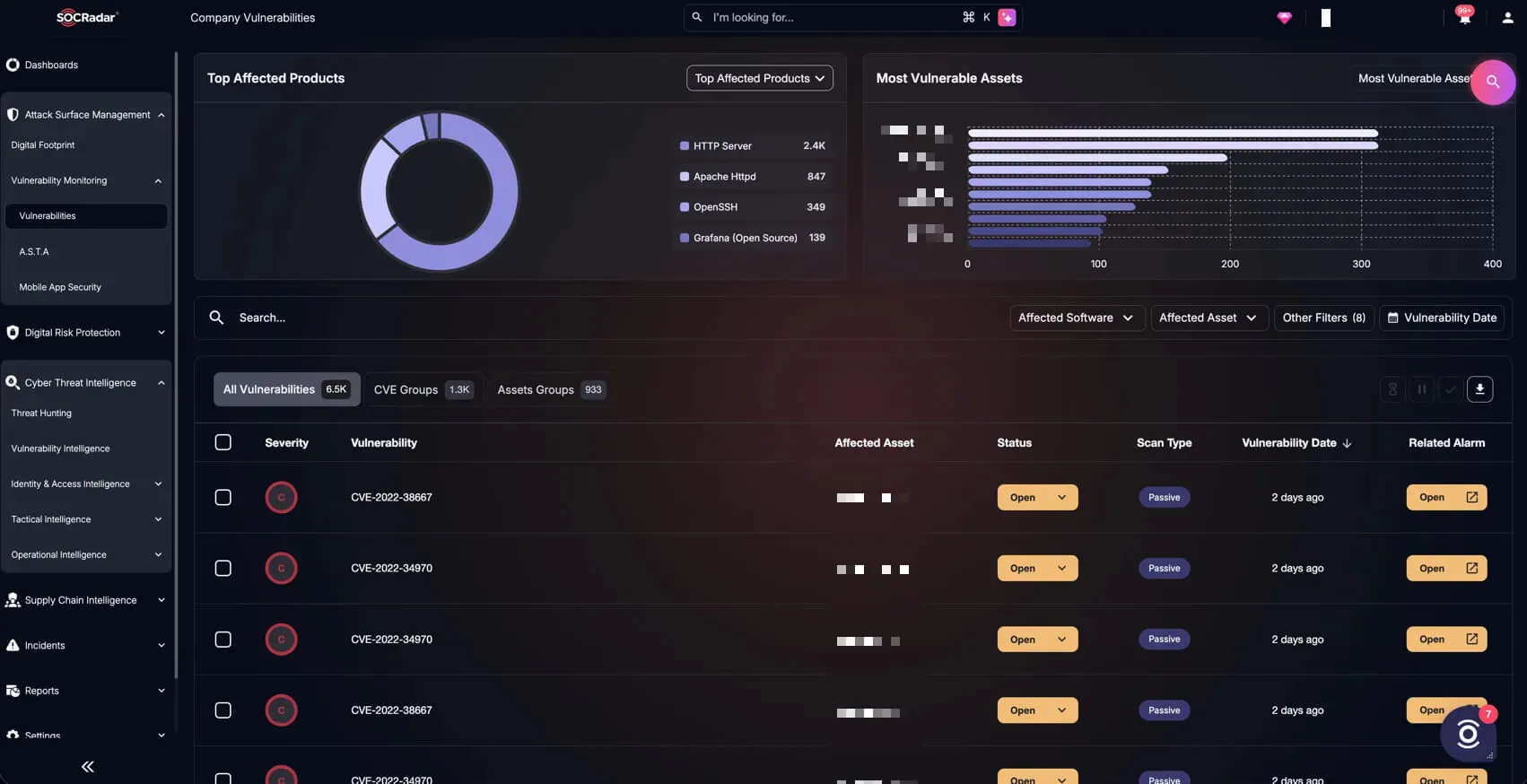
SOCRadar’s ASM Company Vulnerabilities
These capabilities should complement internal asset inventory, software composition analysis, runtime monitoring, log review, and incident-response procedures. Exposure data alone cannot determine whether secrets were accessed before remediation.
Conclusion
CVE-2026-0768 and CVE-2026-66066 affect different technologies and use different attack paths, but both can turn an exposed application feature into access to sensitive credentials. Organizations should restrict or remediate affected services, verify the components and native libraries actually running, and investigate whether connected systems were reached.

Table Of Content
Langflow and Rails Exploitation Raises Credential Risks
What Is CVE-2026-0768 in Langflow?
What Is CVE-2026-66066 in Ruby on Rails?
Why Do These Flaws Create Risk Beyond the Initial Server?
Why the Rails Fix Must Be Accompanied by Secret Rotation
What Should Defenders Do Now?
What Should Teams Learn From These Vulnerabilities?
How Can SOCRadar Support Vulnerability Prioritization?
Conclusion
Related Articles

CVE-2026-97229: Critical GitLab RCE
Oct 13, 2026

CVE-2026-102255: Critical SonicWall SMA1000 SSRF
Oct 12, 2026
Critical Cisco NX-OS Flaws Threaten Nexus Switches
Oct 09, 2026