

Oct 13, 2026

Table Of Content
CVE-2025-53521: F5 BIG-IP APM Flaw Reclassified as Unauthenticated RCE
What Is CVE-2025-53521?
Which BIG-IP Versions Are Affected and What Versions Fix It?
How Does Exploitation Work in Real Deployments?
Is There Active Exploitation?
What Indicators of Compromise Should Defenders Look For on BIG-IP?
What Should Security Teams Do Now?
Related Articles


CVE-2026-97229: Critical GitLab RCE
Oct 13, 2026


CVE-2026-102255: Critical SonicWall SMA1000 SSRF
Oct 12, 2026

Critical Cisco NX-OS Flaws Threaten Nexus Switches
Oct 09, 2026

Apr 01, 2026
5 Mins Read
May 04, 2026

Summarize with:
CVE-2025-53521: F5 BIG-IP APM Flaw Reclassified as Unauthenticated RCE
CVE-2025-53521 is a vulnerability in F5 BIG-IP Access Policy Manager (APM) that was initially treated as a denial-of-service condition in 2025, then reclassified recently as a potential unauthenticated remote code execution (RCE) issue in certain deployments.
BIG-IP APM often sits directly in the authentication and remote access path, so a pre-auth compromise can ripple downstream quickly. Moreover, the vulnerability is actively exploited.
This post breaks down what’s affected, what exposure looks like, what defenders can hunt for, and what to do next.
What Is CVE-2025-53521?
CVE-2025-53521 (CVSS 9.8) affects F5 BIG-IP APM. Exploitation is possible when an APM access policy is configured on a virtual server, and an attacker can send “specific malicious traffic” that triggers code execution.
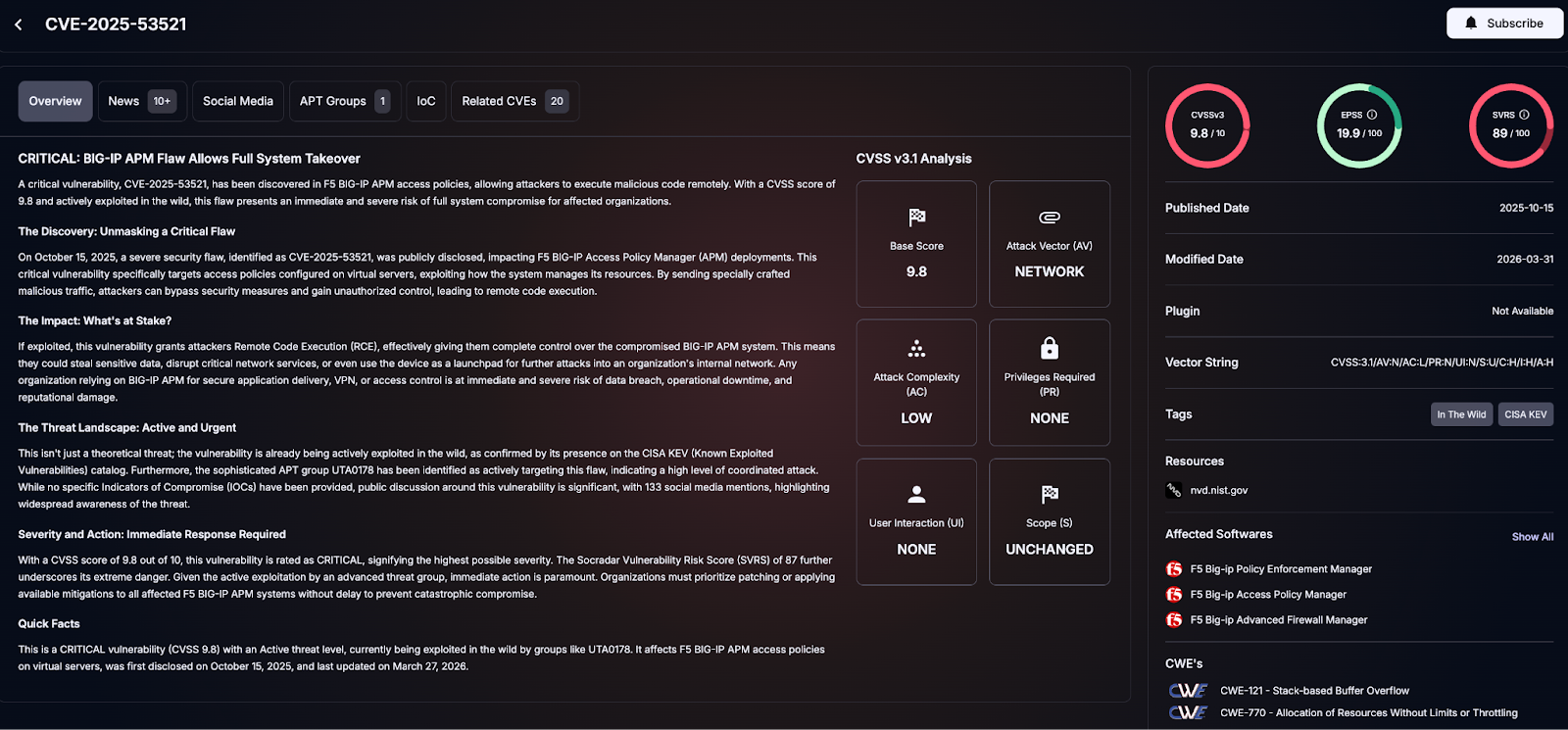
Details of CVE-2025-53521 (SOCRadar Vulnerability Intelligence)
The key change is the 2026 reassessment: what many teams may have triaged as service disruption risk (DoS) is now treated as an unauthenticated RCE scenario under the right configuration. In practice, that shifts the response from “patch when feasible” to “patch and assume you may be targeted.”
Which BIG-IP Versions Are Affected and What Versions Fix It?
The vulnerable ranges and fixed releases for BIG-IP (APM) are as follows:
- 17.5.0 – 17.5.1 → fixed in 17.5.1.3
- 17.1.0 – 17.1.2 → fixed in 17.1.3
- 16.1.0 – 16.1.6 → fixed in 16.1.6.1
- 15.1.0 – 15.1.10 → fixed in 15.1.10.8
If you manage mixed BIG-IP fleets, treat this as a branch-by-branch upgrade requirement, not a single “latest version” answer. Also note the configuration dependency: not every BIG-IP deployment is equally exposed if APM access policies are not bound to virtual servers, but you should confirm that in configuration, not by assumption.
How Does Exploitation Work in Real Deployments?
The publicly described trigger is straightforward: an attacker sends crafted traffic to a virtual server where an APM access policy is in play, and under vulnerable conditions the device may allow remote code execution without authentication.
For defenders, the operational focus is scoping and reachability:
- Identify internet-facing (or untrusted-network-facing) virtual servers with an APM access policy enabled.
- Prioritize those systems first, even if other BIG-IP devices exist in the environment
Is There Active Exploitation?
Yes. According to the official advisory, exploitation is occurring in vulnerable BIG-IP versions, and CISA has added the issue to its Known Exploited Vulnerabilities (KEV) catalog. Together, these developments show that the risk is immediate and real.

Exploitation warning in the official F5 advisory
Active exploitation usually means defenders should expect broad scanning and opportunistic compromise, not only highly targeted attacks. Any exposed and unpatched system may attract attention. Patching is necessary, but it should not be the only response. Security teams should assess whether compromise has already occurred, because patching can stop further exploitation without removing an attacker who already has access.
What Indicators of Compromise Should Defenders Look For on BIG-IP?
F5 provides several host-level and log-level indicators. They will not appear in every intrusion, but they give SOC teams a starting point.
Suspicious Files
- /run/bigtlog.pipe
- /run/bigstart.ltm
System Binaries
Verify hash, size, and timestamps for:
- /usr/bin/umount
- /usr/sbin/httpd
Unexpected changes may indicate tampering or replacement.
Log Patterns
- Signs of local user activity against iControl REST originating from localhost
- Attempts to disable SELinux
- Suspicious response patterns where activity returns HTTP 201 while using a CSS content-type as camouflage
One nuance that affects scoping: webshell behavior may be memory-only, so you may not find clear on-disk artifacts even when compromise occurred. Correlate multiple signals (process behavior, config changes, audit logs, outbound connections) instead of relying on file-based IOCs alone.
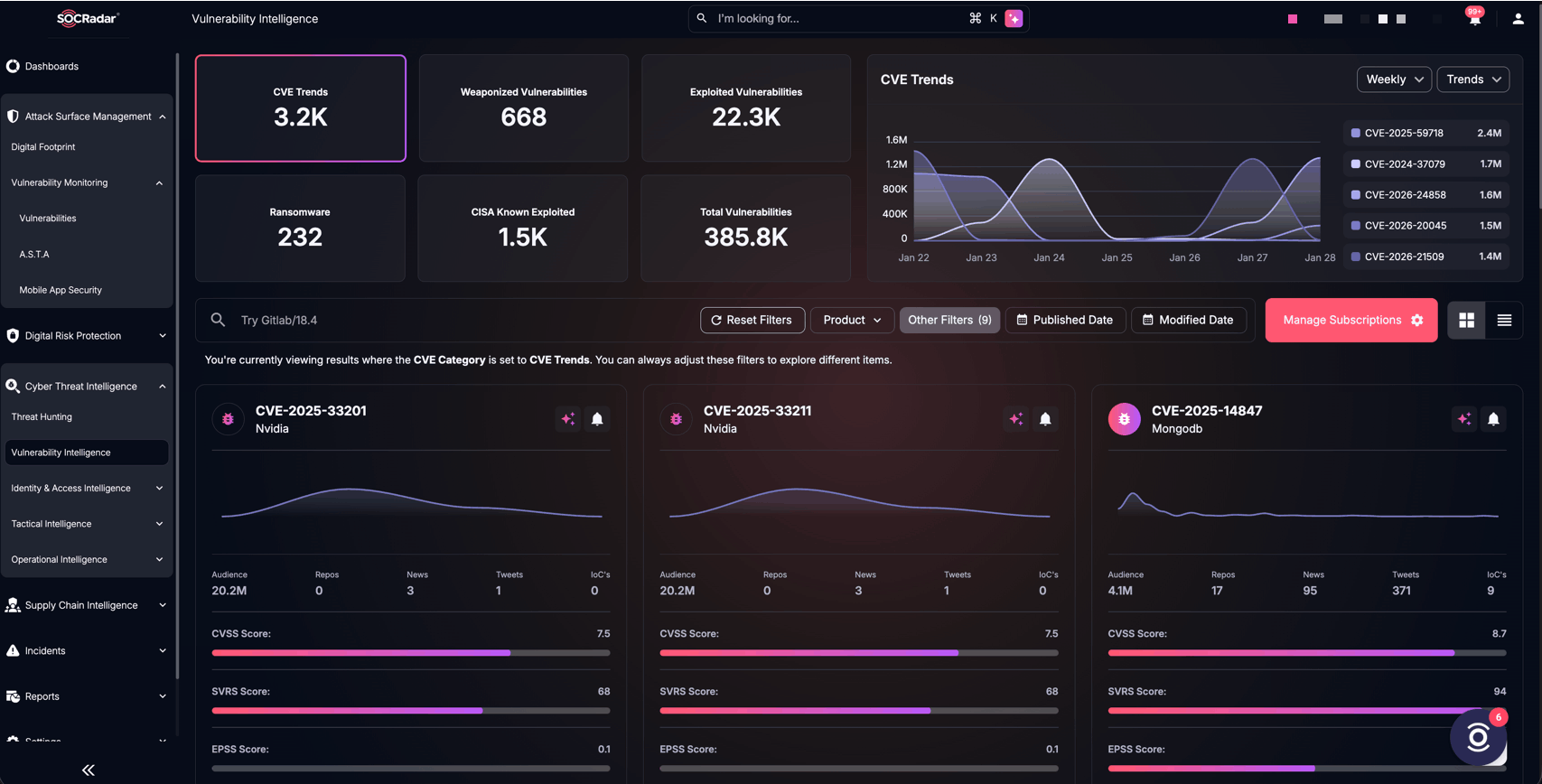
SOCRadar CTI module, Vulnerability Intelligence
For organizations handling exposure at scale, SOCRadar Cyber Threat Intelligence and Attack Surface Management (ASM) modules provide useful context beyond patch guidance alone. Cyber Threat Intelligence helps security teams monitor exploited vulnerabilities, track threat activity around high-risk CVEs, and prioritize action when a flaw moves from theoretical risk to active abuse.
In parallel, ASM helps teams discover exposed assets, validate external exposure, and reduce the chance that vulnerable internet-facing systems remain unnoticed. This combined view helps defenders move faster by showing not only what is vulnerable, but also what is exposed and most likely to matter first.
What Should Security Teams Do Now?
Security teams should move quickly, but they also need to avoid treating this as a patch-only event. When exploitation is active, the priority is to reduce exposure, check for signs of compromise, and prepare for recovery if evidence points to deeper access.
- Patch or upgrade to fixed releases immediately based on your major version branch:
- 17.5.x → 17.5.1.3
- 17.1.x → 17.1.3
- 16.1.x → 16.1.6.1
- 15.1.x → 15.1.10.8
- Scope exposure by configuration, not just version. Inventory virtual servers and confirm where APM access policies are attached. Treat any reachable APM-protected virtual server as a priority candidate.
- Run a compromise assessment before and after patching. Hunt for the file and integrity indicators listed above, then expand into iControl REST audit review and SELinux-related events.
- Prepare recovery playbooks. If you cannot bound the compromise window, a rebuild may be safer than attempting cleanup, and that backups could carry forward attacker persistence. Even if you do not adopt a rebuild-first stance, plan credential rotation (admin accounts, service accounts tied to auth flows, API keys stored or used by APM integrations).
- Monitor for scanning and unusual management endpoint access. Reports mention scanning activity and reconnaissance against management-style endpoints (including /mgmt/shared/identified-devices/config/device-info). Treat unusual probing as a trigger to accelerate patching and deepen log review.