CVE-2026-19478: GitLab GraphQL Flaw Exploited
GitLab has patched CVE-2026-19478, a critical code injection vulnerability affecting self-managed Community Edition (CE) and Enterprise Edition (EE) instances. Under certain conditions, an unauthenticated remote attacker could leverage a GraphQL directive to modify or delete public projects and user data. Because the flaw poses significant operational and supply chain risks to internet-facing deployments, prioritizing updates for self-managed environments is important.
What Is CVE-2026-19478?
CVE-2026-19478 (CVSS 9.4) is a GraphQL code injection vulnerability categorized under CWE-94: Improper Control of Generation of Code.
Its CVSS vector reflects network accessibility, low attack complexity, and zero required privileges or user interaction. Impact centers on integrity and availability, as exploitation allows unauthorized modification or deletion of public projects and user data.
Public technical analyses link the flaw to the @gl_introduced directive used for rolling deployment compatibility. The injection stems from unsafe parsing of attacker-controlled field names, though a complete exploit payload sequence is not available on GitLab’s advisory.
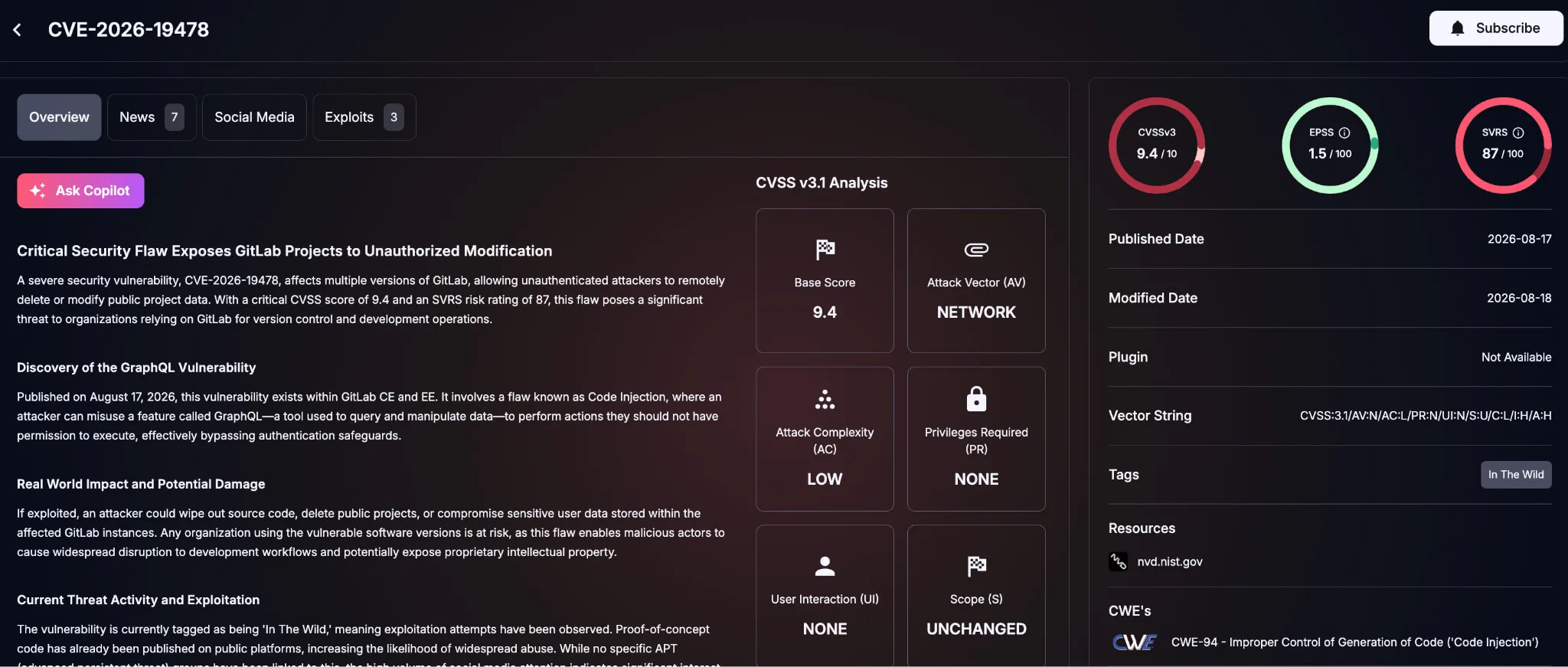
Details of CVE-2026-19478 (SOCRadar Vulnerability Intelligence)
Which GitLab Versions Are Affected?
| GitLab CE/EE branch | Affected versions | Fixed version |
|---|---|---|
| 18.2 to 18.11 | Before 18.11.11 | 18.11.11 |
| 19.0 | Before 19.0.8 | 19.0.8 |
| 19.1 | Before 19.1.6 | 19.1.6 |
| 19.2 | Before 19.2.4 | 19.2.4 |
All self-managed installations in these ranges require immediate updates. In contrast, GitLab.com and GitLab Dedicated environments require no user intervention.
Organizations on outdated or unsupported branches should transition directly to a supported fixed release rather than assuming immunity.
Why Does the GraphQL Flaw Matter?
As a core component of modern software supply chains – handling source code, CI/CD pipelines, runner execution, deploy keys, and artifacts – a compromise in GitLab poses systemic integrity and availability risks far beyond individual repositories.
Beyond project deletion, malicious alteration of repository contents, project settings, pipeline files, or user access controls can subvert downstream automation and erode developer trust.
Current findings do not indicate arbitrary remote code execution on the host server, compromise of private repositories, or full instance takeover. Confirmed risk remains scoped to unauthorized modification or deletion of public assets and user data.
Is CVE-2026-19478 Being Exploited?
Shortly after disclosure, exploitation attempts were observed in the wild. Researchers detected attacks against honeypot networks. Defenders are advised to inspect web server logs for requests invoking the @gl_introduced directive.
While these signals confirm active scanning and targeted probing against exposed instances, they do not currently indicate widespread enterprise breaches or successful modifications of customer repositories.
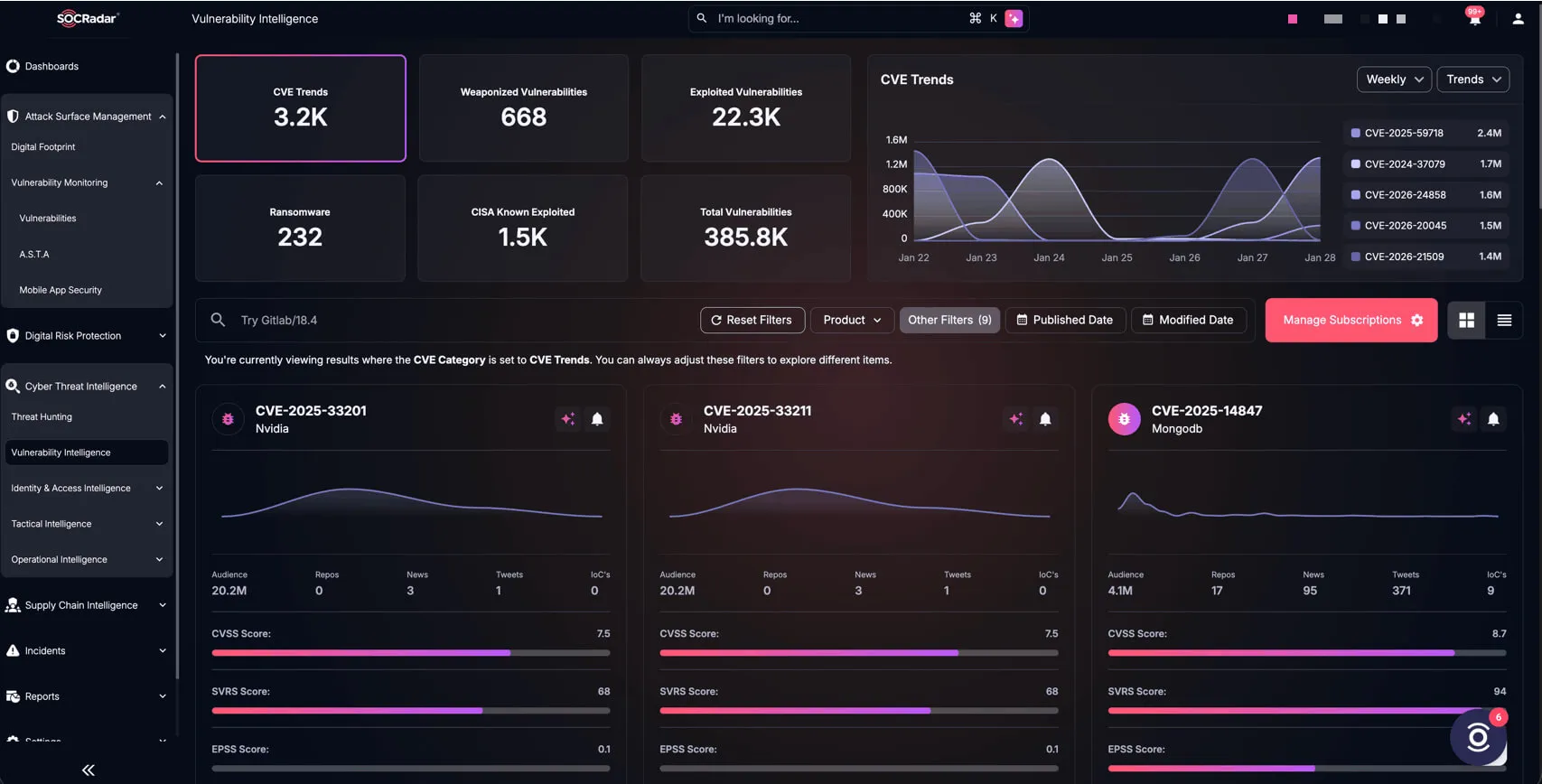
SOCRadar’s Vulnerability Intelligence
To streamline defense efforts, SOCRadar’s Cyber Threat Intelligence (CTI) module continuously tracks CVE-2026-19478 exploitation, emergent PoCs, and threat actor activity, while the Attack Surface Management (ASM) module automatically discovers internet-facing GitLab assets and vulnerable deployments across your digital footprint to prioritize remediation.
What Should Defenders Do Now?
Immediately update self-managed instances to versions 18.11.11, 19.0.8, 19.1.6, or 19.2.4. The patch introduces no database migrations and supports zero-downtime application on multi-node architectures, though standard backup protocols should be followed.
If patching must be delayed, temporarily restrict unauthenticated traffic to /api/graphql and limit public exposure of the instance.
Following the upgrade, audit web server, reverse-proxy, and application logs for anomalous GraphQL queries containing @gl_introduced. Cross-reference suspect requests with project modifications, deletion logs, permission changes, deploy key updates, runner registrations, and modified CI/CD configurations.
Ensure secure offline backups, signed tags, and trusted repository mirrors are verified for integrity. If unauthorized alterations are detected, remediate from a clean administrative environment and immediately revoke affected credentials, access tokens, and deploy keys.