CVE-2026-20223: Cisco Secure Workload Auth Bypass Grants Site Admin Access
Cisco has patched a maximum-severity vulnerability in Cisco Secure Workload (CSW) Cluster Software tracked as CVE-2026-20223. The issue is an authentication and access-control bypass affecting internal REST API endpoints, and it can allow a remote, unauthenticated attacker to obtain Site Admin privileges. Site Admin is the highest-privilege role in Secure Workload and can enable cross-tenant access to sensitive data and configuration changes. This post breaks down what’s known about impact, affected versions, exploitation conditions, and what defenders should do now.
What Is CVE-2026-20223?
CVE-2026-20223 (CVSS 10.0) is an authentication/access-control bypass in Cisco Secure Workload Cluster Software caused by insufficient validation and authentication on certain internal REST API endpoints.
In practical terms, an attacker can send a crafted API request to an affected endpoint and gain Site Admin privileges without valid credentials.
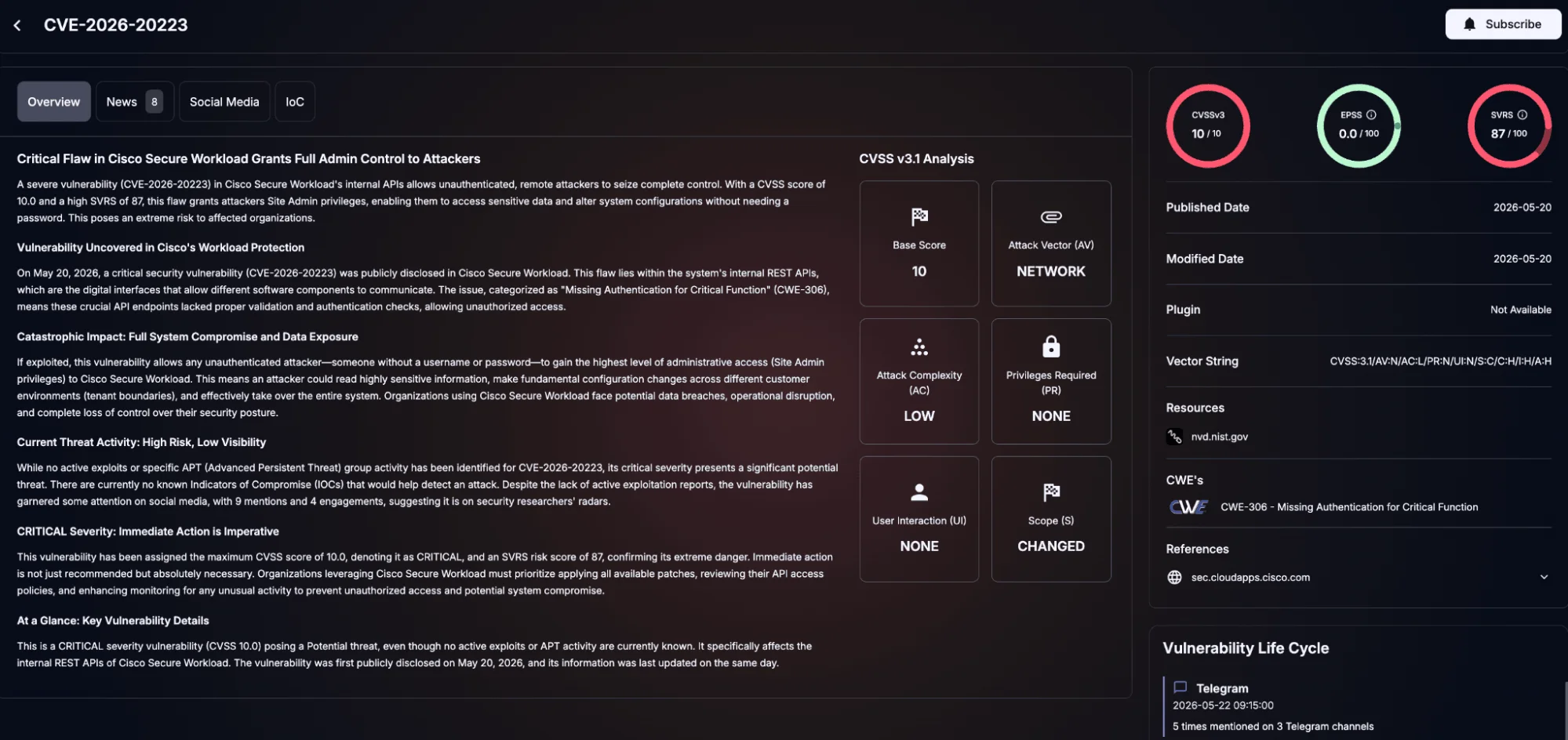
Details of CVE-2026-20223 (SOCRadar Vulnerability Intelligence)
Why Does Site Admin Access Matter in Cisco Secure Workload?
Secure Workload acts as a control plane for workload visibility and microsegmentation policy. Once an attacker has Site Admin, they are no longer constrained to a single user or project scope.
Reported impact includes the ability to read sensitive information and modify configurations across tenant boundaries. In environments where CSW enforces segmentation and security policy, that can translate into broad operational control, not just data exposure.
Which Cisco Secure Workload Versions Are Affected?
Cisco’s fixes are tied to specific maintenance releases in two trains:
- 3.10 fixed in 3.10.8.3
- 4.0 fixed in 4.0.3.17
If you run any version earlier than 3.10.8.3 on the 3.10 train, or earlier than 4.0.3.17 on the 4.0 train, treat it as vulnerable until you verify otherwise.
Cisco’s advisory for CVE-2026-20223 indicates this issue affects both SaaS and on-prem deployments. Some third-party summaries suggest SaaS was remediated automatically. Defenders should approach these details with due diligence, verifying facts via official Cisco bulletins and specific tenant dashboard alerts before proceeding.
How Does Exploitation Work & What Is Actually Known?
The consistent details across reporting are:
- The vulnerable surface is internal REST API endpoints (not described as the web management UI).
- The attacker is remote and unauthenticated.
- Exploitation uses a crafted API request.
- Successful exploitation yields Site Admin privileges.
Missing public details that affect triage
- Specific endpoint paths, required parameters, headers, or request structure have not been widely published.
- It is not clearly established whether “internal” means cluster-only reachability or endpoints that are reachable in common customer network layouts.
Given those gaps, assume attackers will probe for any reachable API surfaces, especially where management networks are not tightly restricted.
Is CVE-2026-20223 Being Exploited in the Wild?
As of the May 20–22, 2026 disclosure and patch window, reporting indicates no known in-the-wild exploitation.
Even without confirmed exploitation, a CVSS 10.0 unauthenticated path to Site Admin is likely to draw fast attacker attention once reverse engineering and exploit development begin. The risk comes from the combination of impact and ease of abuse.
What Should Defenders Do Now?
Patch immediately
Prioritize upgrades to fixed releases:
- Upgrade CSW 3.10 to 3.10.8.3 or later
- Upgrade CSW 4.0 to 4.0.3.17 or later
If you run both trains across environments, handle this as a coordinated patch effort rather than a one-off change.
Reduce exposure of management and API surfaces
Until everything is patched, focus on reachability:
- Restrict Secure Workload management and API access to admin networks only.
- Confirm no unintended exposure exists through load balancers, NAT rules, VPN split-tunnel routes, or overly permissive security groups.
- Review firewall rules for any paths that could make “internal” APIs reachable from broader enterprise networks.
Audit for suspicious high-privilege actions after patching
Because the primary outcome is Site Admin access, focus reviews on control-plane integrity:
- Audit Site Admin activity and role changes.
- Review segmentation policy and configuration changes for anomalies, especially changes that reduce enforcement, create broad allow rules, or modify tenant-related settings.
- If you operate in multi-tenant mode, check for cross-tenant reads or unexpected administrative actions outside normal change windows.
Know Your Exposure with SOCRadar
Most organizations find out they’re exposed when an advisory drops. By then, the race has already started.
SOCRadar’s Attack Surface Management (ASM) module gives you continuous, outside-in visibility into your external assets – what’s exposed, what’s unmanaged, and what’s drifted outside your security baseline. Forgotten subdomains, misconfigured services, open ports on infrastructure you did not know was public-facing – ASM surfaces them before someone else does.
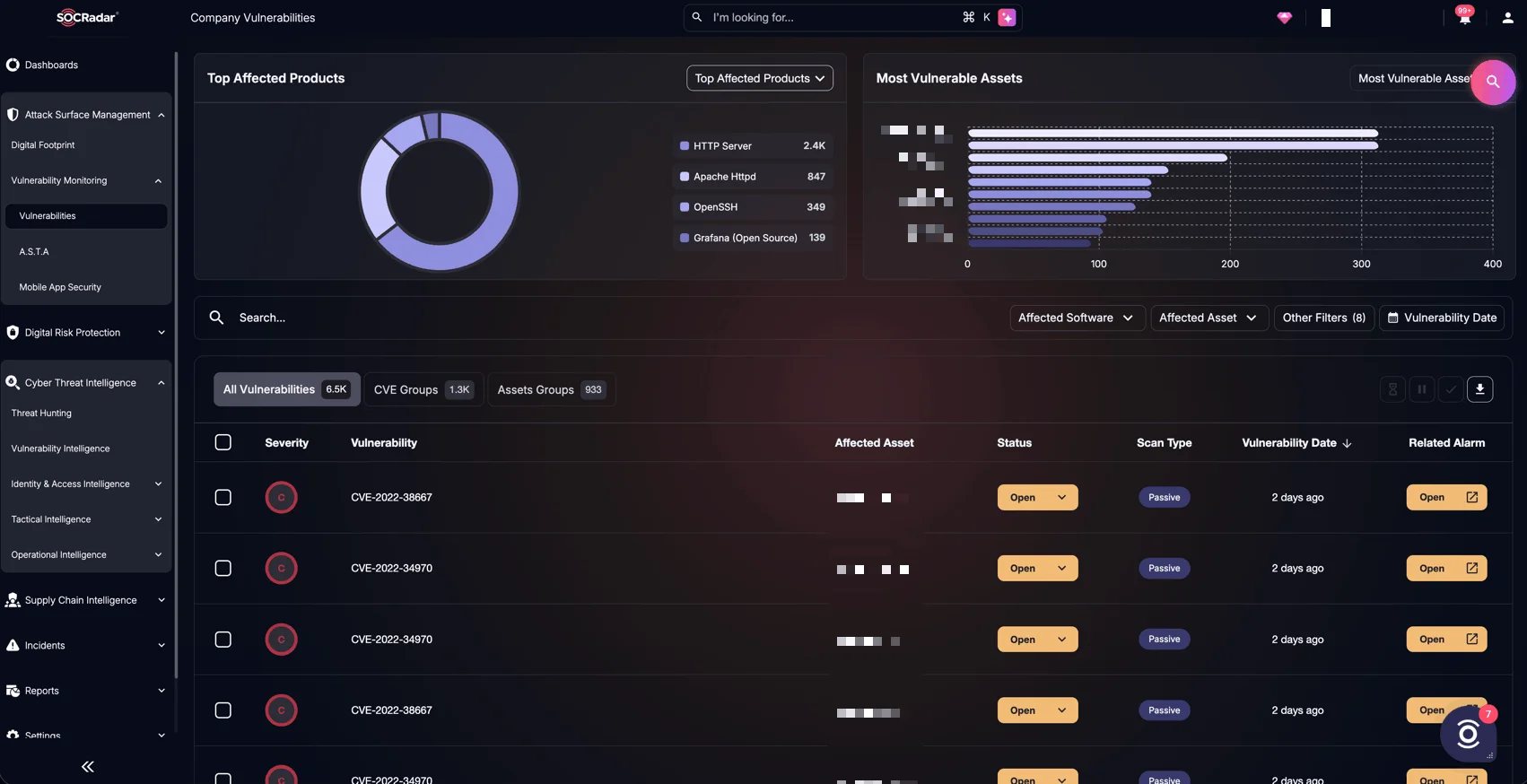
SOCRadar’s ASM, Company Vulnerabilities
In parallel, the Cyber Threat Intelligence module goes beyond just tracking vulnerability feeds and exploitation updates. It tracks threat actor activity, monitors the Dark Web and underground forums for mentions of your organization and technology stack, and delivers finished intelligence you can actually act on; not raw noise that still needs hours of analyst time to make sense of.
What Questions Should Security Teams Clarify Internally?
If you need to prioritize response across many deployments, these questions help narrow actual exposure:
- Which CSW clusters are on < 3.10.8.3 or < 4.0.3.17 today?
- Are any CSW API or management interfaces reachable from networks beyond the intended admin segment?
- Do you have logging that would show unauthenticated API calls that result in privileged actions?
- What is your internal threshold to treat a CSW control-plane event as potential compromise, given the cross-tenant implications described for this issue?
For most organizations, the fastest risk reduction is patching first, then validating network reachability and running a targeted administrative audit focused on Site Admin actions and segmentation policy changes.
Other Cisco Advisories: May 20, 2026 Batch
Cisco’s May 20 release included three additional advisories alongside CVE-2026-20223, all rated Medium severity.
- CVE-2026-20199 affects the ThousandEyes Virtual Appliance with an authenticated remote code execution vulnerability. The authentication requirement limits exposure, but RCE on monitoring infrastructure is worth prioritizing.
- CVE-2026-20206 is a command injection flaw in the BrowserBot component of the ThousandEyes Enterprise Agent. Command injection in an agent that interacts with web content warrants prompt patching regardless of the Medium CVSS rating.
- CVE-2026-20171 covers a BGP-based denial of service on Cisco Nexus 3000 and 9000 series switches. No code execution, but a remotely triggerable DoS on core routing hardware has real availability implications.
None rise to the urgency level of CVE-2026-20223, but if you are already in a Cisco patch cycle this week, they’re worth bundling in.