CVE-2026-20230: Cisco Unified CM WebDialer SSRF Can Lead to Root-Level Compromise
[Update] July 3, 2026: Cisco Confirms Active Exploitation of CVE-2026-20230
Cisco has released fixes for CVE-2026-20230, an unauthenticated remote vulnerability affecting Cisco Unified Communications Manager (Unified CM) and Unified CM Session Management Edition (SME). The flaw is an SSRF issue that can be chained into an arbitrary file write on the underlying operating system, which Cisco notes could later be used to elevate privileges to root.
The primary gating condition remains the WebDialer service; Cisco notes the vulnerability is only exploitable when WebDialer is enabled, though it is disabled by default.
Cisco PSIRT has acknowledged public Proof-of-Concept (PoC) exploit code exists, even though it has not reported active exploitation so far. This post explains what’s vulnerable, what exposure looks like in real environments, and what defenders should do first.
What Is CVE-2026-20230?
CVE-2026-20230 (CVSS 8.6) is a server-side request forgery (SSRF) vulnerability (CWE-918) in Cisco Unified CM and Unified CM SME. It is network-reachable and does not require authentication, which makes exposure the primary risk driver.
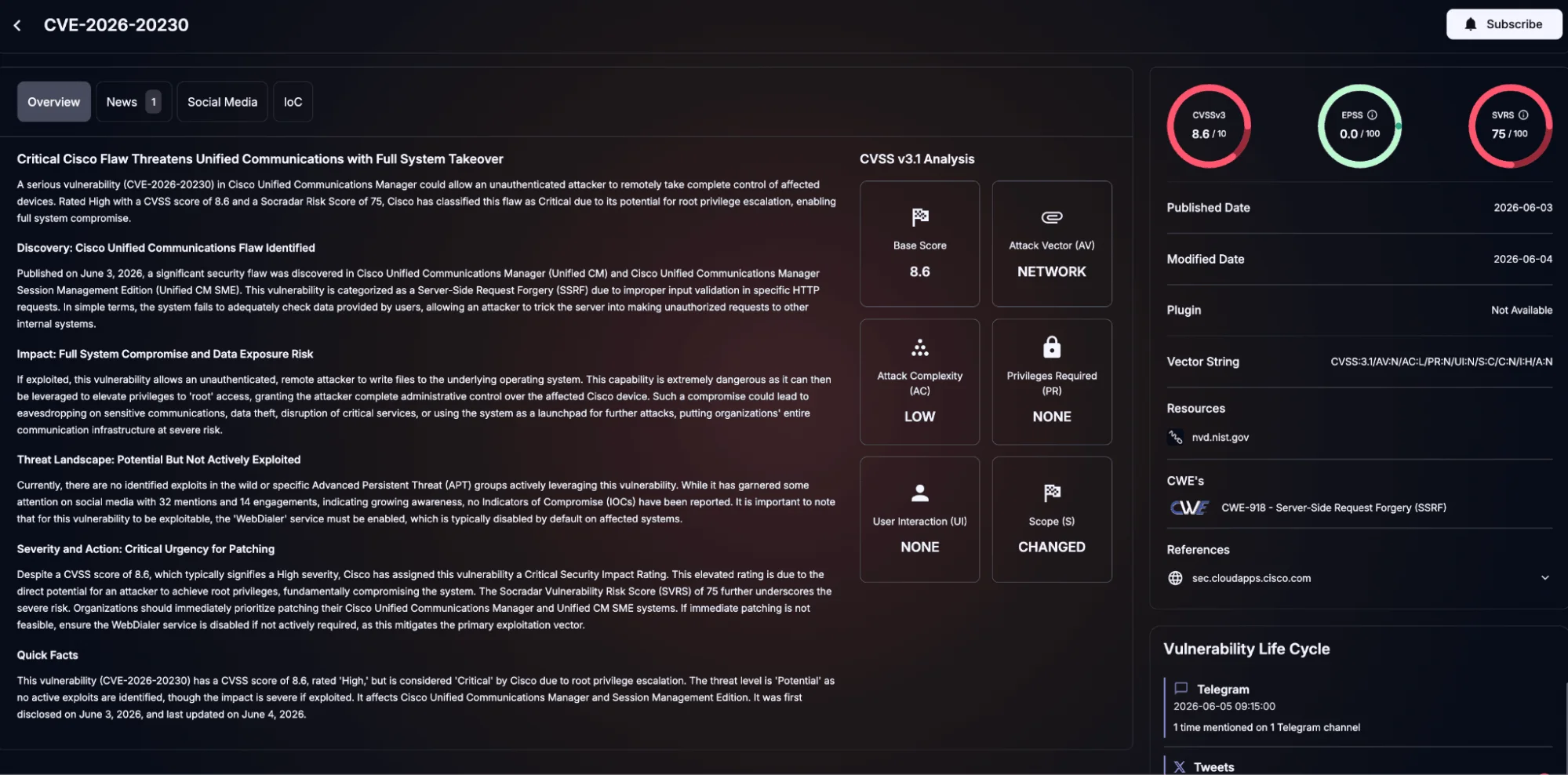
Details of CVE-2026-20230 (SOCRadar Vulnerability Intelligence)
Cisco’s advisory context matters for prioritization. While the CVE itself is high severity, Cisco assigns an impact rating of “Critical” because successful exploitation can enable conditions that lead to root-level compromise.
Which Cisco Products Are Affected, and What Has to Be Enabled for Exploitation?
The affected products are:
- Cisco Unified Communications Manager (Unified CM)
- Cisco Unified CM Session Management Edition (SME)
The key gating condition is the WebDialer service. Cisco indicates the issue is only exploitable when WebDialer is enabled, and WebDialer is disabled by default.
That detail changes the operational question from “Do we run Unified CM?” to “Do we run Unified CM with WebDialer enabled anywhere?” If you have long-lived deployments, verify this explicitly rather than relying on default-setting assumptions.
How Does Exploitation Work at a High Level?
At a high level, exploitation involves an attacker sending a crafted HTTP request that triggers improper input validation and results in SSRF behavior. In SSRF, the target server is manipulated into making requests an attacker controls or influences, often to internal services or local resources that are not directly reachable from the outside.
In this case, Cisco’s published impact goes beyond many SSRF outcomes. Successful exploitation could allow an attacker to write files to the underlying operating system, and Cisco notes this file-write capability could later be used to elevate privileges to root. In practice, defenders should treat this as a potential appliance takeover path if the vulnerable service is exposed and an attacker can reliably reach it.
Is There Public Exploit Code or Evidence of Active Exploitation?
Cisco PSIRT has stated it is aware of publicly available Proof-of-Concept (PoC) exploit code for CVE-2026-20230. That raises the likelihood of scanning and opportunistic targeting, particularly for Unified CM infrastructure where WebDialer is enabled.
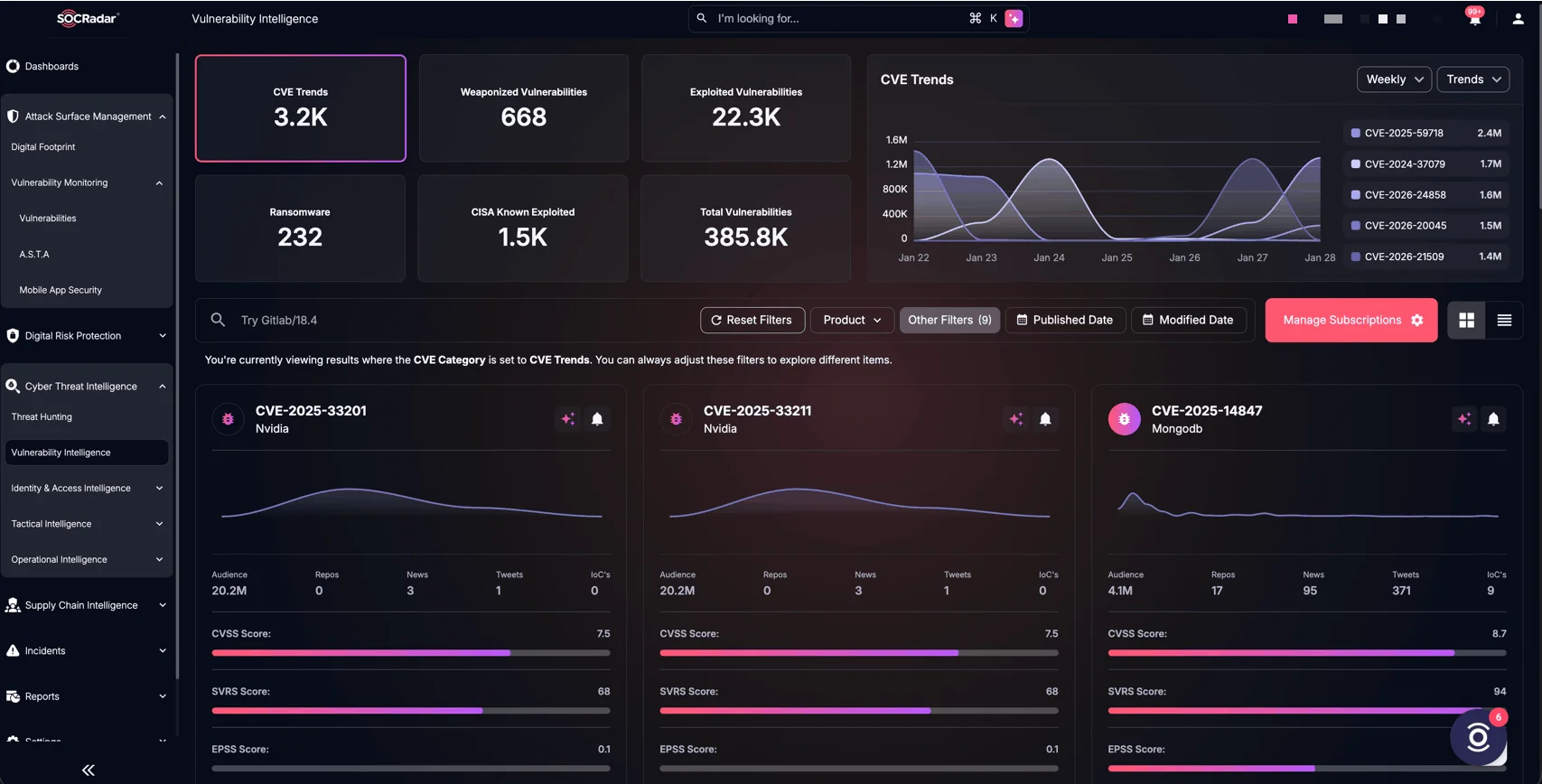
SOCRadar’s Vulnerability Intelligence
SOCRadar’s Cyber Threat Intelligence (CTI) module provides real-time vulnerability intelligence tailored to your asset inventory. With SOCRadar, you can:
- Instantly identify whether newly disclosed CVEs affect your specific product versions and configurations
- Track PoC and exploit activity as it emerges, so you can prioritize based on actual exploitation likelihood; not just CVSS scores
- Receive actionable alerts with remediation context, not just raw vulnerability feeds
- Monitor Dark Web and threat actor chatter to catch early signals of active targeting before it reaches your environment
Cisco Confirms Active Exploitation of CVE-2026-20230
Cisco has updated its stance on CVE-2026-20230 exploitation. While Cisco PSIRT previously said it was aware of public proof-of-concept (PoC) code but had not observed attacks, Cisco has now confirmed that the vulnerability is being actively exploited in the wild. Cisco updated the original advisory, stating that PSIRT became aware of active exploitation in June 2026, and reiterated its recommendation that customers upgrade to a fixed software release.
Third-party reporting also adds detail on how the vulnerability is being leveraged. Defused reportedly observed attackers exploiting CVE-2026-20230 using properly constructed `file://` payloads to create files on targeted devices, aligning with prior concerns that the SSRF could be chained into an arbitrary file write and potentially lead to root-level compromise.
For organizations that cannot immediately upgrade, Cisco’s reiterated mitigation is to disable the vulnerable WebDialer service until patching is completed. Separately, Shadowserver is reportedly tracking over 200 Cisco Unified CM instances exposed online, highlighting the ongoing external attack surface for opportunistic exploitation.
What Should Defenders Do Right Now?
Patch first where possible
Cisco’s recommended remediation is to apply Cisco software updates that address CVE-2026-20230. If you manage multiple Unified CM clusters or mixed version estates, prioritize environments where Unified CM is reachable from untrusted networks or where segmentation is weaker.
Some reporting references fixed releases and interim options (including a COP for certain Release 15 environments), but the safest approach is to follow Cisco’s fixed-version guidance for your exact branch and deployment model.
Disable WebDialer as a short-term mitigation
If you cannot patch immediately, Cisco’s temporary mitigation guidance is to disable the WebDialer service. Since exploitation is gated on WebDialer being enabled, disabling it reduces the reachable attack surface quickly.
Make sure change management includes validating whether any business workflows still depend on WebDialer. If it is unused, consider leaving it disabled after patching to reduce long-term exposure.
Add targeted monitoring focused on SSRF and post-exploitation signals (defensive recommendation)
Cisco’s public notes emphasize SSRF and OS file write impact. As a defensive consideration, teams can also:
- Review Unified CM web-facing logs for unusual or malformed HTTP requests that may indicate probing of WebDialer-related functionality.
- Monitor for unexpected outbound connections originating from Unified CM that could align with SSRF-style behavior.
- Increase scrutiny on unexpected file changes on the appliance OS where feasible, especially around directories and files that could influence execution or privilege boundaries.
These are general detection strategies, not a substitute for patching, but they can help reduce dwell time if exploitation begins.