

Oct 09, 2026

Table Of Content
Related Articles

Critical Cisco NX-OS Flaws Threaten Nexus Switches

CVE-2026-21589: Critical Atlassian File Access
Oct 07, 2026

CVE-2026-88779: Citrix NetScaler Zero-Day
Oct 06, 2026

CVE-2026-90970: GitLab AI Gateway RCE
Oct 05, 2026

FortiMail Zero-Day Under Active Exploitation
Oct 02, 2026

Jan 29, 2026
4 Mins Read

Summarize with:
CVE-2026-22709: vm2 Sandbox Escape Vulnerability
A recently disclosed critical vulnerability in the vm2 Node.js sandbox library, tracked as CVE-2026-22709, allows attackers to escape the sandbox and execute arbitrary code on the host system when applications run untrusted JavaScript. This blog explains how the vulnerability works, which versions are affected, and what actions organizations should take to reduce risk.
What Is CVE-2026-22709?
CVE-2026-22709 (CVSS 9.8) is a sandbox escape vulnerability in vm2, a Node.js library designed to isolate untrusted JavaScript code from the host environment.
The vulnerability can be exploited remotely, does not require authentication or user interaction, and allows full compromise of confidentiality, integrity, and availability. In practical terms, if an attacker can execute code inside a vm2 sandbox, they may be able to break out of that sandbox and run commands directly on the underlying system.
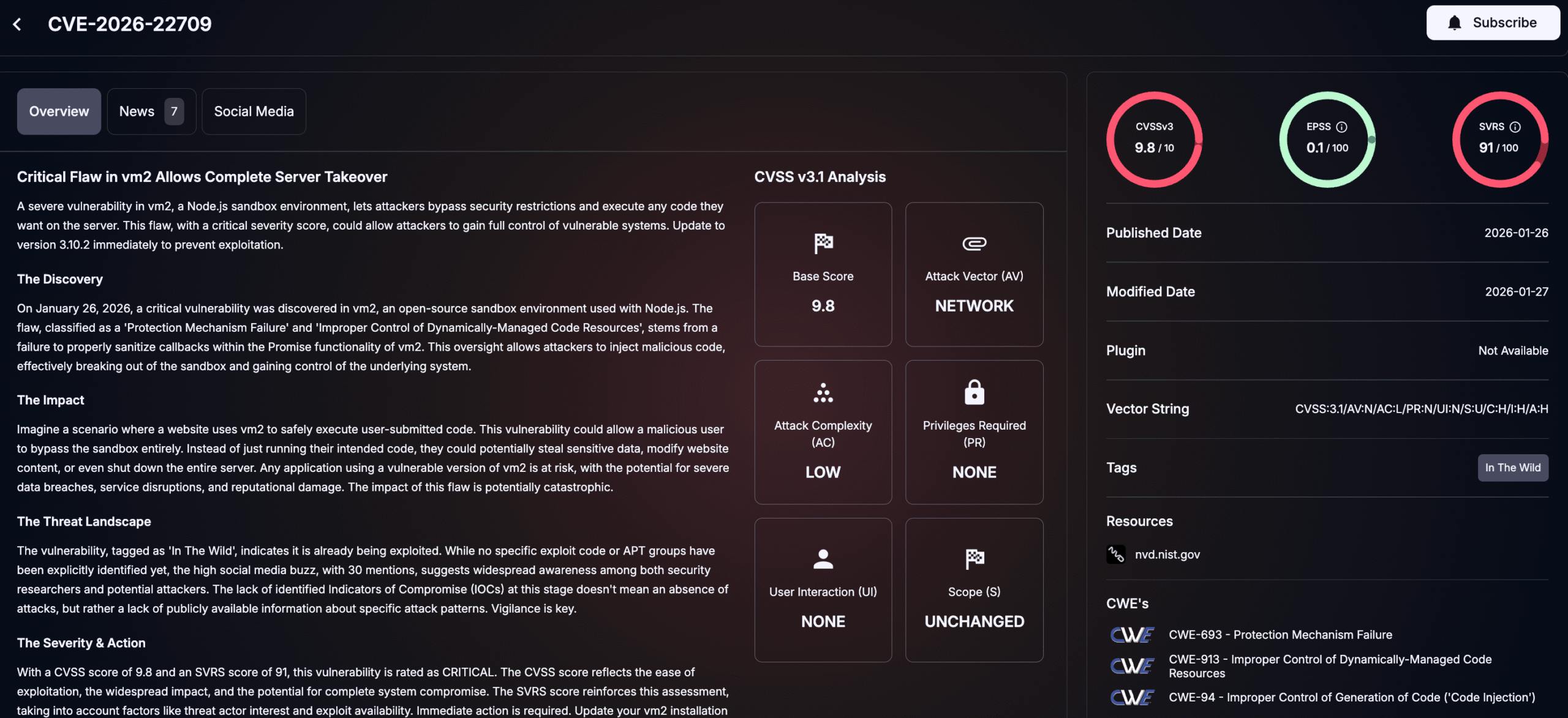
Details of CVE-2026-22709 (SOCRadar Vulnerability Intelligence)
How Does This Vulnerability Allow a Sandbox Escape?
The issue originates from how vm2 processes Promises created by async functions. vm2 separates sandboxed Promises from host Promises to block access to host objects, but async functions return global Promises instead of vm2’s sanitized local ones.
As a result, vm2 does not fully sanitize callback functions attached to these global Promises. An attacker can intercept specific function calls in this flow, bypass the intended sanitization, and receive objects created in the host context. Using standard JavaScript prototype relationships, the attacker can then reach powerful constructors and execute arbitrary code outside the sandbox.
The exploit relies on expected JavaScript behavior rather than unusual edge cases, which keeps the attack complexity low.

Which Versions of vm2 Are Affected?
The vulnerability affects vm2 versions up to and including 3.10.1. The issue was publicly disclosed on January 26, 2026, and a fix was released shortly afterward.
Version 3.10.2 introduced changes that prevent the interception technique used in the attack, and later releases build on that fix. Projects still running older versions remain exposed if they execute untrusted or user-influenced JavaScript code.
Who Is Actually at Risk From This Issue?
Not every application using vm2 is automatically exploitable. Risk depends heavily on how the library is used.
Applications are most exposed when:
- vm2 executes user-supplied or user-influenced JavaScript code.
- The sandbox runs in a server-side environment with access to system resources.
- There are no additional isolation layers, such as containerization or OS-level restrictions.
By contrast, applications that only run hardcoded, trusted scripts inside vm2 face significantly lower risk. The key question is whether an attacker can control or influence the code passed to the sandbox at runtime.
What Should Development Teams Do Now?
The immediate step is to upgrade vm2 to version 3.10.2 or later, which addresses this specific vulnerability. Teams should also review their codebase to identify where vm2 is used and whether untrusted input reaches the sandbox.
A more defensive approach may include reducing the need to execute arbitrary code, applying strict input controls, and using stronger isolation methods such as separate processes or containers with minimal privileges. Defense in depth remains essential when dealing with untrusted code execution.
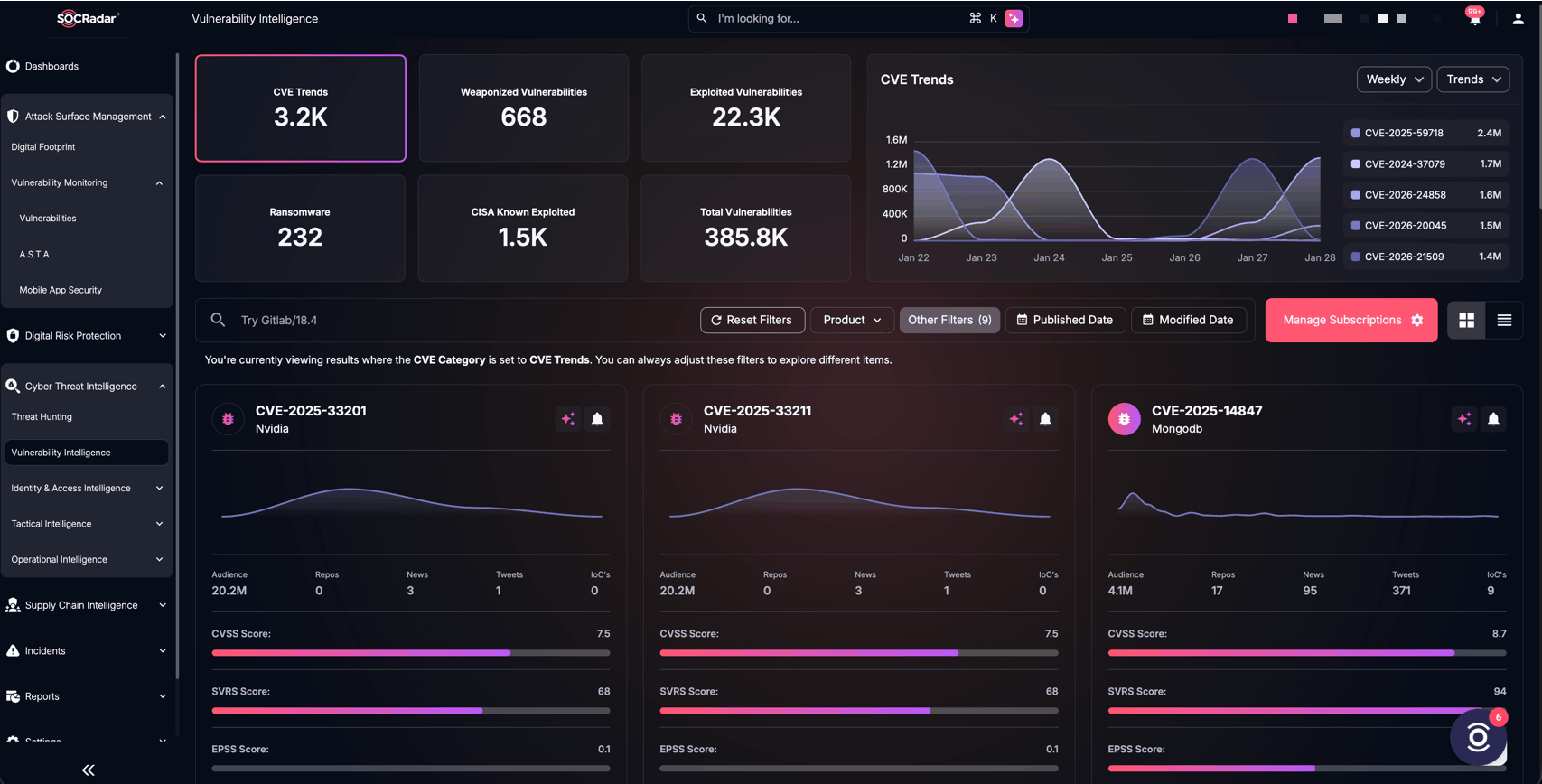
SOCRadar’s Vulnerability Intelligence
Keeping pace with critical vulnerabilities requires timely visibility into affected assets and dependencies. SOCRadar’s Cyber Threat Intelligence helps organizations monitor newly disclosed CVEs, understand their potential impact, and prioritize remediation based on real-world risk.
Additionally, by continuously mapping external attack surfaces and correlating vulnerabilities with exposed technologies, the Attack Surface Management (ASM) module enables security teams to identify affected technologies across their environments, assess exposure, and take action before vulnerabilities are exploited.